
A novel cellular rejuvenation therapy, ER-100, has received clearance from the U.S. Food and Drug Administration (FDA) to proceed with human clinical testing, marking what the sponsor describes as the first investigational therapy of its kind to enter clinical evaluation for optic neuropathies. The announcement was made by Life Biosciences following approval of its investigational new drug application.
ER-100 is designed to modify the epigenome in an effort to restore function in injured cells without altering the underlying DNA sequence. This mechanism reflects an emerging therapeutic strategy centered on partial epigenetic reprogramming, with the goal of reversing cellular dysfunction rather than solely slowing disease progression.
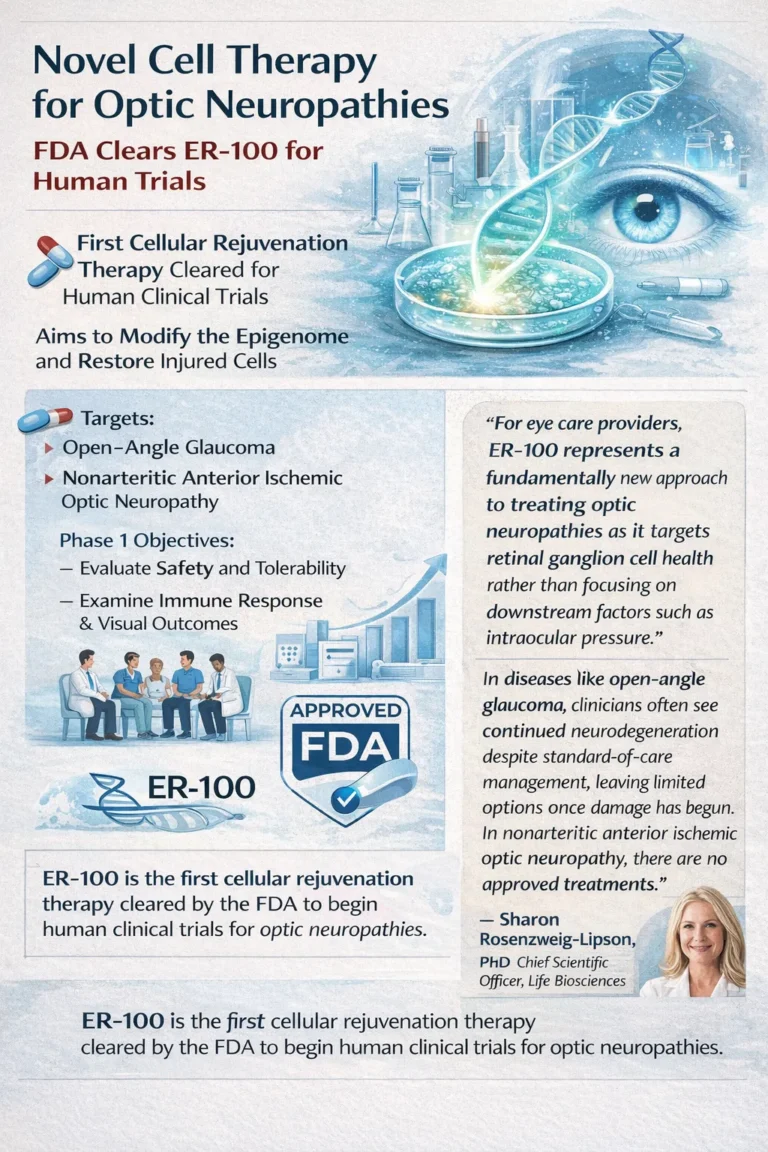
The planned phase 1 trial will enroll patients with Open-angle glaucoma and Nonarteritic anterior ischemic optic neuropathy. The study will primarily evaluate safety and tolerability while also examining immune responses and exploratory visual outcomes.
Commenting on the investigational therapy, Sharon Rosenzweig-Lipson, PhD, chief scientific officer at Life Biosciences, stated, “For eye care providers, ER-100 represents a fundamentally new approach to treating optic neuropathies as it targets retinal ganglion cell health rather than focusing on downstream factors such as intraocular pressure.” She added, “In diseases like open-angle glaucoma, clinicians often see continued neurodegeneration despite standard-of-care management, leaving limited options once damage has begun. In nonarteritic anterior ischemic optic neuropathy, there are no approved treatments.”
According to the company, ER-100 is the first cellular rejuvenation therapy to obtain FDA clearance for human clinical trials in this therapeutic area. The upcoming study is expected to generate data that will inform future development decisions.
“In the near term, Life Biosciences is focused on executing the phase 1 clinical study, with an emphasis on safety and then exploratory efficacy readouts,” Rosenzweig-Lipson said. “These data will guide dose selection and inform the design of subsequent studies. We believe our partial epigenetic reprogramming platform has broad potential beyond the eye, and preclinical data already suggest applicability beyond ophthalmology, including in metabolic and liver diseases.”
The announcement originated from a company press release. Rosenzweig-Lipson disclosed her role as chief scientific officer at Life Biosciences.