Overview of Findings
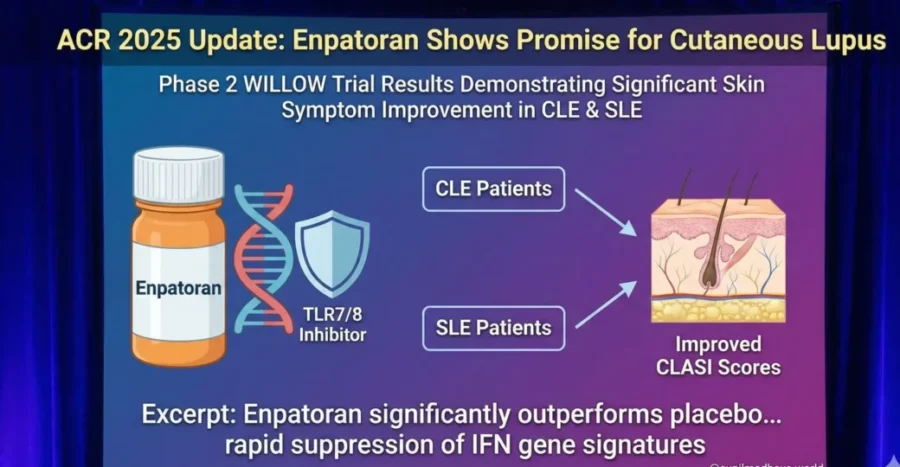
Data presented at ACR Convergence 2025 in Chicago indicates that Enpatoran, a first-in-class oral small molecule Toll-like receptor 7/8 inhibitor, significantly outperforms placebo in treating mucocutaneous symptoms. The data supports its efficacy for patients suffering from both cutaneous lupus erythematosus (CLE) and systemic lupus erythematosus (SLE).
According to lead researcher Eric F. Morand, MBBS, PhD, FRACP, of Monash University, the study was unique in its scope. He stated:
“Cutaneous disease is a feature of both cutaneous lupus erythematosus (CLE) and systemic lupus erythematosus… This basket study offered for the first time an analysis of a medicine in the treatment of cutaneous lupus in both diagnostic categories.”
Study Design: The WILLOW Trial
The findings were derived from a post-hoc analysis of the WILLOW study, a Phase 2, randomized, double-blind, placebo-controlled trial. This “basket study” was designed to evaluate the impact of Enpatoran on skin disease severity using the Cutaneous Lupus Disease Area and Severity Index-Activity (CLASI-A).
The analysis focused on 262 patients from two specific cohorts:
-
Cohort A: Patients with SLE and CLE.
-
Cohort B: Patients with moderate-to-severe active SLE.
-
Baseline: All included patients had a CLASI-A score of 8 or higher at the start of the trial.
Key Efficacy Data
The study measured response rates using CLASI-50 (a 50% improvement) and CLASI-70 (a 70% improvement) benchmarks. Enpatoran demonstrated higher response rates compared to placebo at both 16 and 24 weeks.
Response Rates:
| Metric | Timepoint | Enpatoran Group | Placebo Group |
| CLASI-50 | Week 16 | 71.2% | 37.3% |
| CLASI-50 | Week 24 | 78.8% | 37.3% |
| CLASI-70 | Week 16 | 46.3% | 14.9% |
| CLASI-70 | Week 24 | 57.1% | 25.4% |
Commenting on these statistics, Morand noted:
“Very significant efficacy signals were seen across the pooled CLE and SLE patients, with high rates of achievement of CLASI-50 and CLASI-70.”
Remission and Biological Markers
The study also evaluated “treat-to-target” goals, specifically looking for remission or low disease activity.
-
Remission: A higher proportion of patients in the 50 mg and 100 mg Enpatoran groups achieved a Cutaneous Lupus Activity Investigator’s Global Assessment (CLA-IGA) score of 0 or 1 compared to placebo (nominal P < .0025).
-
Low Disease Activity (Week 24):
-
Score 0–1: 30.2% of Enpatoran patients vs. 16.4% of placebo patients.
-
Score 0–3: 56.3% of Enpatoran patients vs. 26.9% of placebo patients.
-
Regarding these specific endpoints, Morand highlighted:
“Even more interesting, draft definitions of remission were attained at higher rates in enpatoran-treated patients, the first time treat-to-target goals have been evaluated in skin lupus.”
Biologically, the drug also showed rapid action at the genetic level. Morand observed:
“Importantly, both patient groups also showed striking suppression of IFN gene signatures within 2 weeks of commencing treatment.”
Clinical Significance
The results offer a promising outlook for patients dealing with the mucocutaneous manifestations of lupus, a condition that currently lacks specific approved therapies.
Morand concluded:
“The results demonstrate that enpatoran is efficacious in mucocutaneous manifestations of lupus regardless of the underlying diagnosis of CLE or SLE. This is the one of the first positive efficacy findings of a potential treatment for this manifestation of lupus, for which there are no approved therapies, and the first in both CLE and SLE patients.”
Disclosures: Eric F. Morand reports extensive consulting, research support, and advisory roles with major pharmaceutical companies, including AbbVie, AstraZeneca, Bristol Myers Squibb, Eli Lilly, EMD Serono (Merck KGaA), and GlaxoSmithKline, among others.