
Body Roundness Index May Predict Long-Term Mortality Better Than BMI in MASLD, Study Finds
1-Minute Summary
Body roundness index (BRI), a measure incorporating waist circumference and height, may help identify patients with metabolic dysfunction-associated steatotic liver disease (MASLD) who face an increased risk of long-term mortality, including individuals classified as lean or nonobese by body mass index (BMI).
In an analysis of 3,466 adults with MASLD from the Third National Health and Nutrition Examination Survey (NHANES III), researchers tracked mortality over a median of 29 years. A total of 1,528 deaths occurred during follow-up.
BRI showed a stronger association with all-cause mortality than BMI. The adjusted hazard ratio (HR) was 1.23 (95% CI, 1.12–1.34) for BRI, compared with 1.15 (95% CI, 1.05–1.26) for BMI. Among lean participants, BRI remained associated with mortality (adjusted HR, 1.30; 95% CI, 1.05–1.60), whereas BMI did not show a statistically significant association (adjusted HR, 0.95; 95% CI, 0.73–1.22).
The findings suggest that evaluating body shape and central adiposity alongside BMI could improve mortality risk assessment in MASLD. However, the study does not establish that BRI-guided clinical management improves survival or that BRI should replace BMI in routine practice.
Why This Matters
MASLD is characterized by hepatic steatosis associated with cardiometabolic risk factors. Assessment of patients with MASLD commonly includes BMI, which provides a measure of body size relative to height. However, BMI does not directly distinguish between central adiposity, fat distribution, and other components of body composition.
Consequently, two individuals with the same BMI may have different amounts of abdominal or visceral fat and different cardiometabolic risk profiles.
Sarpong Boateng, MD, MPH, a resident physician at Yale New Haven Health, described this concern when discussing the research:
“We often use BMI as a shorthand for obesity and metabolic risk, yet we see patients with MASLD who have a normal or only modestly elevated BMI but still have substantial cardiometabolic disease.”
He added:
“Two individuals with the same BMI can have very different amounts of central adiposity and, potentially, very different metabolic risk. That raised a simple question for us: Are we adequately capturing the type of adiposity that matters most?”
BRI incorporates waist circumference and height to provide an estimate related to body shape and central adiposity. The researchers investigated whether this measure could identify mortality risk that BMI alone might not capture.
This question is particularly relevant for patients with lean MASLD, who may not meet conventional BMI thresholds for overweight or obesity despite having metabolic risk factors and hepatic steatosis.
Study at a Glance
| Feature | Details |
|---|---|
| Study type | Observational cohort analysis |
| Data source | Third National Health and Nutrition Examination Survey (NHANES III) |
| Participants | 3,466 adults with MASLD |
| MASLD definition | Ultrasound-confirmed hepatic steatosis plus at least one cardiometabolic risk criterion |
| Exclusions | Viral hepatitis and significant alcohol use |
| Exposure measures | Body roundness index and body mass index |
| Comparator | BRI versus BMI; additional analyses compared exposure quartiles and BMI-defined subgroups |
| Primary outcomes | All-cause and cardiovascular mortality |
| Deaths recorded | 1,528 |
| Median follow-up | 29 years |
| Statistical methods | Survey-weighted Cox proportional hazards models, restricted cubic splines, Kaplan-Meier analyses, and subgroup analyses |
| Adjustment | Demographic and clinical risk factors, including Fibrosis-4 index score |
| Main finding | BRI was more strongly associated with all-cause mortality than BMI and retained prognostic information among lean and nonobese participants |
| Presentation | ACG Annual Scientific Meeting, October 12–14, 2026, Nashville, Tennessee |
| Randomization | None |
| DOI | Not provided in the supplied report |
Understanding Body Roundness Index
BRI is an anthropometric measure calculated using waist circumference and height. It is intended to capture aspects of body shape and central adiposity that BMI may not adequately reflect.
BMI is calculated from weight and height, but it does not directly measure abdominal fat distribution. BRI may therefore provide complementary information when evaluating cardiometabolic risk.
Neither measure directly quantifies visceral fat, and neither should be interpreted as a definitive assessment of an individual’s metabolic health in isolation.
In this study, the investigators compared BRI and BMI as predictors of long-term mortality among adults with MASLD, including participants whose BMI was below conventional obesity thresholds.
What the Researchers Found
1. BRI showed a stronger association with all-cause mortality than BMI
Across the study population, BRI demonstrated a stronger association with all-cause mortality than BMI.
| Measure | Adjusted HR | 95% CI | Interpretation |
|---|---|---|---|
| Body roundness index | 1.23 | 1.12–1.34 | Statistically significant association with all-cause mortality |
| Body mass index | 1.15 | 1.05–1.26 | Statistically significant association with all-cause mortality |
Both confidence intervals excluded 1.00, indicating statistically significant associations under conventional criteria.
The reported estimates favor BRI as a prognostic marker in this analysis. However, the supplied report does not specify the precise increment or scaling used for the two HR estimates. They should therefore be interpreted as reported rather than treated as a direct quantitative comparison of effect sizes without consulting the full study.
A stronger association also does not, by itself, prove that a measure improves clinical prediction. That would require additional assessment of model discrimination, calibration, and clinical usefulness.
2. BRI retained prognostic information among nonobese participants
The investigators conducted subgroup analyses among participants with nonobese MASLD, defined as BMI below 30 kg/m².
In this subgroup, BRI remained associated with long-term mortality, whereas BMI did not show a statistically significant association.
Boateng explained:
“However, among individuals with nonobese MASLD, body roundness index remained associated with long-term mortality while BMI essentially lost its prognostic signal.”
This finding suggests that a BMI below the conventional obesity threshold does not necessarily indicate low adiposity-related risk in people with MASLD.
3. BRI identified risk among participants classified as lean
The researchers also evaluated participants with lean MASLD, defined as BMI below 25 kg/m².
| Measure | Adjusted HR | 95% CI | Interpretation |
|---|---|---|---|
| BRI among participants with lean MASLD | 1.30 | 1.05–1.60 | Statistically significant association with mortality |
| BMI among participants with lean MASLD | 0.95 | 0.73–1.22 | No statistically significant association |
BRI remained associated with mortality in the lean subgroup, whereas the BMI estimate was not statistically significant.
Boateng highlighted the clinical relevance of this observation:
“‘Lean’ is fundamentally a BMI-based label, and our findings suggest that a lean BMI does not necessarily mean low adiposity-related risk.”
He continued:
“Some individuals classified as lean may still carry substantial central or visceral adiposity. In our analysis, body roundness index identified mortality risk even within lean MASLD, whereas BMI did not.”
These findings support further evaluation of central adiposity measures in patients whose BMI may not adequately reflect their broader cardiometabolic risk profile.
4. Higher BRI was associated with increased mortality among nonobese participants
When the researchers divided nonobese participants with MASLD into quartiles, those in the highest BRI quartile had a 46% higher adjusted relative hazard of death than those in the lowest quartile.
| Measure | Comparison | Adjusted HR | 95% CI | Result |
|---|---|---|---|---|
| BRI | Highest vs lowest quartile among nonobese participants | 1.46 | 1.14–1.88 | Statistically significant association |
| BMI | Highest vs lowest quartile among nonobese participants | 1.09 | 0.78–1.53 | No statistically significant association |
The BMI confidence interval included 1.00, whereas the BRI confidence interval did not.
These results reinforce the study’s central observation that BRI may help distinguish differences in mortality risk among patients who fall below the conventional BMI obesity threshold.
5. Survival analyses favored BRI over BMI
Kaplan-Meier analyses demonstrated statistically significant differences in survival across BRI quartiles (P < .001). Comparable differences were not statistically significant across BMI quartiles.
This pattern suggests that mortality outcomes differed across categories of BRI in the study population, whereas BMI quartiles did not demonstrate the same degree of separation.
However, Kaplan-Meier comparisons alone do not establish that BRI provides superior predictive performance in clinical practice. Such a conclusion would require comprehensive comparisons of prediction models and external validation.
6. A measure of body shape may complement BMI
Boateng summarized the implications of the findings:
“BMI does not tell the whole story in MASLD.”
He added:
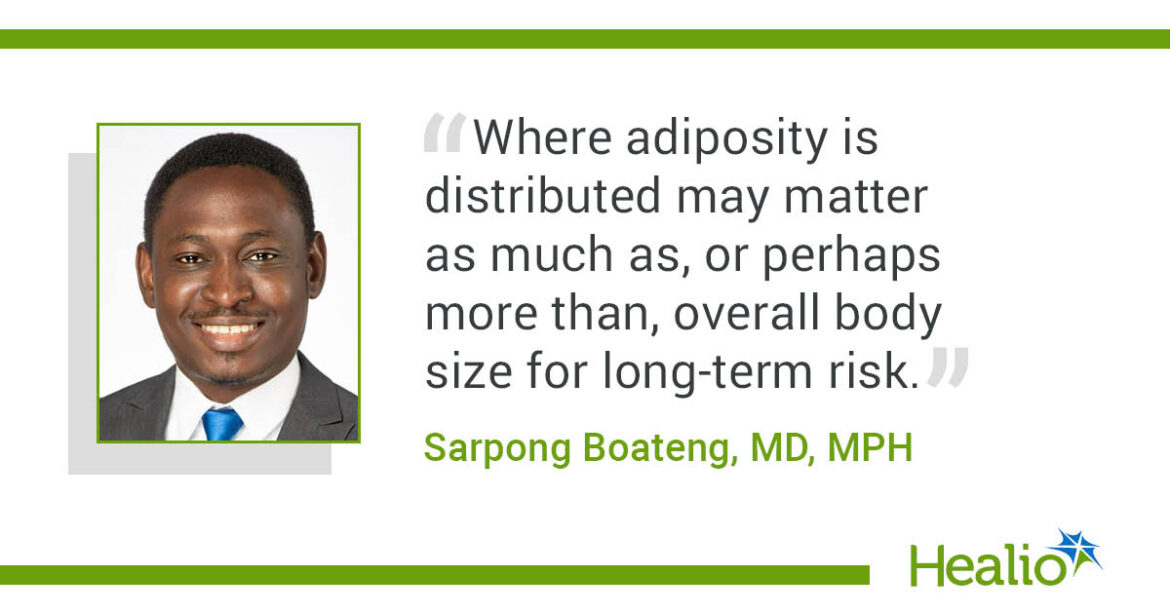
“Where adiposity is distributed may matter as much as, or perhaps more than, overall body size for long-term risk.”
He also cautioned against assuming that individuals who do not meet BMI criteria for obesity are necessarily at low metabolic risk, noting that measures of central adiposity may help identify patients who warrant closer assessment.
Clinical Significance
The findings suggest that BRI may provide complementary information when assessing long-term mortality risk in MASLD, particularly among people with a BMI below conventional obesity thresholds.
Potential value in risk assessment
BMI remains a useful and accessible measure of body size. However, the results indicate that BMI alone may not capture all the adiposity-related risk relevant to patients with MASLD.
Incorporating waist circumference or a derived measure such as BRI could potentially help clinicians recognize patients whose body shape suggests additional cardiometabolic risk despite a normal or modestly elevated BMI.
Implications for lean MASLD
The findings are particularly relevant to lean MASLD, in which hepatic steatosis and cardiometabolic risk factors occur in individuals who do not meet the conventional BMI threshold for overweight or obesity.
A lean BMI should not automatically be interpreted as evidence of low metabolic risk. Assessment should consider the broader clinical picture rather than relying on BMI alone.
Potential role alongside established clinical assessment
The study supports further investigation of BRI as a complementary risk marker. It does not establish that BRI should replace BMI, serve as a stand-alone diagnostic test, or determine treatment decisions independently of other clinical findings.
The study also does not demonstrate that modifying BRI itself reduces mortality. Further research would be needed to determine whether adding BRI to established risk models improves clinical decision-making or patient outcomes.
Limitations
Several limitations should be considered when interpreting these findings.
Observational design
The analysis was observational and cannot establish that higher BRI causes increased mortality. Associations may reflect underlying metabolic, demographic, or clinical factors.
Single data source
The study used NHANES III data. The results may not fully generalize to populations with different demographic characteristics, healthcare settings, or patterns of MASLD and obesity.
Long follow-up and changing health status
The median follow-up was 29 years. Over such an extended period, body composition, metabolic health, medical treatment, and other determinants of mortality may change. The supplied report does not provide sufficient detail to determine how changes in these factors were handled throughout follow-up.
BRI is not a direct measurement of visceral fat
BRI incorporates waist circumference and height but does not directly measure visceral adipose tissue. The results should not be interpreted as proof that visceral fat itself accounted for the observed mortality associations.
Statistical association does not establish clinical superiority
Although BRI had stronger reported associations with mortality, the supplied report does not provide comprehensive comparisons of predictive discrimination, calibration, reclassification, or decision-making utility. These measures would help determine whether BRI meaningfully improves individual risk prediction beyond BMI and established clinical variables.
Limited information on cardiovascular mortality
All-cause and cardiovascular mortality were identified as study outcomes, but the supplied report does not provide numerical cardiovascular mortality estimates. The magnitude of the association with cardiovascular death therefore cannot be independently summarized from the available information.
Conference presentation
The findings were presented at the ACG Annual Scientific Meeting. The supplied report does not provide a DOI or a full peer-reviewed journal publication. The complete study should be consulted for detailed methods, sensitivity analyses, and all author disclosures.
What Doctors Should Know
- Do not rely on BMI alone to assess metabolic risk in MASLD. BMI may not fully represent body shape or central adiposity.
- Consider central adiposity as part of the broader assessment. Waist circumference and potentially BRI may provide additional context when clinically appropriate.
- Recognize that lean MASLD can still carry substantial risk. A BMI below 25 kg/m² does not exclude metabolic dysfunction or increased long-term mortality risk.
- Interpret BRI as a potential complementary marker. The study does not establish that BRI should replace BMI or independently determine treatment.
- Use established clinical risk assessment. BRI should not substitute for comprehensive evaluation of metabolic risk factors, liver disease severity, and other relevant clinical variables.
- Avoid causal conclusions. The study found associations with mortality, not evidence that reducing BRI itself prevents death.
- Look for further validation. External studies and comparisons of predictive performance are needed before concluding that BRI should routinely be added to clinical risk models.
Future Research Priorities
Further studies could help establish whether BRI improves mortality risk prediction and clinical decision-making in MASLD.
Important priorities include:
- External validation in independent populations with MASLD.
- Direct comparisons of prediction models incorporating BMI, BRI, waist circumference, and established clinical risk factors.
- Evaluation of model discrimination, calibration, and clinical utility.
- Studies examining whether BRI adds useful information beyond liver fibrosis measures and cardiometabolic risk factors.
- Investigation of associations with cardiovascular mortality and other specific causes of death.
- Longitudinal analyses examining changes in body shape and adiposity over time.
- Prospective studies assessing whether BRI-guided clinical interventions improve patient outcomes.
Bottom Line
In a cohort of 3,466 adults with MASLD followed for a median of 29 years, body roundness index was more strongly associated with all-cause mortality than BMI. BRI also remained associated with mortality among lean and nonobese participants, whereas BMI did not show a statistically significant association in those subgroup analyses.
The findings suggest that body shape and central adiposity may provide information that BMI alone does not capture. BRI may therefore warrant further evaluation as a complementary mortality risk marker in MASLD.
However, the study does not prove that BRI-guided care improves survival or establish that BRI should replace BMI. Independent validation and assessment of clinical utility are needed before routine implementation can be recommended.
Original Research and DOI
Study title: Body roundness index outperforms body mass index for mortality risk stratification in U.S. adults with MASLD: A 30-year national cohort study.
Lead author: Sarpong Boateng, MD, MPH, and colleagues.
Meeting: American College of Gastroenterology Annual Scientific Meeting, October 12–14, 2026, Nashville, Tennessee.
Data source: Third National Health and Nutrition Examination Survey (NHANES III).
Journal publication: Not identified in the supplied report.
DOI: Not provided in the supplied report.
Disclosure: Boateng reported no relevant financial disclosures. The report directed readers to the study for disclosures from the other authors.
Editorial note:Readers should consult the original abstract or full publication, when available, for complete methods, statistical details, and author disclosures.