
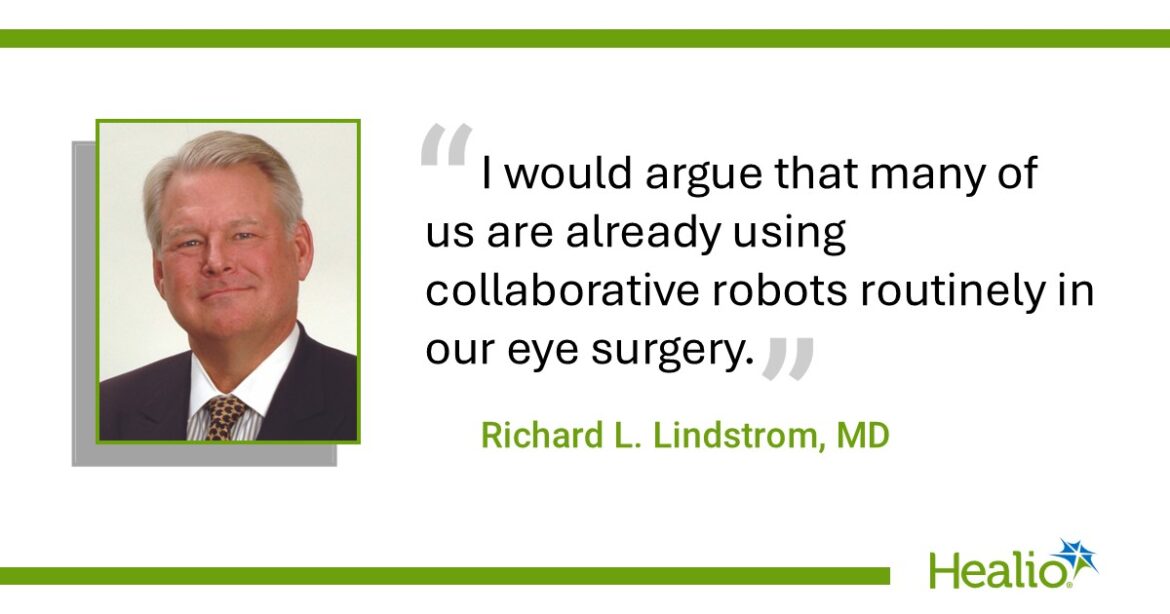
Perspective Overview: What is the current clinical, technological, and strategic outlook regarding the integration of robotics, artificial intelligence, and collaborative robots (cobots) in ophthalmology?
Summary Statement: Expert commentary by Richard L. Lindstrom, MD, highlights that while anxiety and confusion persist among ophthalmologists regarding surgical robotics, historical precedents in urology (e.g., robot-assisted radical prostatectomies) and current advancements in in-human robot-assisted cataract surgery indicate that collaborative robots (“cobots”) will serve as powerful partners rather than replacements for skilled surgeons, driving enhanced safety and reproducibility.
Classification of Surgical Technology in Ophthalmology
To dispel confusion surrounding surgical automation, Dr. Lindstrom categorizes medical devices into four distinct functional tiers:
| Device Category | Definition & Control Mechanism | Clinical Examples in Surgery |
| Tools | Hand-guided implements whose motion and force come entirely from the human user; zero autonomy or control loops. | Forceps, keratomes |
| Machines | Powered devices that perform defined mechanical tasks; operator-driven and incapable of independent operation. | Phacoemulsification devices (cataract surgery) |
| Cobots (Collaborative Robots) | Robots that collaborate with humans to perform tasks; cannot operate independently. Filter human tremor and utilize real-time imaging/AI. | Femtosecond/excimer lasers, Alcon Eagle laser (SLT), Navilas 577s retina system |
| Humanoid Robots | Robots resembling the human body in shape and capability with advanced AI and machine learning. | None currently deployed in clinical surgery |
Industry Adoption: Lessons from Urology
Reflecting on general and urological surgery, Dr. Lindstrom noted the widespread adoption of the Intuitive da Vinci system. Launched in 2000, five generations of the platform have been utilized in more than 20 million surgical procedures by 60,000 surgeons across 70 countries.
Despite increased procedural costs, steeper learning curves, and equivalent operative times, more than 85% of prostate removals for cancer in the U.S. are now robot-assisted radical prostatectomies (RARPs). As Dr. Lindstrom observed:
“Similar to when phacoemulsification first became available for us eye surgeons, our urology colleagues continue to debate the benefits, but patients have decided, and the majority in the advanced countries prefer robot-assisted prostate surgery over the classic manual approach.”
Patients and clinicians favor RARP due to accumulating evidence showing enhanced safety, lower incidences of postoperative incontinence and impotence, and reduced intraoperative complications like hemorrhage and adjacent tissue damage.
Current Ophthalmic Cobots and Industry Innovation
Ophthalmic surgeons already utilize collaborative robotic platforms across subspecialties. These include femtosecond and excimer lasers in corneal refractive surgery, femtosecond lasers for incisions, anterior capsulorrhexis, and nucleus fracture in cataract procedures, as well as specialized therapeutic lasers:
- Alcon Eagle Laser: Designed for reproducible direct selective laser trabeculoplasty (SLT) to simplify glaucoma management.
- Navilas 577s (OD-OS): Engineered for safer and more reproducible laser retinal photocoagulation.
Recent milestones include the completion of the first in-human robot-assisted cataract surgeries by companies such as Horizon Surgical Systems and ForSight Robotics. Additional corporate and academic innovators investing in ophthalmic robotics include Zeiss, AcuSurgical, Ophthorobotics, Lensar, the Stein Eye Institute at UCLA, the Wilmer Eye Institute at Johns Hopkins University, and Intuitive.
Addressing the future landscape, Dr. Lindstrom emphasized:
“I believe that adding the power of AI, machine learning and collaborative robots to a well-trained ophthalmic surgeon over the next decade will provide great benefit to our patients. We eye surgeons will not be replaced, but our ability to retain, restore and enhance vision and provide safe, reproducible surgery for our patients will improve significantly.”
Zero-CLS Video & Interactive Widgets (WordPress / Soledad Theme Compatible)
To ensure high page performance and prevent Cumulative Layout Shift (CLS) within WordPress themes like Soledad, dynamic containers reserve strict aspect ratios and layout containment styling.
Responsive Video Placeholder Code
HTML
<!-- Soledad Theme Compatible Zero-CLS Video Wrapper -->
<div class="soledad-video-container" style="position: relative; width: 100%; aspect-ratio: 16 / 9; min-height: 315px; background-color: #f3f4f6; border-radius: 8px; overflow: hidden; margin: 20px 0;">
  <iframe
    src="https://www.youtube-nocookie.com/embed/placeholder_ophthalmology"
    title="Robotics and AI in Ophthalmic Surgery"
    style="position: absolute; top: 0; left: 0; width: 100%; height: 100%; border: 0;"
    loading="lazy">
  </iframe>
</div>
Interactive Surgical Device Classification Widget
HTML
<!-- Zero-CLS Interactive Ophthalmic Robotics Widget -->
<div class="ophthalmology-robotics-widget" style="min-height: 290px; width: 100%; box-sizing: border-box; padding: 18px; border: 1px solid #d1d5db; border-radius: 8px; background: #ffffff; margin: 24px 0; contain: layout style;">
  <h4 style="margin-top: 0; font-family: system-ui, sans-serif; color: #111827; font-size: 16px;">Ophthalmic Technology Tier Explorer</h4>
  <p style="font-size: 13px; color: #4b5563; margin-bottom: 12px;">Select a device tier to examine its operational role and degree of autonomy:</p>

  <select id="techTierSelect" onchange="updateTechWidget()" style="width: 100%; max-width: 320px; padding: 8px; font-size: 14px; border-radius: 4px; border: 1px solid #9ca3af; background: #f9fafb;">
    <option value="tools">Surgical Tools (Hand-Guided)</option>
    <option value="machines">Surgical Machines (Operator-Driven)</option>
    <option value="cobots">Collaborative Robots / Cobots (Assisted)</option>
    <option value="humanoid">Humanoid Robots (Autonomous Future)</option>
  </select>

  <div id="techWidgetInfoBox" style="margin-top: 16px; padding: 14px; background: #f3f4f6; border-radius: 6px; border-left: 4px solid #0284c7; font-size: 13px; color: #1f2937; line-height: 1.5; min-height: 90px;">
    <strong>Surgical Tools:</strong> Hand-guided implements whose motion and force come entirely from the human user. Examples include forceps and keratomes, possessing zero autonomy or control loops.
  </div>
</div>

<script>
function updateTechWidget() {
  const val = document.getElementById('techTierSelect').value;
  const box = document.getElementById('techWidgetInfoBox');
  if (val === 'tools') {
    box.innerHTML = '<strong>Surgical Tools:</strong> Hand-guided implements whose motion and force come entirely from the human user. Examples include forceps and keratomes, possessing zero autonomy or control loops.';
  } else if (val === 'machines') {
    box.innerHTML = '<strong>Surgical Machines:</strong> Powered devices performing defined mechanical tasks. They are operator-driven and cannot operate independent of a human, such as phacoemulsification units.';
  } else if (val === 'cobots') {
    box.innerHTML = '<strong>Collaborative Robots (Cobots):</strong> Systems that cooperate with surgeons to enhance safety and reproducibility by filtering natural tremors and integrating real-time imaging and AI.';
  } else if (val === 'humanoid') {
    box.innerHTML = '<strong>Humanoid Robots:</strong> Advanced systems shaped like the human body with complex programming and machine learning. None are currently deployed in clinical surgery, maintaining human oversight as essential.';
  }
}
</script>
Clinical & Technology Summary HTML Block (CLS-Optimized)
HTML
<!-- Technology Summary Card - Zero Layout Shift Enforced -->
<div class="tech-summary-card" style="width: 100%; min-height: 250px; box-sizing: border-box; border-left: 4px solid #0284c7; background-color: #f9fafb; padding: 20px; font-family: system-ui, -apple-system, sans-serif; contain: content; margin: 24px 0; border-radius: 0 8px 8px 0; border: 1px solid #e5e7eb; border-left-width: 4px;">
  <div style="display: flex; justify-content: space-between; align-items: center; border-bottom: 1px solid #e5e7eb; padding-bottom: 8px; margin-bottom: 12px;">
    <span style="font-size: 11px; font-weight: 700; text-transform: uppercase; color: #0284c7; letter-spacing: 0.8px;">Expert Perspective & Technology Matrix</span>
    <span style="font-size: 11px; color: #4b5563;">Ophthalmic Robotics | August 2026</span>
  </div>

  <h3 style="margin: 0 0 10px 0; font-size: 15px; font-weight: 600; color: #111827; line-height: 1.4;">
    The Evolution of Collaborative Robots in Ophthalmic Surgery
  </h3>

  <div style="display: grid; grid-template-columns: repeat(auto-fit, minmax(210px, 1fr)); gap: 12px; font-size: 13px; color: #374151;">
    <div><strong>Core Focus:</strong> Cobots & Robotic Cataract Surgery</div>
    <div><strong>Key Milestones:</strong> First in-human trials by Horizon & ForSight</div>
    <div><strong>Primary Benefits:</strong> Enhanced precision, tremor reduction, reproducibility</div>
    <div><strong>Expert Outlook:</strong> Surgeons will be partnered, not replaced, by AI-driven cobots</div>
  </div>

  <div style="margin-top: 14px; padding-top: 10px; border-top: 1px solid #e5e7eb; font-size: 13px; color: #4b5563;">
    <strong>Key Takeaway:</strong> Mirroring adoption patterns in urology, collaborative robotic systems are poised to transform lens-based refractive and cataract surgery by establishing standardized, highly reproducible surgical outcomes.
  </div>
</div>