
Publication date: October 20, 2026
Original research: Abilov Z, et al. JAMA Network Open. 2026.
DOI: 10.1001/jamanetworkopen.2026.38654
1-Minute Summary
A laboratory analysis of 18 selected over-the-counter skin products purchased online in the United States found that 6 products (33.3%) contained undeclared clobetasol propionate, a class 1, superpotent prescription corticosteroid. The findings were reported in JAMA Network Open.
The products were marketed for conditions such as dermatitis, psoriasis, eczema, and hyperpigmentation, despite the absence of disclosed clinically established active ingredients for treating those conditions. Researchers purchased the products between February and December 2025 and used high-resolution liquid chromatography–mass spectrometry with tandem mass spectrometry to test for 28 corticosteroids and antifungals.
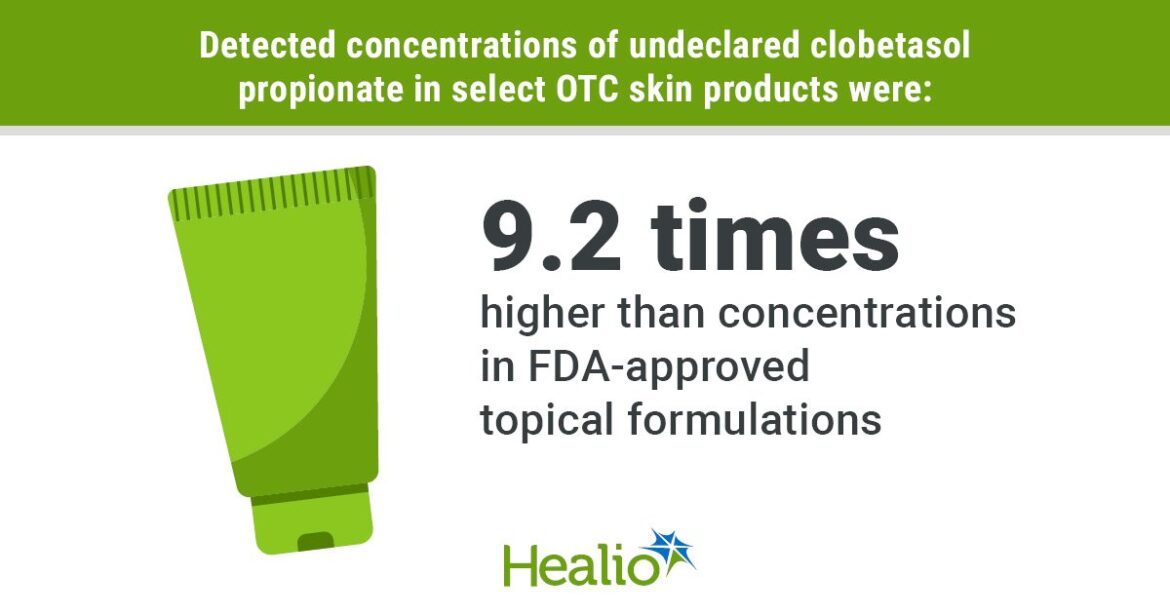
Detected clobetasol concentrations ranged from 0.02% to 0.32%. Some products also contained undeclared antifungal agents. The highest reported clobetasol concentration was 0.32% in Zudaifu cream, more than six times the 0.05% concentration cited for FDA-approved topical clobetasol formulations. The study’s accompanying graphic reported that detected concentrations were as much as 9.2 times the concentration in approved formulations.
Clobetasol can cause adverse effects when used inappropriately, particularly with prolonged or unsupervised exposure. Potential complications include skin thinning, steroid acne, pigmentary changes, suppression of the hypothalamic-pituitary-adrenal (HPA) axis, and ocular complications associated with exposure around the eyes.
The researchers emphasized that the 18 products were deliberately selected for testing. Therefore, the finding that one-third contained undeclared clobetasol does not mean that one-third of all OTC skin products sold in the United States are contaminated or adulterated.
Why This Matters
Consumers increasingly purchase skin-care products online to manage persistent rashes, eczema-like symptoms, psoriasis, and uneven skin pigmentation. Products marketed directly to consumers may appear to be cosmetic preparations or nonprescription remedies, even when they contain potent pharmacologic ingredients that are not disclosed on the label.
Clobetasol propionate is a superpotent topical corticosteroid generally reserved for specific inflammatory skin conditions under appropriate medical supervision. Its undisclosed presence creates a particular concern because consumers may use such products for longer periods, on larger areas, or on sensitive skin sites without understanding the medication’s potency.
The problem is especially relevant when products are used on the face to treat pigmentation or inflammatory conditions. Prolonged application of potent corticosteroids may cause skin atrophy, visible blood vessels, acneiform eruptions, pigmentary changes, and other adverse effects. Exposure near the eyes may also raise concerns about ocular complications, including glaucoma.
The study highlights a potential gap between the claims made by online skin-product sellers and the actual ingredients present in their products. It also raises questions about ingredient transparency, product surveillance, and how consumers can identify products containing undeclared prescription medications.
Study at a Glance
| Feature | Details |
|---|---|
| Study type | Targeted laboratory analysis of selected OTC skin products |
| Publication | JAMA Network Open, 2026 |
| DOI | 10.1001/jamanetworkopen.2026.38654 |
| Products tested | 18 preselected OTC skin products |
| Purchase location | Online marketplaces in the United States |
| Purchase period | February–December 2025 |
| Products with undeclared clobetasol | 6 of 18 (33.3%) |
| Main compound detected | Clobetasol propionate |
| Other undeclared agents reported | Terbinafine and miconazole in certain products |
| Analytical method | High-resolution liquid chromatography–mass spectrometry with tandem mass spectrometry |
| Compounds screened | 28 corticosteroids and antifungals |
| Confirmatory testing | Two additional units were purchased when an undeclared corticosteroid was detected at a pharmacologically active dose, giving three samples per product |
| Main outcome | Detection and concentration of undeclared corticosteroids and antifungals |
| Comparator | No randomized or clinical comparator; product concentrations were assessed against approved topical formulations |
| Follow-up | Not applicable; this was a product-analysis study |
| Main finding | Six selected products contained undeclared clobetasol propionate |
| Funding | Not specified in the supplied news report |
What the Researchers Found
1. One-third of the selected products contained undeclared clobetasol
The investigators evaluated 18 products advertised for persistent skin problems, including dermatitis, psoriasis, eczema, and hyperpigmentation. The products were selected because they made claims about treating these conditions without listing clinically established therapeutic agents among their ingredients.
Six products contained clobetasol propionate that was not declared on the product label. This represented 33.3% of the products examined.
| Finding | Result |
|---|---|
| Total selected products analyzed | 18 |
| Products containing undeclared clobetasol | 6 |
| Proportion of tested products affected | 33.3% |
| Products containing undeclared clobetasol not detected | 12 |
| Corticosteroids and antifungals screened | 28 |
The results demonstrate that potent prescription medication can be present in some online products without being disclosed to consumers. However, because the products were preselected rather than randomly sampled from the entire market, the percentage cannot be used to estimate the prevalence of adulteration across all online skin products.
2. Clobetasol concentrations varied substantially
The six products contained clobetasol propionate at concentrations ranging from 0.02% to 0.32%. The report compared these findings with the 0.05% concentration cited for FDA-approved topical clobetasol formulations.
| Product | Detected clobetasol propionate concentration | Additional undeclared ingredient reported |
|---|---|---|
| Neoprosone gel | 0.09% | None specified in the report |
| Neoprosone cream | 0.06% | None specified in the report |
| Neoprosone serum | 0.02% | None specified in the report |
| Qian Nian Qi Cao cream | 0.25% | Terbinafine |
| Psor-Val spray | 0.21% | None specified in the report |
| Zudaifu cream | 0.32% | Miconazole |
Note: The table reproduces the product names and detected concentrations reported in the supplied article. “None specified” means the report did not identify an additional ingredient for that product; it does not prove that no other undeclared substance was present.
The detected concentrations were not uniform. Neoprosone serum contained 0.02% clobetasol, whereas Zudaifu cream contained 0.32%. The highest reported concentration was therefore substantially greater than the 0.05% concentration cited for approved topical formulations.
The accompanying study graphic reported concentrations as high as 9.2 times those in FDA-approved topical formulations. The clinical significance of an individual concentration depends on more than the percentage alone: the formulation, quantity applied, application site, frequency, duration, and extent of skin absorption all influence exposure and risk.
3. Some products also contained undeclared antifungal agents
Two products were reported to contain additional antifungal ingredients alongside clobetasol propionate:
- Qian Nian Qi Cao cream: clobetasol propionate and terbinafine.
- Zudaifu cream: clobetasol propionate and miconazole.
The presence of multiple undeclared pharmacologic agents raises additional concerns because consumers may be exposed to medications without knowing which substances they are using or what precautions apply.
A combination of a potent corticosteroid and an antifungal does not automatically make a product appropriate for every rash. The correct treatment depends on the underlying diagnosis. For example, corticosteroids can mask certain skin infections or alter their appearance, potentially delaying appropriate diagnosis and treatment.
4. Some affected products were marketed for skin lightening
Three of the six products containing undeclared clobetasol were described as skin-lightening products intended for hyperpigmentation.
This finding is particularly concerning because potent corticosteroids are not routine skin-lightening agents. Unsupervised or prolonged use may produce skin thinning, acneiform eruptions, visible blood vessels, and pigmentary changes. Although temporary changes in inflammation or skin appearance may be mistaken for improvement, they do not establish that a product is safe or appropriate for long-term pigmentation management.
The study did not measure actual consumer use, clinical outcomes, or the frequency of adverse effects among people using these products. The risks discussed by the authors are based on the known pharmacologic effects of potent topical corticosteroids rather than adverse events directly measured in this product survey.
How the Products Were Tested
The researchers purchased the 18 selected products online between February and December 2025. They screened the products for 28 corticosteroids and antifungals using high-resolution liquid chromatography–mass spectrometry with tandem mass spectrometry.
This analytical approach allows researchers to separate chemical compounds and identify substances based on their mass-spectrometric characteristics.
When an undeclared corticosteroid was detected at a pharmacologically active dose, the researchers purchased and analyzed two additional units of that product. This resulted in three samples per product for confirmatory assessment.
The method was designed to identify hidden active ingredients rather than to test whether the products actually improved eczema, psoriasis, dermatitis, or hyperpigmentation in patients. Accordingly, the findings are evidence of undisclosed drug content in selected products, not a clinical trial of their effectiveness or safety.
Clinical Significance and Potential Health Risks
Skin atrophy and structural skin changes
Clobetasol is a superpotent corticosteroid. Inappropriate or prolonged use may cause skin atrophy, in which the skin becomes thinner and more fragile. Other possible effects include visible small blood vessels, stretch-mark-like changes, and delayed recovery from skin injury.
These complications are particularly relevant when a consumer unknowingly uses a potent corticosteroid for weeks or months because the product is marketed as a cosmetic or general skin-care remedy.
Steroid acne and pigmentary changes
Topical corticosteroids can cause acneiform eruptions and changes in skin pigmentation. These effects may be especially troubling for people using the products specifically to improve facial appearance or treat dark spots.
The presence of a hidden corticosteroid can also make it difficult for a clinician to interpret a patient’s skin findings or determine whether the underlying condition is improving, recurring, or being altered by the medication.
Systemic corticosteroid exposure
Although topical products are applied to the skin, systemic absorption can occur. The amount absorbed depends on factors such as potency, application area, duration, skin integrity, and formulation.
Sufficient exposure to potent topical corticosteroids may suppress the HPA axis, which regulates the body’s endogenous cortisol response. The product analysis did not measure systemic absorption or hormone levels in users, so the study cannot quantify the incidence of this complication among consumers of the tested products.
Ocular risks with use near the eyes
Application of potent topical corticosteroids to facial skin, especially near the eyelids, raises concerns about inadvertent periocular exposure. The report notes the association between such exposure and glaucoma.
The study did not directly assess ocular outcomes. Nevertheless, the possibility of undisclosed corticosteroid exposure is relevant when evaluating patients who use unlabelled skin products around the eyes.
What the Researchers and Clinicians Said
Yury V. Popov, MD, PhD, associate professor of medicine at Beth Israel Deaconess Medical Center and Harvard Medical School, described the findings as:
“a significant public health concern”
Popov also warned that direct-to-consumer marketing and inadequate oversight may allow the problem to grow.
Martina Porter, MD, vice chair of research and academics in dermatology at Beth Israel Deaconess Medical Center, emphasized that dermatologists generally avoid using class 1 potency steroids on the face and limit their duration of use because of potential adverse effects. She noted that some complications may not fully reverse after treatment is stopped.
Popov advised clinicians to consider the possibility of hidden medications in products purchased online, particularly among patients seeking treatments for discoloration or chronic inflammatory skin conditions.
Porter also highlighted that clinicians may need to remain alert to the possibility of potent corticosteroids in products bought within the United States, rather than assuming the issue is limited to products purchased abroad.
These comments emphasize a practical challenge: clinicians may not know that a patient has been using a prescription-strength corticosteroid if the product label does not disclose it.
What Doctors Should Know
- Ask specifically about online skin products. Patients may not consider creams, serums, sprays, or skin-lightening products to be medications, so a detailed product history is important.
- Review product packaging when possible. Ask patients to bring the container, ingredient list, photographs, or purchase details when a product may be contributing to unusual skin findings.
- Consider hidden corticosteroid exposure. Unexplained skin atrophy, steroid acne, pigmentary changes, or unusual treatment responses may warrant questions about unlabelled products.
- Assess the underlying diagnosis. Persistent dermatitis, psoriasis-like eruptions, fungal infections, and hyperpigmentation require diagnosis-specific treatment rather than an unknown combination of medications.
- Use caution with facial and periocular application. Potent topical corticosteroids may pose particular risks when used on thin facial skin or near the eyes.
- Avoid abrupt assumptions about systemic effects. The study detected ingredients in products; it did not measure individual patients’ systemic exposure or prove that every user will develop adverse effects.
- Report suspected product safety concerns through appropriate channels. Clinicians and consumers can consult relevant regulatory reporting mechanisms when there is reason to suspect an adulterated or mislabeled product.
- Counsel patients without blame. Consumers may be unaware that a product contains a prescription-strength medication, making a nonjudgmental discussion of use and risks especially important.
Limitations
The findings should be interpreted in light of several important limitations.
- Targeted product selection: The researchers deliberately selected 18 products based on their claims and ingredient disclosures. The sample was not described as a representative random sample of all OTC skin products sold in the United States.
- Market prevalence cannot be estimated: Although 33.3% of the tested products contained undeclared clobetasol, this proportion should not be generalized to the entire US market.
- Consumer exposure was not measured: The researchers could not determine how many people used the products, how frequently they applied them, or how much medication they absorbed.
- Clinical outcomes were not assessed: The study did not evaluate whether users developed skin atrophy, HPA-axis suppression, glaucoma, or other complications.
- Limited product scope: The analysis covered 18 selected products and 28 corticosteroids and antifungals. It does not establish the presence or absence of every possible undeclared drug or contaminant in these products.
- Concentration does not equal individual risk: The measured percentage alone does not determine a user’s absorbed dose or likelihood of harm. Application site, quantity, duration, and skin condition also matter.
- Additional independent surveillance is needed: Broader, representative testing would be required to establish how frequently undeclared prescription drugs occur in online skin products and whether certain product categories or sellers are more affected.
Original Research / DOI
Study: Abilov Z, et al. Study of undeclared prescription-strength corticosteroids in selected over-the-counter skin products.
Journal: JAMA Network Open.
Publication year: 2026.
DOI: 10.1001/jamanetworkopen.2026.38654
Study design: Targeted laboratory analysis of 18 selected products purchased online in the United States.
Funding and disclosures: Consult the original publication for the full statement.
Bottom Line
A targeted laboratory study found undeclared clobetasol propionate in 6 of 18 selected OTC skin products purchased online in the United States. Concentrations ranged from 0.02% to 0.32%, and two products also contained undeclared antifungal agents.
The findings raise concerns about ingredient transparency and the potential for unsuspecting consumers to use superpotent prescription corticosteroids without medical supervision. Such exposure can cause significant skin complications and may carry systemic or ocular risks, depending on how the product is used.
The results do not establish how common the problem is across the entire US market, nor do they show that every user will experience harm. They do support careful product histories in dermatology practice, more extensive product surveillance, and clear consumer counseling about the risks of unlabelled skin treatments.