Headline
Pre-Diagnostic Weight Loss Explains the “Obesity Paradox” in Colorectal Cancer Survival
1-Minute Summary
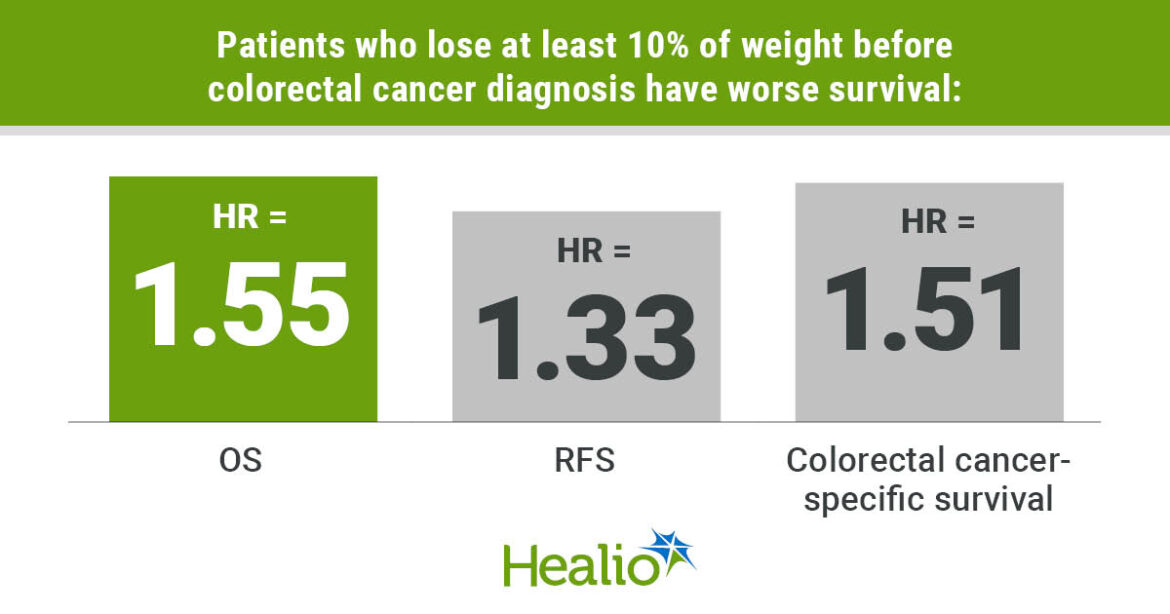
The widely debated “obesity paradox”—a phenomenon where patients with overweight or obesity appear to have better survival rates after a colorectal cancer diagnosis—may actually be an artifact driven by undiagnosed pre-disease weight loss. A recent cohort study of over 5,500 patients found that while patients with overweight initially seemed to have an overall survival advantage, this benefit disappeared once researchers adjusted for pre-diagnostic weight loss. Patients who lost at least 10% of their body weight in the years preceding their diagnosis faced a 55% higher risk of death, suggesting that prior weight loss is a hidden marker of poor prognosis rather than higher BMI being inherently protective.
Why This Matters
For years, conflicting data surrounding the obesity paradox has confused both clinicians and patients, occasionally leading to the misconception that carrying extra weight could be protective against cancer mortality. This study clarifies that single BMI measurements taken at the time of a cancer diagnosis are often misleading, as they may mask significant, cancer-related weight loss. Clinicians must evaluate a patient’s long-term weight trajectory rather than relying solely on cross-sectional BMI to accurately determine prognosis and supportive care needs.
Study at a Glance
| Feature | Details |
|---|---|
| Study type | Cohort study |
| Participants | 5,521 patients with colorectal cancer (Median age: 69; 61% men) |
| Intervention / Exposure | Pre-diagnostic weight loss and varying Body Mass Index (BMI) categories |
| Comparator | Normal weight individuals and individuals without significant pre-diagnostic weight loss |
| Primary outcome | Overall survival (OS), Recurrence-free survival (RFS), and Colorectal cancer-specific survival (CSS) |
| Main finding | Adjusting for pre-diagnostic weight loss eliminates the survival benefit previously attributed to overweight and obesity. |
| Follow-up | Assessed weight change 5 to 14 years prior to diagnosis |
What the Researchers Found
Using data from the Colorectal Cancer: Chances of Prevention Through Screening study in Germany (2001-2016), researchers initially observed the classic obesity paradox. Patients categorized as having overweight had significantly improved overall survival compared to those of normal weight (HR = 0.89). Conversely, patients with underweight had a significantly lower OS (HR = 1.4).
However, when researchers analyzed weight trajectories 5 to 14 years prior to diagnosis, they found that losing at least 10% of body weight severely impacted survival across multiple metrics. When the data was adjusted to account for this pre-diagnostic weight loss, the survival advantage associated with having overweight or obesity vanished.
Table 1. Survival Outcomes Associated with Pre-Diagnostic Weight Loss (≥10%)
| Survival Metric | Hazard Ratio (HR) | 95% Confidence Interval (CI) |
|---|---|---|
| Overall Survival (OS) | 1.55 | 1.39 – 1.72 |
| Colorectal Cancer-Specific Survival (CSS) | 1.51 | 1.31 – 1.74 |
| Recurrence-Free Survival (RFS) | 1.33 | 1.17 – 1.52 |
Dr. Marko Mandic, PhD, of the German Cancer Research Center, explained the underlying mechanism: “We suspected this paradox might be an artifact rather than a true biological protective effect. Colorectal cancer often causes unintentional weight loss in the months and years leading up to diagnosis — sometimes long before any symptoms are apparent. That means a patient’s BMI measured at diagnosis doesn’t necessarily reflect their long-term weight status.”
“The obesity paradox seems to be less about extra body weight being protective, and more about undiagnosed, cancer-related weight loss being a hidden marker of poor prognosis that was previously being misattributed to BMI itself,” Mandic added.
Clinical Significance
The findings underscore that involuntary weight loss before a cancer diagnosis is a critical clinical vulnerability.
“This study provides no evidence that being overweight is actually beneficial for colorectal cancer survival, and clinicians should not interpret the so-called ‘obesity paradox’ as a reason to encourage weight gain in normal-weight patients, which is unfortunately how some earlier findings on this topic have been interpreted,” stated Dr. Mandic.
However, patients presenting with frailty or underweight status still require targeted interventions. “Underweight or frail patients are a distinct clinical picture, and weight loss or low body weight in that group likely reflects a real vulnerability that deserves clinical attention and support rather than reassurance,” he noted.
Limitations
The researchers noted a few key limitations in the study design:
- Reliance on self-reported height and weight history.
- Lack of complete uniformity in the pre-diagnostic weight change data among the patient cohort.
- Lower number of events in CSS and RFS endpoints, which limited statistical power for those specific survival metrics.
What Doctors Should Know
- Do not recommend weight gain to normal-weight colorectal cancer patients under the guise of the obesity paradox.
- Take a comprehensive weight history. “BMI recorded at diagnosis should be interpreted with caution, since it doesn’t tell the full story on its own — a patient’s broader weight history carries important prognostic information that a single BMI measurement can mask,” Mandic advised.
- Identify severe pre-diagnostic weight loss (≥10%) as a marker for a high-risk phenotype that may necessitate earlier supportive care and closer monitoring.
Bottom Line
The improved survival rates historically observed in colorectal cancer patients with overweight or obesity are likely an illusion created by the poor prognosis of patients who experience undiagnosed, cancer-related weight loss prior to clinical presentation.
Original Research / DOI
Mandic M, et al. JAMA Netw Open. 2026;doi:10.1001/jamanetworkopen.2026.29571.