Top Posts
US obesity prevalence 75% under new Lancet criteria
Test post
test post
First
First
New Hope for SMA: FDA Approves Itvisma for...
Addressing lifestyle for CVD prevention
Thyroid imbalance in pregnancy linked to increased likelihood...
SunilMadhavs World
Banner
  • Home
  • Support Portal
  • My Subscriptions
  • Contact Information
  • About
    • Cardiology
      • Gastroenterology
        • Radiology
          • Pulmonology
            • Gynecology
    • Neurology
  • Urology
    • Hematology
      • Profile
        • Log Out
        • Register
        • Edit Account
        • Change Password
        • GDPR-compliant cookie policy.
          • Terms and conditions
            • Contact Information
  • About
    • Privacy policy
      • BASICS DISCUSS
        • BASICS
          • ANATOMY
            • BASICS PRO
              • ANATOMY PRO
              • BIOCHEMISTRY PRO
              • PHYSIOLOGY
                • BIOCHEMISTRY
                  • PHYSIOLOGY PRO
                    • BASICS RESEARCH
                    • ANATOMY ADVANCEMENTS
                    • BIOCHEMISTRY ADVANCEMENTS
                    • PHYSIOLOGY ADVANCEMENTS
  • Team SunilMadhavs World
  • TOPICS
  • INTERMEDIATE
  • 0
Home » US obesity prevalence 75% under new Lancet criteria
Cardiology

US obesity prevalence 75% under new Lancet criteria

by Team SunilMadhavs World January 19, 2026
A+A-
Reset
37


Key takeaways:

  • Using NHANES data from 2017 to 2023, obesity prevalence in the U.S. is 75.2% when excess adiposity cutoffs are used.
  • Among adults with a BMI of less than 25 kg/m2, 38.5% had obesity under new Lancet criteria.

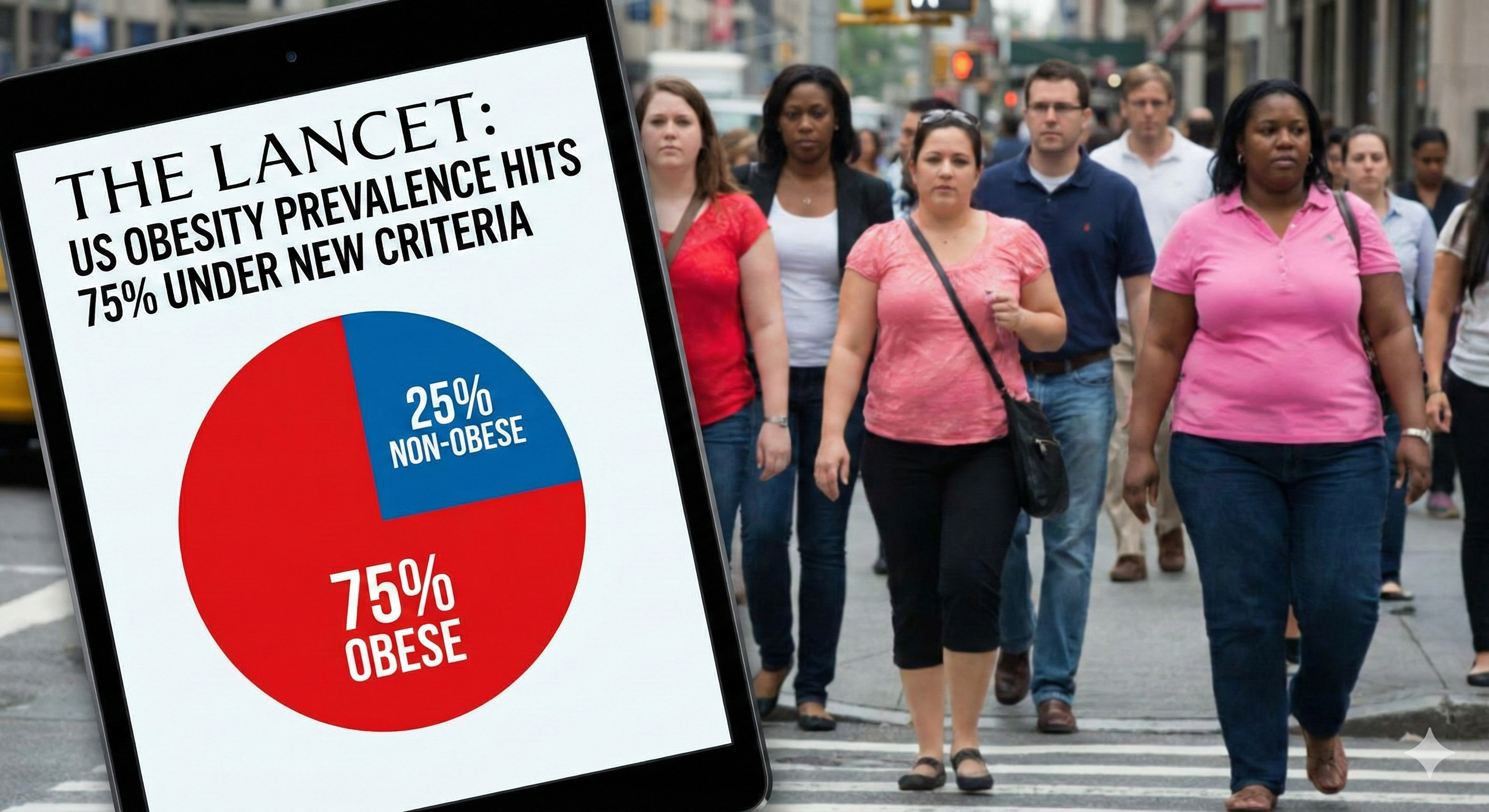
The prevalence of obesity was 75.2% among adults in the U.S. when new criteria proposed by The Lancet Diabetes & Endocrinology Commission was used to diagnose the disease, researchers reported in a JAMA Network Open research letter.

As Healio previously reported, a paper published by The Lancet Diabetes & Endocrinology Commission in January 2025 stated adults could be diagnosed with obesity if they had one measure of excess body fat plus a BMI that indicated obesity, two measures of excess body fat without using BMI, or by measuring body fat directly in a DXA scan. Using BMI, waist circumference, waist-to-hip ratio and waist-to-height ratio cutoffs detailed in the commission’s paper, researchers assessed the prevalence of obesity using National Health and Nutrition Examination Survey data from 2017 to 2023.

About 75% of participants in NHANES from 2017 to 2023 had obesity under newly proposed excess adiposity criteria.
Data were derived from Al-Roub NM, et al. JAMA Netw Open. 2025;doi:10.1001/jamanetworkopen.2025.49124.
 

“Using nationally representative data, we found that three in four U.S. adults were estimated to have obesity,” Kamil Faridi, MD, MSc, assistant professor in medicine in the section of cardiovascular medicine, department of internal medicine at Yale School of Medicine, told Healio. “Importantly, we found that practically all adults with BMI of 30 kg/m2 or higher have obesity, as do 80% of adults in the overweight BMI category of 25 kg/m2 to 30 kg/m2, and nearly 40% of adults in the normal BMI category of less than 25 kg/m2. These findings demonstrate that a large majority of the U.S. population are at risk for or already have adverse health consequences related to excess adiposity and highlight the significant limitations of using BMI alone to define obesity.”

The study group included 14,414 adults, of whom 39.9% had obesity as measured through BMI alone.

Excess adiposity common

When an obesity cutoff of a waist-to-height ratio of more than 0.5 was used, 75.2% of adults had obesity using The Lancet Diabetes & Endocrinology Commission’s criteria. The prevalence of obesity was 100% for adults with a BMI of 30 kg/m2 or higher, 80.4% among those with a BMI of 25 kg/m2 to 29.9 kg/m2, and 38.5% for adults with a BMI of less than 25 kg/m2.

Faridi described the high prevalence of obesity among the study participants as “very concerning.”

Kamil Faridi

“It demonstrates most Americans are at risk of poor health related to obesity-related conditions such as cardiovascular-kidney-metabolic syndrome, including diabetes, heart attack, stroke, heart failure and many other diseases including cancer and infection,” Faridi said.

Of the study group, 80% had an elevated waist-to-height ratio that indicated obesity according to the commission’s criteria, 73.1% had an elevated waist-to-hip ratio and 58.3% had a waist circumference indicating obesity.

Faridi said one of the key takeaways of the study is that health care professionals should not rely solely on BMI to diagnose obesity.

“Waist circumference more appropriately identifies excess adiposity, particularly the metabolically harmful visceral adiposity, but unfortunately waist circumference is rarely measured or used in clinical practice,” Faridi said. “In light of the Lancet Commission’s new obesity definition and recommendations, millions of adults are therefore not appropriately screened, identified or managed for health risks directly related to excess adiposity. Waist circumference measurements should be standardized and included as part of routine health visits and should be documented in the electronic health record.”

More research needed

When researchers used a higher waist-to-height ratio of 0.6, obesity prevalence dropped to 58.4% of the study group. Faridi said using a waist-to-height ratio cutoff of 0.5 may potentially overestimate excess adiposity and some studies use higher cutoffs, which is why researchers also analyzed an alternative cutoff of 0.6.

“Our study was not designed to determine the optimal cutoff values of anthropometric criteria for either obesity prevalence estimates or individual clinical care,” Faridi said. “Even so, our findings indicate that further research is needed to determine the optimal criteria cutoffs under the Lancet Commission definition. In particular, further research on cutoffs is needed based on age, sex and race and ethnicity, and future studies should explore the potential implications of these criteria for screening and management.”

Faridi said the study combined the commission’s definition of preclinical and clinical obesity, and more research is needed to assess the prevalence of each of those conditions separately.

For more information:

Kamil Faridi, MD, MSc, can be reached at kamil.faridi@yale.edu.

Published by:

Source link

Related posts:

Test post

January 5, 2026
January 1, 2026

test post

January 1, 2026
You Might Be Interested In
  • Test post
    January 5, 2026
  • January 1, 2026
0 0 votes
Article Rating
0 comments 0 FacebookTwitterPinterestEmail
Team SunilMadhavs World

previous post
Test post

Related Articles

Test post

January 5, 2026

January 1, 2026

test post

January 1, 2026

January 1, 2026
Subscribe
Login
Notify of
Save my name, email, and website in this browser cookies for the next time I comment.

Save my name, email, and website in this browser cookies for the next time I comment.

0 Comments
Oldest
Newest Most Voted
Inline Feedbacks
View all comments

Login/Register

Google Icon
Login With Google
X Icon
Login With X
Facebook Icon
Login With Facebook

Keep me signed in until I sign out

Forgot your password? Register here

Google Icon
Login With Google
X Icon
Login With X
Facebook Icon
Login With Facebook

Login here

Social Networks

Facebook Twitter Instagram Linkedin Rss

Categories

Popular Posts

  • 1

    Suicide of patient on LVAD therapy sparks wider mental health discussion

    July 4, 2025
  • 2

    WHO in India

    June 18, 2025
  • 3

    Mediterranean diet could improve psoriasis symptoms

    October 13, 2025
  • 4

    Oral drug lowers OSA severity over 6 months

    June 2, 2025
  • 5

    FDA Approves Lenz Therapeutics’ Vizz™ for Presbyopia Treatment

    August 2, 2025

Recent Posts

  • US obesity prevalence 75% under new Lancet criteria

    January 19, 2026
  • Test post

    January 5, 2026
  • January 1, 2026
  • test post

    January 1, 2026

About SunilMadhavs World

Facebook Twitter Instagram Pinterest Youtube Snapchat
  • Log In
  • About
  • Register
  • Profile
  • My account
  • Edit Account
  • Change Password
  • My Subscriptions
  • chnfo@suni0
  • Support Portal
  • Contact Information
  • Privacy policy
  • GDPR-compliant cookie policy.
  • Terms and conditions
  • Medical Disclaimer

@2019 - All Right Reserved. Designed and Developed by PenciDesign

SunilMadhavs World
  • Home
  • Support Portal
  • My Subscriptions
  • Contact Information
  • About
    • Cardiology
      • Gastroenterology
        • Radiology
          • Pulmonology
            • Gynecology
    • Neurology
  • Urology
    • Hematology
      • Profile
        • Log Out
        • Register
        • Edit Account
        • Change Password
        • GDPR-compliant cookie policy.
          • Terms and conditions
            • Contact Information
  • About
    • Privacy policy
      • BASICS DISCUSS
        • BASICS
          • ANATOMY
            • BASICS PRO
              • ANATOMY PRO
              • BIOCHEMISTRY PRO
              • PHYSIOLOGY
                • BIOCHEMISTRY
                  • PHYSIOLOGY PRO
                    • BASICS RESEARCH
                    • ANATOMY ADVANCEMENTS
                    • BIOCHEMISTRY ADVANCEMENTS
                    • PHYSIOLOGY ADVANCEMENTS
  • Team SunilMadhavs World
  • TOPICS
  • INTERMEDIATE
SunilMadhavs World
  • Home
  • Support Portal
  • My Subscriptions
  • Contact Information
  • About
    • Cardiology
      • Gastroenterology
        • Radiology
          • Pulmonology
            • Gynecology
    • Neurology
  • Urology
    • Hematology
      • Profile
        • Log Out
        • Register
        • Edit Account
        • Change Password
        • GDPR-compliant cookie policy.
          • Terms and conditions
            • Contact Information
  • About
    • Privacy policy
      • BASICS DISCUSS
        • BASICS
          • ANATOMY
            • BASICS PRO
              • ANATOMY PRO
              • BIOCHEMISTRY PRO
              • PHYSIOLOGY
                • BIOCHEMISTRY
                  • PHYSIOLOGY PRO
                    • BASICS RESEARCH
                    • ANATOMY ADVANCEMENTS
                    • BIOCHEMISTRY ADVANCEMENTS
                    • PHYSIOLOGY ADVANCEMENTS
  • Team SunilMadhavs World
  • TOPICS
  • INTERMEDIATE
@2019 - All Right Reserved. Designed and Developed by PenciDesign

Shopping Cart

Close

No products in the cart.

Close
wpDiscuz