Clinical Overview of Alexander Disease and the FDA Approval of Zanvastro
Alexander disease represents an ultra-rare, progressive, and frequently fatal neurological disorder estimated to impact approximately 300 individuals across the United States. The pathology of the condition extensively compromises motor, cognitive, autonomic, and gastrointestinal functions. Until recently, clinical management was strictly confined to supportive care and symptom mitigation.
A historic milestone was reached with the regulatory approval of Zanvastro (zilganersen), an antisense oligonucleotide (ASO) developed by Ionis Pharmaceuticals. Recognized as the first approved disease-modifying treatment for Alexander disease, Zanvastro alters the underlying biological trajectory of the disorder. Dr. Amy Waldman, a pediatric neurologist at the Children’s Hospital of Philadelphia, highlighted the transformative nature of this development:
“There’s tremendous excitement about the fact that we now have a disease-modifying therapy for Alexander disease, that Zanvastro gets to the underlying biology.”
The approval follows more than a decade of focused research built upon a natural history study initiated in 2016, with foundational investigations into the biology and clinical trajectories of Alexander disease tracing back to the 1980s.
Mechanism of Action and Administration Protocols
Zanvastro functions as an antisense oligonucleotide designed to directly target and reduce the pathological accumulation of glial fibrillary acidic protein (GFAP). In Alexander disease, excess GFAP forms toxic intracellular aggregates within astrocytes, known as Rosenthal fibers, which severely disrupt neurological function. Dr. Waldman explained this mechanism:
“As an antisense oligonucleotide (ASO), Zanvastro works by reducing glial fibrillary acidic protein (GFAP), a toxic accumulation of astrocytes in the brain that leads to the creation of the Rosenthal fibers that disrupt neurological function.”
The therapeutic regimen is approved as a 50 mg dose administered quarterly via intrathecal injection.
Global Clinical Trial Design and Efficacy Outcomes
The safety and efficacy of Zanvastro were evaluated in a global, randomized, double-blind, placebo-controlled study encompassing 53 participants aged 2 to 53 years. Patients were randomized in a 2:1 ratio into 25 mg Zanvastro, 50 mg Zanvastro, and control cohorts.
Gait Speed and Motor Function Outcomes
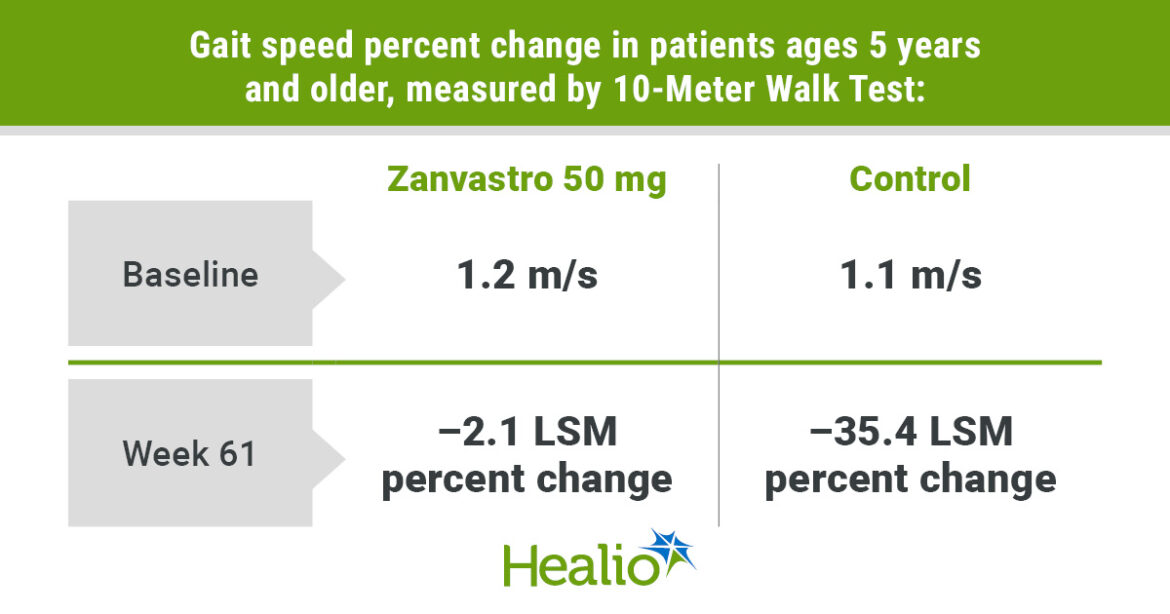
In participants aged 5 years and older, the therapy demonstrated significant stabilization of gait speed, evaluated via the 10-Meter Walk Test after 60 weeks of treatment.
- At baseline, the 50 mg treatment group ($n = 17$) presented with a mean gait speed of 1.2 meters per second, compared to 1.1 meters per second in the control group ($n = 13$).
- Following 61 weeks, the Zanvastro cohort demonstrated a least squares mean (LSM) percent change of –2.1% (95% CI; –23, 18.8).
- Conversely, the control group experienced a marked LSM percent change of –35.4% (95% CI; –59.3, –11.5), yielding an LSM difference of 33.3% (95% CI, 1.4–65.3).
Reflecting on the rapid clinical decline observed in the untreated group, Dr. Waldman noted:
“It was very humbling that in those just 15 months … there was a decline in patients who were relatively stable to begin with. The fact that patients continued to worsen in the control arm compared to the stability that was seen in Zanvastro was quite an achievement.”
Biomarker and Pediatric Subgroup Findings
Significant divergence between treatment and control arms was also documented in plasma glial fibrillary acidic protein (GFAP) levels from baseline at week 61, demonstrating targeted modulation of the disease’s underlying biology (LSM difference 33.6%, $P = .003$). Among younger participants aged 2 to 4 years, evaluations using the Gross Motor Function Measure-88 revealed significant differences at week 61 (LSM difference 22.9%, $P = .034$). Furthermore, researchers successfully incorporated an open-label evaluation involving four patients under the age of 2 years. Dr. Waldman emphasized the broad applicability of the trial:
“It’s a very heterogeneous disease, and we were very fortunate that this trial was for all ages, all disease phenotypes, so we could offer it to everyone. Even with such heterogeneity, that it met its statistical endpoints and had clinical meaningful benefits is really tremendous.”
Summary of Clinical Trial Findings and Trial Demographics
| Parameter / Metric | Zanvastro Treatment Cohort | Control Group / Comparator | Statistical Significance / Outcome |
|---|---|---|---|
| Total Study Population | 53 participants (ages 2 to 53 years) across global trial | Randomized 2:1 against control | Evaluated across multiple age-stratified functional endpoints |
| Gait Speed Baseline (Age $\ge$ 5) | Mean speed: 1.2 m/s ($n = 17$ in 50 mg group) | Mean speed: 1.1 m/s ($n = 13$) | Baseline comparability established |
| Gait Speed Change (Week 61) | LSM percent change: –2.1% (95% CI; –23, 18.8) | LSM percent change: –35.4% (95% CI; –59.3, –11.5) | LSM difference: 33.3% (95% CI, 1.4–65.3) |
| Plasma GFAP Modulation | Significant reduction from baseline at week 61 | Continued elevation or lack of suppression | LSM difference 33.6%, $P = .003$ |
| Gross Motor Function (Ages 2–4) | Evaluated via GMFM-88 | Standard supportive control parameters | LSM difference 22.9%, $P = .034$ |
Safety Profile and Tolerability
Adverse reactions associated with Zanvastro were predominantly mild to moderate in severity. The most frequently reported events included:
- Vomiting
- Back pain
- Cough
- Headache
- Post-lumbar puncture syndrome
One isolated case of aseptic meningitis occurred during the trial; however, the patient successfully continued therapy and was re-dosed without lasting complications. Dr. Waldman summarized the safety profile:
“The drug was very well tolerated. There weren’t really any of those significant things that didn’t resolve with just some supportive care.”
Broader Scientific Implications and Future Horizons
Beyond Alexander disease, clinical investigators view the successful validation of Zanvastro as a vital proof-of-concept for addressing other neurological conditions involving gain-of-function pathologies and rare leukodystrophies. Dr. Waldman highlighted the expanding pharmacological toolkit:
“I think people are so focused right now on gene therapy or CRISPR-Cas9 or other things, and it’s just a reminder that we really do have a number of tools that can work for these incurable neurologic conditions.”
To facilitate safe and structured distribution, Ionis Pharmaceuticals announced plans to roll out Zanvastro across 12 designated leukodystrophy centers of excellence throughout the United States, while simultaneously establishing broader outreach channels to identify new patients. The therapy will launch at a list price of $285,000 per dose, accompanied by dedicated reimbursement and financial assistance programs to support patient access and continuity of care.
Expert Perspective: Clinical Realities and Societal Challenges
Albee Messing, VMD, PhD, Chair of the Scientific Advisory Committee for the End AxD Foundation, provided an expert clinical perspective on the approval, contextualizing its emotional and practical significance for affected families:
“There’s no question that it’s really a dream come true for the Alexander disease community in many ways. They’ve been waiting. I’ve been contacted by several parents whose children died decades ago.”
Dr. Messing noted the limitations of the current therapeutic iteration while emphasizing its foundational importance:
“It’s not a cure. It’s imperfect, but hopefully it provides the foundation for future improvements. There are various ways you can imagine improving it. I’m hoping Ionis is working on that. But at least this sets the ground rules for it. It’s got the FDA endorsement behind it as a strategy, and that’s terrific.”
Addressing the clinical expectations of disease stabilization versus slowing progression, Dr. Messing observed:
“The real hope is that it either stabilizes patients in their current state or they actually improve. But really the most obvious benefit right now is hope more than anything else. I think there is a possibility, which we’ve always known was a possibility, that it slows the progression. In some people, it’s still a progressive disease, but it doesn’t progress as fast. Some people may be happy about that. They have more time with their family. Some people may find that an agonizing experience, and it really all depends on the individual and their current state.”
Emphasizing the value of early intervention down to infancy, Dr. Messing added:
“I think there’s been the general notion, and certainly from the animal work, that the earlier you treat, the more effective it will be. That’s one of the reasons why I’m really happy that they approved it down through infancy. The way the trial was initially set up, it started at 2 years old, but a_l_o_t of kids start having problems before then. So, the earlier you can give the treatment, the better off you’re going to be.”
Regarding future optimizations, dosing schedules, and drug delivery modalities, Dr. Messing remarked:
“This is my personal opinion because the End AxD Foundation’s Scientific Advisory Committee has not really gathered to talk about this. For Zanvastro specifically, I would think the obvious thing to consider is doses, and whether, if they play around with the doses, they can get better results. For instance, a higher dose might give you more suppression and be more effective. There may be some people who can be weaned off the ASO after a while, and we don’t know that. The earlier treatment will be more effective, and they just need more patients and more experience with that, more data and longitudinal studies to see. I think there’s a lot that can be done with Zanvastro as it is. I think from the medical science side, biology side, there are the obvious things that we all want to see, such as improved means of delivery so you don’t have to do intrathecal administration – something that you can give via an intravenous route or something like that, or subcutaneously. There are people working on that, but I think the results are a long way off.”
Finally, Dr. Messing raised critical considerations regarding healthcare equity, administration infrastructure, and broader economic models associated with ultra-orphan therapeutics:
“It goes beyond the biology. I think the other really serious problem is the cost and equity and availability and how that will roll out. I think a lot of places can do intrathecal administration. That’s not such a huge deal. I think right now Ionis is trying to limit it to the places that have been part of the clinical trial. Intrathecal administration by itself is not such a limiting factor. Whatever they say about insurance coverage or adjustments, that’s all a black box, as far as we’re concerned. You have more and more of these kinds of very highly specialized treatments, not so personalized, but for an ultra-rare disorder, astronomical costs are attached to that. How that gets settled at a societal level is a major problem.”