Zasocitinib Achieves Higher Psoriasis Clearance Rates Than Deucravacitinib in Phase 3 Head-to-Head Trial
1-minute summary
The investigational oral tyrosine kinase 2 (TYK2) inhibitor zasocitinib demonstrated superior skin-clearance outcomes compared with deucravacitinib in adults with moderate to severe plaque psoriasis, according to late-breaking results from the phase 3 LATITUDE Atlas trial presented at the European Academy of Dermatology and Venereology (EADV) Congress in Vienna.
The randomized, head-to-head study included 604 participants who received once-daily zasocitinib 30 mg or deucravacitinib 6 mg for 16 weeks. Complete skin clearance, defined as a 100% improvement in the Psoriasis Area and Severity Index (PASI 100), was achieved by 36.5% of participants receiving zasocitinib compared with 13.9% receiving deucravacitinib (P < .001).
Zasocitinib also produced higher response rates for PASI 90, a Physician’s Global Assessment (PGA) score of 0, and an absolute PASI score of 2 or lower. The investigators reported greater improvements in dermatology-related quality of life and itch scores with zasocitinib. Both treatments were generally well tolerated, and no new safety signals were identified during the reported study period.
These findings suggest that zasocitinib may become another oral treatment option for adults with moderate to severe plaque psoriasis. However, it remains investigational in the supplied report, and the results reflect a 16-week comparison rather than long-term effectiveness or safety.
Why this matters
Plaque psoriasis is a chronic inflammatory skin disease that can cause persistent plaques, itching, discomfort, and substantial effects on quality of life. Treatment goals often include reducing disease severity, achieving clear or nearly clear skin, and relieving symptoms that interfere with daily activities.
Oral targeted therapies provide an alternative to injectable biologic treatments for some patients. Zasocitinib is an investigational, highly selective oral TYK2 inhibitor. Deucravacitinib, marketed as Sotyktu, is an established oral TYK2 inhibitor.
Direct comparisons between treatments can help clinicians and researchers understand their relative efficacy. In this trial, zasocitinib achieved higher response rates across several measures of psoriasis severity at week 16.
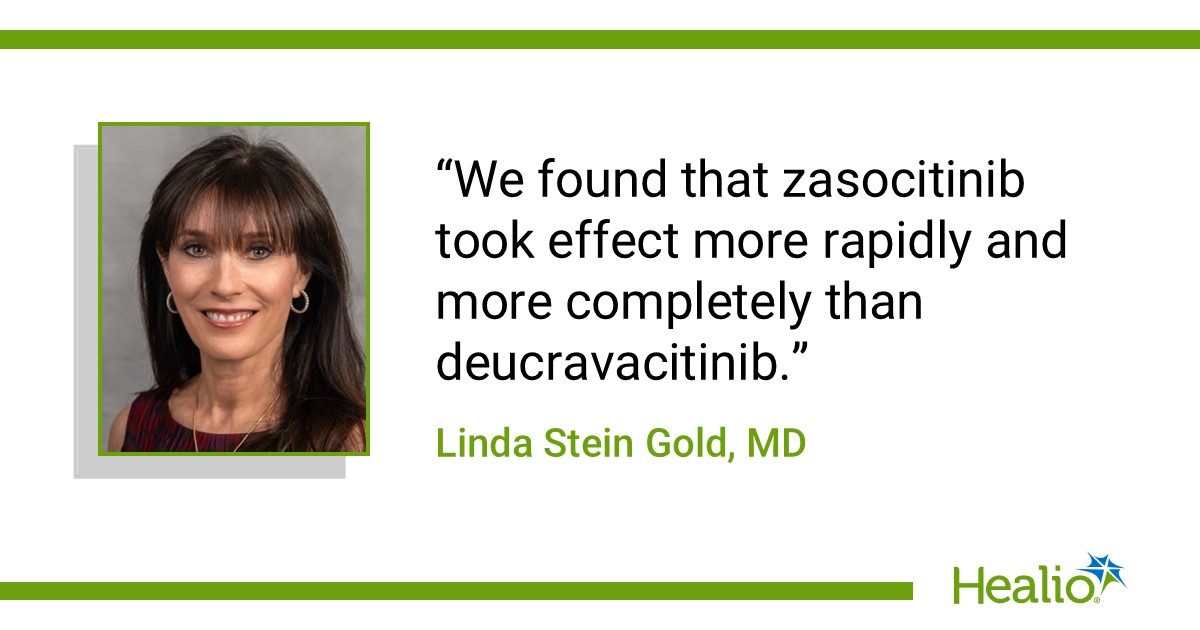
Linda Stein Gold, MD, the study’s principal investigator and director of dermatology clinical research at Henry Ford Health, stated:
“We found that zasocitinib took effect more rapidly and more completely than deucravacitinib.”
She added:
“Zasocitinib has the potential to be a new oral option that acts quickly and effectively for adults with moderate to severe plaque psoriasis.”
These statements reflect the investigator’s interpretation of the findings. The supplied report does not provide detailed time-to-response data or longer-term comparative results to independently quantify how quickly the treatments began working.
Study at a glance
| Feature | Details |
|---|---|
| Study type | Phase 3 randomized, head-to-head clinical trial |
| Trial name | LATITUDE Atlas |
| Participants | 604 adults with moderate to severe plaque psoriasis |
| Intervention | Zasocitinib 30 mg orally once daily |
| Comparator | Deucravacitinib 6 mg orally once daily |
| Treatment duration | 16 weeks |
| Primary endpoint | Proportion achieving PASI 100 at week 16 |
| Key secondary endpoints | PASI 90, absolute PASI ≤2, and PGA 0 |
| Additional outcomes | Dermatology Life Quality Index (DLQI) and Itch Numeric Rating Scale |
| Main finding | PASI 100 achieved by 36.5% with zasocitinib vs 13.9% with deucravacitinib |
| Safety finding | Generally well tolerated; no new safety signals reported |
| Presentation | EADV Congress, September 30–October 3, 2026, Vienna |
| DOI | Not provided in the supplied report |
What the researchers found
1. Participant characteristics
A total of 604 participants were randomized to receive one of the two oral treatments.
| Characteristic | Zasocitinib | Deucravacitinib |
|---|---|---|
| Participants randomized | 301 | 303 |
| Dose | 30 mg once daily | 6 mg once daily |
| Mean age | 46.1 years | 45.6 years |
| Men | 64.1% | 69.6% |
| Treatment duration | 16 weeks | 16 weeks |
The groups had similar mean ages, although the proportion of men differed modestly. The supplied report does not provide additional baseline information such as psoriasis duration, baseline PASI scores, previous biologic exposure, or disease distribution.
2. Complete skin clearance: PASI 100
The primary endpoint was the proportion of participants achieving PASI 100 at week 16, indicating complete clearance of psoriasis according to the PASI assessment.
| Outcome at week 16 | Zasocitinib | Deucravacitinib |
|---|---|---|
| PASI 100 | 36.5% | 13.9% |
| Absolute difference | 22.6 percentage points | — |
| Relative response rate | Approximately 2.6 times that of deucravacitinib | Reference |
| Reported statistical significance | P < .001 | — |
The absolute difference of 22.6 percentage points and the relative response rate of approximately 2.6 are calculated from the percentages reported in the supplied article.
The results indicate that complete skin clearance was substantially more common in the zasocitinib group at week 16. The reported P value indicates a statistically significant difference under the trial’s analysis, although confidence intervals were not included in the supplied report.
3. PASI 90 response
PASI 90 represents at least a 90% improvement in the PASI score from baseline.
| Outcome at week 16 | Zasocitinib | Deucravacitinib |
|---|---|---|
| PASI 90 | 62.5% | 34.0% |
| Absolute difference | 28.5 percentage points | — |
| Reported statistical significance | P < .001 | — |
Nearly two-thirds of participants receiving zasocitinib achieved PASI 90, compared with approximately one-third receiving deucravacitinib. The 28.5-percentage-point difference is calculated from the reported response rates.
4. Physician’s Global Assessment
The PGA provides a clinician-rated assessment of overall psoriasis severity. A PGA score of 0 represents clear skin.
| Outcome at week 16 | Zasocitinib | Deucravacitinib |
|---|---|---|
| PGA 0 | More than 43% | 18.5% |
| Reported statistical significance | P < .001 | — |
More than 43% of participants in the zasocitinib group achieved a PGA score of 0, compared with 18.5% in the deucravacitinib group. The exact zasocitinib percentage was not supplied in the article excerpt, so a precise absolute difference cannot be calculated.
5. Absolute PASI score of 2 or lower
An absolute PASI score of 2 or lower indicates low residual psoriasis severity.
| Outcome at week 16 | Zasocitinib | Deucravacitinib |
|---|---|---|
| Absolute PASI ≤2 | 66.1% | 38.0% |
| Absolute difference | 28.1 percentage points | — |
| Reported statistical significance | P < .001 | — |
The higher response rate with zasocitinib suggests that more participants reached a low level of residual disease at week 16.
6. Quality of life and itch
The investigators also evaluated patient-reported outcomes, including the Dermatology Life Quality Index (DLQI) and the Itch Numeric Rating Scale.
| Outcome | Zasocitinib | Deucravacitinib |
|---|---|---|
| Reported DLQI change/value | 7.62 | 9.51 |
| Reported Itch Numeric Rating Scale change/value | 3.22 | 3.96 |
The supplied article states that participants receiving zasocitinib experienced greater changes from baseline in both measures. However, the excerpt does not clearly specify the sign convention or provide the full statistical details for these values. They are therefore reproduced as reported rather than independently interpreted as absolute improvements.
7. Safety and tolerability
Zasocitinib was generally well tolerated during the 16-week study period. No new safety signals were identified in the reported presentation.
The most commonly reported adverse events included:
- Upper respiratory tract infection
- Nasopharyngitis
- Acne
The supplied report does not provide event-specific incidence rates, serious adverse-event rates, discontinuation rates, or detailed laboratory findings. The absence of new safety signals over 16 weeks does not establish long-term safety.
Clinical significance
The LATITUDE Atlas findings suggest that zasocitinib may offer greater short-term efficacy than deucravacitinib for several measures of plaque psoriasis severity.
Higher rates of complete clearance: PASI 100 was achieved by 36.5% of participants receiving zasocitinib, compared with 13.9% receiving deucravacitinib.
Consistent results across efficacy measures: Higher response rates were also reported for PASI 90, PGA 0, and absolute PASI ≤2. This consistency strengthens the evidence for a difference in short-term skin-clearance outcomes between the study groups.
Potential patient-reported benefits: The reported DLQI and itch findings suggest that improvements may extend beyond visible skin lesions, although detailed statistical information is needed to quantify these effects.
An oral treatment option under investigation: If subsequent evidence and regulatory decisions support its use, zasocitinib could expand oral treatment choices for adults with moderate to severe plaque psoriasis.
Nevertheless, these findings do not establish superiority over injectable biologics, durability of remission, or long-term safety. Treatment decisions require consideration of the full evidence, individual patient factors, comorbidities, preferences, and approved prescribing information.
Limitations
- Short follow-up: The reported comparison covered 16 weeks, which is insufficient to establish long-term efficacy, durability of response, or uncommon adverse effects.
- Conference presentation: The findings were presented at a scientific congress. The supplied article does not include a full peer-reviewed publication of the detailed trial results.
- Limited statistical detail: Confidence intervals and complete statistical analyses were not provided for all reported endpoints.
- Incomplete patient-reported outcome information: The reported DLQI and itch values lack sufficient detail in the supplied excerpt to fully interpret the magnitude of improvement.
- Incomplete safety data: The report does not provide the frequency of individual adverse events, serious events, treatment discontinuations, or laboratory abnormalities.
- Limited generalizability information: The supplied excerpt does not fully describe previous treatments, comorbidities, disease duration, or other baseline characteristics that could influence response.
- Investigational status: Zasocitinib was described as investigational in the report. The findings do not by themselves establish regulatory approval or its suitability for routine clinical use.
- Industry sponsorship: Takeda sponsored the LATITUDE Atlas trial, and the principal investigator reported financial relationships with several pharmaceutical companies, including Takeda. These disclosures do not invalidate the results but are relevant when evaluating the evidence alongside the full trial report and independent studies.
What doctors should know
- Recognize the trial population: The findings apply to adults with moderate to severe plaque psoriasis enrolled in a 16-week phase 3 comparison.
- Understand the main efficacy results: PASI 100 was achieved by 36.5% with zasocitinib and 13.9% with deucravacitinib. Higher responses with zasocitinib were also reported for PASI 90, PGA 0, and absolute PASI ≤2.
- Distinguish short-term efficacy from long-term benefit: The study provides evidence about outcomes at week 16, not long-term disease control or sustained remission.
- Interpret patient-reported outcomes carefully: The supplied report does not include enough statistical detail to independently assess the clinical importance of the DLQI and itch findings.
- Do not overinterpret the safety findings: No new safety signals were identified, but a 16-week study cannot exclude uncommon or delayed adverse effects.
- Follow regulatory and publication updates: Because zasocitinib was investigational in the supplied report, clinicians should consult current regulatory information and the complete trial publication before considering any change in treatment practice.
Bottom line
In the phase 3 LATITUDE Atlas head-to-head trial, investigational zasocitinib produced higher rates of complete and near-complete skin clearance than deucravacitinib in adults with moderate to severe plaque psoriasis after 16 weeks. PASI 100 was achieved by 36.5% of participants receiving zasocitinib compared with 13.9% receiving deucravacitinib.
The findings support further evaluation of zasocitinib as a potential oral treatment option. Longer-term published data are needed to clarify durability, comprehensive safety, and its place among available psoriasis therapies.
Original research / DOI
Conference presentation: Stein Gold L, et al. LATITUDE Atlas trial, abstract LB-312.
Presented at: European Academy of Dermatology and Venereology Congress, September 30–October 3, 2026; Vienna, Austria.
Trial sponsor: Takeda.
DOI: Not provided in the supplied report.
Principal investigator: Linda Stein Gold, MD.
Disclosure: Stein Gold reported financial relationships with AbbVie, Alumis, Amgen, Arcutis Biotherapeutics, Bambusa Therapeutics, Galderma, Incyte, Johnson & Johnson, Kymera Therapeutics, Leo Pharma, Lilly, Organon, Oruka Therapeutics, Pfizer, Regeneron, Sanofi, Takeda, and UCB.