Clinical Background and Pathophysiological Context
Hidradenitis suppurativa (HS) is a chronic, painful, and debilitating autoinflammatory skin disease characterized by deep-seated nodules, abscesses, draining sinus tracts, and extensive scarring, typically localized to intertriginous anatomical regions such as the axillae, groin, buttocks, and inframammary folds. In recent years, substantial clinical research has underscored an intimate epidemiological and immunologic link between HS and inflammatory bowel disease (IBD), encompassing both Crohn’s disease and ulcerative colitis. Patients presenting with HS inherently exhibit an elevated baseline vulnerability to developing gastrointestinal inflammation compared to the general population.
Concurrently, the therapeutic landscape for moderate-to-severe HS has evolved beyond conventional antibiotics and anti–tumor necrosis factor (anti-TNF) agents like adalimumab. Biologics targeting the interleukin-17 (IL-17) signaling cascade have emerged as core therapeutic options. Among the three targeted biologic therapies approved for HS, two function through IL-17 inhibition:
- Secukinumab (Cosentyx, Novartis): A selective human monoclonal antibody that neutralizes interleukin-17A (IL-17A), validated through pivotal clinical trials including the SUNSHINE and SUNRISE programs.
- Bimekizumab (Bimzelx, UCB): A humanized monoclonal antibody designed to selectively and simultaneously inhibit both interleukin-17A and interleukin-17F (IL-17A/F), which proved superior efficacy in the BE HEARD clinical trial program.
Despite the robust efficacy demonstrated across these large-scale phase 3 initiatives, the clinical application of IL-17 inhibitors has been met with vigilance and prescriber hesitancy. This caution stems from earlier findings across dermatological, rheumatological, and gastroenterological trials—particularly in psoriasis, ankylosing spondylitis, and failed trials of IL-17 blockers in active Crohn’s disease—where IL-17 blockade was linked to paradoxical flares of bowel disease or reports of de novo intestinal inflammation. Because the IL-17 cytokine family serves a dual role by driving cutaneous inflammation while simultaneously reinforcing the gut mucosal barrier, the clinical community has debated whether IL-17 targeted therapies impose an independent, additive risk of IBD onto a population already predisposed to gastrointestinal pathology.
Systematic Review and Meta-Analysis Architecture
To rigorously evaluate this safety concern, Marley Cutrona, BS, a medical student in the Department of Dermatology at the Icahn School of Medicine at Mount Sinai, along with colleagues, conducted a comprehensive systematic review and meta-analysis published in JAMA Dermatology (Cutrona M, et al. JAMA Dermatol. 2026; doi:10.1001/jamadermatol.2026.3373).
The investigators aggregated global evidence to quantify the exact frequency and relative risk of de novo IBD onset and underlying IBD flares among HS patients undergoing IL-17 pathway blockade. The analysis evaluated 24 studies comprising a total cohort of 3,015 patients receiving an IL-17 inhibitor:
- 10 Randomized Controlled Trials (RCTs)
- 11 Observational Cohort Studies
- 3 Case Series
The primary objective was to determine whether IL-17 inhibition imposes a tangible, drug-induced additive risk of IBD above the pre-existing baseline incidence associated with hidradenitis suppurativa.
Quantitative Findings and Risk Stratification
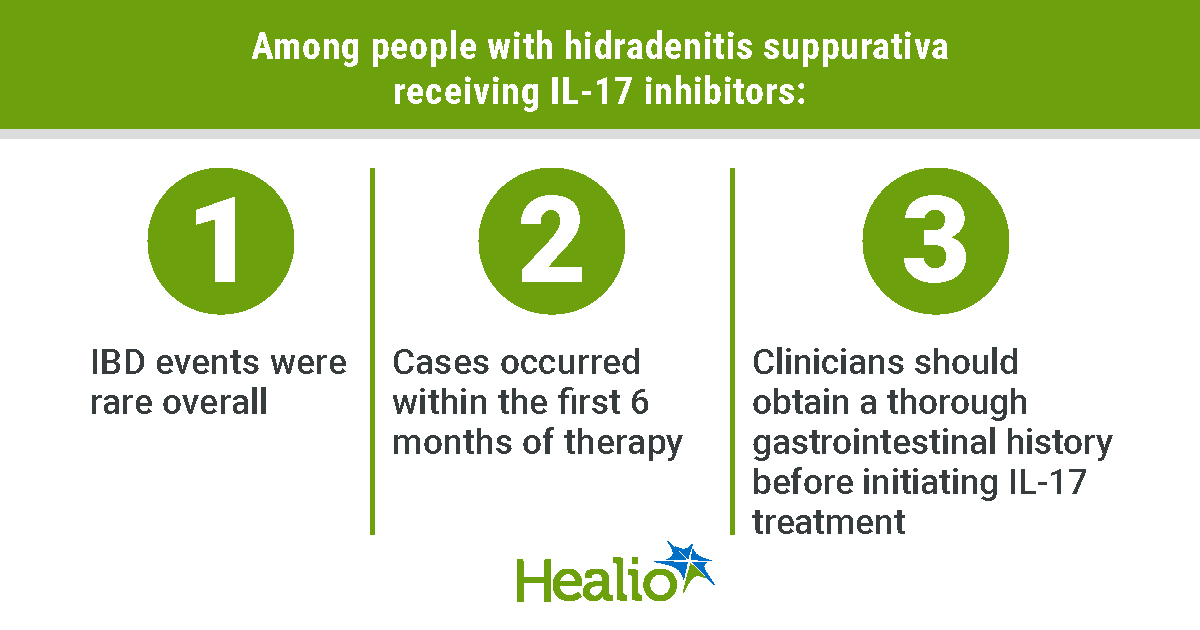
The investigation demonstrated that gastrointestinal adverse events culminating in verified IBD were remarkably infrequent across all therapeutic trials and real-world cohorts.
In the high-evidence tier of randomized controlled trials:
- Across the 10 evaluated RCTs, 2,572 HS patients received an IL-17 inhibitor.
- Within this substantial population, only six patients developed new-onset IBD.
- Through the primary randomized control period (week 16), new-onset IBD materialized in 0.23% of participants receiving an active IL-17 inhibitor, compared to 0% among those randomized to placebo.
- The risk difference between the active treatment arms and the placebo cohorts was calculated at 0.002 (95% CI, 0.003 to 0.007).
In nonrandomized real-world cohorts and observational investigations:
- Across 11 cohort studies capturing 469 patients treated with IL-17 inhibitors, seven instances of new-onset IBD were identified.
- This corresponded to a crude incidence rate of 1.49% and an estimated pooled incidence rate of 3.9% (95% CI, 2.3% to 6.5%).
- The comparatively higher event rates documented within observational datasets relative to RCTs likely reflect longer clinical follow-up periods, the inclusion of medically complex patients routinely excluded from phase 3 protocols, and confounding by indication.
Across all 24 evaluated clinical studies (comprising 3,015 patients), the researchers identified a cumulative total of:
- 17 cases of new-onset IBD
- 4 instances of pre-existing IBD flares
A critical temporal pattern was identified regarding the time-to-onset of gastrointestinal pathology: the documented adverse events manifested predominantly within the first 6 months following the initiation of IL-17 targeted therapy. This finding indicates that the period of maximal clinical vulnerability for either unmasking latent subclinical bowel inflammation or triggering new gastrointestinal pathology falls squarely within the earliest stages of biologic administration.
Comparative Data Synthesis
| Study Design Category | Evaluated Patient Volume ($N$) | New-Onset IBD Cases | Reported Incidence Metrics | Calculated Risk Difference vs. Placebo |
|---|---|---|---|---|
| Randomized Controlled Trials (RCTs) | 2,572 patients across 10 trials | 6 cases | 0.23% in active treatment vs. 0% in placebo (at 16 weeks) | 0.002 (95% CI, 0.003 to 0.007) |
| Nonrandomized / Cohort Studies | 469 patients across 11 studies | 7 cases | Crude incidence: 1.49% |
Pooled incidence: 3.9% (95% CI, 2.3% to 6.5%) | Not applicable (observational/non-placebo designs) |
| Total Evidence Base (RCTs + Cohorts + Case Series) | 3,015 patients across 24 studies | 17 new cases
4 disease flares | Events concentrated within the initial 6 months of therapy | Overall risk remains low and non-additive to underlying disease baseline |
Summary of Approved IL-17 Biologics in Hidradenitis Suppurativa
| Therapeutic Agent | Proprietary Name / Manufacturer | Molecular Target Mechanism | Key Supporting Clinical Trial Programs |
|---|---|---|---|
| Secukinumab | Cosentyx (Novartis) | Selective Interleukin-17A (IL-17A) inhibitor | SUNSHINE and SUNRISE phase 3 trials |
| Bimekizumab | Bimzelx (UCB) | Dual Interleukin-17A and Interleukin-17F (IL-17A/F) inhibitor | BE HEARD I and BE HEARD II phase 3 trials |
Author Conclusions and Clinical Guidance
Synthesizing their quantitative findings, Marley Cutrona and colleagues concluded that while hidradenitis suppurativa carries an undisputed intrinsic association with inflammatory bowel disease, the administration of IL-17 inhibitors does not superimpose an additive pharmacological risk:
“In this systematic review and meta-analysis, IBD events during IL-17 inhibitor therapy for HS were uncommon, with higher incidence rates in nonrandomized studies compared with RCTs, although events remained rare overall,” Marley Cutrona, BS, a medical student in the department of dermatology at Icahn School of Medicine at Mount Sinai, and colleagues wrote. “Although HS is associated with IBD, an additive risk with IL-17 inhibitor treatment was not observed.”
The investigative team reiterated that their conclusions support the overall therapeutic safety profile of this class of medications in managing HS, while highlighting the importance of clinical diligence:
“The findings of our study support a low risk of IBD in patients with HS treated with IL-17 inhibitors,” the researchers wrote. “However, current guidelines recommend avoiding IL-17 inhibitors in patients with concomitant active IBD. For patients with HS without known IBD, a thorough gastrointestinal history should be obtained before treatment with IL-17 inhibitors and patients should be monitored for gastrointestinal symptoms.”
Expert Perspective and Practical Implications
In an accompanying clinical perspective, Christopher J. Sayed, MD, of the University of North Carolina at Chapel Hill, emphasized that these data provide crucial clarity for practicing dermatologists who manage severe, recalcitrant HS:
“This is very reassuring news. The increased risk for IBD in patients with HS has generated some hesitancy in prescribing IL-17 inhibitors. This reinforces that, if the risk exists, it is exceptionally low and should not interfere with appropriate treatment in the absence of concerning gastrointestinal symptoms.”
Dr. Sayed’s commentary highlights that the theoretical hazard of drug-induced bowel inflammation should not become a therapeutic barrier preventing patients from accessing clinically efficacious biologics. Provided that patients are free of unmanaged or suspicious gastrointestinal symptoms—such as persistent hematochezia, unexplained chronic diarrhea, involuntary weight loss, or severe abdominal cramping—IL-17 blockade represents a sound therapeutic modality.
Disclosures and Industry Affiliations
The perspective author, Dr. Christopher J. Sayed, documented financial associations (encompassing research support, advisory roles, or consulting arrangements) with multiple biotechnology and pharmaceutical entities, including:
- AbbVie
- Alumis
- AstraZeneca
- Cantargia
- Elasmogen
- Incyte
- InflaRx
- MoonLake Immunotherapeutics
- Novartis
- Sandoz
- Sanofi
- Sonoma Biotherapeutics
- Takeda Pharmaceuticals
- UCB
Methodological Limitations and Investigative Nuances
While the conclusions offer strong reassurance for clinical practice, the authors identified several methodological caveats that warrant careful interpretation:
- Statistical Power Constraints: Because true de novo IBD presentations and unmasked flares occurred at exceptionally low absolute numbers, the statistical power to uncover subtle differences between various IL-17 targeting molecules (e.g., selective IL-17A inhibition versus dual IL-17A/F blockade) remained constrained.
- Endpoint Designations: Across the majority of the randomized controlled trials evaluated, inflammatory bowel disease was monitored solely as a treatment-emergent adverse event rather than an adjudicated primary or secondary study endpoint. Consequently, surveillance protocols, gastrointestinal screening questionnaires, and diagnostic confirmation methods lacked standardization across protocols.
- Follow-Up Inconsistencies: The observation windows varied considerably among the pooled investigations. While randomized phases offered uniform, highly monitored 16-week intervals, real-world observational cohorts and open-label extensions exhibited widely disparate durations of follow-up, which may account for the discrepancy in reported crude incidence rates between RCTs (0.23%) and observational cohorts (3.9%).
Overall, this extensive systematic synthesis clarifies the clinical safety parameters of IL-17 pathway inhibition in hidradenitis suppurativa, indicating that the inherent risk profile of these therapeutics does not exacerbate the pre-existing risk of inflammatory bowel disease in this patient population. Baseline gastrointestinal risk assessments and early-phase clinical symptom surveillance remain prudent best practices.