Drinking Water Disinfection Byproducts Linked to Higher Uterine Cancer Risk in Observational Study
1-Minute Summary
A cohort analysis involving 53,100 women enrolled in the California Teachers Study found that higher estimated exposure to certain drinking-water disinfection byproducts was associated with an increased risk of uterine cancer, particularly endometrioid tumors.
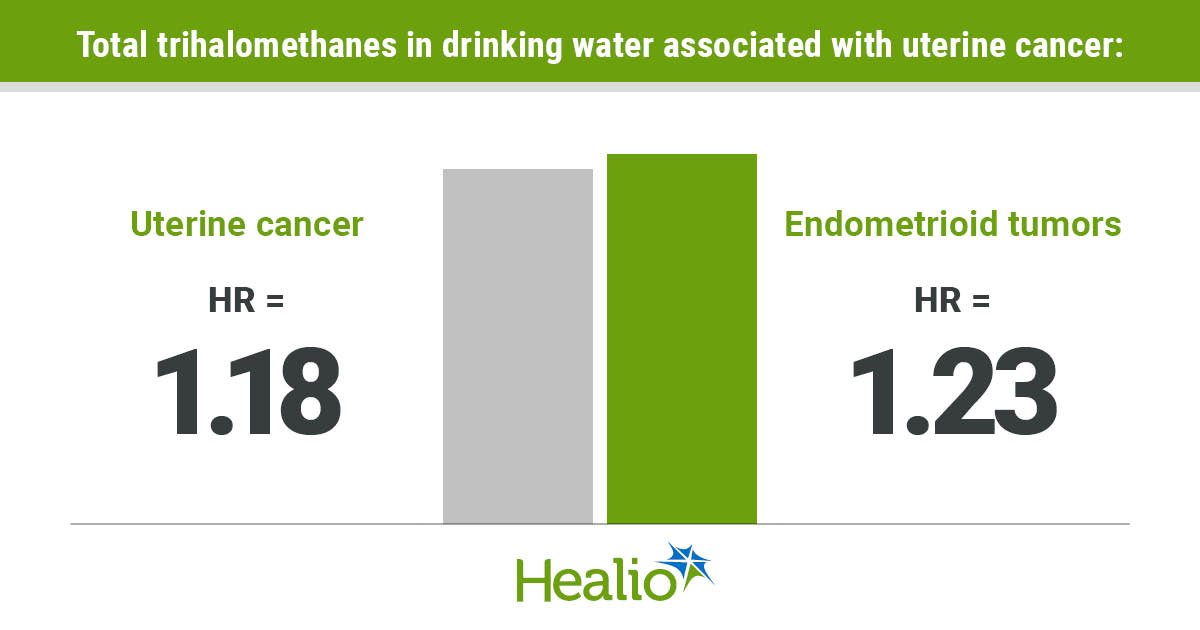
Women in the highest tertile of total trihalomethanes exposure had an 18% higher relative hazard of uterine cancer overall and a 23% higher relative hazard of endometrioid tumors than women in the lowest tertile. Higher exposure to haloacetic acids was associated with an increased risk of nonendometrioid tumors.
The findings, published in JAMA Network Open, provide additional evidence supporting further investigation of possible links between drinking-water contaminants and cancer. However, the study does not prove causation or demonstrate that existing drinking-water standards are inadequate. Exposure estimates were based primarily on contaminant concentrations in water serving participants’ homes, rather than comprehensive measurements of individual lifetime consumption.
Why This Matters
Disinfection of public drinking water is a major public health intervention that reduces the spread of waterborne infectious diseases. However, chemical disinfectants such as chlorine can react with naturally occurring substances in water, producing disinfection byproducts, including trihalomethanes and haloacetic acids.
Some of these compounds have raised concerns because of their potential health effects. Total trihalomethanes are regulated in the United States and have previously been associated with bladder cancer.
The current study examined whether exposure to these byproducts might also be associated with uterine cancer, a malignancy whose incidence has increased over recent decades.
Approximately 90% of people in the United States obtain their drinking water from community water systems, according to the Healio report. Consequently, even relatively small associations between common environmental exposures and cancer could be important at a population level if confirmed by additional research.
Rena R. Jones, PhD, MS, a senior investigator in the National Cancer Institute’s Division of Cancer Epidemiology and Genetics, raised the question of whether existing limits adequately address this potential outcome.
“Are current limits protective against this cancer? That’s a fair question to ask.”
Jones also emphasized the need to interpret the results carefully:
“The data are not without limitations, but the findings point to a signal that I think should be taken seriously.”
These observations support further epidemiologic investigation, rather than an immediate conclusion that regulated drinking water is unsafe.
Study at a Glance
| Feature | Details |
|---|---|
| Study type | Observational cohort analysis |
| Study population | 53,100 women participating in the California Teachers Study |
| Median age | 50 years; interquartile range, 43–60 years |
| Population characteristics | 85% White |
| Recruitment | 1995–1996 |
| Follow-up period | Through 2020 |
| Eligibility described in the report | Women without a prior cancer history or hysterectomy who had a community-water-served address and maintained the residence for at least 10 years |
| Exposure | Estimated residential exposure to total trihalomethanes, individual trihalomethanes, total haloacetic acids, and selected haloacetic acids |
| Comparator | Highest versus lowest exposure tertile |
| Primary outcomes | Incidence of uterine cancer overall, endometrioid tumors, and nonendometrioid tumors |
| Main finding | Higher estimated exposure to selected disinfection byproducts was associated with increased risk of specific uterine cancer outcomes |
| Study setting | California |
| Randomization | None; this was not a randomized controlled trial |
Background: How Drinking-Water Disinfection Byproducts Form
Public water systems use disinfection to control microorganisms that can cause infectious diseases. Chlorination is one widely used method. During treatment, disinfectants can react with substances present in the water and generate chemical byproducts.
Two groups evaluated in this study were:
- Trihalomethanes (THMs): A group of disinfection byproducts that includes chloroform and bromodichloromethane.
- Haloacetic acids (HAAs): Another group of disinfection byproducts that includes monochloroacetic acid.
The US Environmental Protection Agency regulates certain drinking-water contaminants under the Safe Drinking Water Act. However, the study addressed a separate scientific question: whether exposure levels relevant to public water systems might also be associated with uterine cancer, beyond previously investigated outcomes such as bladder cancer.
Jones and colleagues had previously reported an association between drinking-water disinfection byproducts and uterine cancer in an Iowa population. The California analysis was conducted to investigate whether the earlier observation could be reproduced in a geographically and demographically different cohort.
What the Researchers Found
1. Total trihalomethanes and uterine cancer
Women in the highest tertile of estimated total trihalomethanes exposure had a significantly higher relative hazard of uterine cancer overall and endometrioid tumors than women in the lowest tertile.
| Outcome | Exposure comparison | Hazard ratio (HR) | 95% CI | Interpretation |
|---|---|---|---|---|
| Uterine cancer overall | Total trihalomethanes: highest vs lowest tertile | 1.18 | 1.02–1.38 | 18% higher relative hazard |
| Endometrioid tumors | Total trihalomethanes: highest vs lowest tertile | 1.23 | 1.05–1.46 | 23% higher relative hazard |
Both confidence intervals excluded 1.00, consistent with statistically significant associations at the conventional 5% level.
These estimates describe relative hazards, not absolute probabilities of developing cancer. The report does not provide enough information to calculate an individual woman’s absolute risk from these results alone.
2. Associations with individual trihalomethanes
Analysis of individual compounds identified associations involving chloroform and bromodichloromethane.
| Exposure measure | Cancer outcome | HR | 95% CI | Interpretation |
|---|---|---|---|---|
| Chloroform, highest vs lowest tertile | Uterine cancer overall | 1.18 | 1.02–1.37 | 18% higher relative hazard |
| Chloroform, highest vs lowest tertile | Endometrioid tumors | 1.27 | 1.07–1.50 | 27% higher relative hazard |
| Bromodichloromethane, highest vs lowest tertile | Endometrioid tumors | 1.22 | 1.03–1.44 | 22% higher relative hazard |
The results suggest that associations may differ by chemical compound and tumor subtype. They do not, by themselves, identify the biological mechanism responsible for the observed patterns.
3. Haloacetic acids and nonendometrioid tumors
Higher estimated exposure to total haloacetic acids and monochloroacetic acid was associated with an increased relative hazard of nonendometrioid uterine tumors.
| Exposure measure | Cancer outcome | HR | 95% CI | Interpretation |
|---|---|---|---|---|
| Total haloacetic acids, highest vs lowest tertile | Nonendometrioid tumors | 1.86 | 1.06–3.25 | 86% higher relative hazard |
| Monochloroacetic acid, highest vs lowest tertile | Nonendometrioid tumors | 1.86 | 1.01–3.44 | 86% higher relative hazard |
Although both estimates were statistically significant according to their reported confidence intervals, the intervals were relatively wide. This indicates considerable uncertainty about the magnitude of the associations.
The findings should therefore be considered evidence of a potential association requiring further study, not definitive proof of a causal relationship.
4. Replication of earlier findings
The California analysis followed an earlier study in Iowa that had also reported a relationship between drinking-water disinfection byproducts and uterine cancer.
Jones described the consistency between the investigations:
“The association we had previously observed in Iowa was not likely a chance finding.”
She added that the California results were similar to those observed in the earlier study despite differences in geography and study population.
Replication across separate populations strengthens confidence that an epidemiologic signal merits further investigation. Nevertheless, replication of an association does not eliminate the possibility of residual confounding, exposure misclassification, or other sources of bias.
Clinical Significance
The study does not establish a new screening recommendation for uterine cancer or provide a basis for individual clinical risk prediction based solely on a patient’s drinking-water source.
For clinicians, the primary significance is the contribution of emerging environmental evidence to understanding potential cancer risk factors. These results may be useful when discussing environmental exposures in a broader prevention context, but they should not displace established clinical assessment, prevention, or diagnostic pathways.
For public health researchers and regulators, the results support continued evaluation of disinfection byproducts, cancer outcomes, and the adequacy of exposure assessment in population studies.
Jones stressed that the available evidence does not itself confirm that current regulatory limits cause harm. She also pointed to a wider body of research on drinking-water contaminants, including studies investigating nitrate exposure and ovarian cancer.
Discussing nitrate regulation, Jones said:
“The allowed level of nitrate in drinking water is set not based on cancer at all, it’s based on the risk of blue-baby syndrome.”
She noted that evidence concerning cancer outcomes may not be fully reflected in standards originally established to address other health risks. The report also cited Denmark’s decision to lower its drinking-water nitrate standard by approximately tenfold, partly in response to accumulating cancer research. This is contextual evidence about regulatory approaches to a different contaminant, not direct evidence about the safety of trihalomethanes or haloacetic acids.
Jones summarized the broader concern:
“We’ve had several studies that have made this link [with water contaminants and cancer] consistently.”
She also acknowledged that the total number of studies remains limited and that the issue warrants continued attention.
Limitations
Several limitations affect the interpretation of this analysis.
Incomplete historical exposure data
The researchers lacked drinking-water quality data from before 1990. Consequently, the analysis could not fully reconstruct participants’ earlier exposure histories.
Uncertainty about individual consumption
Exposure estimates were based largely on contaminant concentrations in water serving participants’ residences. For most participants, the researchers did not have detailed information on the amount of water consumed, frequency of consumption, use of water filters, or other factors that could influence actual exposure.
Jones explained:
“Another important caveat is we don’t have estimates of how much women are ingesting, apart from a small subset.”
She clarified that the investigators knew the concentrations in water supplied to participants’ homes but did not have a complete lifetime assessment of drinking-water habits.
Observational design
Because the study was not randomized, it cannot establish causation. Other factors associated with exposure patterns or cancer risk could potentially contribute to the observed associations, including factors not adequately measured or controlled in the analysis.
Generalizability
The cohort consisted of women enrolled in the California Teachers Study, and 85% were White. The results may not apply equally to populations with different demographic characteristics, residential histories, water systems, or exposure patterns.
Uncertainty in the magnitude of some associations
The confidence intervals for the haloacetic acid findings were relatively wide, particularly for nonendometrioid tumors. This limits precision when estimating the strength of those associations.
No proof that current standards are inadequate
The study investigated associations between estimated exposure and cancer incidence. It did not directly test whether changing regulatory limits would reduce uterine cancer incidence or establish a threshold at which exposure becomes unsafe.
What Doctors and Public Health Professionals Should Know
- Interpret the findings cautiously. The study identifies associations, not confirmed causal effects.
- Avoid overinterpreting relative risks. An elevated HR does not directly indicate an individual’s absolute probability of developing cancer.
- Do not recommend unproven cancer screening changes based on this study alone. The report does not establish a new screening protocol or a validated individual risk calculator.
- Recognize the public health question. Disinfection protects against waterborne infections, while the formation of chemical byproducts creates a separate issue that researchers continue to investigate.
- Support better exposure assessment. Future studies would benefit from long-term water-quality records and more detailed data on actual consumption, filtration, and residential history.
- Distinguish research findings from regulatory conclusions. The study raises a question about whether current standards address all relevant health outcomes, but it does not establish that regulated water is unsafe.
Future Research Priorities
Further investigation could help determine whether the observed associations are reproducible and whether they reflect causal relationships.
Important priorities include:
- Studies in additional populations with different demographic and geographic characteristics.
- Improved estimates of long-term exposure, including historical water-quality measurements.
- Collection of individual water-consumption and filtration data.
- Evaluation of differences between endometrioid and nonendometrioid tumors.
- Research examining potential biological mechanisms and the contribution of individual disinfection byproducts.
- Analyses that can better inform regulatory assessments of cancer outcomes while accounting for the established benefits of drinking-water disinfection.
Jones said her team has water-ingestion data from another population that it plans to evaluate in future work. Such data may help address some of the uncertainties surrounding actual exposure.
Bottom Line
In a cohort of 53,100 women, higher estimated exposure to total trihalomethanes in community drinking water was associated with a higher relative hazard of uterine cancer overall and endometrioid tumors. Higher exposure to total haloacetic acids and monochloroacetic acid was associated with nonendometrioid tumors.
The findings add to earlier research suggesting a possible relationship between drinking-water disinfection byproducts and uterine cancer. However, incomplete historical exposure information and limited data on individual water consumption constrain interpretation.
The results justify further research into long-term exposure and cancer risk. They do not prove that drinking-water contaminants caused the cancers observed or establish that current regulatory limits are unsafe.
Original Research and DOI
Study: Spaur M, et al. Research on drinking-water disinfection byproducts and uterine cancer in the California Teachers Study.
Journal: JAMA Network Open. 2026.
DOI: 10.1001/jamanetworkopen.2026.24391
Expert quoted: Rena R. Jones, PhD, MS, National Cancer Institute.
Readers should consult the original research paper for the complete methods, adjusted analyses, and detailed interpretation.