
Top Posts
US obesity prevalence 75% under new Lancet criteria
Test post
test post
First
First
New Hope for SMA: FDA Approves Itvisma for...
Addressing lifestyle for CVD prevention
Thyroid imbalance in pregnancy linked to increased likelihood...
SunilMadhavs World
Banner
  • Home
  • Support Portal
  • My Subscriptions
  • Contact Information
  • About
    • Cardiology
      • Gastroenterology
        • Radiology
          • Pulmonology
            • Gynecology
    • Neurology
  • Urology
    • Hematology
      • Profile
        • Log Out
        • Register
        • Edit Account
        • Change Password
        • GDPR-compliant cookie policy.
          • Terms and conditions
            • Contact Information
  • About
    • Privacy policy
      • BASICS DISCUSS
        • BASICS
          • ANATOMY
            • BASICS PRO
              • ANATOMY PRO
              • BIOCHEMISTRY PRO
              • PHYSIOLOGY
                • BIOCHEMISTRY
                  • PHYSIOLOGY PRO
                    • BASICS RESEARCH
                    • ANATOMY ADVANCEMENTS
                    • BIOCHEMISTRY ADVANCEMENTS
                    • PHYSIOLOGY ADVANCEMENTS
  • Team SunilMadhavs World
  • TOPICS
  • INTERMEDIATE
  • 0
Home » Air pollution tied to 91,000 premature deaths yearly
Pulmonology

Air pollution tied to 91,000 premature deaths yearly

A new study quantifies the severe public health toll of pollutants from the U.S. oil and gas industry.

by Team SunilMadhavs World August 29, 2025
A+A-
Reset
163

Oil and Gas Emissions Drive Major Health Burdens and Deep Inequities

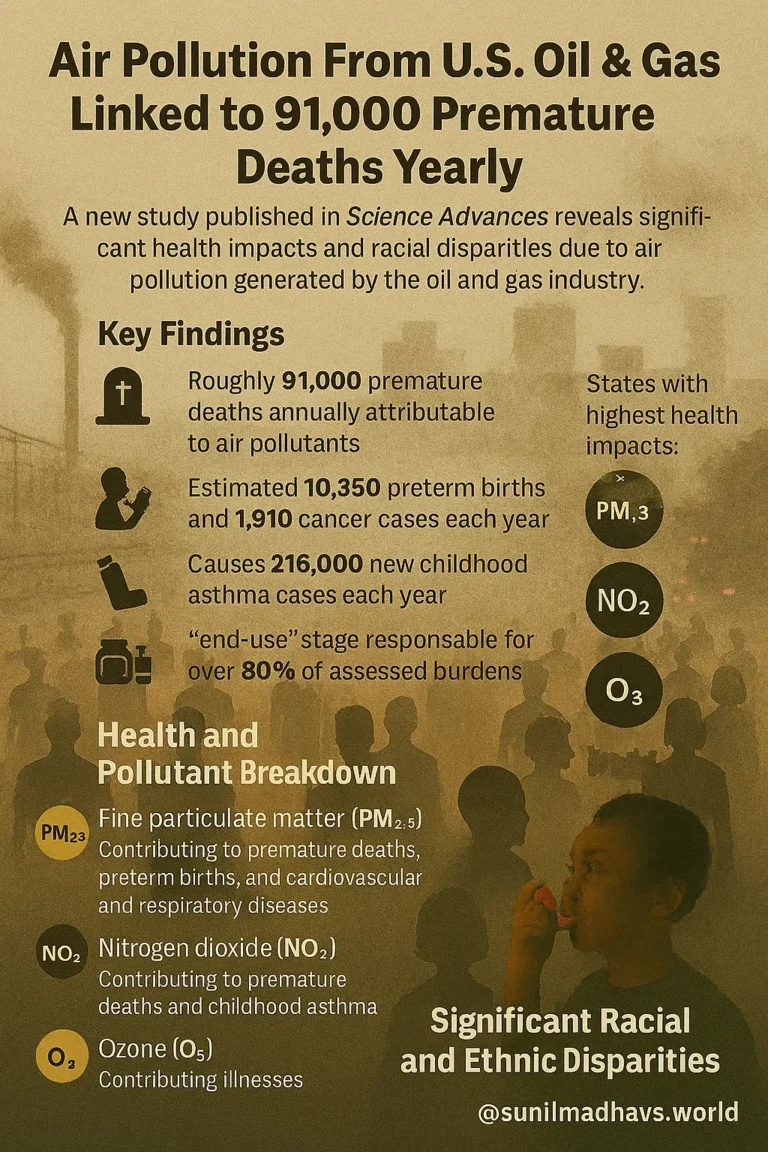
A landmark study led by Dr. Elois Marais, published in Science Advances, offers one of the most comprehensive assessments to date of the public health toll caused by air pollution from the U.S. oil and gas industry. Using 2017 data, the researchers mapped emissions across the entire fossil fuel lifecycle—from upstream exploration and drilling, through midstream transport and storage, to downstream refining and petrochemical processing, and finally to end-use combustion in vehicles, homes, and industries. They then linked these emissions to epidemiological data on disease risk, revealing a staggering annual burden: 91,000 premature deaths, 10,350 preterm births, 216,000 cases of childhood-onset asthma, and 1,610 new cancer diagnoses.

The analysis found that the end-use stage—where oil and gas are burned for energy—was by far the most damaging. This final phase alone accounted for:

  • 94% of PMâ‚‚.â‚…-related premature deaths
  • 96% of NOâ‚‚-related premature deaths
  • 94% of PMâ‚‚.â‚…-attributable preterm births
  • 91% of NOâ‚‚-driven childhood asthma cases
  • 82% of HAP-linked cancer cases

These pollutants—fine particulate matter (PM₂.₅), nitrogen dioxide (NO₂), ozone (MDA8 O₃), and hazardous air pollutants (HAPs)—are known to penetrate deep into the lungs and bloodstream, triggering inflammation, respiratory distress, cardiovascular disease, and cellular damage that can lead to cancer.
 

Geographic and Demographic Disparities

The health burden is not evenly distributed. States with large populations or significant fossil fuel infrastructure bear the brunt. New York and Pennsylvania top the list with 7,200 and 6,300 premature deaths annually from oil and gas pollution. California, Texas, and New Jersey also rank high in total impact. When adjusted for population, residents of New Jersey, Washington D.C., New York, California, and Maryland face the highest per-capita risks.

But the most sobering findings relate to racial and ethnic disparities. The study revealed that:

  • Black communities face a 40–60% higher risk of death and preterm birth from PMâ‚‚.â‚… and NOâ‚‚ exposure compared to national averages.
  • Asian populations are disproportionately affected by HAP-related cancers and NOâ‚‚-induced childhood asthma.
  • Native American and Hispanic groups are more impacted by upstream and midstream emissions, often due to proximity to drilling and transport infrastructure.

These disparities reflect decades of environmental injustice, where communities of color have been systematically exposed to higher levels of pollution due to zoning laws, industrial siting, and legacy housing policies like redlining. Many of these communities live near highways, refineries, and petrochemical plants—not by choice, but by design.

Limitations and Call to Action

Dr. Marais and her team caution that their findings likely underestimate the true health burden. The study did not account for indoor air pollution, acute exposure events, or the cumulative effects of multiple pollutants. Moreover, the data was analyzed at a relatively coarse geographic scale, limiting its utility for neighborhood-level interventions.

Still, the implications are clear. The researchers advocate for:

  • More granular studies to help clinicians and policymakers identify and protect vulnerable populations.
  • Targeted interventions to reduce exposure in high-risk communities.
  • A national transition away from oil and gas, which would yield substantial public health benefits.

As Dr. Marais notes, communities living near polluting infrastructure have long known the risks—they’ve lived them. This study doesn’t just validate their experiences; it equips them with scientific evidence to demand change. It also provides policymakers with a roadmap for reducing both the total and unequal health burdens of fossil fuel pollution.

In essence, the research reframes air pollution not just as an environmental issue, but as a profound public health crisis—one that disproportionately harms the most marginalized and demands urgent, equity-focused solutions.

Source link

Related posts:

Automated VEST Algorithm: A Leap Forward in PAH Diagnosis

July 22, 2025

Oral drug lowers OSA severity over 6 months

June 2, 2025
You Might Be Interested In
  • Automated VEST Algorithm: A Leap Forward in PAH Diagnosis
    July 21, 2025
  • Oral drug lowers OSA severity over 6 months
    June 2, 2025
0 0 votes
Article Rating
Air pollutionAsthmaCancerPremature births
0 comments 0 FacebookTwitterPinterestEmail
Team SunilMadhavs World

previous post
Although rare, GLP-1s tied to higher risk for eye complications
next post
Risk for Parkinson’s disease increased with presence of metabolic syndrome components

Related Articles

Automated VEST Algorithm: A Leap Forward in PAH...

July 21, 2025

Oral drug lowers OSA severity over 6 months

June 2, 2025
Subscribe
Login
Notify of
Save my name, email, and website in this browser cookies for the next time I comment.

Save my name, email, and website in this browser cookies for the next time I comment.

0 Comments
Oldest
Newest Most Voted
Inline Feedbacks
View all comments

Login/Register

Google Icon
Login With Google
X Icon
Login With X
Facebook Icon
Login With Facebook

Keep me signed in until I sign out

Forgot your password? Register here

Google Icon
Login With Google
X Icon
Login With X
Facebook Icon
Login With Facebook

Login here

Social Networks

Facebook Twitter Instagram Linkedin Rss

Categories

Popular Posts

  • 1

    Suicide of patient on LVAD therapy sparks wider mental health discussion

    July 4, 2025
  • 2

    WHO in India

    June 18, 2025
  • 3

    Mediterranean diet could improve psoriasis symptoms

    October 13, 2025
  • 4

    Oral drug lowers OSA severity over 6 months

    June 2, 2025
  • 5

    FDA Approves Lenz Therapeutics’ Vizzâ„¢ for Presbyopia Treatment

    August 2, 2025

Recent Posts

  • US obesity prevalence 75% under new Lancet criteria

    January 19, 2026
  • Test post

    January 5, 2026
  • January 1, 2026
  • test post

    January 1, 2026

About SunilMadhavs World

Facebook Twitter Instagram Pinterest Youtube Snapchat
  • Log In
  • About
  • Register
  • Profile
  • My account
  • Edit Account
  • Change Password
  • My Subscriptions
  • chnfo@suni0
  • Support Portal
  • Contact Information
  • Privacy policy
  • GDPR-compliant cookie policy.
  • Terms and conditions
  • Medical Disclaimer

@2019 - All Right Reserved. Designed and Developed by PenciDesign

SunilMadhavs World
  • Home
  • Support Portal
  • My Subscriptions
  • Contact Information
  • About
    • Cardiology
      • Gastroenterology
        • Radiology
          • Pulmonology
            • Gynecology
    • Neurology
  • Urology
    • Hematology
      • Profile
        • Log Out
        • Register
        • Edit Account
        • Change Password
        • GDPR-compliant cookie policy.
          • Terms and conditions
            • Contact Information
  • About
    • Privacy policy
      • BASICS DISCUSS
        • BASICS
          • ANATOMY
            • BASICS PRO
              • ANATOMY PRO
              • BIOCHEMISTRY PRO
              • PHYSIOLOGY
                • BIOCHEMISTRY
                  • PHYSIOLOGY PRO
                    • BASICS RESEARCH
                    • ANATOMY ADVANCEMENTS
                    • BIOCHEMISTRY ADVANCEMENTS
                    • PHYSIOLOGY ADVANCEMENTS
  • Team SunilMadhavs World
  • TOPICS
  • INTERMEDIATE
SunilMadhavs World
  • Home
  • Support Portal
  • My Subscriptions
  • Contact Information
  • About
    • Cardiology
      • Gastroenterology
        • Radiology
          • Pulmonology
            • Gynecology
    • Neurology
  • Urology
    • Hematology
      • Profile
        • Log Out
        • Register
        • Edit Account
        • Change Password
        • GDPR-compliant cookie policy.
          • Terms and conditions
            • Contact Information
  • About
    • Privacy policy
      • BASICS DISCUSS
        • BASICS
          • ANATOMY
            • BASICS PRO
              • ANATOMY PRO
              • BIOCHEMISTRY PRO
              • PHYSIOLOGY
                • BIOCHEMISTRY
                  • PHYSIOLOGY PRO
                    • BASICS RESEARCH
                    • ANATOMY ADVANCEMENTS
                    • BIOCHEMISTRY ADVANCEMENTS
                    • PHYSIOLOGY ADVANCEMENTS
  • Team SunilMadhavs World
  • TOPICS
  • INTERMEDIATE
@2019 - All Right Reserved. Designed and Developed by PenciDesign

Shopping Cart

Close

No products in the cart.

Close
wpDiscuz