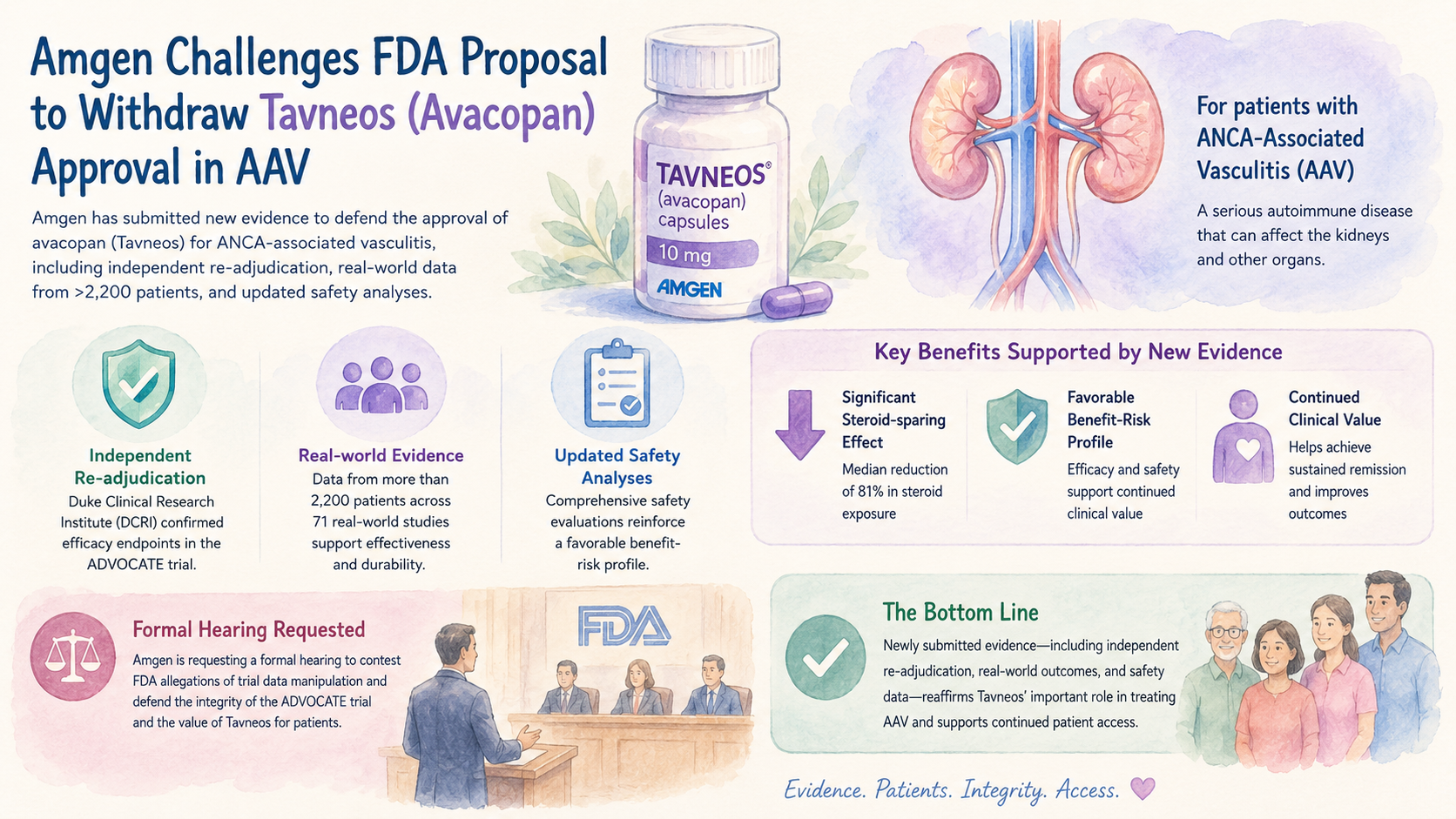
Amgen Rejects FDA Allegations of Trial Manipulation, Submits New Data to Defend Avacopan Approval
Journal Reference Style: Rheumatology News Summary
Date of Origin: July 29, 2026
ADVOCATE Trial Re-Adjudication Summary (2026)
Sponsor: Amgen | Independent Evaluator: Duke Clinical Research Institute
Summary
Amgen has formally contested the US Food and Drug Administration (FDA) Center for Drug Evaluation and Research (CDER) proposal to withdraw marketing approval for avacopan (Tavneos), an oral complement 5a receptor antagonist approved for ANCA-associated vasculitis (AAV). Responding to allegations of data manipulation in the pivotal ADVOCATE trial, Amgen submitted a 104-page response featuring an independent 2026 re-adjudication by the Duke Clinical Research Institute (DCRI), alongside meta-analytic and real-world safety data to demonstrate a favorable risk-benefit profile.
In April 2026, Tracy Beth Høeg, MD, PhD, acting director of CDER, issued a formal letter detailing the agency’s intent to withdraw approval for avacopan. The primary allegations center on actions taken following the initial database lock of the ADVOCATE trial by former ChemoCentryx employees:
Background and Regulatory Conflict
The FDA’s Case for Withdrawal
- Unblinded Review: Huibin Yue, PhD (Director of Biostatistics), and Pirow Bekker, MD, PhD (Chief Medical Officer), reviewed unblinded trial data for quality control.
- Initial Efficacy: According to the FDA, initial unblinded analyses showed the primary endpoint of remission failed to reach statistical significance.
- Data Alteration & Second Lock: The FDA alleged that the pair initiated a blinded re-adjudication of nine trial participants, leading to five patients in the avacopan cohort being reclassified as achieving sustained remission. Upon rerunning the analysis, the results achieved statistical significance.
- Journal Retraction: The New England Journal of Medicine retracted the original ADVOCATE study at the request of lead academic authors David R.W. Jayne, MD, and Peter A. Merkel, MD, MPH, citing concerns over the 2019 re-adjudication process.
Amgen’s Rebuttal
Jay Bradner, MD, Amgen’s Executive Vice President of Research and Development, alongside legal counsel, asserted that the original findings remain valid:
“In this submission, Amgen demonstrates that the totality of evidence — including a recently completed independent re-adjudication of the clinical trial at issue here, along with sensitivity analyses, real-world, and post-marketing evidence, and recently developed manuscripts — strongly supports that Tavneos plays a critical and otherwise unmet role in treating [ANCA-associated vasculitis (AAV)] and that CDER’s withdrawal proposal should be rejected.”
Amgen rejected claims of intentional data alteration, clarifying:
“Contrary to CDER’s allegations, those results were not ‘manipulated.’ Rather, the 2019 re-adjudication followed a prespecified procedure to correctly and consistently apply prespecified trial rules to potentially erroneously classified data. No underlying clinical data were altered.”
“What the Center has characterized as ‘data manipulation’ was a prespecified quality control process that is not prohibited by FDA regulations. ChemoCentryx did not invent data, alter source records, or override a blinded adjudicator’s clinical judgment during that process.”
Key Data Submissions
1. 2026 Independent Re-Adjudication (Duke Clinical Research Institute)
Amgen commissioned the Duke Clinical Research Institute (DCRI) to conduct a fully blinded, independent re-adjudication of the ADVOCATE dataset.
| Endpoint | Avacopan Group | Prednisone Taper Group | Treatment Difference (95% CI) | Efficacy Finding |
|---|---|---|---|---|
| Week 26 Remission | 68.1% | 67.1% | 2.2% (-7.5 to 11.9) | Confirmed Noninferiority |
| Week 52 Sustained Remission | 61.4% | 52.4% | 9.8% (-0.3 to 19.9) | Favored Avacopan (Directional)* |
| Glucocorticoid Reduction | — | — | Median -81%; Mean -56% | Significant Reduction |
*Note: While superiority was not formally met at 52 weeks in the 2026 re-adjudication (unlike the original published 12.5% difference [95% CI, 2.6% to 22.3%]), directional efficacy favoring avacopan was sustained.
2. Real-World Evidence & Systematic Reviews
Systematic Literature Review & Meta-Analysis (Ibiloye et al.)
- Cohort: 71 real-world studies ($N > 2,200$ adult AAV patients).
- 6-Month Remission Rate: 87% (95% CI, 75%–94%)
- 12-Month Remission Rate: 93% (95% CI, 86%–97%)
- 12-Month Relapse Rate: 7% (95% CI, 4%–11%)
- Renal Function Impact: eGFR improved by an average of ~18 mL/min/1.73 $m^2$; 66% of dialysis-dependent patients were able to discontinue dialysis.
Comparative Effectiveness Analysis (Dang et al.)
- Cohort: Optum Market Clarity database ($n = 183$ avacopan vs $n = 4,096$ standard-of-care controls).
- Steroid Exposure: Avacopan cohort demonstrated lower 6-month steroid burden (weighted total difference: -559.7 mg; 95% CI, -814.2 to -1.9).
- Relapse Rate: Trend toward lower relapses at 12 months (weighted HR = 0.81; 95% CI, 0.59–1.13).
3. Safety Profile & Hepatotoxicity Analyses
| Safety Parameter | Global Safety Database Finding (Bharania et al.) | Real-World Meta-Analysis Finding |
|---|---|---|
| Serious Hepatic Adverse Events | 31 per 1,000 patient-years | 7% serious hepatotoxicity |
| Any Hepatotoxicity | Not reported in safety database summary | 11% |
| Vanishing Bile Duct Syndrome (VBDS) | 31 cases (27 concentrated in Japan) | Not specified |
| Serious Infections | Not reported in safety database summary | 7% |
The FDA previously flagged 76 cases of drug-induced liver injury (8 fatal) and 7 cases of VBDS in March 2026. Global safety analysis notes VBDS fatalities were predominantly observed in Japanese patients aged $>65$ years.
Expert & Patient Perspectives
Clinical Expert Testimony
- Lindsay S. Lally, MD (Weill Cornell Medicine):
“Tavneos has been a welcome option for AAV patients and has been adopted by many rheumatologists as part of a first line treatment strategy.”
Patient Experience
- Glen (Severe Active GPA):
“Years on corticosteroids took a toll on my body. I developed osteoporosis, diabetes, neuropathy, vision changes and memory fog. Having another treatment option has helped me move forward while reducing my dependence on steroids.”
- Brandi (Severe Active GPA):
“Steroids helped stabilize my disease when I needed them most, but living with them long term also came with challenges. Having the opportunity to reduce my steroid use has reduced the impact the use of steroids has had on my body.”
Current Procedural Status
Amgen maintains that the FDA has no legal basis for revocation and has submitted an official request for summary judgment or a formal evidentiary hearing:
“Rare disease patients deserve all treatment options available to them. Ultimately, this submission is about ensuring that people living with ANCA-associated vasculitis continue to have access to an important treatment option.”