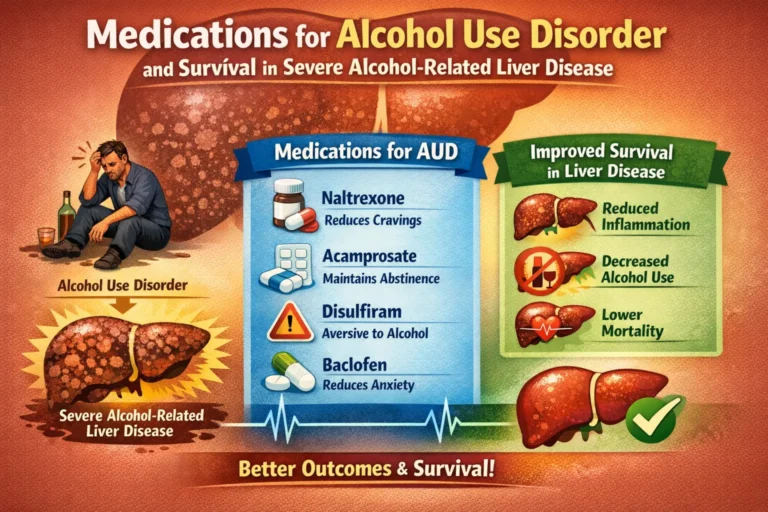
Medications for Alcohol Use Disorder and Survival in Severe Alcohol-Related Liver Disease: A Retrospective Cohort Study
Original Research Summary
JAMA Network Open, 2026. Single-Center Retrospective Cohort Analysis.
Importance
Alcohol-related liver disease (ALD) is among the leading indications for liver transplantation in the United States, yet medications for alcohol use disorder (MAUD) remain profoundly underutilized in this population — despite evidence that reducing or eliminating alcohol consumption represents the most effective intervention for reversing hepatic injury. This retrospective cohort study provides compelling evidence that MAUD use of 3 months or longer is independently associated with meaningful improvements in both 1-year and 3-year survival among patients with severe ALD undergoing transplant evaluation.
Background
Akshay Shetty, MD, transplant hepatologist and assistant clinical professor in medicine and surgery at the David Geffen School of Medicine, Pfleger Liver Institute, Ronald Reagan UCLA Medical Center, identified persistent underuse of MAUDs in ALD as a central clinical problem: “Treatment for AUD faces multiple barriers including patient readiness, stigma associated with the disease and limited patient knowledge about treatment efficacy, to list a few.”
Current estimates underscore this gap. Among U.S. adults with AUD as of 2023, approximately 7.8% received any treatment for the condition, and only 2.0% received medication-based treatment. Among patients with liver disease specifically, treatment rates for AUD were somewhat higher — 10% to 14% for any treatment modality — but MAUD utilization remained extremely low at 0.4% to 0.8%.
Study Design and Population
Shetty and colleagues conducted a retrospective cohort study identifying 2,567 patients evaluated for liver transplant eligibility for ALD at a single tertiary center between January 1, 2016 and December 31, 2022. After applying inclusion criteria — transplant committee evaluation, ALD as the primary etiology of liver disease, and age older than 18 years — 1,309 patients were included in the final analytic cohort.
Table 1: Baseline Cohort Characteristics
| Characteristic | Value |
|---|---|
| Total patients included | 1,309 |
| Mean age | 57.1 years |
| Male sex | 989 (75.6%) |
| Female sex | 320 (24.4%) |
| Mean MELD-Na score | 22.6 (SD ±10.5) |
| Mean hepatic decompensations | 1.6 (SD ±0.7) |
| Patients using at least one MAUD | 467 (35.7%) |
Table 2: MAUDs Included in Analysis
| Category | Medications |
|---|---|
| FDA-approved for AUD | Acamprosate, disulfiram, naltrexone |
| Off-label use for AUD | Baclofen, gabapentin, topiramate |
Primary Efficacy Findings
Survival Benefit Associated with MAUD Use ≥3 Months
Using MAUDs for 3 months or longer was associated with meaningfully improved survival at both assessed timepoints:
Table 3: Survival Benefit of MAUD Use (≥3 Months)
| Timepoint | Survival Benefit vs. No MAUD Use |
|---|---|
| 1-year survival | +6.6 percentage points |
| 3-year survival | +18.5 percentage points |
All-Cause Mortality by Number of MAUDs Used
Table 4: All-Cause Mortality by Number of MAUDs
| MAUD Exposure | Deaths / Total Patients | Mortality Rate | P Value |
|---|---|---|---|
| No MAUDs | 289 / 842 | 34.3% | Reference |
| Three MAUDs | 1 / 10 | 10.0% | .005 |
All-Cause Mortality by Duration of MAUD Use
Table 5: All-Cause Mortality by Duration of MAUD Use
| MAUD Duration | Deaths / Total Patients | Mortality Rate | P Value |
|---|---|---|---|
| No MAUD use | 312 / 900 | 34.7% | Reference |
| MAUD use >6 months | 12 / 95 | 12.6% | <.001 |
These associations remained statistically significant after adjustment for MELD-Na score, liver transplant status, hepatic complications, medical comorbidities, and sociodemographic variables.
Treatment Utilization Gap: Summary
Table 6: MAUD Utilization Rates in Relevant Populations (2023 Estimates)
| Population | Any AUD Treatment | MAUD Specifically |
|---|---|---|
| U.S. adults with AUD (general) | ~7.8% | ~2.0% |
| Patients with liver disease and AUD | ~10–14% | ~0.4–0.8% |
| Study cohort (transplant evaluation) | — | 35.7% (at least one MAUD) |
Limitations
The authors identified several important methodological constraints. The single tertiary center design limits generalizability and may introduce selection bias toward more complex or treatment-engaged patients. The final two years of the observation window — 2021 and 2022 — coincided with the COVID-19 pandemic, which Dr. Shetty acknowledged may have influenced findings:
“Like other substance use disorders, patients with AUD were severely impacted from disruption in continued care and treatment delivery during the early phase of COVID-19 pandemic, while rapid introduction of telehealth may have offset this change.”
Clinical Implications and Call to Action
The study’s findings carry a direct and actionable message for hepatologists and gastroenterologists: MAUD initiation and sustained use are associated with substantially reduced mortality in patients with severe ALD — a population with limited therapeutic options and high short-term mortality risk. Dr. Shetty emphasized the multidisciplinary imperative:
“In this patient population with advanced chronic liver disease, gastroenterologists and hepatologists should keep playing a key role in conjunction with addiction medicine providers to help patients on their road to recovery.”
He additionally identified patient engagement and education as prerequisites for medication adherence, noting that patients’ buy-in is central to treatment success — and that dismantling the stigma, knowledge gaps, and access barriers surrounding AUD treatment in the liver disease context represents an essential systems-level goal.
Corresponding author: Akshay Shetty, MD, David Geffen School of Medicine at UCLA, Pfleger Liver Institute. Contact: akshayshetty@mednet.ucla.edu. Financial disclosures were not reported with this communication.