
Top Posts
US obesity prevalence 75% under new Lancet criteria
Test post
test post
First
First
New Hope for SMA: FDA Approves Itvisma for...
Addressing lifestyle for CVD prevention
Thyroid imbalance in pregnancy linked to increased likelihood...
SunilMadhavs World
Banner
  • Home
  • Support Portal
  • My Subscriptions
  • Contact Information
  • About
    • Cardiology
      • Gastroenterology
        • Radiology
          • Pulmonology
            • Gynecology
    • Neurology
  • Urology
    • Hematology
      • Profile
        • Log Out
        • Register
        • Edit Account
        • Change Password
        • GDPR-compliant cookie policy.
          • Terms and conditions
            • Contact Information
  • About
    • Privacy policy
      • BASICS DISCUSS
        • BASICS
          • ANATOMY
            • BASICS PRO
              • ANATOMY PRO
              • BIOCHEMISTRY PRO
              • PHYSIOLOGY
                • BIOCHEMISTRY
                  • PHYSIOLOGY PRO
                    • BASICS RESEARCH
                    • ANATOMY ADVANCEMENTS
                    • BIOCHEMISTRY ADVANCEMENTS
                    • PHYSIOLOGY ADVANCEMENTS
  • Team SunilMadhavs World
  • TOPICS
  • INTERMEDIATE
  • 0
Home » Higher PFAS exposure may increase weight regain for teens after bariatric surgery
BARIATRICS

Higher PFAS exposure may increase weight regain for teens after bariatric surgery

by Team SunilMadhavs World August 19, 2025
A+A-
Reset
138

–Key Insights:

– Adolescents with higher presurgical blood levels of three types of per- and polyfluoroalkyl substances (PFAS) were more likely to experience weight regain after bariatric surgery.

– Researchers recommend further studies to understand how PFAS may affect outcomes of other obesity treatments.

A recent study published in *Obesity* suggests that teenagers undergoing bariatric surgery tend to regain more weight if they have elevated levels of PFAS in their bloodstream before surgery. These findings come from the Teen-LABS study, which tracks the long-term effects of bariatric surgery in patients 19 years and younger.

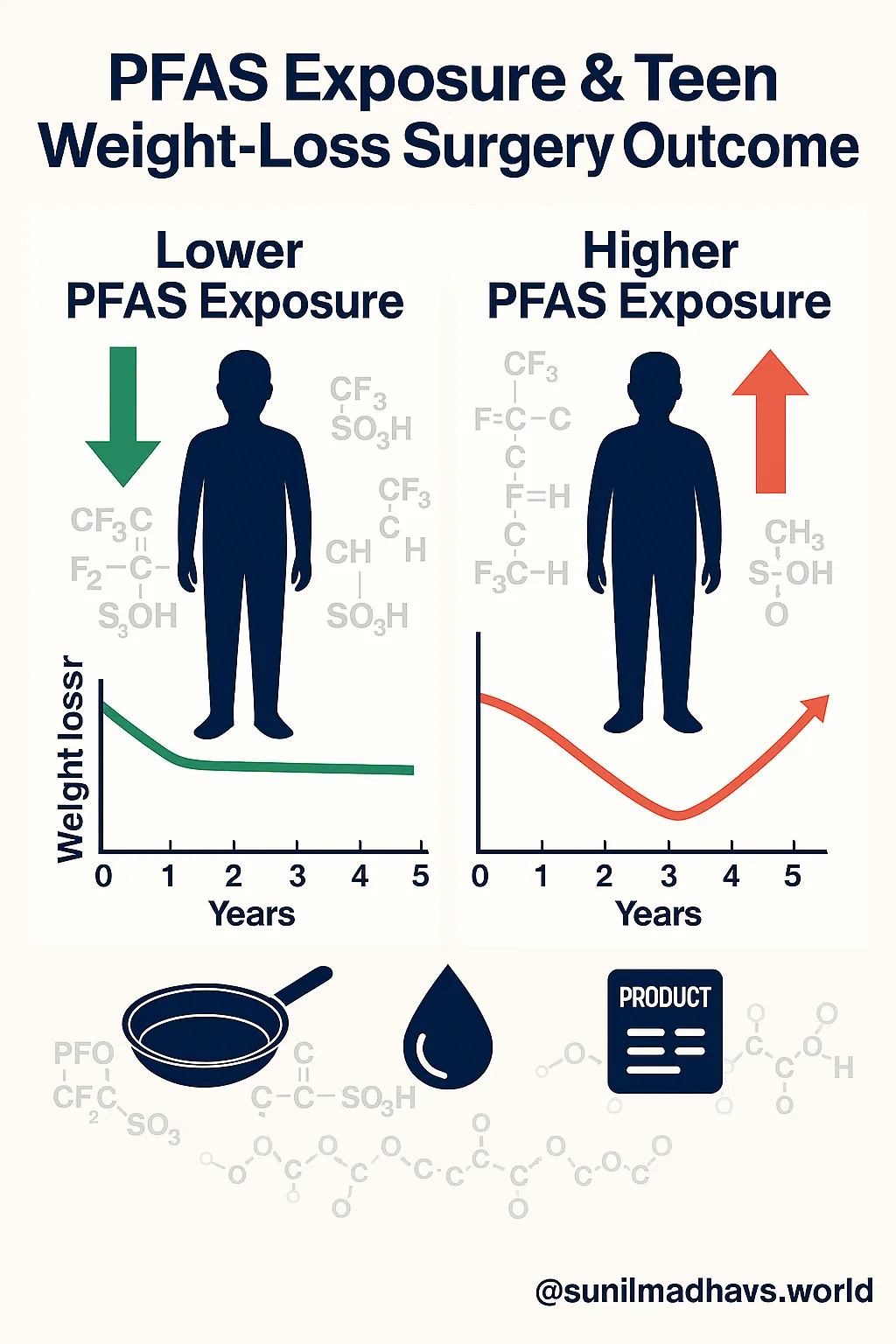
The analysis revealed that adolescents with higher plasma concentrations of three perfluoroalkyl sulfonic acids showed greater increases in BMI, body weight, and waist circumference between 1 and 5 years post-surgery.
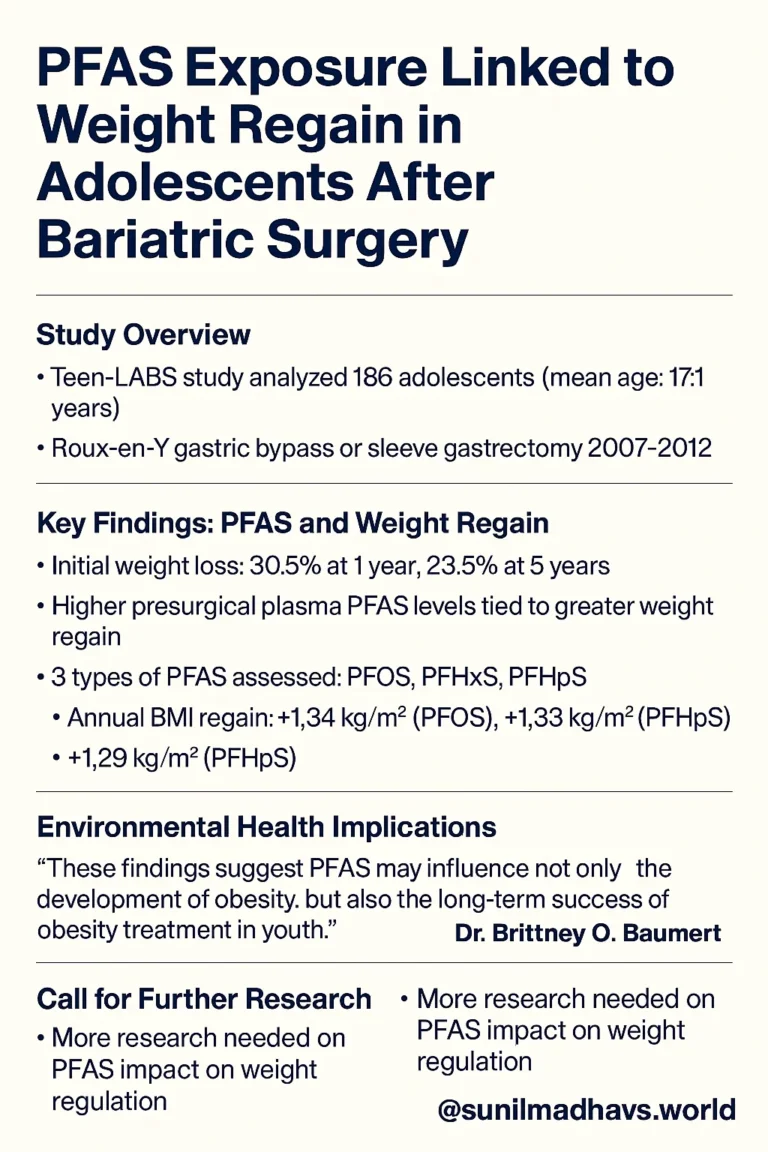
### Study Details

– Participants: 186 adolescents (average age 17.1 years; 76.3% female) who underwent Roux-en-Y gastric bypass or sleeve gastrectomy between 2007 and 2012.

– Measurements: PFAS levels were determined using fasting blood samples collected 30 days before surgery. BMI, weight, and waist circumference were recorded at 6 months, 1 year, 3 years, and 5 years after surgery.

Initial Weight Loss: On average, participants lost 30.5% of their body weight within the first year. By the fifth year, the average weight loss was 23.5% compared with baseline.

—

### PFAS Exposure and Weight Regain

– PFOS (perfluorooctane sulfonate): Adolescents exposed to 2.73 ng/mL regained 1.34 kg/m² BMI per year.

– PFHxS (perfluorohexane sulfonic acid): At 0.9 ng/mL, adolescents showed a 1.33 kg/m² BMI regain annually.

– PFHpS (perfluoroheptanesulfonic acid): At 0.1 ng/mL, BMI increased by 1.29 kg/m² per year.

The statistical analyses confirmed significant interactions between PFAS levels and BMI change for all three chemicals.

**Body weight regain:**

– Exposure to PFOS (2.73 ng/mL) was tied to a 2.73 percentage point increase in body weight annually.

– PFHpS exposure (0.1 ng/mL) led to a 2.59 percentage point rise annually.

– Those in the highest tertile for PFHpS exposure regained 4.31 percentage points per year, compared with 2.68 points for those in the lowest tertile.

**Waist circumference:**

– A PFHxS level of 0.9 ng/mL corresponded to an annual 0.29 cm increase in waist size.

– Adolescents in the highest tertile for PFHpS exposure experienced an annual 2.74 cm waist increase, compared with just 0.29 cm in the lowest tertile.

**Combined PFAS effects:** When PFOS, PFHxS, and PFHpS were evaluated together as a mixture, every one-quartile increase corresponded to a 4.41 cm increase in waist circumference at 5 years. Interestingly, this combined effect was not significantly tied to BMI or total weight regain after 5 years.

—

### Implications and Research Gaps

Lead author Brittney O. Baumert, PhD, MPH (Keck School of Medicine, USC) explained that the findings provide new insight into how environmental exposures may impact not just obesity development, but also the long-term success of surgical weight-loss treatments.

She emphasized the need to incorporate environmental health considerations into obesity treatment strategies, suggesting that doing so could improve outcomes over time.

Baumert also pointed out steps individuals can take to lower PFAS exposure, such as:

– Replacing nonstick cookware with PFAS-free alternatives,

– Using water filters capable of removing PFAS,

– Checking labels to avoid PFAS-containing products.

**Future Directions:** Researchers should explore whether PFAS affects weight outcomes in people using obesity medications and investigate the biological mechanisms linking PFAS exposure to weight regulation. Baumert also suggested integrating environmental biomarker screening into long-term obesity intervention trials to help tailor follow-up care and provide better counseling for patients.

—

**Contact:** Brittney O. Baumert, PhD, MPH – bbaumert@usc.edu | Instagram: @brittneybaumertphd | LinkedIn: @BrittneyOliviaBaumert

**Disclosures:** Baumert reported no financial conflicts of interest. Full disclosure information for other study authors is available in the published paper.

Source link

Related posts:

New framework would reclassify many Americans with overweight as having obesity

July 25, 2025
You Might Be Interested In
  • New framework would reclassify many Americans with overweight as having obesity
    July 25, 2025
0 0 votes
Article Rating
Bariatric SurgeryObesitypolyfluoroalkyl substances (PFAS)
0 comments 0 FacebookTwitterPinterestEmail
Team SunilMadhavs World

previous post
Cardiovascular events ‘happen early’ in lupus
next post
Standardized protocol for PJI may lead to better outcomes

Related Articles

New framework would reclassify many Americans with overweight...

July 25, 2025
Subscribe
Login
Notify of
Save my name, email, and website in this browser cookies for the next time I comment.

Save my name, email, and website in this browser cookies for the next time I comment.

0 Comments
Oldest
Newest Most Voted
Inline Feedbacks
View all comments

Login/Register

Google Icon
Login With Google
X Icon
Login With X
Facebook Icon
Login With Facebook

Keep me signed in until I sign out

Forgot your password? Register here

Google Icon
Login With Google
X Icon
Login With X
Facebook Icon
Login With Facebook

Login here

Social Networks

Facebook Twitter Instagram Linkedin Rss

Categories

Popular Posts

  • 1

    Suicide of patient on LVAD therapy sparks wider mental health discussion

    July 4, 2025
  • 2

    WHO in India

    June 18, 2025
  • 3

    Mediterranean diet could improve psoriasis symptoms

    October 13, 2025
  • 4

    Oral drug lowers OSA severity over 6 months

    June 2, 2025
  • 5

    FDA Approves Lenz Therapeutics’ Vizzâ„¢ for Presbyopia Treatment

    August 2, 2025

Recent Posts

  • US obesity prevalence 75% under new Lancet criteria

    January 19, 2026
  • Test post

    January 5, 2026
  • January 1, 2026
  • test post

    January 1, 2026

About SunilMadhavs World

Facebook Twitter Instagram Pinterest Youtube Snapchat
  • Log In
  • About
  • Register
  • Profile
  • My account
  • Edit Account
  • Change Password
  • My Subscriptions
  • chnfo@suni0
  • Support Portal
  • Contact Information
  • Privacy policy
  • GDPR-compliant cookie policy.
  • Terms and conditions
  • Medical Disclaimer

@2019 - All Right Reserved. Designed and Developed by PenciDesign

SunilMadhavs World
  • Home
  • Support Portal
  • My Subscriptions
  • Contact Information
  • About
    • Cardiology
      • Gastroenterology
        • Radiology
          • Pulmonology
            • Gynecology
    • Neurology
  • Urology
    • Hematology
      • Profile
        • Log Out
        • Register
        • Edit Account
        • Change Password
        • GDPR-compliant cookie policy.
          • Terms and conditions
            • Contact Information
  • About
    • Privacy policy
      • BASICS DISCUSS
        • BASICS
          • ANATOMY
            • BASICS PRO
              • ANATOMY PRO
              • BIOCHEMISTRY PRO
              • PHYSIOLOGY
                • BIOCHEMISTRY
                  • PHYSIOLOGY PRO
                    • BASICS RESEARCH
                    • ANATOMY ADVANCEMENTS
                    • BIOCHEMISTRY ADVANCEMENTS
                    • PHYSIOLOGY ADVANCEMENTS
  • Team SunilMadhavs World
  • TOPICS
  • INTERMEDIATE
SunilMadhavs World
  • Home
  • Support Portal
  • My Subscriptions
  • Contact Information
  • About
    • Cardiology
      • Gastroenterology
        • Radiology
          • Pulmonology
            • Gynecology
    • Neurology
  • Urology
    • Hematology
      • Profile
        • Log Out
        • Register
        • Edit Account
        • Change Password
        • GDPR-compliant cookie policy.
          • Terms and conditions
            • Contact Information
  • About
    • Privacy policy
      • BASICS DISCUSS
        • BASICS
          • ANATOMY
            • BASICS PRO
              • ANATOMY PRO
              • BIOCHEMISTRY PRO
              • PHYSIOLOGY
                • BIOCHEMISTRY
                  • PHYSIOLOGY PRO
                    • BASICS RESEARCH
                    • ANATOMY ADVANCEMENTS
                    • BIOCHEMISTRY ADVANCEMENTS
                    • PHYSIOLOGY ADVANCEMENTS
  • Team SunilMadhavs World
  • TOPICS
  • INTERMEDIATE
@2019 - All Right Reserved. Designed and Developed by PenciDesign

Shopping Cart

Close

No products in the cart.

Close
wpDiscuz