
Top Posts
Acupuncture may improve pain, reduce opioid use after...
Denosumab does not raise atypical femur fracture risk
Asthma exacerbations drop with medium-dose ICS to biologic...
Hypercortisolism common in patients with resistant hypertension
Elegrobart reduces proptosis in active thyroid eye disease
Brepocitinib ‘a major move forward’ as first targeted...
Posts about celeb-owned alcohol brands reach most underage...
Evolocumab cuts heart events in patients with diabetes...
Extended use of AUD medications cut mortality risk...
Zongertinib a ‘breakthrough’ for NSCLC with HER2 mutations
SunilMadhavs World
  • Home
  • Support Portal
  • My Subscriptions
  • Contact Information
  • About
    • Cardiology
      • Gastroenterology
        • Radiology
          • Pulmonology
            • Gynecology
    • Neurology
  • Urology
    • Hematology
      • Profile
        • Log Out
        • Register
        • Edit Account
        • Change Password
        • GDPR-compliant cookie policy.
          • Terms and conditions
            • Contact Information
  • About
    • Privacy policy
      • BASICS DISCUSS
        • BASICS
          • ANATOMY
            • BASICS PRO
              • ANATOMY PRO
              • BIOCHEMISTRY PRO
              • PHYSIOLOGY
                • BIOCHEMISTRY
                  • PHYSIOLOGY PRO
                    • BASICS RESEARCH
                    • ANATOMY ADVANCEMENTS
                    • BIOCHEMISTRY ADVANCEMENTS
                    • PHYSIOLOGY ADVANCEMENTS
  • Team SunilMadhavs World
  • TOPICS
  • INTERMEDIATE
  • 0
Home » MIND Diet and Dementia Risk Reduction
CategoriesNeurologyTRIALS

MIND Diet and Dementia Risk Reduction

by Team SunilMadhavs World October 30, 2025
by Team SunilMadhavs World Published: July 25, 2025Updated: October 30, 2025
A+A-
Reset
182

A new analysis from a large, ethnically diverse population suggests that adhering to the MIND diet—a blend of the Mediterranean and DASH diets designed to protect the brain—may significantly reduce the risk of developing Alzheimer’s disease and other forms of dementia.


Study Details and Key Findings

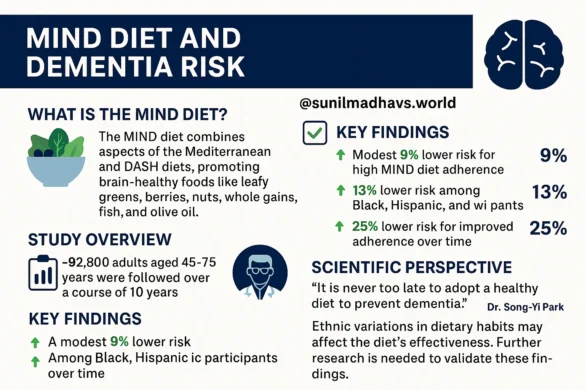
At the 2025 NUTRITION conference in Orlando, researchers presented findings showing that the MIND diet was linked to a 9% to 25% reduced risk for Alzheimer’s disease and related dementias (ADRD). The Multiethnic Cohort Study, which followed 92,849 adults aged 45 to 75, found that people who most closely followed the MIND diet had better brain health outcomes.

  • Over the study period, 21,478 cases of ADRD were identified.
  • Those with the highest adherence to the diet showed a 9% lower risk of developing dementia compared to those with the lowest adherence (Hazard Ratio: 0.91; Confidence Interval: 0.87–0.96).
  • Black, Hispanic, and white participants had an even more notable 13% reduced risk.
  • The strongest protection was seen in individuals who significantly improved their diet over a decade, with a 25% reduction in dementia risk (HR: 0.75; CI: 0.69–0.82).
  • These trends were consistent across age groups, suggesting mid-to-late-life dietary changes can still offer brain health benefits.

According to Dr. Song-Yi Park, associate professor at the University of Hawaii at Manoa, these findings reinforce the idea that it’s never too late to begin eating healthier to protect the brain.

Ethnic Differences in Diet Impact

Interestingly, the benefits were less evident in Asian American and Native Hawaiian participants, hinting that the MIND diet may not fully align with or reflect the protective qualities of traditional ethnic diets. Park emphasized the importance of understanding how cultural dietary patterns might interact with brain health, suggesting that personalized or culturally adapted dietary interventions may be more effective for some populations.


Supporting Research and Broader Context

This study builds on previous research linking the MIND diet to improved cognitive function and a lower risk of mental decline. Although this presentation was based on a conference abstract and not yet peer-reviewed, it strengthens the existing body of evidence suggesting that overall diet quality—rather than individual nutrients—plays a key role in preserving cognitive health.

Other healthy eating patterns such as the Mediterranean, DASH, and Nordic diets have also been associated with a slower rate of cognitive decline. These diets typically:

  • Limit saturated fats and added sugars
  • Prioritize vegetables, whole grains, fruits, and healthy fats
  • Include region-specific beneficial foods, such as olive oil in Mediterranean cultures or fatty fish in Nordic regions.

The U.S. POINTER Study and Upcoming Insights

Complementing this research, the U.S. POINTER study—a two-year clinical trial led by the Alzheimer’s Association—is exploring whether combining healthy diet, physical activity, and other lifestyle interventions can protect cognitive function in older adults at high risk of mental decline. This is the first large-scale U.S. study of its kind in a racially and culturally diverse population, with results expected in July 2025 at the Alzheimer’s Association International Conference (AAIC).


Practical Implications and Public Engagement

As emphasized by Courtney Kloske, PhD, Director of Scientific Engagement at the Alzheimer’s Association, simple lifestyle changes—especially dietary improvements—can play a powerful role in maintaining brain health. The association promotes 10 Healthy Habits for Your Brain, which include balanced nutrition, physical activity, social engagement, and mental stimulation.

For those eager to learn more, the AAIC for All program offers free online access to highlights from the world’s largest dementia science conference, taking place July 31, 2025, in Toronto and virtually.


Funding and Disclosures

This study was funded by the National Cancer Institute and the National Institute on Aging. Dr. Park and co-investigators disclosed no conflicts of interest.

Source link

Related posts:

Elegrobart reduces proptosis in active thyroid eye disease

April 7, 2026

Brepocitinib ‘a major move forward’ as first targeted therapy for dermatomyositis: VALOR

April 2, 2026

Evolocumab cuts heart events in patients with diabetes but no CVD

April 1, 2026
You Might Be Interested In
  • Elegrobart reduces proptosis in active thyroid eye disease
    April 7, 2026
  • Brepocitinib ‘a major move forward’ as first targeted therapy for dermatomyositis: VALOR
    April 2, 2026
0 0 votes
Article Rating
Alzheimer'sDementiaMind diet
(adsbygoogle = window.adsbygoogle || []).push({});
0 comments 0 FacebookTwitterPinterestEmail
Team SunilMadhavs World

Subscribe
Login
Notify of
Save my name, email, and website in this browser cookies for the next time I comment.

Save my name, email, and website in this browser cookies for the next time I comment.

0 Comments
Oldest
Newest Most Voted
Inline Feedbacks
View all comments
previous post
Automated VEST Algorithm: A Leap Forward in PAH Diagnosis
next post
New framework would reclassify many Americans with overweight as having obesity

Related Articles

Elegrobart reduces proptosis in active thyroid eye disease

April 7, 2026

Brepocitinib ‘a major move forward’ as first targeted...

April 2, 2026

Evolocumab cuts heart events in patients with diabetes...

April 1, 2026

New Hope for SMA: FDA Approves Itvisma for...

December 3, 2025

Brepocitinib may emerge as the first targeted treatment...

November 27, 2025

Mediterranean diet could improve psoriasis symptoms

October 13, 2025

Login/Register

New: Instant Back/Forward Navigation

When you opt to “Remember Me”, WordPress will tell your browser to save the state of pages when you navigate away from them. This allows them to be restored instantly when you use the back and forward buttons in your browser.

Google Icon
Login With Google
X Icon
Login With X
Facebook Icon
Login With Facebook

Keep me signed in until I sign out

Forgot your password? Register here

Google Icon
Login With Google
X Icon
Login With X
Facebook Icon
Login With Facebook

Login here

Social Networks

Facebook Twitter Instagram Linkedin Rss

Categories

Popular Posts

  • 1

    Suicide of patient on LVAD therapy sparks wider mental health discussion

    July 4, 2025
  • 2

    Mediterranean diet could improve psoriasis symptoms

    October 13, 2025
  • 3

    WHO in India

    June 18, 2025
  • 4

    TAVR and surgery showed similar results at 7-year follow-up.

    November 27, 2025
  • 5

    Oral drug lowers OSA severity over 6 months

    June 2, 2025

Recent Posts

  • Acupuncture may improve pain, reduce opioid use after THA

    April 29, 2026
  • Denosumab does not raise atypical femur fracture risk

    April 24, 2026
  • Asthma exacerbations drop with medium-dose ICS to biologic switch

    April 13, 2026
  • Hypercortisolism common in patients with resistant hypertension

    April 7, 2026

About SunilMadhavs World

Facebook Twitter Instagram Pinterest Youtube Snapchat
  • Log In
  • About
  • Register
  • Profile
  • My account
  • Edit Account
  • Change Password
  • My Subscriptions
  • chnfo@suni0
  • Support Portal
  • Contact Information
  • Privacy policy
  • GDPR-compliant cookie policy.
  • Terms and conditions
  • Medical Disclaimer

@2019 - All Right Reserved. Designed and Developed by PenciDesign

SunilMadhavs World
  • Home
  • Support Portal
  • My Subscriptions
  • Contact Information
  • About
    • Cardiology
      • Gastroenterology
        • Radiology
          • Pulmonology
            • Gynecology
    • Neurology
  • Urology
    • Hematology
      • Profile
        • Log Out
        • Register
        • Edit Account
        • Change Password
        • GDPR-compliant cookie policy.
          • Terms and conditions
            • Contact Information
  • About
    • Privacy policy
      • BASICS DISCUSS
        • BASICS
          • ANATOMY
            • BASICS PRO
              • ANATOMY PRO
              • BIOCHEMISTRY PRO
              • PHYSIOLOGY
                • BIOCHEMISTRY
                  • PHYSIOLOGY PRO
                    • BASICS RESEARCH
                    • ANATOMY ADVANCEMENTS
                    • BIOCHEMISTRY ADVANCEMENTS
                    • PHYSIOLOGY ADVANCEMENTS
  • Team SunilMadhavs World
  • TOPICS
  • INTERMEDIATE
SunilMadhavs World
  • Home
  • Support Portal
  • My Subscriptions
  • Contact Information
  • About
    • Cardiology
      • Gastroenterology
        • Radiology
          • Pulmonology
            • Gynecology
    • Neurology
  • Urology
    • Hematology
      • Profile
        • Log Out
        • Register
        • Edit Account
        • Change Password
        • GDPR-compliant cookie policy.
          • Terms and conditions
            • Contact Information
  • About
    • Privacy policy
      • BASICS DISCUSS
        • BASICS
          • ANATOMY
            • BASICS PRO
              • ANATOMY PRO
              • BIOCHEMISTRY PRO
              • PHYSIOLOGY
                • BIOCHEMISTRY
                  • PHYSIOLOGY PRO
                    • BASICS RESEARCH
                    • ANATOMY ADVANCEMENTS
                    • BIOCHEMISTRY ADVANCEMENTS
                    • PHYSIOLOGY ADVANCEMENTS
  • Team SunilMadhavs World
  • TOPICS
  • INTERMEDIATE
@2019 - All Right Reserved. Designed and Developed by PenciDesign

Shopping Cart

Close

No products in the cart.

Close
wpDiscuz