
Top Posts
Denosumab does not raise atypical femur fracture risk
Asthma exacerbations drop with medium-dose ICS to biologic...
Hypercortisolism common in patients with resistant hypertension
Elegrobart reduces proptosis in active thyroid eye disease
Brepocitinib โ€˜a major move forwardโ€™ as first targeted...
Posts about celeb-owned alcohol brands reach most underage...
Evolocumab cuts heart events in patients with diabetes...
Extended use of AUD medications cut mortality risk...
Zongertinib a โ€˜breakthroughโ€™ for NSCLC with HER2 mutations
Biomarker panel distinguishes alcohol vs. metabolic liver disease
SunilMadhavs World
  • Home
  • Support Portal
  • My Subscriptions
  • Contact Information
  • About
    • Cardiology
      • Gastroenterology
        • Radiology
          • Pulmonology
            • Gynecology
    • Neurology
  • Urology
    • Hematology
      • Profile
        • Log Out
        • Register
        • Edit Account
        • Change Password
        • GDPR-compliant cookie policy.
          • Terms and conditions
            • Contact Information
  • About
    • Privacy policy
      • BASICS DISCUSS
        • BASICS
          • ANATOMY
            • BASICS PRO
              • ANATOMY PRO
              • BIOCHEMISTRY PRO
              • PHYSIOLOGY
                • BIOCHEMISTRY
                  • PHYSIOLOGY PRO
                    • BASICS RESEARCH
                    • ANATOMY ADVANCEMENTS
                    • BIOCHEMISTRY ADVANCEMENTS
                    • PHYSIOLOGY ADVANCEMENTS
  • Team SunilMadhavs World
  • TOPICS
  • INTERMEDIATE
  • 0
Home ยป Denosumab does not raise atypical femur fracture risk
ORTHOPEDICSPHARMACOLOGY

Denosumab does not raise atypical femur fracture risk

by Team SunilMadhavs World April 24, 2026
A+A-
Reset
3

Interactive Data Explorer: Denosumab vs. Bisphosphonates

Osteoporosis Therapy Safety Comparison
Denosumab vs. Bisphosphonates (U.K. Population Study)
Bisphosphonates (1st Line) 161,839 Patients
Denosumab (Prolia) 2,310 Patients
Clinical Context: Denosumab is frequently utilized as a second-line therapy for patients who fail or are intolerant to bisphosphonates. Adjusting for this prior exposure is critical for accurate risk assessment.
0.82
Bisphosphonates
0.89
Denosumab
Subtrochanteric & Diaphyseal Femur Fractures
(Incidence per 1,000 person-years)
0.94
Adjusted Hazard Ratio
95% Confidence Interval: 0.62 – 1.43
1.0 (No Difference)
0.62
1.43
Not Statistically Significant: Because the confidence interval crosses 1.0, there is no evidence of an increased risk of atypical femur fractures associated with Denosumab compared to Bisphosphonates.
@sunilmadhavs.world

Denosumab Does Not Elevate Atypical Femur Fracture Risk Relative to Bisphosphonates in Real-World Study

The long-term administration of bisphosphonatesโ€”a widely utilized first-line pharmacological therapy for osteoporosis managementโ€”has been definitively correlated with a rare but profoundly morbid complication: atypical femur fractures (AFF). These subtrochanteric and diaphyseal fractures are characterized by significantly delayed union and considerable patient morbidity. Haolan Qi, MD, MSc, an epidemiology master’s student at McGill University, elaborated on the clinical response to this adverse event during a presentation at the American Association of Clinical Endocrinology Annual Scientific and Clinical Conference in Las Vegas:

โ€œTo mitigate this risk, a drug holiday was introduced for bisphosphonate treatment. Denosumab is another potent antiresorptive agent, but unlike bisphosphonates, denosumab is not retained in the bone matrix and does not exert residual activity after discontinuation. Its effects are highly reversible, and treatment cessation leads to a rebound phenomenon, where bone density rapidly drops and vertebral fracture risk spikes. Therefore, denosumab is technically administered without a drug holiday. Since it is also antiresorptive, there are concerns that it might also increase atypical femur fracture risk.โ€

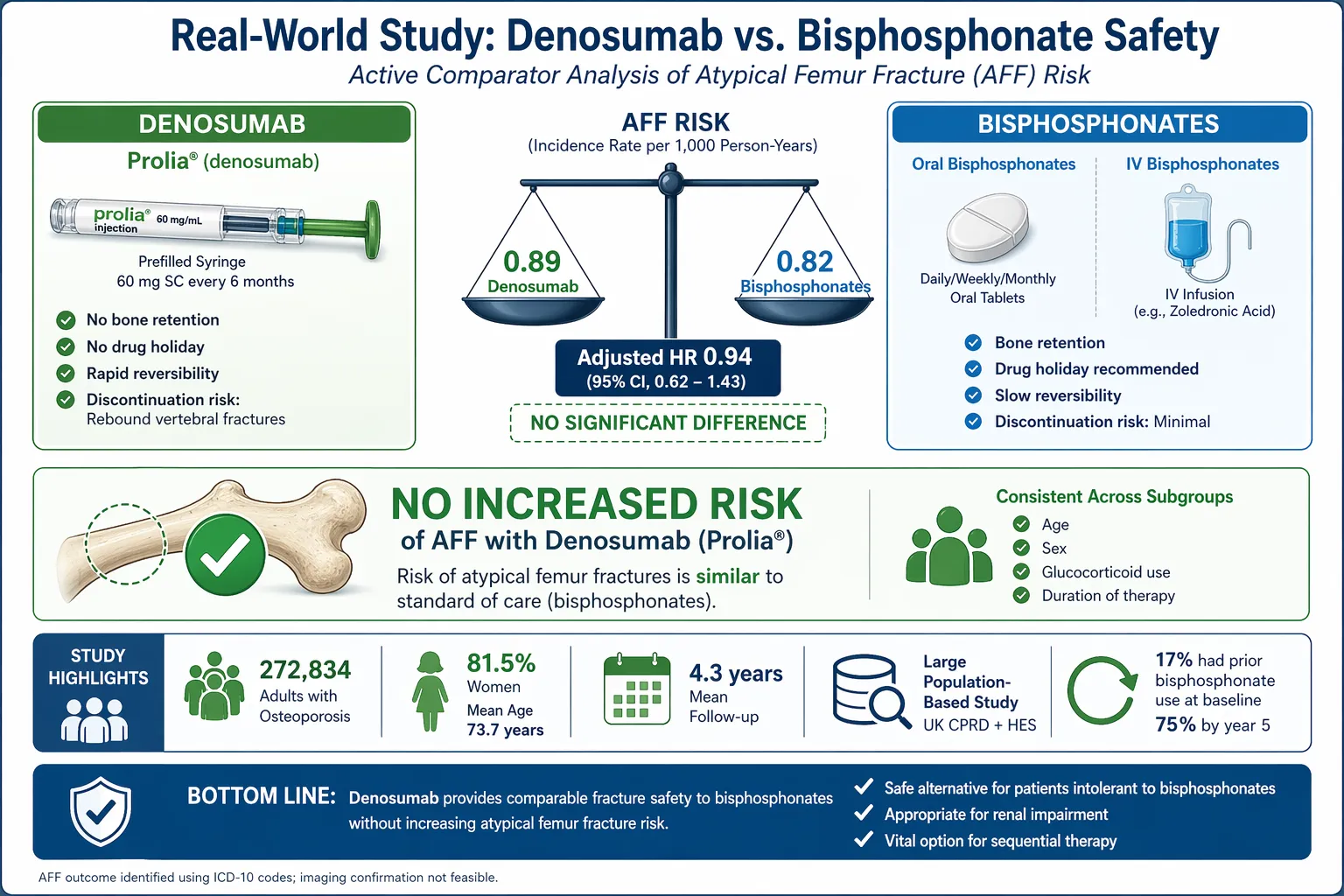
To address this crucial safety concern, investigators conducted a large-scale, population-based active comparator study utilizing the U.K. Clinical Practice Research Datalink linked to Hospital Episode Statistics.

ย 

Study Design and Participant Demographics

The retrospective cohort study evaluated 272,834 adults diagnosed with osteoporosis. Participants with a documented history of atypical femur fractures or high-trauma fractures were rigorously excluded from the analysis. The cohort was predominantly female (81.5%) with a mean age of 73.7 years.

Participants were categorized into four distinct exposure groups: denosumab, bisphosphonates, alternative active therapies, and a supplement-only control group. The researchers employed multivariable models to adjust for critical covariates, including age, sex, race, body mass index (BMI), clinical comorbidity status, prior history of fracture, and historical bisphosphonate utilization (>5 years prior).

Table 1: Osteoporosis Treatment Exposure Cohorts

Treatment Group Number of Patients (N) Percentage of Total Cohort
Bisphosphonates (First-line) 161,839 59.3%
Calcium/Vitamin D Supplements Only 108,408 39.7%
Denosumab (Prolia, Amgen) 2,310 0.8%
Other Osteoporosis Therapies* 277 0.1%
Total Analyzed Cohort 272,834 100%

*Includes calcitonin, teriparatide, abaloparatide, and romosozumab.

Regarding baseline differences between the primary comparison groups, Dr. Qi noted, โ€œCompared to bisphosphonate users, denosumab users were generally older and had a higher prevalence of renal insufficiency and flare fractures. We accounted for these differences in our adjusted models.โ€

ย 

Methodological Approach to Fracture Identification

The primary clinical outcome was the incidence of subtrochanteric and diaphyseal femur fractures. Because this was an analysis of administrative data, identifying true AFF events required a methodological proxy.

โ€œTo diagnose atypical femur fractures, according to the gold standard established by the American Society of Bone and Mineral Research, a blind review of X-ray images with radiographic features such as transverse fracture line, cortical thickening, etc, is required,โ€ Qi explained. โ€œTo extract and review individual X-ray images is not feasible within an administrative dataset. So, we used ICD-10 codes for subtrochanteric and diaphyseal femur fractures as proxies for atypical femur fractures.โ€

Clinical Outcomes and Risk Assessment

Over a mean follow-up duration of 4.3 years, the study recorded a total of 662 subtrochanteric and diaphyseal femur fracture events across the entire cohort, yielding an overall incidence rate of 0.8 per 1,000 person-years.

When comparing the two primary antiresorptive therapies, the incidence rates were remarkably similar, and the adjusted hazard ratio indicated no statistically significant difference in fracture risk.

Table 2: Incidence and Relative Risk of Subtrochanteric/Diaphyseal Femur Fractures

Outcome Metric Denosumab Users Bisphosphonate Users
Total Fracture Events 24 397
Incidence Rate (per 1,000 person-years) 0.89 0.82
Adjusted Hazard Ratio (HR) 0.94 (Reference Group)
95% Confidence Interval (CI) 0.62 – 1.43 N/A

The researchers emphasized that these findings remained consistent and did not vary significantly when stratified by patient age, sex, concomitant history of glucocorticoid use, or the total duration of the osteoporosis therapy.

The Impact of Sequential Therapy

A critical nuance in analyzing real-world pharmacological data in osteoporosis is the sequential nature of treatment. Dr. Qi highlighted the substantial crossover effect observed during the study period: at baseline, only 17% of denosumab users had prior exposure to bisphosphonates; however, by the 5-year mark, this figure had surged to 75%.

โ€œThis reflects the real-world sequence of osteoporotic management,โ€ stated Dr. Qi. โ€œDenosumab is often prescribed as a second-line therapy. Many patients who fail or who are intolerant of bisphosphonates transition to denosumab. Therefore, adjusting for prior bisphosphonate use was very crucial to estimate the true effect of denosumab.โ€

To validate their primary findings against this confounding factor, the research team conducted a rigorous sensitivity analysis that explicitly excluded patients with prior bisphosphonate utilization. This secondary analysis confirmed the primary results: prolonged denosumab therapy did not independently elevate the risk of atypical femoral fractures when compared to bisphosphonate therapy.

Conclusion

The findings from this large administrative dataset provide substantial reassurance regarding the long-term safety profile of denosumab.

โ€œWe found a reassuring safety profile, with no evidence of an increased risk associated with denosumab use in a real-world setting,โ€ Qi concluded. โ€œClinically, these results should be reassuring and support the use of denosumab as a vital therapy option for osteoporosis, with a risk profile similar to the standard of care.โ€

ย 

Source link

Related posts:

Asthma exacerbations drop with medium-dose ICS to biologic switch

April 9, 2026

New Hope for SMA: FDA Approves Itvisma for Ages 2+

December 3, 2025

Although rare, GLP-1s tied to higher risk for eye complications

August 28, 2025
You Might Be Interested In
  • Standardized protocol for PJI may lead to better outcomes
    August 22, 2025
0 0 votes
Article Rating
bisphosphonatesDenosumabosteoporosis
(adsbygoogle = window.adsbygoogle || []).push({});
0 comments 0 FacebookTwitterPinterestEmail
Team SunilMadhavs World

Subscribe
Login
Notify of
Save my name, email, and website in this browser cookies for the next time I comment.

Save my name, email, and website in this browser cookies for the next time I comment.

0 Comments
Oldest
Newest Most Voted
Inline Feedbacks
View all comments
previous post
Asthma exacerbations drop with medium-dose ICS to biologic switch

Related Articles

Standardized protocol for PJI may lead to better...

August 22, 2025

Login/Register

New: Instant Back/Forward Navigation

When you opt to โ€œRemember Meโ€, WordPress will tell your browser to save the state of pages when you navigate away from them. This allows them to be restored instantly when you use the back and forward buttons in your browser.

Google Icon
Login With Google
X Icon
Login With X
Facebook Icon
Login With Facebook

Keep me signed in until I sign out

Forgot your password? Register here

Google Icon
Login With Google
X Icon
Login With X
Facebook Icon
Login With Facebook

Login here

Social Networks

Facebook Twitter Instagram Linkedin Rss

Categories

Popular Posts

  • 1

    Suicide of patient on LVAD therapy sparks wider mental health discussion

    July 4, 2025
  • 2

    Mediterranean diet could improve psoriasis symptoms

    October 13, 2025
  • 3

    WHO in India

    June 18, 2025
  • 4

    TAVR and surgery showed similar results at 7-year follow-up.

    November 27, 2025
  • 5

    Oral drug lowers OSA severity over 6 months

    June 2, 2025

Recent Posts

  • Denosumab does not raise atypical femur fracture risk

    April 24, 2026
  • Asthma exacerbations drop with medium-dose ICS to biologic switch

    April 13, 2026
  • Hypercortisolism common in patients with resistant hypertension

    April 7, 2026
  • Elegrobart reduces proptosis in active thyroid eye disease

    April 7, 2026

About SunilMadhavs World

Facebook Twitter Instagram Pinterest Youtube Snapchat
  • Log In
  • About
  • Register
  • Profile
  • My account
  • Edit Account
  • Change Password
  • My Subscriptions
  • chnfo@suni0
  • Support Portal
  • Contact Information
  • Privacy policy
  • GDPR-compliant cookie policy.
  • Terms and conditions
  • Medical Disclaimer

@2019 - All Right Reserved. Designed and Developed by PenciDesign

SunilMadhavs World
  • Home
  • Support Portal
  • My Subscriptions
  • Contact Information
  • About
    • Cardiology
      • Gastroenterology
        • Radiology
          • Pulmonology
            • Gynecology
    • Neurology
  • Urology
    • Hematology
      • Profile
        • Log Out
        • Register
        • Edit Account
        • Change Password
        • GDPR-compliant cookie policy.
          • Terms and conditions
            • Contact Information
  • About
    • Privacy policy
      • BASICS DISCUSS
        • BASICS
          • ANATOMY
            • BASICS PRO
              • ANATOMY PRO
              • BIOCHEMISTRY PRO
              • PHYSIOLOGY
                • BIOCHEMISTRY
                  • PHYSIOLOGY PRO
                    • BASICS RESEARCH
                    • ANATOMY ADVANCEMENTS
                    • BIOCHEMISTRY ADVANCEMENTS
                    • PHYSIOLOGY ADVANCEMENTS
  • Team SunilMadhavs World
  • TOPICS
  • INTERMEDIATE
SunilMadhavs World
  • Home
  • Support Portal
  • My Subscriptions
  • Contact Information
  • About
    • Cardiology
      • Gastroenterology
        • Radiology
          • Pulmonology
            • Gynecology
    • Neurology
  • Urology
    • Hematology
      • Profile
        • Log Out
        • Register
        • Edit Account
        • Change Password
        • GDPR-compliant cookie policy.
          • Terms and conditions
            • Contact Information
  • About
    • Privacy policy
      • BASICS DISCUSS
        • BASICS
          • ANATOMY
            • BASICS PRO
              • ANATOMY PRO
              • BIOCHEMISTRY PRO
              • PHYSIOLOGY
                • BIOCHEMISTRY
                  • PHYSIOLOGY PRO
                    • BASICS RESEARCH
                    • ANATOMY ADVANCEMENTS
                    • BIOCHEMISTRY ADVANCEMENTS
                    • PHYSIOLOGY ADVANCEMENTS
  • Team SunilMadhavs World
  • TOPICS
  • INTERMEDIATE
@2019 - All Right Reserved. Designed and Developed by PenciDesign

Shopping Cart

Close

No products in the cart.

Close
wpDiscuz