249
Clinical Trial Overview: The STAREE Trial
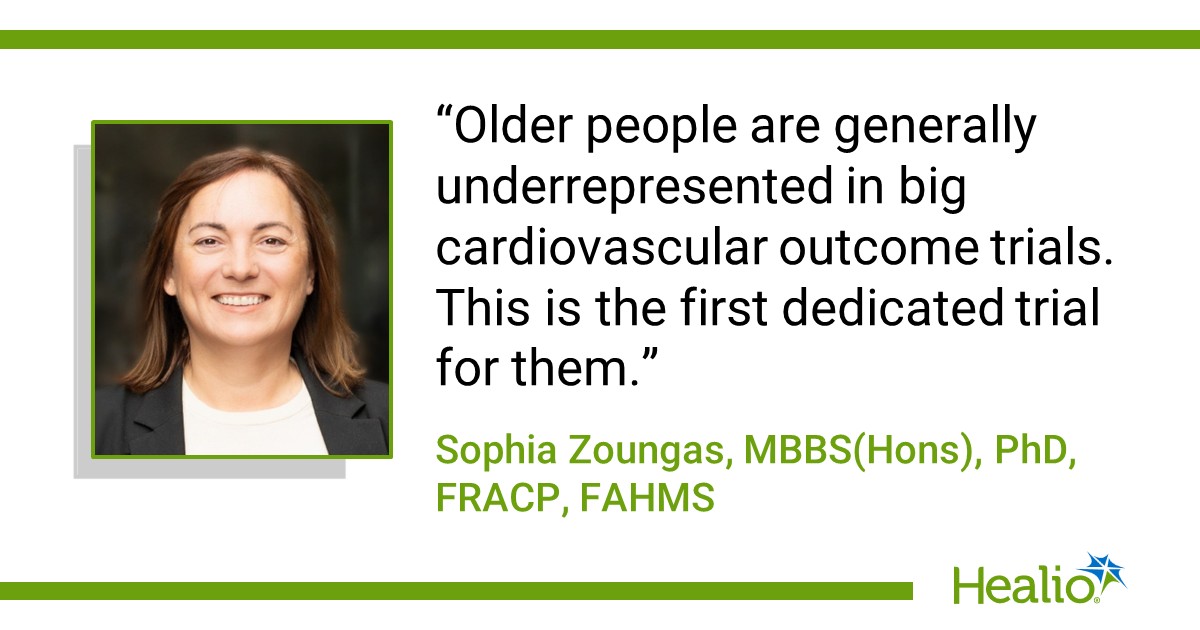
Presented at the European Society of Cardiology Congress and simultaneously published in The New England Journal of Medicine, the STAREE trial evaluated the efficacy and safety of statin therapy for primary cardiovascular prevention in older adults. Led by Sophia Zoungas, MBBS(Hons), PhD, FRACP, FAHMS, executive director of The George Institute for Global Health Australia, the study addressed a critical evidentiary gap, noting that older individuals—particularly those aged 75 and older—have historically been underrepresented in major cardiovascular outcome trials.
Highlighting the background and importance of the trial, Dr. Zoungas stated:
“STAREE is an important trial because older people have questioned the evidence to date. Older people are generally underrepresented in big cardiovascular outcome trials. This is the first dedicated trial for them. We have been able to rigorously examine not only the efficacy of statin therapy, but also safety.”
Trial Design and Participant Cohort
The trial enrolled 9,971 older adults with a mean age of 75 years ($51.9\%$ women) who had no prior history of cardiovascular disease, diabetes, or dementia at baseline. Participants were randomized to receive either atorvastatin $40\text{ mg}$ once daily ($n = 4,984$) or matching placebo ($n = 4,987$).
The study evaluated two primary co-endpoints:
- A composite cardiovascular endpoint comprising cardiovascular death, myocardial infarction, stroke, and coronary revascularization.
- Disability-free survival, defined as survival free of dementia and persistent major physical disability.
Key Results and Clinical Metrics
Over an average follow-up of 6 years, primary cardiovascular events occurred in 297 participants in the statin group compared with 412 participants in the placebo group ($\text{HR} = 0.7$; $95\%$ CI, $0.61–0.82$; $P < .001$), yielding a number needed to treat (NNT) of 37 to prevent a major cardiovascular event. Conversely, primary endpoint events related to disability-free survival occurred in 637 statin participants and 676 placebo participants ($\text{HR} = 0.94$; $95\%$ CI, $0.84–1.05$; $P = .025$).
| Endpoint / Clinical Parameter | Atorvastatin 40 mg Group (n=4,984) | Placebo Group (n=4,987) | Statistical Measure & Effect |
| Mean Cohort Age | 75 years ($51.9\%$ women) | 75 years ($51.9\%$ women) | Baseline characteristic |
| Primary CV Events (Composite) | 297 participants | 412 participants | $\text{HR} = 0.7$ ($95\%$ CI, $0.61–0.82$; $P < .001$) |
| Number Needed to Treat (NNT) | 37 (to prevent 1 CV event) | N/A | Over 6-year average follow-up |
| Disability-Free Survival Events | 637 participants | 676 participants | $\text{HR} = 0.94$ ($95\%$ CI, $0.84–1.05$; $P = .025$) |
| Safety & Tolerability Profile | Increased musculoskeletal, hepatobiliary, & diabetes events (mostly mild) | Lower incidence of specific metabolic events | No overall increase in disability or dementia |
Addressing the safety profile and the implications for cognitive and physical health, Dr. Zoungas noted:
“What is important to note here is that there was no harm and this was an outcome that is actually assessing risk-benefit balance. If the side effects were, as some were proposing, substantial in an older population, we would have seen an increase in disability and dementia. Post-marketing surveillance suggests that there are memory problems associated with statin use. We showed that statins were safe.”
She further emphasized the potential impact on clinical practice guidelines:
“The $30\%$ reduction in LDL cholesterol is consistent with the treatment effect on major cardiovascular events. We hope that, now that we have this definitive evidence, clinical guidelines will be able to change … and that older people will be comfortable to go and see their usual doctor and have that conversation about their cardiovascular health.”
Expert Commentary and Clinical Perspectives
Discussing the broader clinical impact, François Mach, MD, FESC, of Geneva University Hospital, stated that the findings clarify the risk-benefit balance for individuals aged 70 and older. Dr. Mach remarked:
“Should STAREE results change our clinical practice? Yes. Older age should no longer be used as a reason to withhold statin therapy for primary prevention. National and international guidelines must be adapted accordingly.”
However, Dr. Mach added a note of individualized caution:
“The treatment decision should integrate life expectancy, concomitant risk, treatment burden and patient priorities. The important questions now are which older adults should we treat, and for how long? Does preventing an event give them a more meaningful life?”
Providing an American Heart Association perspective, Manesh R. Patel, MD, FACC, FAHA, FSCAI, of Duke University School of Medicine, observed:
“The STAREE study asks important questions: In patients older than age 70 with no known CVD, diabetes or dementia, does reducing cholesterol with atorvastatin improve CV outcomes, and does it improve survival, disability or dementia? The study shows that statin therapy did reduce CV events, even in this older population at 6 years, by an important amount, $30\%$. In addition, there were no between-group differences in survival, disability or dementia. This is an important message that many people ask about.”
Zero-CLS Interactive Widget Code for WordPress (Soledad Theme)
To prevent Cumulative Layout Shift (CLS) on WordPress sites using the Soledad theme, the widget container below enforces strict dimensional boundaries and CSS containment (
contain: layout size style).HTML
<div class="staree-trial-widget-wrapper" style="contain: layout size style; min-height: 440px; width: 100%; box-sizing: border-box;">
  <div id="stareeCalculator" class="soledad-custom-widget" style="background: #ffffff; border: 1px solid #dcdcdc; padding: 24px; border-radius: 8px; box-shadow: 0 4px 6px rgba(0,0,0,0.02);">
    <h3 style="margin-top: 0; font-size: 18px; color: #111; font-weight: 700;">STAREE Trial CV Event Risk Estimator</h3>
    <p style="font-size: 14px; color: #555; line-height: 1.5;">Simulate absolute risk reduction and projected major adverse cardiovascular events in older adult cohorts over a 6-year period based on STAREE trial hazard ratios.</p>

    <div style="margin-bottom: 15px;">
      <label for="stareeCohortInput" style="display: block; font-weight: 600; font-size: 13px; color: #333; margin-bottom: 6px;">Total Older Adult Patient Cohort (Age $\ge 70$):</label>
      <input type="number" id="stareeCohortInput" value="1000" style="width: 100%; padding: 10px; box-sizing: border-box; border: 1px solid #ccc; border-radius: 4px; font-size: 14px;" />
    </div>

    <button onclick="calculateStareeOutcomes()" style="background: #0056b3; color: #fff; border: none; padding: 10px 18px; border-radius: 4px; cursor: pointer; font-weight: 600; font-size: 14px;">Calculate Projected Outcomes</button>

    <div id="stareeWidgetOutput" style="margin-top: 20px; font-size: 14px; color: #222; min-height: 60px; line-height: 1.6;">
      <em>Enter a patient population size above to estimate cardiovascular event reductions.</em>
    </div>
  </div>
</div>

<script>
function calculateStareeOutcomes() {
  const cohort = parseInt(document.getElementById('stareeCohortInput').value) || 0;
  // Based on trial control event rate roughly ~8.26% over 6 years (412/4987) and 30% RRR (HR 0.7)
  const baselineEvents = Math.round(cohort * 0.0826);
  const statinEvents = Math.round(baselineEvents * 0.70);
  const eventsPrevented = baselineEvents - statinEvents;

  document.getElementById('stareeWidgetOutput').innerHTML = `
    <strong>Projected Outcomes for Cohort of ${cohort} (6-Year Horizon):</strong><br>
    • Estimated Events with Placebo (Standard Care): <strong>~${baselineEvents} patients</strong><br>
    • Estimated Events with Atorvastatin $40\text{ mg}$: <strong>~${statinEvents} patients</strong><br>
    • Major CV Events Prevented: <strong>~${eventsPrevented} patients</strong>
  `;
}
</script>
Zero-CLS Clinical Trial Summary HTML Code
HTML
<div class="clinical-trial-summary-container" style="contain: layout size style; min-height: 340px; width: 100%; font-family: inherit; border-left: 4px solid #0056b3; background: #fafafa; padding: 22px; box-shadow: 0 2px 5px rgba(0,0,0,0.04); box-sizing: border-box;">
  <h4 style="margin: 0 0 12px 0; font-size: 18px; color: #1a1a1a; font-weight: 700;">Clinical Trial Summary: The STAREE Trial</h4>
  <ul style="margin: 0; padding-left: 20px; font-size: 14px; color: #333; line-height: 1.7;">
    <li><strong>Trial Design:</strong> Large-scale, dedicated primary prevention randomized trial in older adults.</li>
    <li><strong>Participant Cohort:</strong> 9,971 older adults (mean age 75 years) without prior CVD, diabetes, or dementia.</li>
    <li><strong>Intervention:</strong> Atorvastatin $40\text{ mg}$ daily vs. matching placebo over an average follow-up of 6 years.</li>
    <li><strong>Primary Cardiovascular Endpoint:</strong> 30% relative reduction in major adverse cardiovascular events ($\text{HR} = 0.7$; $95\%$ CI, $0.61–0.82$; $P < .001$; NNT = 37).</li>
    <li><strong>Disability-Free Survival Endpoint:</strong> No significant difference in disability-free survival ($\text{HR} = 0.94$; $P = .025$), confirming statin safety without increasing dementia or physical disability.</li>
  </ul>
</div>