68
Headline
Multicenter Observational Study Identifies Significant Increase in Nail Alterations and Inflammatory Scalp Hair Loss Associated With GLP-1 Receptor Agonist Therapy
1-minute summary
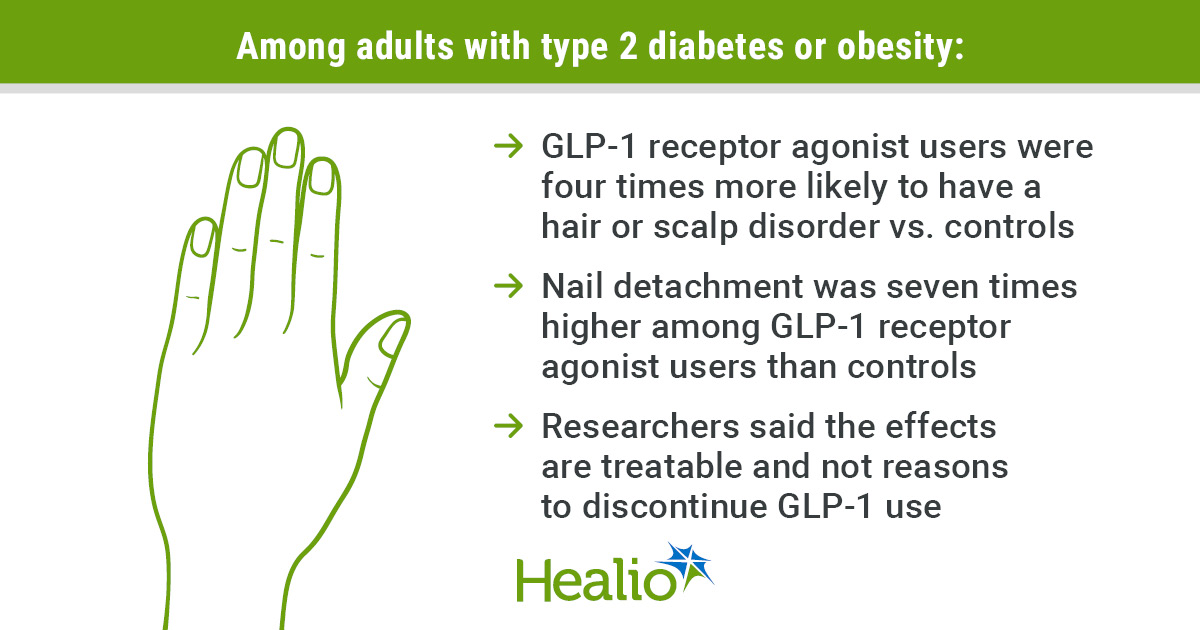
In a multinational comparative study presented at the European Academy of Dermatology and Venerology (EADV) Congress, researchers observed that individuals receiving glucagon-like peptide-1 (GLP-1) receptor agonists experienced significantly higher frequencies of nail abnormalities and hair loss compared with matched control patients with obesity and/or type 2 diabetes. Nail detachment was nearly seven times more frequent among GLP-1 users, and over 66% reported at least one nail condition over a 3-month observation window. Furthermore, hair loss in this cohort was predominantly paired with scalp erythema, pruritus, or scaling, pointing toward an inflammatory etiology beyond classical telogen effluvium. Clinicians are advised to perform baseline cutaneous examinations and investigate treatable inflammatory or nutritional causes while discouraging patients from discontinuing GLP-1 therapy prematurely.
Why this matters
With millions of patients initiating GLP-1 receptor agonists worldwide for obesity and glycemic control, cutaneous side effects have become a major factor in treatment adherence. Although diffuse hair loss has been previously characterized as a physiological stress response to rapid weight reduction (telogen effluvium), novel nail abnormalities—such as onycholysis and dyschromia—and concurrent scalp inflammation suggest alternate biological mechanisms, including potential direct pharmacological effects or localized nutrient depletion within rapidly dividing keratinized structures. Unmanaged dermatologic changes often drive self-discontinuation of cardiometabolically essential therapies; identifying recognizable, treatable manifestations allows clinicians to mitigate distress and sustain adherence.
Study at a glance
| Feature | Details |
| Study type | Cross-sectional observational comparative study |
| Participants | 1,904 adults with type 2 diabetes and/or obesity (BMI $\ge$ 30 kg/m²) from Brazil, France, Mexico, and the United States |
| Intervention | GLP-1 receptor agonist therapy ($n = 575$; mean exposure: 18.5 months) |
| Comparator | Unexposed control cohort with type 2 diabetes and/or obesity ($n = 1,329$) |
| Primary outcome | Prevalence of hair/scalp abnormalities and nail disorders over a 3-month evaluation window |
| Main finding | GLP-1 agonist users had significantly elevated odds of nail detachment (OR, 6.84), dyschromia (OR, 4.09), new-onset hair loss (OR, 2.67), and scalp erythema (OR, 3.05) |
| Follow-up | Retrospective evaluation window of 3 months for acute changes; mean GLP-1 duration was 18.5 months |
What the researchers found
Investigators evaluated dermatologic presentations across GLP-1 receptor agonist recipients versus unexposed controls. Weight reduction over the 3-month window was reported by 76.3% of GLP-1 users compared to 47.3% of controls ($P < .001$). Overall, 66.0% or more of GLP-1 users noted $\ge$1 nail disorder versus 52.8% of controls ($P < .001$).
As investigator Charles Taïeb, MD, noted:
“Until now, nail changes associated with the use of GLP-1 receptor agonists had essentially been anecdotal and isolated to a handful of adverse event reports. But we found a strong and consistent nail signal in this study.”
Comparative Nail and Scalp Outcomes
| Clinical Manifestation | GLP-1 Users (n=575) | Controls (n=1,329) | Odds Ratio (95% CI) | P Value |
| Any Nail Disorder | >66% | 52.8% | — | <.001 |
| Nail Detachment | 39.3% | 8.7% | 6.84 (5.30–8.81) | <.001 |
| Nail Dyschromia | 45.6% | 17.0% | 4.09 (3.29–5.08) | <.001 |
| Onycholysis | 49.2% | 29.7% | 2.29 (1.87–2.80) | <.001 |
| Ridges or Grooves | 46.8% | 31.8% | 1.89 (1.55–2.31) | <.001 |
| Nail Fragility | 58.3% | 51.1% | 1.34 (1.09–1.65) | .005 |
| Hair / Scalp Involvement | 50.4% | 33.5% | 4.49 (3.62–5.56) | <.001 |
| Loss of Hair Volume/Density | 42.4% | 19.3% | 3.23 (2.61–4.00) | <.001 |
| Scalp Erythema | Elevated | Baseline | 3.05 (2.34–3.99) | <.001 |
| New-Onset Hair Loss | 26.1% | 11.6% | 2.67 (2.03–3.50) | <.001 |
Crucially, these disparities were not explained solely by catabolic weight shifts:
“What surprised us most is that these differences persisted when we looked only at participants who had lost weight, suggesting that weight loss alone does not seem to account for them. And these controls were not drawn from the general population but from people with type 2 diabetes and/or obesity who had never taken the drugs, so the two groups share the metabolic background.”
Even following adjustment for pre-existing dermatologic diagnoses and nutritional deficits, nail detachment and discoloration remained approximately 2 to 3 times more frequent in the GLP-1 exposed cohort.
Clinical significance
These findings suggest a multi-factorial pathophysiology beyond classic weight-loss telogen effluvium:
- The Keratinized Matrix Hypothesis: Taïeb stated, “Our working hypothesis is that the nail matrix, like the hair follicle, is a rapidly renewing keratinized structure and may be sensitive to the same metabolic and nutritional changes that accompany these treatments, possibly with a direct effect of the drug on top. Which of these contributions dominates, and whether the changes are reversible, is exactly what our planned prospective study is designed to answer.”
- Inflammatory Scalp Involvement: Rather than isolated non-inflammatory shedding, the vast majority of hair loss cases coincided with scalp pruritus, scaling, and erythema:“The classical explanation, telogen effluvium after rapid weight loss, does not predict an inflamed scalp. So, our hypothesis is that an inflammatory component is involved, in addition to the shedding linked to weight loss. Scalp inflammation was the rule rather than the exception, which clinicians do not currently look for and which may be treatable.”
Limitations
- Study Design: The cross-sectional, observational methodology cannot demonstrate definitive direct causation between GLP-1 receptor agonists and nail/hair pathology.
- Pre-existing Burden: Approximately 50% of GLP-1 users reported pre-existing nail abnormalities prior to initiating medication, confounding the absolute baseline risk.
- Assessment Methodology: Data relied in part on participant reporting across international centers rather than blinded, standardized, sequential dermoscopic scoring or trichoscopy.
- Lack of Longitudinal Reversibility Data: The study does not establish the definitive time course of symptom onset or demonstrate whether abnormalities spontaneously resolve upon weight stabilization or dose cessation.
What doctors should know
- Perform Baseline and Follow-up Inspections: Taïeb emphasized: “Ask about hair, scalp and nails before starting a GLP-1 receptor agonist and during follow-up and examine them. Look for treatable contributors, including pre-existing dermatological conditions and nutritional deficiencies, and keep in mind that not everything that happens during GLP-1 treatment is necessarily caused by the treatment itself.”
- Actively Inspect for Scalp Dermatitis: Because scalp inflammation was common, evaluate patients presenting with shedding for seborrheic dermatitis, eczematous inflammation, or contact dermatitis, which are medically actionable.
- Counsel Patients Against Unilateral Discontinuation: Cosmetic changes can trigger self-directed cessation of vital cardiometabolic therapies:“The message we want to pass on is awareness rather than alarm: These changes are frequent, usually benign and are not a reason to discontinue therapy on one’s own initiative. Anyone who notices them should mention it to their doctor.”
Bottom line
GLP-1 receptor agonists are associated with significantly increased rates of nail detachment, discoloration, and inflammatory scalp hair loss compared with metabolically matched controls. These alterations appear independent of weight loss alone, warranting proactive clinical examination and reassurance to prevent unguided treatment cessation.
Original research / DOI
- Source: Piraccini BM, et al. Abstract AS-1799. Presented at: European Academy of Dermatology and Venerology (EADV) Congress; September 30–October 3, 2026; Vienna, Austria.