
Frailty Predicts Dementia, Disability and Loss of Independence in Older Adults With Arthritis
1-minute summary
Frailty was independently associated with an increased risk of dementia, physical disability and loss of independence among older adults living with arthritis, according to a 13-year analysis of data from the National Health and Aging Trends Study (NHATS), presented at ACR Convergence 2026.
Among 4,184 adults aged 65 years or older with physician-diagnosed arthritis, frailty was associated with approximately 2.8 times the risk of developing basic activities of daily living (ADL) disability and mobility disability compared with being robust. Frailty was also associated with increased risks of instrumental ADL disability, loss of independence and composite dementia.
The findings highlight the potential value of routine frailty screening in rheumatology practice, including identifying patients who are pre-frail and may benefit from early preventive interventions.
Why this matters
Arthritis is a common chronic condition among older adults and can contribute to pain, inflammation, reduced physical activity and physical deconditioning. These features overlap with several components of frailty, potentially increasing vulnerability to adverse health outcomes.
Frailty is clinically important because it extends beyond joint symptoms and disease activity. It can affect a patient’s ability to walk, perform everyday activities, maintain independence and preserve cognitive function.
Namrata Singh, MD, MSCI, FACP, associate professor in the Division of Rheumatology and fellowship program associate director at the University of Washington Medical Center, explained that arthritis and frailty “share a lot of ground.”
She noted: “Both include pain, inflammation, deconditioning and reduced physical activity.”
Although rheumatologists routinely assess joint symptoms, disease activity and pain, Singh emphasized the importance of considering broader functional outcomes.
“In rheumatology, we focus closely on joints, disease activity and pain. But for many older patients, what matters most is whether they stay independent, stay mobile and stay cognitively well,” she said.
The study addresses an important evidence gap: whether frailty predicts the development of specific geriatric syndromes among people with arthritis over an extended period.
Study at a glance
| Feature | Details |
|---|---|
| Study type | Longitudinal observational cohort analysis |
| Data source | National Health and Aging Trends Study (NHATS) |
| Study period | 2011–2024 |
| Participants | 4,184 adults aged 65 years or older with physician-diagnosed arthritis |
| Population represented | Approximately 18.7 million older Americans, according to the investigators |
| Frailty assessment | Fried frailty phenotype |
| Comparison groups | Robust, pre-frail and frail |
| Comparator | Robust participants with arthritis |
| Outcomes assessed | Composite dementia, ADL disability, IADL disability, mobility disability and loss of independence |
| Main finding | Frailty was associated with significantly higher risks across all five outcomes |
| Follow-up | Up to 13 years |
| Presentation | ACR Convergence 2026, Abstract 2928 |
How was frailty defined?
The investigators classified participants using the Fried frailty phenotype. Participants were categorized according to the number of frailty criteria they met.
| Frailty category | Number of criteria met |
|---|---|
| Robust | 0 |
| Pre-frail | 1–2 |
| Frail | 3 or more |
Physical frailty was described in the report using features such as:
- Unintentional weight loss
- Exhaustion
- Slow walking speed
- Weak grip strength
- Low physical activity
Participants had to have physician-diagnosed arthritis at baseline in 2011 and a valid Fried frailty phenotype assessment.
What the researchers found
The analysis included 4,184 older adults with arthritis. The investigators followed participants who did not have the respective outcome at baseline to determine whether they subsequently developed dementia, disability or loss of independence.
Compared with robust participants, frail participants had significantly higher risks of developing all five geriatric outcomes assessed.
Risk of adverse outcomes associated with frailty
| Outcome | Hazard ratio (HR) | 95% CI | Interpretation |
|---|---|---|---|
| ADL disability | 2.79 | 2.31–3.39 | Nearly 2.8 times the risk |
| Mobility disability | 2.78 | 2.31–3.36 | Nearly 2.8 times the risk |
| Loss of independence | 2.31 | 1.94–2.76 | More than twice the risk |
| IADL disability | 1.73 | 1.40–2.15 | Approximately 73% higher risk |
| Composite dementia | 1.71 | 1.45–2.03 | Approximately 71% higher risk |
Hazard ratios compare frail participants with robust participants. All reported confidence intervals exclude 1.0.
The strongest associations were observed for basic ADL disability and mobility disability.
Frailty and functional decline
Frail participants had a hazard ratio of 2.79 for developing ADL disability (95% CI, 2.31–3.39). This association remained significant after adjustment for several potential confounding factors, including:
- Age
- Sex
- Race and ethnicity
- Education
- Diabetes
- Cardiovascular disease
- Body mass index
- Smoking
- Multimorbidity
The association with mobility disability was similarly strong, with an HR of 2.78 (95% CI, 2.31–3.36).
Frail participants also had higher risks of losing independence (HR, 2.31; 95% CI, 1.94–2.76) and developing IADL disability (HR, 1.73; 95% CI, 1.40–2.15).
Frailty and dementia
Frailty was also associated with an increased risk of composite dementia.
Compared with robust adults with arthritis, frail adults had a 71% higher hazard of developing composite dementia (HR, 1.71; 95% CI, 1.45–2.03).
This finding suggests that frailty in older adults with arthritis may identify patients who are vulnerable not only to physical decline but also to cognitive complications.
Pre-frailty may provide an opportunity for prevention
An important finding was the reported dose-response relationship between frailty and adverse outcomes.
Singh explained: “Frail patients had a higher risk for all five outcomes we studied. Risk rises with frailty. We saw a dose-response gradient, and even pre-frail patients carried significant excess risk. That makes pre-frailty a window for early action.”
Although the report does not provide exact hazard ratios for the pre-frail group, the investigators noted that pre-frailty was also associated with significantly increased risks.
Clinical significance
The findings suggest that frailty assessment could add clinically useful information to the routine evaluation of older adults with arthritis.
Traditional rheumatology assessments often emphasize inflammatory activity, pain, joint damage and treatment response. However, these measures may not fully capture a patient’s vulnerability to functional decline, cognitive impairment or loss of independence.
Frailty screening may help identify patients who require more comprehensive assessment and preventive care.
The particularly strong associations with ADL and mobility disability are clinically relevant because these outcomes directly affect a patient’s ability to live independently.
Identifying pre-frailty may be especially important. Early recognition could allow clinicians to initiate interventions before more advanced functional deterioration develops.
What doctors should know
1. Consider frailty screening in older patients with arthritis
Singh recommended that rheumatologists routinely assess frailty rather than relying exclusively on joint symptoms and disease activity.
Her recommendation was straightforward: “Screen for it.”
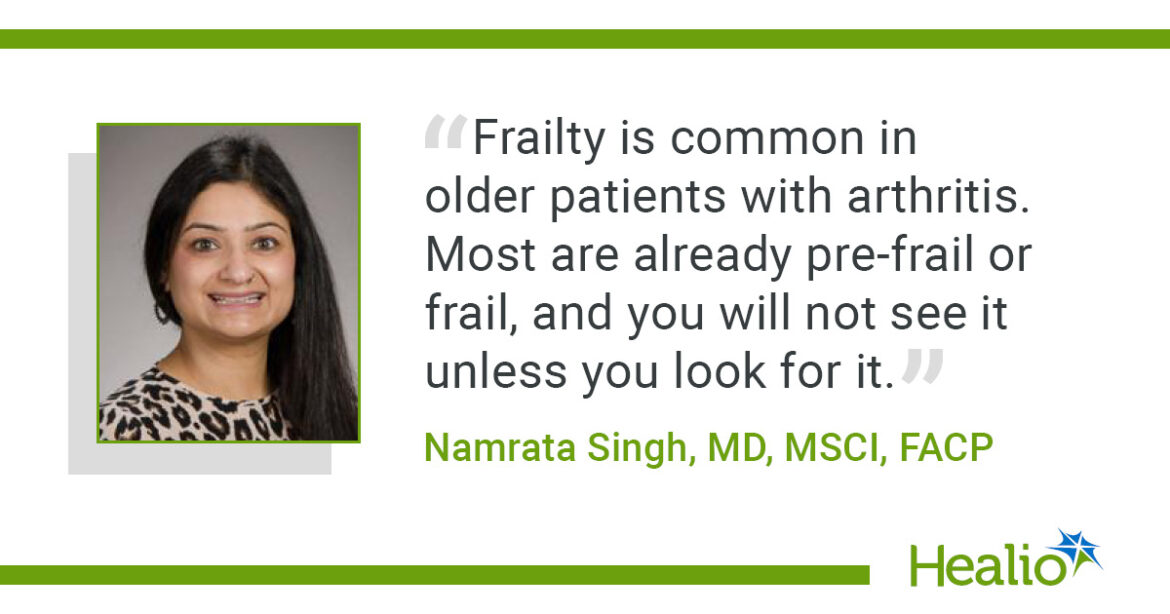
She added: “Frailty is common in older patients with arthritis. Most are already pre-frail or frail, and you won’t see it unless you look for it.”
2. Use brief clinical assessments
Frailty screening does not necessarily require a lengthy evaluation.
Singh noted: “A frailty assessment such as grip strength, gait speed or a brief questionnaire is quick to do in clinic.”
These assessments may help identify patients who would benefit from additional evaluation and targeted interventions.
3. Consider early preventive interventions
Potential interventions identified by Singh include:
- Structured exercise programs
- Physical therapy
- Nutritional interventions
- Cognitive screening
- Referral to geriatric services when appropriate
The aim is to identify modifiable risks and support mobility, physical function and independence.
4. Evaluate outcomes beyond joint disease
The findings reinforce the importance of assessing outcomes that matter to older patients, including their ability to perform daily activities, remain mobile and maintain cognitive health.
As Singh summarized: “Frailty predicts what patients care about most.”
Limitations
The findings should be interpreted in the context of the study design and the information available in the conference report.
- Observational design: The analysis identifies associations between frailty and subsequent outcomes but cannot establish that frailty directly causes dementia, disability or loss of independence.
- Residual confounding: Although the investigators adjusted for several demographic and clinical factors, unmeasured or incompletely measured factors may still have influenced the observed associations.
- Conference presentation: The findings were reported from an abstract presented at ACR Convergence 2026. The full peer-reviewed publication and complete methodological details were not provided in the source report.
- Limited quantitative detail for pre-frailty: The report describes increased risks among pre-frail participants and a dose-response relationship but does not provide the corresponding hazard ratios.
- Generalizability: The analysis focused on Medicare beneficiaries aged 65 years or older with physician-diagnosed arthritis. The findings may not apply directly to younger individuals or populations with different demographic and clinical characteristics.
- No intervention comparison: The study did not test whether frailty screening, exercise, nutritional support or physical therapy reduces the incidence of the reported outcomes.
Bottom line
Frailty was independently associated with substantially increased risks of dementia, disability and loss of independence among older adults with arthritis in a 13-year observational analysis.
The strongest associations were observed for ADL disability and mobility disability, each with hazard ratios of approximately 2.8 among frail participants compared with robust participants.
The reported dose-response relationship, including increased risk among pre-frail individuals, supports considering frailty screening as part of comprehensive rheumatology care.
Routine assessment of grip strength, gait speed or validated frailty questionnaires may help clinicians identify vulnerable patients and consider early interventions such as exercise, physical therapy, nutritional support and geriatric evaluation.
Original research / DOI
Presentation: Singh N. Abstract 2928. Presented at: ACR Convergence 2026; November 6–11, 2026; Orlando, Florida.
Study database: National Health and Aging Trends Study (NHATS), 2011–2024.
DOI:The findings were reported as a conference abstract rather than a DOI-linked journal publication in the supplied source.
Disclosures: Namrata Singh reported no relevant financial disclosures.