77
Question: What is the association between BMI normalization and the risk of disease progression in individuals with islet autoantibodies and overweight or obesity?
Findings: In an observational analysis of 833 participants from the TrialNet Pathway to Prevention study, individuals who achieved a normal BMI experienced an approximately 48% lower risk of progressing to clinical, or stage 3, type 1 diabetes (adjusted HR = 0.52; $P < .001$), with pronounced risk reductions observed among children and male subgroups.
Meaning: Weight stabilization and achieving a healthy BMI trajectory may serve as a critical, modifiable factor in mitigating or delaying disease progression in early-stage type 1 diabetes.
Study Overview & Cohort Characteristics
Data published in Diabetes Care investigated whether reducing body mass index (BMI) to a normal range alters the trajectory of early-stage type 1 diabetes. Principal investigator Maria J. Redondo, MD, PhD, MPH, professor of pediatrics at Texas Children’s Hospital, noted:
“Among individuals with islet autoantibodies who had overweight or obesity, those whose BMI subsequently returned to the healthy range had an approximately 48% lower risk of progressing to clinical, or stage 3, type 1 diabetes.”
Dr. Redondo further emphasized:
“Although our observational study cannot establish that BMI normalization prevents type 1 diabetes, the findings suggest that excess weight may be a potentially modifiable contributor to disease progression, particularly in youth.”
The study analyzed data from 833 children and adults with type 1 diabetes autoantibodies and overweight or obesity who participated in the TrialNet Pathway to Prevention study. Baseline screening for islet autoantibodies was performed, followed by longitudinal monitoring using hemoglobin A1c measurements and oral glucose tolerance tests every 6 to 12 months. During follow-up, 26.8% of the cohort successfully transitioned to a normal BMI range.
Disease Progression and Subgroup Analyses
Participants who achieved a normal BMI exhibited a significantly reduced likelihood of advancing across disease stages compared to those who maintained overweight or obesity:
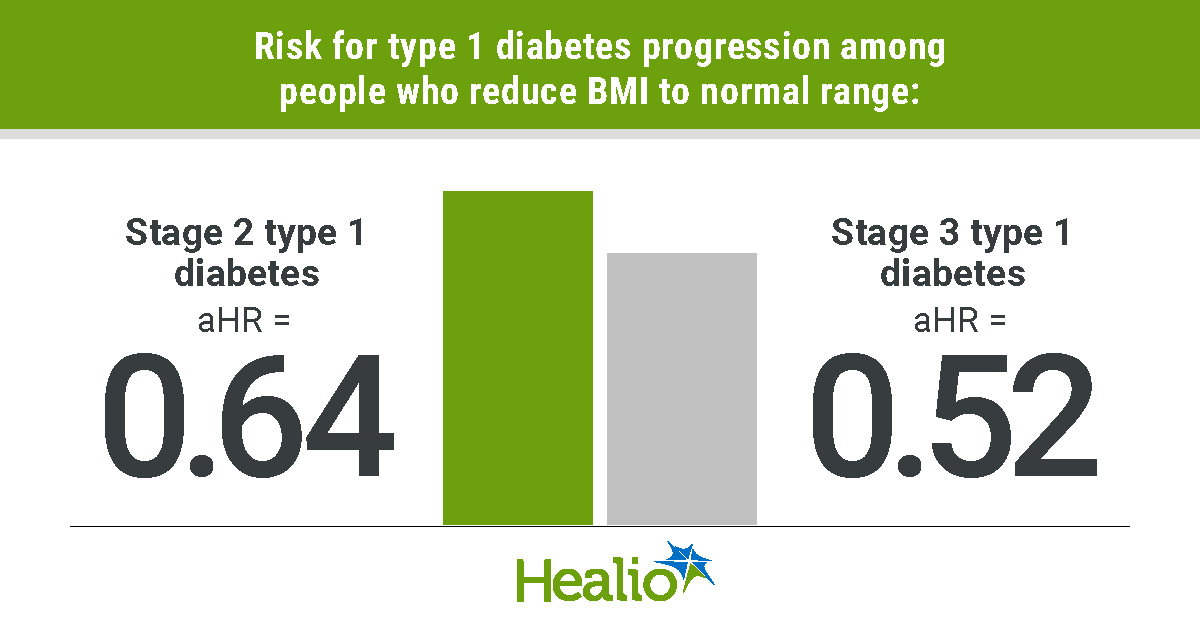
- Progression to Stage 3 Type 1 Diabetes: Adjusted HR = 0.52 ($P < .001$)
- Progression to Stage 2 Type 1 Diabetes: Adjusted HR = 0.64 ($P = .003$)
- Stage 1 to Stage 2 Transition: Adjusted HR = 0.62 ($P = .01$)
- Stage 2 to Stage 3 Transition: Adjusted HR = 0.35 ($P = .003$)
Subgroup analyses revealed notable demographic variations in risk reduction:
- Children and Adolescents: Adjusted HR = 0.5 ($P = .004$)
- Males: Adjusted HR = 0.47 ($P = .005$)
- Boys Younger than 12 Years: Adjusted HR = 0.27 ($P < .001$)
- Adolescent Girls (Aged 12 to 18 Years): Adjusted HR = 0.23 ($P = .043$)
No statistically significant associations between BMI normalization and reduced progression risk were identified among adult cohorts or females overall.
| Subgroup / Cohort Stratification | Adjusted Hazard Ratio (aHR) | Statistical Significance (P Value) |
| Overall Stage 3 Progression (Normal vs. Overweight/Obesity) | 0.52 | $P < .001$ |
| Overall Stage 2 Progression | 0.64 | $P = .003$ |
| Children & Adolescents (Stage 3 Risk) | 0.50 | $P = .004$ |
| Males (Stage 3 Risk) | 0.47 | $P = .005$ |
| Boys < 12 Years (Stage 3 Risk) | 0.27 | $P < .001$ |
| Girls Aged 12–18 Years (Stage 3 Risk) | 0.23 | $P = .043$ |
Clinical Implications and Growth Trajectories
The findings underscore the clinical importance of active BMI monitoring for individuals testing positive for type 1 diabetes autoantibodies. Dr. Redondo stated:
“Our findings provide an additional reason to promote healthy nutrition, physical activity and age-appropriate weight trajectories.”
Addressing pediatric care specifically, she added:
“Importantly, BMI normalization in a growing child does not necessarily require weight loss; it may be achieved through weight stabilization while the child continues to grow.”
While the observational study does not isolate a single preventative medical intervention, maintaining a healthy weight through lifestyle guidance can be utilized alongside close clinical monitoring and emerging immunotherapies for individuals with early-stage disease.
Zero-CLS Video & Interactive Widgets (WordPress / Soledad Theme Compatible)
To maintain optimal Core Web Vitals and prevent Cumulative Layout Shift (CLS) within WordPress themes like Soledad, containers utilize explicit aspect ratios and layout containment properties.
Responsive Zero-CLS Video Container
HTML
<!-- Soledad Theme Compatible Zero-CLS Video Wrapper -->
<div class="soledad-video-container" style="position: relative; width: 100%; aspect-ratio: 16 / 9; min-height: 315px; background-color: #f3f4f6; border-radius: 8px; overflow: hidden; margin: 20px 0;">
  <iframe
    src="https://www.youtube-nocookie.com/embed/placeholder_t1d_trial"
    title="BMI Normalization and Type 1 Diabetes Progression"
    style="position: absolute; top: 0; left: 0; width: 100%; height: 100%; border: 0;"
    loading="lazy">
  </iframe>
</div>
Interactive Subgroup Risk Reduction Widget
HTML
<!-- Zero-CLS Interactive Subgroup Risk Widget -->
<div class="t1d-widget-container" style="min-height: 290px; width: 100%; box-sizing: border-box; padding: 18px; border: 1px solid #d1d5db; border-radius: 8px; background: #ffffff; margin: 24px 0; contain: layout style;">
  <h4 style="margin-top: 0; font-family: system-ui, sans-serif; color: #111827; font-size: 16px;">TrialNet Subgroup Risk Explorer</h4>
  <p style="font-size: 13px; color: #4b5563; margin-bottom: 12px;">Select a demographic subgroup to examine adjusted hazard ratios for stage 3 T1D progression:</p>

  <select id="subgroupSelect" onchange="updateT1DWidget()" style="width: 100%; max-width: 320px; padding: 8px; font-size: 14px; border-radius: 4px; border: 1px solid #9ca3af; background: #f9fafb;">
    <option value="boys12">Boys < 12 Years Old</option>
    <option value="girls12">Girls Aged 12–18 Years</option>
    <option value="males">All Males</option>
    <option value="children">Children & Adolescents (Overall)</option>
  </select>

  <div id="t1dWidgetBox" style="margin-top: 16px; padding: 14px; background: #f3f4f6; border-radius: 6px; border-left: 4px solid #0284c7; font-size: 13px; color: #1f2937; line-height: 1.5; min-height: 90px;">
    <strong>Boys < 12 Years:</strong> Achieving a normal BMI was associated with a dramatic reduction in stage 3 progression risk (aHR = 0.27; P < .001).
  </div>
</div>

<script>
function updateT1DWidget() {
  const val = document.getElementById('subgroupSelect').value;
  const box = document.getElementById('t1dWidgetBox');
  if (val === 'boys12') {
    box.innerHTML = '<strong>Boys < 12 Years:</strong> Achieving a normal BMI was associated with a dramatic reduction in stage 3 progression risk (aHR = 0.27; P < .001).';
  } else if (val === 'girls12') {
    box.innerHTML = '<strong>Girls Aged 12–18 Years:</strong> Adolescent females demonstrated a significant lower risk of stage 3 disease upon reaching normal BMI (aHR = 0.23; P = .043).';
  } else if (val === 'males') {
    box.innerHTML = '<strong>All Males:</strong> Lowering BMI to normal levels yielded a strong protective association against clinical disease progression (aHR = 0.47; P = .005).';
  } else if (val === 'children') {
    box.innerHTML = '<strong>Children & Adolescents (Overall):</strong> Youth with islet autoantibodies who returned to a healthy BMI saw an approximate 50% lower risk of stage 3 T1D (aHR = 0.50; P = .004).';
  }
}
</script>
Clinical Trials Summary HTML Block (CLS-Optimized)
HTML
<!-- Clinical Trials Summary Card - Zero Layout Shift Enforced -->
<div class="clinical-trial-summary-card" style="width: 100%; min-height: 250px; box-sizing: border-box; border-left: 4px solid #0284c7; background-color: #f9fafb; padding: 20px; font-family: system-ui, -apple-system, sans-serif; contain: content; margin: 24px 0; border-radius: 0 8px 8px 0; border: 1px solid #e5e7eb; border-left-width: 4px;">
  <div style="display: flex; justify-content: space-between; align-items: center; border-bottom: 1px solid #e5e7eb; padding-bottom: 8px; margin-bottom: 12px;">
    <span style="font-size: 11px; font-weight: 700; text-transform: uppercase; color: #0284c7; letter-spacing: 0.8px;">Clinical Trial Summary & Evidence Matrix</span>
    <span style="font-size: 11px; color: #4b5563;">Diabetes Care | August 2026</span>
  </div>

  <h3 style="margin: 0 0 10px 0; font-size: 15px; font-weight: 600; color: #111827; line-height: 1.4;">
    TrialNet Pathway to Prevention: BMI Normalization in Early-Stage Type 1 Diabetes
  </h3>

  <div style="display: grid; grid-template-columns: repeat(auto-fit, minmax(210px, 1fr)); gap: 12px; font-size: 13px; color: #374151;">
    <div><strong>Study Cohort:</strong> N = 833 (Children & Adults with Autoantibodies)</div>
    <div><strong>Intervention Focus:</strong> BMI Normalization / Weight Trajectory</div>
    <div><strong>Primary Endpoint:</strong> Progression to Stage 3 Type 1 Diabetes</div>
    <div><strong>Key Finding:</strong> 48% lower risk of progression with normal BMI</div>
  </div>

  <div style="margin-top: 14px; padding-top: 10px; border-top: 1px solid #e5e7eb; font-size: 13px; color: #4b5563;">
    <strong>Clinical Takeaway:</strong> Excess weight is a modifiable risk factor in early-stage type 1 diabetes. Promoting healthy pediatric weight trajectories via stabilization or growth management significantly delays clinical disease onset.
  </div>
</div>