Osteoporosis Screening and Treatment Remain Uncommon in Patients With Gout Despite Higher Fracture Risk
1-minute summary
Patients with gout may face an increased risk of osteoporotic fractures, yet osteoporosis diagnosis and bone-protective treatment remain less common in this population than among patients with osteoarthritis (OA) or soft-tissue rheumatism (STR), according to a retrospective cohort study published in Arthritis Care & Research.
Researchers analyzed data from the American College of Rheumatology’s Rheumatology Informatics System for Effectiveness (RISE) registry linked to Medicare claims from 2015 through 2021. The study included 3,350 matched patients with gout and 3,350 with OA, as well as a separate comparison involving 772 patients with gout and 772 with STR.
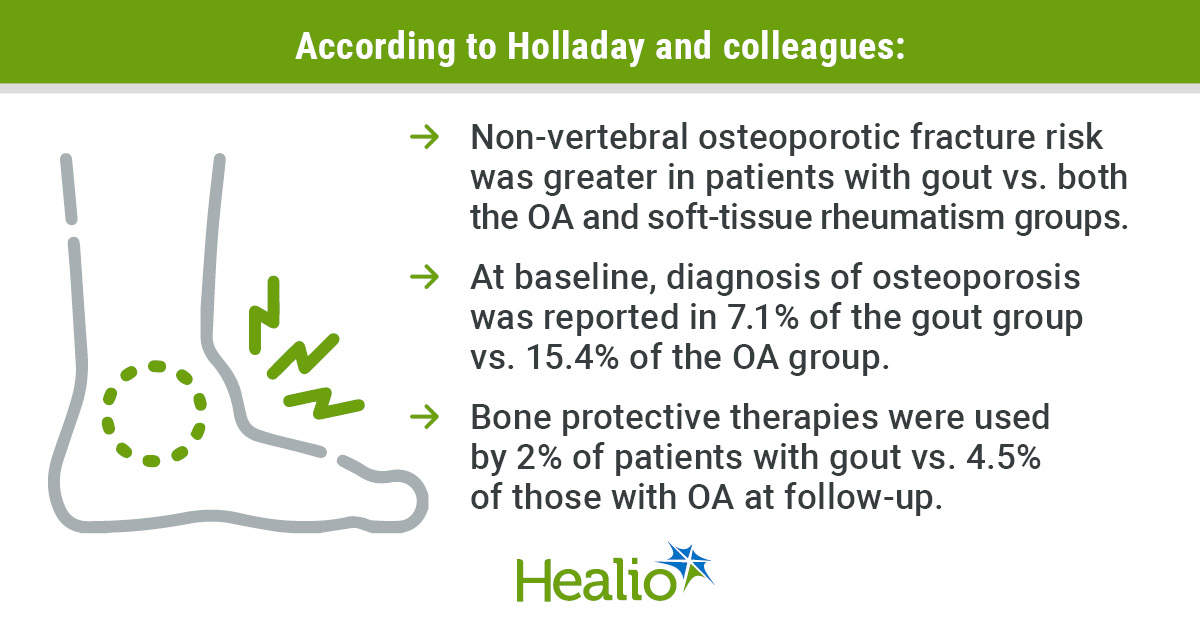
At baseline, only 5% of patients with gout in the gout-versus-OA cohort received bone-protective therapy, compared with 11.8% of patients with OA. A baseline osteoporosis diagnosis was recorded in 7.1% of patients with gout and 15.4% of those with OA. Despite this lower recorded prevalence of diagnosis and treatment, the incidence of nonvertebral osteoporotic fractures was higher among patients with gout than among those with OA (incidence rate ratio [IRR], 1.4; 95% CI, 1.1-1.8) or STR (IRR, 2.0; 95% CI, 1.3-3.1).
The findings highlight a potential gap in bone-health assessment and management in gout. The investigators emphasized the importance of evaluating osteoporosis and bone mineral density, while noting that whether better urate control reduces fracture risk remains unknown.
Why this matters
Gout is an inflammatory arthritis associated with hyperuricemia and recurrent episodes of joint inflammation. Patients with gout may also have multiple comorbidities, including chronic kidney disease (CKD), diabetes, and cardiovascular disease, which can complicate their overall health management.
Osteoporosis can remain undiagnosed until a fracture occurs. Because osteoporotic fractures may lead to pain, reduced mobility, disability, and additional health complications, recognizing and addressing bone-health risks is an important part of comprehensive care.
The study identified two important concerns: patients with gout were less likely to have a recorded osteoporosis diagnosis or receive bone-protective therapy than comparison groups, while their nonvertebral osteoporotic fracture risk was higher.
Emily E. Holladay, MPH, and colleagues explained the clinical concern:
“Gout is an inflammatory erosive arthropathy, and patients with gout have been shown to have a higher occurrence of osteopenia or osteoporosis and osteoporotic fractures.”
The researchers also highlighted the burden of coexisting disease:
“Osteoporotic fractures further impact quality of life and contribute to the multimorbidity that affects many patients with gout.”
These findings suggest that bone health may deserve greater attention during the routine assessment of patients with gout. However, the observational design does not establish that gout itself directly causes osteoporosis or that any particular screening or treatment strategy would reduce fractures in this population.
Study at a glance
| Feature | Details |
|---|---|
| Study type | Retrospective matched cohort study |
| Publication | Arthritis Care & Research, 2026 |
| Data sources | ACR RISE registry linked to Medicare claims |
| Study period | 2015-2021 |
| Gout-versus-OA cohort | 3,350 patients with gout and 3,350 with OA |
| Gout-versus-STR cohort | 772 patients with gout and 772 with STR |
| Intervention | None; observational assessment of diagnosis, medication use, and fracture outcomes |
| Comparator | Osteoarthritis and soft-tissue rheumatism groups |
| Matching variables | Age, sex, race, and enrollment quarter |
| Main outcomes | Osteoporosis diagnosis, bone-protective therapy use, and osteoporotic fracture incidence |
| Main finding | Higher nonvertebral osteoporotic fracture risk in patients with gout despite lower recorded treatment use |
| Follow-up | Registry and claims data from 2015-2021; individual follow-up duration not provided in the supplied report |
| DOI | 10.1002/acr.80134 |
What the researchers found
1. Study population and comparison groups
The investigators used data from the RISE registry linked to Medicare claims between 2015 and 2021. Patients with gout were matched 1:1 with patients who had OA or STR according to age, sex, race, and enrollment quarter.
The study excluded patients with inconsistent age or sex information and those receiving immunomodulation during the baseline period.
| Cohort | Patients with gout | Comparison group | Comparison patients |
|---|---|---|---|
| Gout versus OA | 3,350 | Osteoarthritis | 3,350 |
| Gout versus STR | 772 | Soft-tissue rheumatism | 772 |
The two comparisons should be interpreted separately because they involved different matched populations.
2. Baseline osteoporosis diagnosis and bone-protective therapy
In the gout-versus-OA cohort, patients with gout had lower recorded rates of osteoporosis diagnosis and bone-protective therapy use at baseline.
| Baseline measure | Gout | Osteoarthritis |
|---|---|---|
| Bone-protective therapy use | 5.0% | 11.8% |
| Recorded osteoporosis diagnosis | 7.1% | 15.4% |
| Osteoporotic fracture rate reported at baseline | 1.4% | 2.6% |
The lower baseline fracture percentage in the gout group does not contradict the higher fracture incidence observed during follow-up. Baseline prevalence and subsequent incidence measure different aspects of disease occurrence and may reflect differences in prior diagnosis, follow-up time, and underlying risk.
The supplied report does not provide enough detail to determine how much of the difference in recorded osteoporosis diagnoses reflected true differences in disease prevalence versus differences in screening and recognition.
3. Bone-protective therapy in the gout-versus-STR cohort
Bone-protective therapy was also less common among patients with gout than among patients with soft-tissue rheumatism.
| Baseline measure | Gout | Soft-tissue rheumatism |
|---|---|---|
| Bone-protective therapy use | 9.0% | 23.2% |
These findings show a consistent pattern of lower recorded bone-protective treatment use among patients with gout across both comparison cohorts.
However, the supplied article does not provide the full clinical reasons for prescribing or withholding therapy, such as individual bone mineral density measurements, prior fractures, contraindications, or treatment eligibility.
4. Nonvertebral osteoporotic fracture risk
The study found a higher incidence of nonvertebral osteoporotic fractures among patients with gout compared with both control groups.
| Comparison | Incidence rate ratio (IRR) | 95% confidence interval | Interpretation |
|---|---|---|---|
| Gout versus OA | 1.4 | 1.1-1.8 | Higher fracture incidence in the gout group |
| Gout versus STR | 2.0 | 1.3-3.1 | Higher fracture incidence in the gout group |
An IRR of 1.4 indicates that the observed fracture incidence rate was 40% higher in the gout group than in the OA group. An IRR of 2.0 indicates that it was twice the rate in the STR group.
Both confidence intervals exclude 1.0, consistent with statistically significant differences under the reported analyses. These estimates are associations and do not establish that gout independently causes fractures.
The supplied article does not provide the absolute follow-up fracture rates, the specific nonvertebral fracture sites, or adjusted estimates for all potential confounders.
5. Bone-protective treatment during follow-up
The researchers also reported low use of bone-protective therapy during follow-up visits.
| Follow-up treatment use | Gout | Comparator |
|---|---|---|
| Gout versus OA cohort | 2.0% | OA: 4.5% |
| Gout versus STR cohort | 3.4% | STR: 10.3% |
These figures suggest that the treatment-use gap persisted beyond baseline. The supplied report does not clarify whether these percentages represent treatment at any follow-up visit, use at a specific visit, or another defined measure of longitudinal treatment.
6. What remains unknown about urate control
The authors noted that the relationship between serum uric acid, gout, osteoporosis, and fracture risk remains uncertain. Previous research has produced contradictory findings about whether serum uric acid levels are associated with osteoporosis diagnosis or fracture outcomes.
The study did not establish whether achieving better urate control reduces osteoporosis risk or prevents fractures.
As Holladay and colleagues stated:
“Whether effective gout management—urate clearance—would impact osteoporosis diagnosis and fracture risk is unknown.”
This distinction is important: the observed association between gout and fracture incidence does not demonstrate that urate-lowering treatment will improve bone health.
Clinical significance
The findings suggest that bone health may be underrecognized in patients with gout and that this population may benefit from more deliberate assessment of osteoporosis risk.
Consider bone health as part of comprehensive gout care. A gout diagnosis may provide an opportunity to review prior fractures, other osteoporosis risk factors, relevant comorbidities, and whether bone mineral density assessment is indicated.
Do not rely on recorded diagnosis alone. The lower prevalence of documented osteoporosis among patients with gout could reflect differences in underlying disease, screening, or recognition. The study cannot distinguish these explanations conclusively.
Interpret fracture risk in context. The higher nonvertebral fracture incidence was observed in matched observational cohorts. Individual risk still depends on factors such as age, prior fracture, bone density, medications, kidney function, and other clinical characteristics.
Avoid assuming urate lowering prevents fractures. The study did not test whether urate-lowering treatment reduces fracture incidence. That question requires dedicated research.
Recognize the treatment gap without assuming every patient needs medication. Bone-protective treatment decisions should be based on an individual’s fracture risk, osteoporosis evaluation, comorbidities, and relevant clinical guidance.
Limitations
- Retrospective observational design: The study can identify associations but cannot establish causality between gout, osteoporosis, treatment use, and fractures.
- Potential residual confounding: Matching addressed age, sex, race, and enrollment quarter, but other differences between groups may have influenced fracture risk and treatment patterns.
- Claims and registry data: Recorded diagnoses and medication use may not fully capture disease severity, adherence, or treatment received outside the available data sources.
- Incomplete bone-health information: The supplied report does not provide detailed bone mineral density results, prior fracture histories, or the clinical criteria used to initiate bone-protective treatment.
- Different comparison cohorts: The gout-versus-OA and gout-versus-STR analyses involved different sample sizes and should not be interpreted as directly interchangeable.
- Uncertain interpretation of follow-up treatment percentages: The precise longitudinal definition of bone-protective therapy use is not detailed in the supplied article excerpt.
- Generalizability: The study used RISE registry and Medicare claims data, so the findings may not fully represent younger patients, people without Medicare coverage, or all clinical settings.
- No intervention evaluation: The study did not test whether osteoporosis screening, bone-protective medication, or improved urate control reduces fracture incidence.
What doctors should know
- Recognize the reported risk difference: Patients with gout had higher nonvertebral osteoporotic fracture incidence than matched patients with OA or STR in this study.
- Review osteoporosis risk during clinical care: Consider prior fractures, age, relevant comorbidities, medication exposure, and whether bone mineral density testing is appropriate.
- Do not interpret lower diagnosis rates as lower risk: Fewer recorded osteoporosis diagnoses among patients with gout may not mean that their underlying bone health is better.
- Individualize bone-protective treatment: The study documents low use but does not establish that all patients with gout require osteoporosis medication.
- Address comorbidities: CKD, diabetes, and cardiovascular disease may complicate care and should be considered when evaluating bone health and treatment options.
- Avoid unsupported claims about urate lowering: It remains unknown whether more effective urate control changes osteoporosis diagnosis or fracture risk.
- Use the findings to identify a care opportunity: The results support greater attention to bone health in gout, while prospective studies are needed to determine the best screening and prevention strategies.
Bottom line
A retrospective matched cohort study found that patients with gout received bone-protective therapy less frequently than patients with OA or soft-tissue rheumatism, yet had higher nonvertebral osteoporotic fracture incidence. The reported IRR was 1.4 versus OA and 2.0 versus STR.
The findings highlight a potential gap in osteoporosis recognition and management among patients with gout. Clinicians should consider bone-health assessment when appropriate, but the study does not establish that gout causes fractures or that urate-lowering treatment prevents them.
Original research / DOI
Article: Holladay EH, et al. Study of osteoporosis diagnosis, bone-protective treatment, and osteoporotic fracture outcomes in patients with gout compared with osteoarthritis and soft-tissue rheumatism.
Journal: Arthritis Care & Research. 2026.
Data sources: American College of Rheumatology RISE registry linked to Medicare claims, 2015-2021.
DOI: 10.1002/acr.80134
Lead author affiliation: University of Alabama at Birmingham.
Disclosures: A complete author-disclosure statement was not included in the supplied article excerpt.