1-Minute Summary
Chimeric antigen receptor (CAR) T-cell therapy was associated with substantial reductions in systemic lupus erythematosus (SLE) disease activity in a pooled analysis of 31 clinical studies involving 243 patients with treatment-refractory SLE.
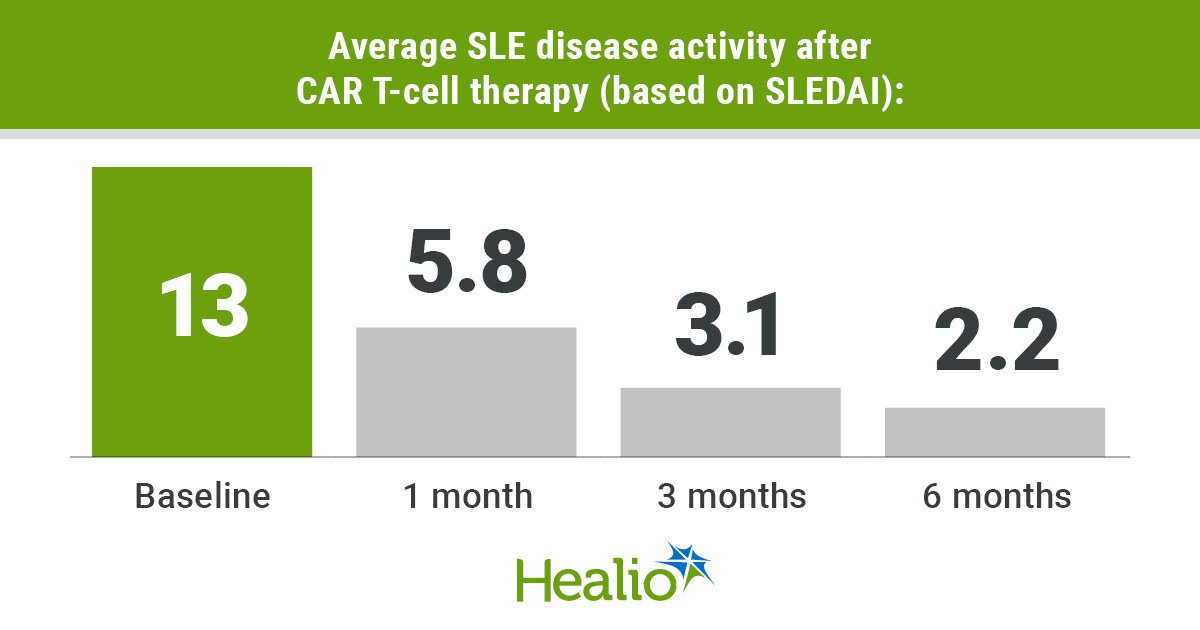
All included patients had previously failed at least 2 immunosuppressive therapies. Disease activity, measured using the Systemic Lupus Erythematosus Disease Activity Index (SLEDAI), fell progressively after CAR-based therapy—from a mean baseline score of 13.0 to 5.8 at 1 month, 3.1 at 3 months, and 2.2 at 6 months.
Approximately 80% of patients received autologous CAR therapy, 18% received allogeneic therapy, and 2% received in vivo CAR therapy.
Autologous CAR therapy was independently associated with more than twice the likelihood of achieving a SLEDAI score of 0 compared with allogeneic therapy (HR, 2.33; 95% CI, 1.05-5.17; P = .037).
Cytokine release syndrome (CRS) occurred in 64% of patients, but nearly all cases were low grade. Immune effector cell-associated neurotoxicity syndrome (ICANS) occurred in approximately 5%, and severe infections occurred in approximately 5%.
The findings provide encouraging evidence that CAR T-cell therapy may induce profound disease suppression in highly refractory lupus. However, the current evidence comes largely from small, uncontrolled studies, and randomized prospective trials are needed before the treatment’s comparative efficacy, durability, and long-term safety can be established.
Why This Matters
Systemic lupus erythematosus is a chronic autoimmune disease characterized by abnormal immune activation and the production of pathogenic autoantibodies that can damage multiple organs, including the kidneys, skin, joints, cardiovascular system, lungs, and nervous system.
Although glucocorticoids, immunosuppressants, biologic therapies, and other targeted agents have improved outcomes, a subset of patients continue to experience severe or recurrent disease despite multiple treatments.
CAR T-cell therapy represents a fundamentally different therapeutic approach.
Rather than chronically suppressing selected inflammatory pathways, CAR-modified immune cells can eliminate specific populations of pathogenic B cells and potentially allow the immune system to reconstitute in a less autoreactive state—an approach sometimes described as an immune reset.
Early reports of CAR T-cell therapy in severe autoimmune diseases have generated considerable interest, but the evidence has largely consisted of small case series and early clinical studies.
The pooled analysis presented at ACR Convergence 2026 therefore sought to bring together the available clinical experience to better characterize efficacy and safety.
Senior author Anca Askanase, MD, MPH, described the magnitude of improvement as striking:
“In terms of efficacy, the majority of patients had significant, extraordinary improvement in their disease activity score.”
The findings are promising, but they do not yet establish CAR T-cell therapy as curative or as a replacement for established SLE treatments.
Study at a Glance
| Feature | Details |
|---|---|
| Study | CAR-T Cell Therapy in SLE: A Pooled Analysis |
| Study type | Systematic review with pooled longitudinal analysis |
| Studies included | 31 |
| Participants | 243 patients with SLE |
| Population | Patients with refractory SLE |
| Prior therapy | All had failed ≥2 immunosuppressants |
| Intervention | CAR-based cellular therapy |
| Autologous therapy | 197 patients, approximately 80% |
| Allogeneic therapy | 43 patients, approximately 18% |
| In vivo CAR therapy | 5 patients, approximately 2% |
| Major CAR target | CD19 in approximately 70% |
| CD19/BCMA bispecific therapy | Approximately 22% |
| Comparator | No uniform randomized comparator |
| Primary clinical measure | Change in SLEDAI over time |
| Mean baseline SLEDAI | 13.0 |
| Main finding | Progressive reduction in SLEDAI through 6 months |
| Key safety outcome | CRS occurred in 64%, predominantly grade 1-2 |
| Follow-up | Varied among included studies |
| Presentation | ACR Convergence 2026, Orlando |
The systematic review searched MEDLINE, Embase, Scopus, and CENTRAL and identified 7,096 records, of which 31 studies met inclusion criteria.
What the Researchers Found
SLE Disease Activity Declined Rapidly After CAR Therapy
The most notable finding was a progressive reduction in SLE disease activity following CAR therapy.
Mean SLEDAI scores changed as follows:
| Time point | Mean SLEDAI | 95% CI |
|---|---|---|
| Baseline | 13.0 | 11.0-15.0 |
| 1 month | 5.8 | 3.8-7.8 |
| 3 months | 3.1 | 1.2-5.1 |
| 6 months | 2.2 | 0.3-4.2 |
These pooled trajectories indicate a rapid early reduction in disease activity followed by continued improvement through at least 6 months.
A mean SLEDAI decline from 13 to approximately 2 represents a substantial change in clinical disease burden, particularly because the included patients had refractory disease despite previous immunosuppressive treatment.
However, these findings derive from pooled observational and early-phase clinical evidence rather than a randomized comparison with standard therapy.
Disease Activity Over Time
The reduction in SLEDAI appeared early.
At 1 month, mean disease activity had already fallen from 13.0 to 5.8.
By 3 months, the mean score had fallen further to 3.1.
At 6 months, the pooled mean SLEDAI was 2.2.
This pattern suggests that CAR therapy may produce relatively rapid immune-mediated disease suppression.
| Change from baseline | Approximate mean reduction |
|---|---|
| Baseline to 1 month | −7.2 SLEDAI points |
| Baseline to 3 months | −9.9 points |
| Baseline to 6 months | −10.8 points |
These descriptive reductions should not be interpreted as treatment effects against an untreated control group because no common randomized comparator was available.
Autologous vs Allogeneic CAR Therapy
The investigators also examined whether the manufacturing approach influenced treatment response.
Most patients received autologous CAR T cells, meaning the therapeutic cells were derived from the patient’s own T cells.
Approximately 18% received allogeneic products manufactured from donor-derived cells.
In adjusted Cox regression analysis, patients receiving autologous CAR therapy were significantly more likely to achieve complete clinical disease inactivity as measured by a SLEDAI score of 0.
| Comparison | Result |
|---|---|
| Autologous vs allogeneic therapy | HR, 2.33 |
| 95% CI | 1.05-5.17 |
| P value | .037 |
Thus, autologous therapy was associated with more than twice the likelihood of reaching SLEDAI 0 at last follow-up.
However, this finding should not be interpreted as proof that autologous products are inherently superior.
Patients were not randomly assigned between manufacturing strategies, and differences in baseline characteristics, CAR constructs, disease severity, conditioning regimens, treatment centers, and follow-up could contribute to the observed association.
Lupus Nephritis May Influence Response
The ACR analysis also found that patients with lupus nephritis demonstrated a steeper decline in SLEDAI over time than those without renal involvement.
In multivariable mixed-effects modeling:
| Predictor of steeper SLEDAI decline | β estimate | 95% CI | P value |
|---|---|---|---|
| Autologous CAR therapy | 0.43 | 0.17-0.70 | .001 |
| Presence of lupus nephritis | 0.35 | 0.09-0.61 | .008 |
Target antigen, patient age, and CAR dose adjusted for body weight were not statistically significant predictors of the longitudinal change in SLEDAI in the reported model.
These findings may eventually help refine patient selection, although they require prospective validation.
Types of CAR Therapy Used
The pooled population was heterogeneous with regard to CAR target.
| CAR target | Patients | Proportion |
|---|---|---|
| CD19-targeted therapy | 169 | 70% |
| Bispecific CD19/BCMA therapy | 54 | 22% |
| Other targets | 20 | 8% |
CD19-directed therapy therefore accounted for the majority of current clinical experience.
Targeting CD19 aims to remove autoreactive B-cell populations that contribute to autoantibody production and immune dysregulation in SLE.
Dual CD19/BCMA approaches may potentially target a broader spectrum of B-lineage cells, including antibody-producing plasma cell populations, although comparative evidence remains limited.
Safety
Cytokine Release Syndrome Was Common but Usually Mild
CRS was the most frequently reported adverse event.
It occurred in 155 of 243 patients (64%).
| CRS severity | Patients | Approximate proportion |
|---|---|---|
| Any CRS | 155 | 64% |
| Grade 1-2 | 150 | 62% of all patients |
| Grade 3 | 4 | 2% |
| Grade 4 | 1 | <1% |
Therefore, although CRS was common, severe CRS was uncommon.
Askanase summarized the finding:
“There was a 64% risk of cytokine release syndrome, but a majority of these cytokine release syndromes were mild and managed with conservative regimens.”
She described the overall findings as suggesting:
“a favorable safety profile.”
That characterization requires context: CAR therapy remains an intensive cellular treatment capable of producing serious and occasionally life-threatening toxicities.
Neurologic Toxicity
Immune effector cell-associated neurotoxicity syndrome occurred in 12 patients, or approximately 5%.
The ACR abstract reported:
| ICANS severity | Patients |
|---|---|
| Grade 1 | 5 |
| Grade 2 | 2 |
| Grade 3 | 4 |
| Grade 4 | 1 |
| Total | 12 |
Although the overall frequency was low, severe neurologic toxicity occurred in a small number of patients and remains an important consideration when evaluating CAR therapy for a nonmalignant chronic disease.
Serious Infections and Hematologic Toxicity
Severe grade 3 or 4 infections were reported in 11 patients, approximately 5% of the pooled population.
One patient died from pneumococcal meningitis.
In addition, prolonged hematologic toxicity lasting more than 28 days was reported in 22 patients, or approximately 9%.
| Safety outcome | Patients | Rate |
|---|---|---|
| Cytokine release syndrome | 155 | 64% |
| ICANS | 12 | 5% |
| Severe infections | 11 | 5% |
| Prolonged hematologic toxicity | 22 | 9% |
| Fatal pneumococcal meningitis | 1 | — |
These events reinforce the need to evaluate benefit against substantial treatment complexity and potential toxicity.
Clinical Significance
The magnitude of disease-activity reduction observed in this pooled analysis is clinically important because the population consisted of patients with difficult-to-treat SLE who had already failed multiple immunosuppressive agents.
CAR T-cell therapy offers a mechanistically different strategy from conventional immunosuppression.
Rather than requiring continuous suppression of inflammatory pathways, the therapy may eliminate autoreactive immune-cell populations and permit reconstitution of a more naïve B-cell repertoire.
The possibility of achieving prolonged remission after a limited course of cellular therapy has generated substantial interest in rheumatology.
Askanase expressed optimism about this approach:
“We are truly excited about the possibility of bringing CAR T-cell therapy to people with lupus and autoimmune diseases to harness the healing power of the T cells and treat and cure diseases.”
The word “cure,” however, should be interpreted as an aspiration rather than an established clinical outcome.
The current evidence does not demonstrate that CAR T-cell therapy cures SLE. Long-term relapse rates, treatment-free remission duration, organ-specific outcomes, late toxicity, and survival remain insufficiently characterized.
Why Autologous CAR Therapy May Have Performed Better
Autologous CAR products are created from a patient’s own T cells, modified ex vivo, expanded, and reinfused after lymphodepleting conditioning.
Potential advantages include reduced risk of immune rejection and potentially greater persistence of the engineered cells.
Allogeneic products offer different theoretical advantages, including immediate availability and standardized manufacturing, but donor-derived cells may face immune rejection or require additional engineering.
The pooled analysis found superior SLEDAI 0 achievement with autologous products, but this result remains associational rather than causal.
Randomized head-to-head comparisons would be required before concluding that one platform provides superior disease control.
Limitations
1. Evidence Came From Small Studies
Although the pooled population included 243 patients, the analysis combined 31 separate studies, meaning individual studies were generally very small.
Small studies can exaggerate apparent treatment effects and may inadequately capture rare adverse outcomes.
2. No Uniform Randomized Comparator
Most available CAR therapy evidence in SLE consists of early-phase trials, case series, or observational studies.
Without randomized control groups, improvements cannot be attributed exclusively to CAR therapy with the same confidence as results from large controlled trials.
3. Substantial Clinical Heterogeneity
The studies differed in:
- CAR construct,
- target antigen,
- manufacturing strategy,
- conditioning regimen,
- disease manifestations,
- concomitant therapy,
- patient selection,
- follow-up duration, and
- outcome assessment.
Pooling these studies improves statistical power but introduces heterogeneity.
4. Follow-up Remains Limited
SLE is a lifelong disease.
Follow-up of several months or even a few years cannot determine whether immune remission will remain durable over decades.
5. Potential Publication Bias
Highly successful early CAR T-cell experiences may be more likely to be published than unsuccessful treatments.
This could inflate pooled estimates of efficacy.
6. Comparisons Between Autologous and Allogeneic Therapy Were Nonrandomized
The HR of 2.33 favoring autologous therapy is important but exploratory.
Differences in patients or treatment protocols may explain part of the association.
7. SLEDAI Does Not Capture Every Clinically Important Outcome
SLEDAI is a validated measure of lupus disease activity, but remission, quality of life, glucocorticoid discontinuation, organ damage, renal response, fertility, treatment-free remission, and long-term survival are also clinically important.
8. Serious Toxicities Remain Possible
Although most CRS was mild, severe CRS, neurotoxicity, prolonged cytopenias, serious infection, and a fatal infection were observed.
These risks are particularly important when considering CAR therapy for a chronic nonmalignant disease.
What Doctors Should Know
The pooled evidence supports CAR T-cell therapy as one of the most promising investigational approaches for severe, treatment-refractory SLE, but it remains a specialized and evolving treatment strategy.
Important clinical points include:
- The analysis included 243 patients from 31 studies.
- All patients had refractory SLE and had failed at least 2 immunosuppressants.
- Mean SLEDAI fell from 13.0 at baseline to 2.2 at 6 months.
- Most patients received autologous CAR therapy.
- Autologous therapy was associated with a higher likelihood of reaching SLEDAI 0 than allogeneic therapy.
- Patients with lupus nephritis appeared to have a steeper decline in disease activity.
- CRS occurred in 64%, but most cases were grade 1 or 2.
- ICANS occurred in approximately 5%.
- Severe infections occurred in approximately 5%.
- Prolonged hematologic toxicity occurred in approximately 9%.
- At least 1 fatal serious infection was reported.
- CAR T-cell therapy should not yet be described as a proven cure for lupus.
- Prospective controlled trials are required to determine optimal patient selection, CAR target, manufacturing strategy, durability, long-term toxicity, and comparative effectiveness.
Current results are most relevant to patients with severe refractory disease, not to the general SLE population.
Bottom Line
A systematic review and pooled analysis of 31 studies involving 243 patients with refractory systemic lupus erythematosus found that CAR-based cellular therapy was associated with substantial and progressive reductions in disease activity.
Mean SLEDAI decreased from 13.0 at baseline to 5.8 at 1 month, 3.1 at 3 months, and 2.2 at 6 months.
Autologous CAR therapy was associated with more than twice the likelihood of achieving complete SLEDAI-defined disease inactivity compared with allogeneic therapy (HR, 2.33; 95% CI, 1.05-5.17; P = .037).
Cytokine release syndrome occurred frequently but was overwhelmingly low grade, whereas severe infection, neurotoxicity, and prolonged hematologic toxicity affected smaller proportions of patients.
The results strengthen the emerging evidence that CAR T-cell therapy may induce profound disease control in selected patients with treatment-refractory lupus.
However, the evidence remains based predominantly on small, nonrandomized studies. Whether CAR therapy produces durable treatment-free remission, which patients benefit most, and whether its benefits justify its risks and complexity will require prospective controlled trials and substantially longer follow-up.
Original Research / DOI
Study: CAR-T Cell Therapy in SLE: A Pooled Analysis
Authors: Alberto Nordmann-Gomes, Leila Khalili, Ellen Montgomery, Laurel Zhang, Anca Askanase
Study type: Systematic review and pooled analysis
Abstract number: 0256
Meeting: ACR Convergence 2026
Presentation date: November 8, 2026
Location: Orlando, Florida
Conference citation: Nordmann-Gomes A, Khalili L, Montgomery E, Zhang L, Askanase A. CAR-T Cell Therapy in SLE: A Pooled Analysis. Abstract 0256. Presented at ACR Convergence 2026.
DOI: No unique DOI for this conference abstract was identified in the available ACR record.
The official ACR abstract confirms the systematic search methodology, 31 included studies, 243 patients, longitudinal SLEDAI analysis, safety outcomes, and comparison of autologous and allogeneic approaches.