Which Hair Loss Treatments Work? Evidence, Safety, and Emerging Therapies
1-Minute Summary
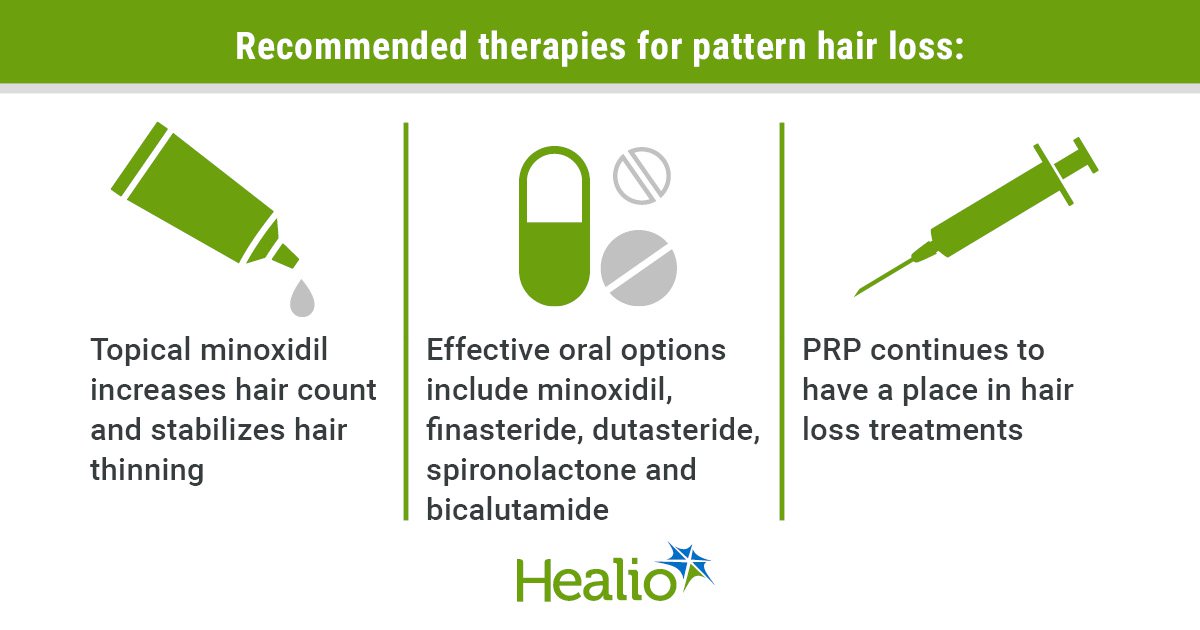
Minoxidil remains one of the most established pharmacologic treatments for androgenetic alopecia in both men and women, while finasteride, dutasteride, spironolactone, and bicalutamide provide additional options depending on sex, clinical context, treatment goals, and tolerance.
In an expert dermatology discussion, Maryanne Makredes Senna, MD, reviewed commonly used therapies for male and female pattern hair loss, including topical and oral minoxidil, oral and topical antiandrogen therapies, platelet-rich plasma (PRP), and investigational drugs.
According to Senna, established topical therapies can produce approximately 13 to 16 additional hairs/cm² compared with placebo, while oral minoxidil at 5 mg daily may produce approximately 14 to 15 hairs/cm² after 6 months.
Treatment choice must also account for safety. Oral minoxidil may cause palpitations or changes in blood pressure, while hirsutism can be particularly troublesome in women. Oral finasteride may cause sexual adverse effects, alter sperm counts, lower measured prostate-specific antigen (PSA), and has been associated with depression.
PRP may benefit selected patients, although the quality and consistency of evidence remain variable. Several emerging approaches—including androgen receptor blockers, PP405, prolactin receptor blockade, and extended-release oral minoxidil—are under clinical investigation.
Why This Matters
Androgenetic alopecia is among the most common causes of chronic hair loss in adults and can substantially affect quality of life, self-image, and psychological well-being.
Although numerous therapies are marketed for hair loss, the strength of evidence differs considerably across available and investigational treatments. Dermatologists must therefore distinguish therapies supported by reproducible clinical evidence from treatments supported primarily by smaller studies, heterogeneous protocols, or early-phase trials.
The current discussion highlights an important clinical principle: treatment of hair loss increasingly involves combinations of established and adjunctive therapies rather than reliance on a single intervention.
Topical minoxidil remains an important first-line option, while oral minoxidil has become increasingly used off label. Antiandrogen therapies may provide additional benefit in appropriately selected patients, particularly those with androgen-mediated hair loss.
At the same time, emerging therapies may eventually expand treatment options for patients who do not respond adequately or experience a plateau with currently available treatments.
Study at a Glance
The source material is not a single randomized controlled trial. It is an expert video interview summarizing evidence from multiple clinical studies, systematic reviews, and ongoing investigational programs.
| Feature | Details |
|---|---|
| Source type | Expert dermatology interview and evidence overview |
| Primary condition discussed | Male and female pattern hair loss / androgenetic alopecia |
| Expert | Maryanne Makredes Senna, MD |
| Interviewer | Joel M. Gelfand, MD, MSCE, FAAD |
| Study type | Not a single RCT, cohort, or meta-analysis |
| Participants | Not applicable to the interview as a whole |
| Established treatments discussed | Topical minoxidil, oral minoxidil, finasteride, dutasteride, spironolactone, bicalutamide |
| Procedural treatment discussed | Platelet-rich plasma |
| Emerging treatments | Androgen receptor blockers, PP405, prolactin receptor–targeted monoclonal antibodies, extended-release oral minoxidil |
| Primary outcome discussed across studies | Change in hair density, typically hairs/cm² |
| Main clinical message | Minoxidil remains a central therapy, with several antiandrogen and investigational options available or under study |
| Follow-up | Varies by individual study; several efficacy estimates cited at 6 months |
| Original DOI | No single DOI applies to the interview as a whole |
What the Researchers and Experts Found
Minoxidil Remains a Core Treatment
For male and female pattern hair loss, topical minoxidil remains among the best-established therapies.
Senna described topical minoxidil as highly effective for stimulating regrowth and noted that topical finasteride and dutasteride may also be useful treatment options.
She summarized the magnitude of response with established therapies:
“These treatments provide a regrowth of 13 to 16 hairs/cm² relative to placebo.”
The interview also highlighted increasing clinical use of low-dose oral minoxidil, which is generally used off label for hair loss.
Senna stated that immediate-release oral minoxidil may be prescribed across a range of approximately 1.25 mg to 15 mg per day, depending on the clinical situation.
Oral Minoxidil
Oral minoxidil has attracted increasing interest because some patients prefer tablets to topical therapy, particularly when topical formulations leave residue in the hair or scalp.
According to the interview, a dose of 5 mg per day may produce approximately 14 to 15 additional hairs/cm² after 6 months in men and women.
| Oral minoxidil feature | Reported finding |
|---|---|
| Commonly discussed dose | 5 mg/day |
| Reported hair-density improvement | Approximately 14-15 hairs/cm² |
| Time point | 6 months |
| Administration | Oral |
| Regulatory use for alopecia | Off label |
| Important adverse effects | Palpitations, blood-pressure changes, increased heart rate, hirsutism |
The potential convenience of oral therapy must be balanced against systemic cardiovascular effects.
Cardiovascular Safety of Oral Minoxidil
Because minoxidil was originally developed as an antihypertensive medication, cardiovascular safety is an important consideration.
Senna cited a large study involving approximately 1,400 patients, noting that clinically significant cardiovascular effects appeared uncommon at lower doses.
She stated:
“Unless you take upwards of 10 to 15 mg in one given dose, the likelihood of significant cardiovascular side effects tends to not be a major issue.”
She also noted that doses such as 5 mg daily may cause mild, asymptomatic increases in heart rate and decreases in blood pressure.
Although these effects may be clinically minor in many patients, clinicians should consider baseline cardiovascular status, concomitant medications, symptoms of hypotension, and palpitations when prescribing oral minoxidil.
Hirsutism With Oral Minoxidil
For women, one of the most clinically relevant adverse effects of oral minoxidil is unwanted hair growth.
Senna identified hirsutism as the most common and bothersome adverse event among women receiving oral minoxidil.
This adverse effect should be discussed before treatment because it may affect adherence even when scalp hair growth is favorable.
Finasteride
Finasteride reduces androgen-mediated miniaturization of hair follicles by inhibiting conversion of testosterone to dihydrotestosterone.
Oral finasteride remains an important treatment option for male androgenetic alopecia, but counseling about potential adverse effects is essential.
According to the expert discussion, sexual adverse effects including decreased libido and erectile dysfunction may occur in approximately 5% to 10% of men.
Finasteride may also decrease sperm counts.
Senna emphasized that this effect appears potentially reversible:
“Sperm regenerates every 3 months.”
She further noted that long-term studies extending to approximately 5 years suggest sperm counts can recover after treatment discontinuation.
Finasteride and PSA
Finasteride may also complicate interpretation of prostate-specific antigen testing.
According to the interview, oral finasteride can lower measured PSA concentrations by approximately 50%.
This is clinically important because PSA values may need to be interpreted differently in men receiving finasteride.
The medication has also been associated with depression, another potential adverse effect that should be addressed during counseling.
Dutasteride, Spironolactone, and Bicalutamide
Several other antiandrogen approaches may be considered depending on the patient’s sex and clinical circumstances.
The discussion identified:
-
Dutasteride, including topical formulations and oral treatment in selected patients.
-
Spironolactone, which can be used to reduce androgen-mediated hair loss in women.
-
Bicalutamide, another androgen-blocking option that may be used in selected women.
The evidence base, regulatory status, monitoring requirements, and adverse-effect profiles differ substantially among these drugs.
Selection should therefore be individualized rather than based solely on relative hair-density gains.
Comparison of Established Hair Loss Treatments
| Treatment | Typical role discussed | Reported efficacy | Important considerations |
|---|---|---|---|
| Topical minoxidil | Men and women | Approximately 13-16 hairs/cm² relative to placebo for established topical therapies discussed | Scalp application; residue may affect adherence |
| Oral minoxidil | Men and women; off-label | Approximately 14-15 hairs/cm² at 6 months with 5 mg/day | Palpitations, BP changes, hirsutism |
| Finasteride | Primarily men | Effective antiandrogen therapy | Sexual adverse effects, sperm count, PSA reduction, depression association |
| Dutasteride | Selected men and women | Effective antiandrogen option | Systemic antiandrogen effects and reproductive considerations |
| Spironolactone | Women | Useful androgen-blocking option | Requires appropriate patient selection and monitoring |
| Bicalutamide | Selected women | Antiandrogen option | Requires careful monitoring and individualized use |
Platelet-Rich Plasma
Platelet-rich plasma has become an increasingly popular procedural treatment for hair loss, although evidence remains more heterogeneous than for established pharmacologic therapies.
Senna stated that she continues to offer PRP to selected patients.
A 2024 systematic review cited during the interview reportedly found improvements of approximately 22 to 25 hairs/cm² with PRP.
| PRP feature | Reported information |
|---|---|
| Treatment | Platelet-rich plasma |
| Evidence | Variable across studies |
| Reported increase | Approximately 22-25 hairs/cm² |
| Evidence cited | 2024 systematic review |
| Advantages | Avoids daily topical medication |
| Disadvantages | Cost, procedure discomfort, variable protocols |
Senna cautioned that cost is an important limitation:
“It can work for the right patient, but not every patient.”
This distinction is important because PRP preparation methods, treatment intervals, platelet concentrations, and outcome measurements vary considerably between studies.
Emerging Androgen Receptor Blockers
Investigational androgen receptor–blocking drugs represent another potential strategy for patients with androgen-dependent hair loss.
Early studies cited in the interview have demonstrated approximately 8 to 12 additional hairs/cm² after 6 months.
Senna emphasized that these effects may not yet match those observed with minoxidil:
“Not as good as what we think we are getting with topical and oral minoxidil.”
Nevertheless, therapies with different mechanisms may eventually serve as adjunctive treatments for patients whose response to established therapy has plateaued.
PP405
PP405 is an experimental topical therapy targeting mitochondrial metabolism within hair follicles.
The compound is described as a topical mitochondrial pyruvate carrier modulator intended to alter follicular energy utilization and potentially reactivate dormant hair follicles.
This approach remains investigational, and the source does not provide sufficient late-phase clinical evidence to compare PP405 directly with established treatments.
Prolactin Receptor–Targeted Therapy
Another emerging strategy involves monoclonal antibodies directed against the prolactin receptor.
Researchers are investigating whether blocking prolactin receptor signaling might improve hair growth by modifying biological pathways involved in the hair cycle.
The source notes that these programs remain in phase 1 and phase 2 investigation.
At present, efficacy and long-term safety remain uncertain.
Extended-Release Oral Minoxidil
One of the most promising investigational approaches discussed was an extended-release formulation of oral minoxidil.
The objective is to maintain drug exposure sufficient to promote hair growth while avoiding high peak concentrations that may increase cardiovascular adverse effects.
According to Senna, trials in men and women have reported hair-density gains of approximately 23 to 25 hairs/cm² after 6 months.
She described the results as particularly encouraging:
“They have shown that this oral can produce upwards of 23 to 25 hairs/cm² after 6 months.”
The formulation is undergoing clinical investigation with the aim of obtaining regulatory approval.
Reported Hair-Density Changes Across Therapies
The efficacy figures below come from different studies and therefore should not be interpreted as a head-to-head comparison.
| Therapy or approach | Reported increase in hair density | Approximate assessment period |
|---|---|---|
| Established topical therapies discussed | 13-16 hairs/cm² | Varies |
| Oral minoxidil 5 mg/day | 14-15 hairs/cm² | 6 months |
| PRP | 22-25 hairs/cm² | Varies by studies in systematic review |
| Emerging androgen receptor blockers | 8-12 hairs/cm² | 6 months |
| Investigational extended-release oral minoxidil | 23-25 hairs/cm² | 6 months |
These values arise from separate studies with different populations, designs, treatment protocols, and outcome assessments and should not be used to rank efficacy directly.
Clinical Significance
The treatment landscape for androgenetic alopecia is expanding considerably.
Topical minoxidil continues to represent a foundational therapy because of its established efficacy and extensive clinical experience.
Low-dose oral minoxidil offers another option for patients who cannot tolerate or do not wish to use topical preparations, although systemic exposure introduces additional safety considerations.
Finasteride, dutasteride, spironolactone, and bicalutamide expand treatment options by targeting androgen signaling.
PRP may be beneficial for selected patients but remains limited by cost and heterogeneity of available evidence.
Most importantly, several investigational agents could introduce entirely new mechanisms of treatment. These therapies may eventually benefit patients who respond incompletely to established treatments.
Limitations
Several important limitations apply when interpreting the information presented.
1. This Was an Expert Interview, Not a Single Clinical Trial
The source synthesizes evidence from several studies rather than reporting one uniform study population or protocol.
Therefore, the reported efficacy estimates should not be interpreted as direct comparative evidence.
2. Hair-Density Outcomes Are Not Directly Comparable
Reported increases in hairs/cm² came from different studies with different methodologies, populations, doses, and treatment durations.
A higher numerical increase does not necessarily indicate superior efficacy.
3. Oral Minoxidil Use for Alopecia Is Off Label
Although increasingly used in dermatology, oral minoxidil is not universally approved specifically for treatment of androgenetic alopecia.
4. Evidence for PRP Remains Heterogeneous
PRP protocols vary in preparation technique, platelet concentration, injection frequency, and outcome measurement.
5. Emerging Therapies Remain Investigational
PP405, prolactin receptor–targeting antibodies, novel androgen receptor blockers, and extended-release minoxidil require further clinical trials before their long-term efficacy and safety can be established.
6. Expert Disclosures
The source reports financial relationships involving several pharmaceutical and biotechnology companies. Such disclosures should be considered when interpreting expert commentary.
What Doctors Should Know
For patients with androgenetic alopecia, treatment should be individualized according to sex, age, reproductive considerations, cardiovascular history, degree of hair loss, patient preference, and willingness to accept potential adverse effects.
Key considerations include:
-
Topical minoxidil remains a well-established first-line option.
-
Low-dose oral minoxidil may be useful when topical treatment is impractical or poorly tolerated.
-
Cardiovascular symptoms and blood-pressure effects should be considered when prescribing oral minoxidil.
-
Hirsutism should be discussed with women considering oral minoxidil.
-
Finasteride counseling should include possible sexual adverse effects and effects on sperm counts.
-
PSA values may be approximately 50% lower in men taking finasteride.
-
Antiandrogen therapies for women require careful patient selection.
-
PRP may help selected patients but has variable evidence and substantial cost.
-
Reported hair-density improvements from separate studies should not be interpreted as head-to-head comparisons.
-
Investigational treatments are promising but should not yet replace therapies with established efficacy.
Bottom Line
Minoxidil remains one of the most important treatments for male and female pattern hair loss, with both topical and off-label oral formulations demonstrating clinically meaningful hair regrowth.
Finasteride, dutasteride, spironolactone, and bicalutamide provide additional therapeutic options by targeting androgen-dependent pathways.
Treatment selection should be guided not only by efficacy but also by adverse-effect profiles, reproductive considerations, cardiovascular status, convenience, cost, and patient preferences.
PRP may benefit selected patients, although evidence remains heterogeneous.
Emerging therapies—including androgen receptor blockers, PP405, prolactin receptor–targeted monoclonal antibodies, and extended-release oral minoxidil—could further expand the treatment landscape, but most remain investigational.
For clinicians, the central message is that hair loss treatment is increasingly individualized and multimodal, with established therapies remaining the foundation while newer approaches continue to undergo clinical evaluation.
Original Research / DOI
Single DOI: Not applicable / not provided in the supplied source.
The interview refers to several individual studies, including a large oral-minoxidil safety study, a 2024 systematic review of PRP, and early clinical trials of investigational therapies, but the source does not provide sufficient bibliographic details to assign a verified DOI to each study.