CUE-221 Achieves Complete Hives Resolution in Chronic Spontaneous Urticaria: Phase 2 Trial Reports Sustained Responses After Treatment
Topic: Allergy and Clinical Immunology
Study phase: Phase 2
Evidence status: Preliminary topline results reported by the manufacturer
1-Minute Summary
CUE-221, an investigational humanized anti-immunoglobulin E (IgE) monoclonal antibody, was associated with higher rates of complete hives resolution than placebo in adults with chronic spontaneous urticaria (CSU) inadequately controlled by H1 antihistamines, according to preliminary topline results from a phase 2 clinical trial involving 145 adults.
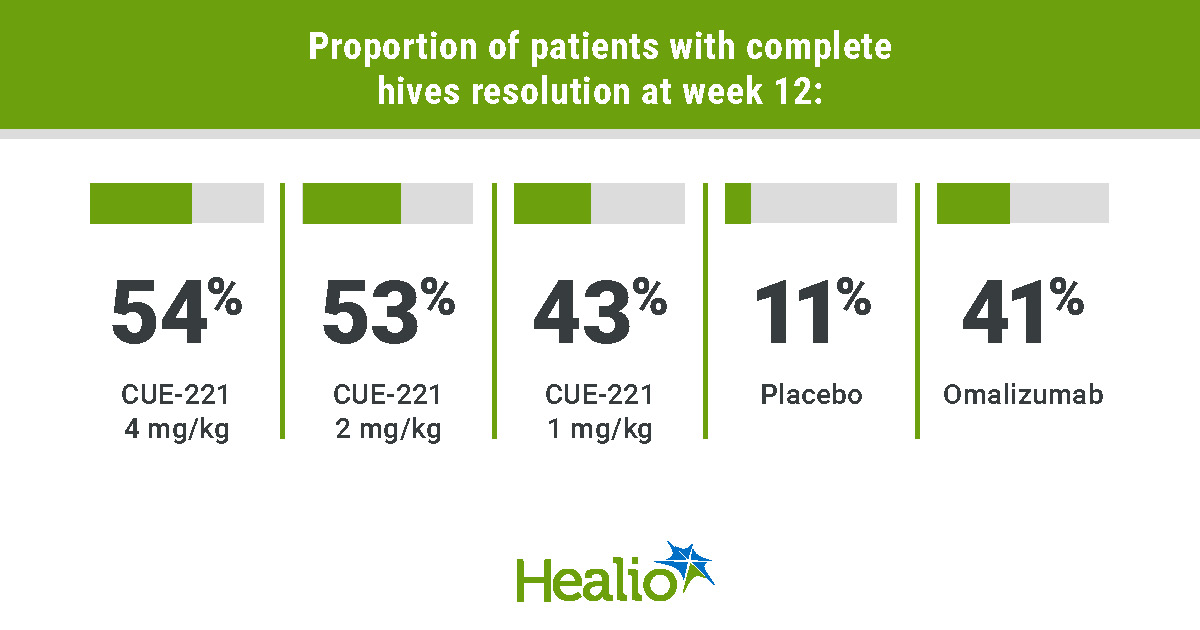
At week 12, complete resolution of hives, defined as a weekly hives severity score (HSS7) of 0, was reported in 54% of participants receiving CUE-221 at 4 mg/kg, 53% receiving 2 mg/kg, and 43% receiving 1 mg/kg, compared with 11% receiving placebo and 41% receiving omalizumab. Complete response based on the weekly urticaria activity score (UAS7 = 0) occurred in 46%, 39%, and 38% of the respective CUE-221 dose groups, compared with 11% in the placebo group and 29% in the omalizumab group.
The high-dose group also demonstrated sustained responses after treatment discontinuation. At week 28, 12 weeks after the last injection, complete hives resolution was reported in 60% of participants receiving CUE-221 at 4 mg/kg, compared with 24% receiving omalizumab. Complete response based on UAS7 = 0 persisted in 43% and 24%, respectively.
CUE-221 was designed to both neutralize IgE activity and preserve IgE binding to CD23, potentially affecting the production of new IgE. Although these findings suggest a potentially differentiated treatment effect, the results remain preliminary. Full peer-reviewed trial data are needed to establish the statistical robustness, durability, and clinical relevance of the observed differences.
Why This Matters
Chronic spontaneous urticaria is characterized by recurrent wheals (hives), itching, and sometimes angioedema without an identifiable external trigger. Symptoms can persist for months or years and substantially impair sleep, daily activities, and quality of life.
H1 antihistamines are a standard initial treatment, but some patients remain symptomatic despite appropriate therapy. Omalizumab, an anti-IgE biologic, is an established treatment option for eligible patients whose CSU remains inadequately controlled.
CUE-221 is being investigated as a potential alternative with a distinct molecular design. Unlike conventional IgE-neutralizing approaches, it was engineered to block IgE interactions with the high-affinity FcεRI receptor while preserving IgE binding to CD23. The proposed dual mechanism may affect both immediate IgE-mediated allergic signaling and the regulation of new IgE production.
The apparent persistence of complete responses after treatment discontinuation is particularly noteworthy. However, a response observed after drug withdrawal does not by itself establish disease modification, long-term remission, or superiority over established therapies. Those possibilities require confirmation in adequately powered, fully reported clinical trials.
Study at a Glance
| Feature | Details |
|---|---|
| Study type | Multicenter, randomized, double-blind, placebo- and active comparator-controlled phase 2 clinical trial |
| Participants | 145 adults with moderate to severe CSU inadequately controlled by H1 antihistamines |
| Investigational treatment | Subcutaneous CUE-221 at 4 mg/kg, 2 mg/kg, or 1 mg/kg |
| Comparator groups | Subcutaneous placebo and omalizumab 300 mg |
| Dosing interval | Every 4 weeks |
| Treatment period | Five assigned treatment administrations, through week 16 |
| Primary outcome | Complete hives resolution at week 12, defined as HSS7 = 0 |
| Other efficacy outcomes | Complete response defined as UAS7 = 0; change in UAS7; persistence of response after treatment discontinuation |
| Main finding | At week 12, complete hives resolution was reported in 54% of the 4 mg/kg group vs 11% of the placebo group |
| Off-treatment finding | At week 28, complete hives resolution was reported in 60% of the 4 mg/kg group vs 24% of the omalizumab group |
| Follow-up | Through week 36, including 20 weeks off treatment after the week 16 administration |
| Trial registration | Not provided in the supplied report |
| Publication status | Topline findings reported through a company announcement and conference call, as described by Healio |
| Original research DOI | Not provided in the supplied report |
Important methodological note: The supplied report describes the week 12 endpoint as the primary endpoint but does not provide a trial registration number, complete statistical analysis plan, confidence intervals, or a peer-reviewed original manuscript. These details should be verified before drawing definitive conclusions about comparative efficacy.
What the Researchers Found
1. Participant characteristics and treatment allocation
A total of 145 adults were reported as enrolled in the study. Two participants were randomized but did not receive treatment. The treatment groups included 35 participants receiving CUE-221 at 4 mg/kg, 36 receiving 2 mg/kg, 37 receiving 1 mg/kg, 18 receiving placebo, and 17 receiving omalizumab.
| Baseline characteristic | CUE-221 4 mg/kg | CUE-221 2 mg/kg | CUE-221 1 mg/kg | Placebo | Omalizumab |
|---|---|---|---|---|---|
| Participants allocated | 35 | 36 | 37 | 18 | 17 |
| Mean age, years | 41.7 | 39.1 | 42.8 | 37.8 | 42.3 |
| Women, % | 54.3 | 50.0 | 62.2 | 61.1 | 35.3 |
| Mean CSU duration, years | 4.1 | 6.1 | 4.0 | 4.5 | 3.3 |
| Mean baseline UAS7 | 28.5 | 31.0 | 29.5 | 31.7 | 30.6 |
The baseline UAS7 values indicate substantial disease activity across the groups. The trial therefore evaluated an adult population with persistent symptoms despite antihistamine treatment, rather than an unselected population with mild or newly developed urticaria.
The numbers available for efficacy analyses varied by visit. At week 12, data were available for 33 participants in each of the 4 mg/kg and 2 mg/kg groups, 32 in the 1 mg/kg group, 18 in the placebo group, and 15 in the omalizumab group.
The report also stated that complete study data were available for 24, 28, 24, 14, and 13 participants in these groups, respectively. The precise definition of complete study data and the handling of missing observations were not provided in the supplied article.
2. Complete resolution of hives at week 12
At week 12, all three CUE-221 dose groups had a higher reported proportion of participants achieving complete hives resolution than the placebo group.
| Treatment group | Participants with week 12 data | Complete hives resolution, % | Absolute difference vs placebo |
|---|---|---|---|
| CUE-221 4 mg/kg | 33 | 54 | +43 percentage points |
| CUE-221 2 mg/kg | 33 | 53 | +42 percentage points |
| CUE-221 1 mg/kg | 32 | 43 | +32 percentage points |
| Placebo | 18 | 11 | Reference |
| Omalizumab 300 mg | 15 | 41 | +30 percentage points |
Absolute differences are calculated from the rounded percentages in the supplied report and are descriptive, not adjusted treatment-effect estimates.
The 4 mg/kg and 2 mg/kg groups showed similar week 12 rates of complete hives resolution, while the 1 mg/kg group had a lower reported rate. The omalizumab group also showed improvement relative to placebo.
The article reported that each CUE-221 dose group had a statistically significant advantage over placebo for this endpoint. However, the supplied report did not provide exact P values, confidence intervals, or details of multiplicity adjustment.
3. Complete response based on overall urticaria activity
The investigators also assessed complete response using UAS7 = 0, which reflects the absence of both hives and itch during the preceding 7 days.
| Treatment group | Complete response at week 12, % | Absolute difference vs placebo |
|---|---|---|
| CUE-221 4 mg/kg | 46 | +35 percentage points |
| CUE-221 2 mg/kg | 39 | +28 percentage points |
| CUE-221 1 mg/kg | 38 | +27 percentage points |
| Placebo | 11 | Reference |
| Omalizumab 300 mg | 29 | +18 percentage points |
The 4 mg/kg group had the highest reported rate of complete UAS7 response. According to the report, the difference between the 4 mg/kg group and placebo was statistically significant. The supplied text did not establish statistical significance for every other comparison in this table.
The distinction between HSS7 = 0 and UAS7 = 0 is important. Complete hives resolution does not necessarily mean that itching has also disappeared. UAS7 = 0 is a broader measure of complete symptom control.
4. Change in UAS7 from baseline to week 12
Mean UAS7 scores decreased in all active-treatment groups, with the largest reported reductions in the CUE-221 4 mg/kg and 2 mg/kg groups.
| Treatment group | Change in mean UAS7 from baseline to week 12 |
|---|---|
| CUE-221 4 mg/kg | −24 points |
| CUE-221 2 mg/kg | −24 points |
| CUE-221 1 mg/kg | −22 points |
| Placebo | −13 points |
| Omalizumab 300 mg | −23 points |
The conference call presentation cited a minimal clinically important improvement of approximately 9.5 to 10.5 points on UAS7. The reported mean reductions in all five groups exceeded that range.
This finding should be interpreted alongside the placebo response and the small comparator groups. Although the mean reductions suggest clinically meaningful symptom improvement, the supplied report does not provide sufficient information to independently evaluate the uncertainty around between-group differences.
5. Persistence of complete hives resolution after treatment
Responses were assessed after the final scheduled treatment administration at week 16.
| Assessment time | Time since last injection | CUE-221 4 mg/kg | CUE-221 2 mg/kg | CUE-221 1 mg/kg | Omalizumab |
|---|---|---|---|---|---|
| Week 12 | During treatment | 54% | 53% | 43% | 41% |
| Week 22 | 6 weeks | 69% | 61% | 57% | 41% |
| Week 28 | 12 weeks | 60% | 31% | 24% | 24% |
Percentages are reported in the supplied article. The table does not imply that the same individuals achieved or maintained a response at every assessment.
At week 22, the proportion with complete hives resolution increased in each CUE-221 group, reaching 69% in the 4 mg/kg group. At week 28, the rate remained 60% in the high-dose group but declined to 31% and 24% in the lower-dose groups.
The omalizumab group had a reported complete hives resolution rate of 24% at week 28.
These observations suggest a possible dose-related difference in the persistence of response. Nevertheless, the available data do not establish whether the difference reflects sustained biological effects, differences in drug exposure, random variation, missing observations, or other factors.
6. Persistence of complete overall response
The report also provided week 28 results for UAS7 = 0.
| Treatment group | Complete response at week 12 | Complete response at week 28 |
|---|---|---|
| CUE-221 4 mg/kg | 46% | 43% |
| Omalizumab 300 mg | 29% | 24% |
The high-dose CUE-221 group retained a similar reported rate of complete overall response between weeks 12 and 28, whereas the omalizumab rate declined.
This comparison is potentially important because UAS7 = 0 captures the absence of both hives and itch. However, the supplied report did not provide corresponding week 28 UAS7 = 0 results for the two lower CUE-221 doses or placebo, nor did it provide confidence intervals for the comparison.
7. Proposed mechanism of action
CUE-221 is a humanized anti-IgE IgG1 monoclonal antibody engineered to influence IgE biology through two proposed mechanisms.
The first is neutralization of IgE and inhibition of its binding to the high-affinity FcεRI receptor, which plays a central role in mast-cell and basophil activation in allergic disease.
The second is preservation of IgE binding to CD23, a low-affinity IgE receptor involved in the regulation of IgE responses. The developers propose that this design may support downregulation of new IgE production in addition to blocking IgE-mediated allergic signaling.
Dominic Borie, MD, PhD, chief medical officer and head of research and development at Cue Biopharma, explained:
“CUE-221 was designed to block IgE binding to the high affinity receptor, and in doing so, provides potent IgE neutralization or IgE blocking.”
He further explained that the antibody was designed to preserve IgE binding to CD23 by selecting binding sites distant from the region involved in CD23 engagement.
These are statements describing the investigational drug’s intended mechanism. The clinical results reported so far do not independently prove that suppression of new IgE production caused the observed off-treatment responses.
Clinical Significance
The results raise the possibility that CUE-221 could provide substantial symptom control for some patients with CSU who remain symptomatic despite antihistamine treatment.
Three findings are particularly relevant:
- High rates of complete hives resolution: The 4 mg/kg and 2 mg/kg groups had reported week 12 complete hives resolution rates above 50%, compared with 11% in the placebo group.
- Potential durability after discontinuation: The 4 mg/kg group maintained a reported 60% complete hives resolution rate 12 weeks after the final injection, suggesting a possible persistent effect beyond active dosing.
- A potential distinction between symptom control and disease modification: The proposed CD23-related mechanism offers a biological hypothesis for longer-lasting effects, but the current results do not establish that CUE-221 modifies the underlying disease process.
The active comparator findings should also be interpreted cautiously. Although CUE-221’s reported response rates were higher than those of omalizumab at several time points, the omalizumab group included only 17 allocated participants, with 15 contributing week 12 data. The supplied report does not establish that the trial was powered to demonstrate superiority over omalizumab.
Consequently, the findings should be considered hypothesis-generating rather than sufficient grounds to replace established CSU treatment.
Safety and Tolerability
Treatment-related treatment-emergent adverse events were reported in the three CUE-221 dose groups.
| Treatment group | Participants allocated | Participants with treatment-related adverse events |
|---|---|---|
| CUE-221 4 mg/kg | 35 | 42.9% |
| CUE-221 2 mg/kg | 36 | 47.2% |
| CUE-221 1 mg/kg | 37 | 32.4% |
According to the company-reported results:
- No treatment-related serious adverse events were reported.
- No anaphylaxis events occurred in any group.
- One grade 2 injection-site reaction was reported as an adverse event of special interest.
- Two participants discontinued the study because of treatment-related adverse events, one each in the 2 mg/kg and 1 mg/kg groups.
- No treatment-emergent adverse events resulted in death.
The supplied report does not provide a complete adverse-event table for placebo and omalizumab, detailed event categories, laboratory findings, or sufficiently long follow-up to characterize uncommon or delayed adverse effects.
The sample size is also too small to exclude rare serious harms. Further clinical evaluation is necessary before the safety profile can be considered established.
Limitations
Several limitations affect the interpretation of these findings.
Preliminary reporting: The results were presented as topline data through a company announcement and conference call, rather than as a fully reported peer-reviewed trial publication in the supplied source.
Small treatment groups: Individual groups contained only 17 to 37 allocated participants. Small samples increase uncertainty around response rates and limit the ability to detect uncommon adverse events.
Incomplete outcome data: The numbers contributing data varied across assessments. The supplied report does not fully describe the statistical handling of missing data or whether all percentages were calculated using the same analysis population.
Unclear comparative power: Although the trial included omalizumab as an active comparator, the report does not establish that it was designed or powered to demonstrate superiority over omalizumab.
Limited statistical detail: Exact P values, confidence intervals, prespecified analysis methods, and multiplicity adjustments were not supplied for all reported comparisons.
Uncertain durability: Off-treatment responses were observed over a limited period. Longer follow-up is needed to determine whether responses persist, relapse, or require retreatment.
Mechanistic uncertainty: The proposed effect on new IgE production remains an interpretation of the findings until pharmacokinetic, pharmacodynamic, and other mechanistic data are fully evaluated.
Limited generalizability: The findings apply to the adult CSU population studied and should not automatically be extrapolated to children, other urticaria subtypes, or other IgE-mediated conditions.
Potential sponsor-related bias: The trial sponsor’s employees presented the findings and offered interpretations of the mechanism and clinical significance. Independent assessment of the complete data is important.
What Doctors Should Know
- CUE-221 remains an investigational treatment in the supplied report; these results do not establish regulatory approval or routine clinical availability.
- H1 antihistamines remain a standard first-line treatment approach for CSU, with subsequent treatment guided by disease control, clinical guidelines, and patient-specific factors.
- Omalizumab is an established therapeutic option for eligible patients with CSU that remains inadequately controlled by antihistamines.
- The highest CUE-221 dose produced the strongest reported persistence of complete symptom responses after treatment discontinuation.
- HSS7 = 0 and UAS7 = 0 are distinct outcomes. The former indicates complete hives resolution, whereas the latter indicates complete control of both hives and itch.
- The reported differences versus omalizumab are descriptive unless supported by prespecified, adequately powered comparative analyses.
- The absence of reported anaphylaxis or treatment-related serious adverse events in this small study does not establish that these risks are absent.
- Clinicians should await full trial publication and subsequent confirmatory studies before drawing conclusions about long-term efficacy, comparative superiority, disease modification, or optimal dosing.
Bottom Line
In a phase 2 study of adults with moderate to severe CSU inadequately controlled by H1 antihistamines, CUE-221 was associated with higher reported rates of complete hives resolution than placebo. The 4 mg/kg dose also showed persistent responses 12 weeks after the final injection, with 60% achieving complete hives resolution and 43% achieving complete response on UAS7.
The results support further investigation of CUE-221’s dual-mechanism design. However, small treatment groups, preliminary reporting, incomplete statistical details, and limited off-treatment follow-up prevent definitive conclusions about superiority over omalizumab or disease modification.
Larger, fully reported studies will be necessary to establish the treatment’s efficacy, safety, durability, and place in CSU management.
Original Research and Disclosures
Company announcement: Cue Biopharma. Cue Biopharma Announces Positive Topline Results From CUE-221 Phase 2 Study in Chronic Spontaneous Urticaria.
https://www.cuebiopharma.com/news/cue-biopharma-announces-positive-topline-results-from-cue-221-phase-2-study-in-chronic-spontaneous-urticaria/
Original research DOI: Not provided in the supplied report. A DOI or peer-reviewed manuscript should not be inferred from the company announcement alone.
Disclosures: Dominic Borie, MD, PhD, and Shao-Lee Lin, MD, PhD, were reported to be employees of Cue Biopharma.