Weight-Loss Medications Not Associated With Increased Risk of Respiratory Adverse Events
1-minute summary
A systematic review and meta-analysis found no evidence that several widely used weight-loss medications increase the risk of common respiratory adverse events compared with placebo.
The analysis included 123 studies, comprising 116 randomized controlled trials, 2 pooled analyses, 2 large single-group studies, 1 comparative study and 1 nonrandomized controlled trial. The medications evaluated included liraglutide, semaglutide, tirzepatide, orlistat, naltrexone-bupropion, phentermine-topiramate and setmelanotide.
For liraglutide, semaglutide, tirzepatide and naltrexone-bupropion, the investigators did not identify an increased risk of respiratory adverse events compared with placebo. Outcomes examined included lower respiratory tract infections, other respiratory tract infections, cough and several upper respiratory tract infections.
However, the evidence specifically involving people with asthma or other respiratory diseases was limited. Only 1 additional trial specifically focused on people with obesity and asthma, and respiratory adverse events were not reported in that study.
The findings are therefore reassuring regarding the general respiratory safety profile of several weight-loss medications, but they do not establish respiratory benefit or disease-specific safety in patients with asthma or COPD.
Why this matters
Obesity and respiratory diseases frequently coexist. People with obesity and asthma may have more difficult-to-control disease and poorer outcomes, while weight reduction itself can improve respiratory health.
The increasing use of GLP-1 receptor agonists and dual GLP-1/GIP receptor agonists has generated interest in whether these medications could affect respiratory outcomes directly, beyond their effects on body weight and metabolic health.
At the same time, previous spontaneous adverse-event reports had raised questions about possible respiratory adverse events associated with some GLP-1 receptor agonists. The investigators therefore conducted a systematic review and meta-analysis to more comprehensively assess respiratory safety.
The study’s findings provide reassurance for clinicians considering weight-loss medications in patients who are concerned about respiratory adverse effects, but the evidence remains insufficient to make conclusions specifically about people with asthma or COPD.
Study at a glance
| Feature | Details |
|---|---|
| Study type | Systematic review and meta-analysis |
| Publication | Annals of the American Thoracic Society |
| Total studies | 123 |
| Randomized controlled trials | 116 |
| Other studies | 2 pooled analyses, 2 large single-group studies, 1 comparative study, 1 nonrandomized controlled trial, plus 1 additional open-label RCT specifically involving obesity and asthma |
| Interventions | Multiple weight-loss medications |
| Comparator | Placebo in the primary comparative analyses |
| Primary focus | Respiratory adverse events |
| Major medications with sufficient evidence | Liraglutide, semaglutide, tirzepatide, naltrexone-bupropion |
| Additional medications | Orlistat, phentermine-topiramate, setmelanotide |
| Main finding | No evidence of increased respiratory adverse-event risk for several commonly used agents |
| Asthma-specific evidence | Very limited |
| DOI | 10.1093/annalsats/aaoag177 |
The review searched 4 databases and 2 clinical trial registries.
Weight-loss medications evaluated
The studies included several pharmacologic approaches to weight management.
| Medication | Number of studies |
|---|---|
| Liraglutide | 53 |
| Semaglutide | 37 |
| Tirzepatide | 16 |
| Orlistat | 6 |
| Naltrexone-bupropion | 5 |
| Phentermine-topiramate | 4 |
| Setmelanotide | 1 |
Liraglutide, semaglutide and tirzepatide were the principal GLP-1-based therapies represented in the analysis.
What the researchers found
No increased risk of lower respiratory tract infections
For liraglutide, semaglutide and tirzepatide, the analysis did not demonstrate a statistically significant difference compared with placebo for lower respiratory tract infections.
These outcomes included:
- bronchitis,
- pneumonia, and
- viral pneumonia.
The same overall lack of significant difference was observed for broader respiratory tract infections, cough and other respiratory harms.
Summary
| Respiratory outcome | GLP-1 / dual GLP-1-GIP therapies vs placebo |
|---|---|
| Lower respiratory tract infection | No significant increase |
| Bronchitis | No significant increase |
| Pneumonia | No significant increase |
| Viral pneumonia | No significant increase |
| Respiratory tract infection | No significant increase |
| Cough | No significant increase |
| Other respiratory harms | No significant increase |
Upper respiratory tract infections
The investigators also examined several upper respiratory tract outcomes, including:
- nasopharyngitis,
- sinusitis,
- acute sinusitis,
- rhinitis,
- allergic rhinitis,
- pharyngitis, and
- bacterial pharyngitis.
Most comparisons did not show statistically significant differences between GLP-1/dual GLP-1-GIP therapies and placebo.
Two statistically significant differences were identified:
| Outcome | Time period | Risk difference | 95% CI |
|---|---|---|---|
| Sinusitis | 0–6 months | −1.0% | −1.9% to −0.1% |
| Rhinitis | 13–24 months | −0.7% | −1.1% to −0.2% |
The negative risk differences indicate that these events were less frequent in the medication group than in the placebo group during the specified periods. However, the authors urged caution when interpreting these isolated statistically significant findings.
They noted that the analysis involved a large number of outcomes and time periods, increasing the possibility of chance findings arising from multiple comparisons.
The researchers wrote:
“Although we found statistically significant differences for a few outcomes, these findings should be interpreted with caution, given the potential for spurious significance due to multiple comparisons arising from the large number of outcomes and time periods evaluated.”
Medication-specific findings
Liraglutide
The most frequently studied liraglutide doses were:
- 1.2 mg
- 1.8 mg
- 3 mg
No increased risk of respiratory adverse events was identified for these doses compared with placebo.
Nasopharyngitis over time
The incidence of nasopharyngitis among liraglutide studies increased with longer study duration:
| Duration | Nasopharyngitis incidence |
|---|---|
| 0–6 months | 8.0% |
| 7–12 months | 15.7% |
| 13–24 months | 23.7% |
The increasing incidence over time does not, by itself, demonstrate that liraglutide caused the events. Longer observation provides more opportunities for adverse events to occur, and the underlying populations and study characteristics may differ across durations.
Semaglutide
The principal semaglutide doses assessed were:
- 1 mg
- 2.4 mg
- 14 mg
As with liraglutide, the analysis did not identify an increased risk of respiratory adverse events compared with placebo.
Nasopharyngitis over time
| Duration | Nasopharyngitis incidence |
|---|---|
| 0–6 months | 7.2% |
| 7–12 months | 11.9% |
| 13–24 months | 12.5% |
Thus, nasopharyngitis incidence increased between the earliest and later observation periods, although the increase was less pronounced between 7–12 and 13–24 months.
Tirzepatide
The principal tirzepatide doses evaluated were:
- 5 mg
- 10 mg
- 15 mg
No increased respiratory adverse-event risk compared with placebo was identified.
Unlike liraglutide and semaglutide, nasopharyngitis incidence with tirzepatide did not show a consistent increase with longer study duration.
| Duration | Nasopharyngitis incidence |
|---|---|
| 0–6 months | 4.1% |
| 7–12 months | 8.9% |
| 13–24 months | 4.2% |
Naltrexone-bupropion
The most commonly evaluated dose was:
32 mg/360 mg
The analysis did not identify a heightened risk of respiratory adverse events compared with placebo.
Evidence for other weight-loss medications
Evidence for orlistat, phentermine-topiramate and setmelanotide was substantially more limited.
The investigators stated that the available data were too sparse to permit meaningful summaries of respiratory adverse-event patterns.
| Medication | Evidence base | Interpretation |
|---|---|---|
| Liraglutide | 53 studies | Respiratory safety generally reassuring |
| Semaglutide | 37 studies | Respiratory safety generally reassuring |
| Tirzepatide | 16 studies | Respiratory safety generally reassuring |
| Orlistat | 6 studies | Insufficient for meaningful summary |
| Naltrexone-bupropion | 5 studies | No heightened risk identified |
| Phentermine-topiramate | 4 studies | Insufficient for meaningful summary |
| Setmelanotide | 1 study | Insufficient for meaningful summary |
What the researchers said
The investigators described the overall findings as reassuring:
“The overall findings were reassuring.”
They further stated:
“Across 123 studies, including 116 randomized controlled trials, we did not find evidence that liraglutide, semaglutide, tirzepatide or naltrexone-bupropion increased the risk of respiratory adverse events compared with placebo.”
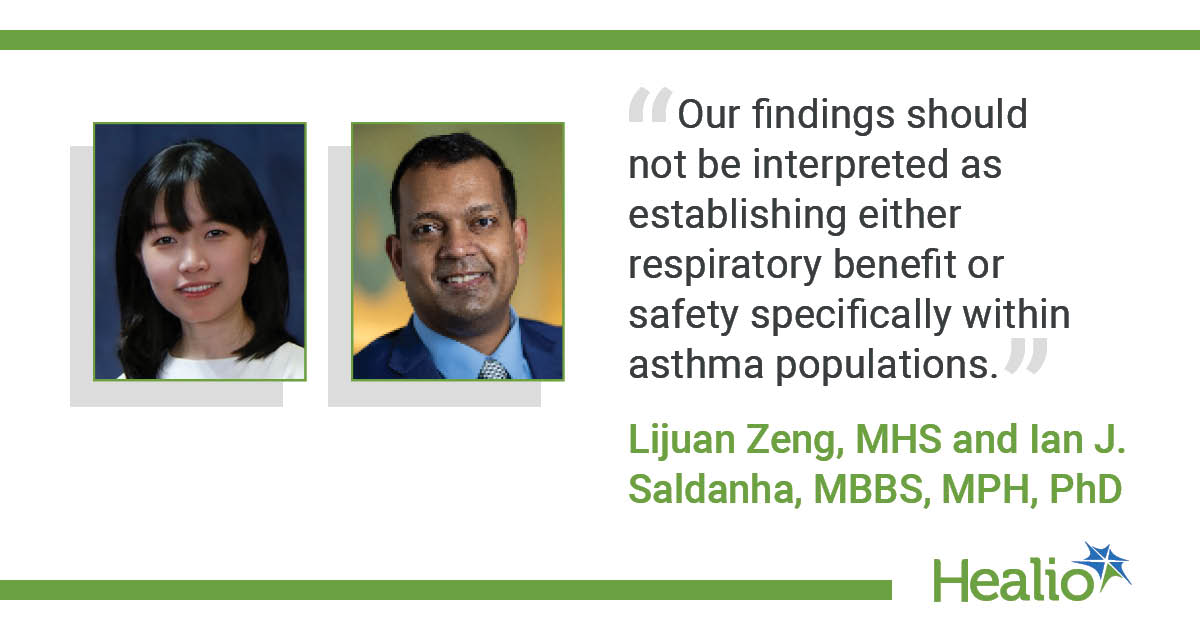
Ian J. Saldanha, MBBS, MPH, PhD, and Lijuan Zeng, MHS, PhD, emphasized that the available evidence does not indicate an increased risk of common respiratory adverse events with several widely used weight-loss therapies:
“The available evidence does not suggest an increased risk of common respiratory adverse events with several widely used weight-loss medications, particularly GLP-1 and dual GLP-1/GIP receptor agonists.”
They also cautioned against extrapolating the findings to patients with respiratory diseases:
“The evidence is much more limited for patients with respiratory diseases, such as asthma or COPD.”
Evidence specifically involving asthma
The asthma-specific evidence was one of the major limitations of the review.
The investigators identified 1 additional open-label randomized controlled trial that specifically enrolled individuals with obesity and asthma. However, respiratory adverse events were not reported in that study.
Consequently, the meta-analysis cannot establish whether these medications:
- improve asthma control,
- reduce asthma exacerbations,
- worsen asthma,
- reduce respiratory medication requirements, or
- have direct effects on airway inflammation.
The authors emphasized:
“There was very limited evidence specifically addressing people with asthma.”
They also noted that many large weight-loss trials included participants with asthma, but asthma-specific outcomes were rarely reported.
Why the asthma evidence gap matters
Obesity and asthma frequently coexist, and obesity can make asthma more difficult to control.
Weight reduction itself may improve asthma outcomes. This creates an important clinical question: if GLP-1-based medications produce substantial weight loss, are respiratory improvements simply a consequence of weight reduction, or could these medications also have direct effects on respiratory disease?
The current evidence cannot answer that question.
The researchers therefore identified a need for studies that distinguish between:
Weight loss → improved metabolic health → improved respiratory outcomes
and a potential:
Direct pharmacologic effect of GLP-1/GIP pathways → altered airway inflammation or respiratory disease activity
Clinical significance
For clinicians prescribing liraglutide, semaglutide, tirzepatide or naltrexone-bupropion for weight management, the findings are generally reassuring with respect to common respiratory adverse events.
The available evidence did not show an increased risk compared with placebo for several respiratory outcomes.
However, clinicians should distinguish between:
Respiratory safety
The available evidence suggests no major increase in common respiratory adverse events with several commonly used agents.
Respiratory efficacy
The study does not establish that these medications improve asthma, COPD or other respiratory diseases.
Disease-specific safety
The evidence is insufficient to conclude that these medications are specifically safe or beneficial for all patients with asthma or COPD.
What doctors should know
- A large systematic review and meta-analysis evaluated respiratory adverse events associated with weight-loss medications.
- The evidence base included 123 studies, with 116 randomized controlled trials.
- Liraglutide, semaglutide, tirzepatide and naltrexone-bupropion were not associated with an increased risk of respiratory adverse events compared with placebo.
- No significant increase was observed for lower respiratory tract infections, broader respiratory infections, cough or several other respiratory outcomes.
- Two statistically significant findings favored active treatment for sinusitis and rhinitis, but these should be interpreted cautiously because of multiple comparisons.
- Respiratory adverse-event data for orlistat, phentermine-topiramate and setmelanotide were too limited for meaningful conclusions.
- The evidence specifically involving asthma was very limited.
- Respiratory outcomes were rarely reported separately in large weight-loss trials that included people with asthma.
- The study should not be interpreted as proving that GLP-1-based therapies improve asthma or COPD.
- Future trials should prospectively collect respiratory outcomes in participants with obesity and asthma.
Limitations
1. Limited asthma-specific evidence
The largest limitation is the small amount of evidence specifically addressing people with asthma.
Although patients with asthma may have been included in some larger weight-loss trials, asthma-specific outcomes were often not reported.
2. Sparse evidence for several medications
The number of studies evaluating orlistat, phentermine-topiramate and setmelanotide was small, limiting the ability to assess respiratory safety reliably.
3. Multiple statistical comparisons
The analysis assessed numerous respiratory outcomes across multiple time periods. This creates the possibility of statistically significant findings occurring by chance.
The authors specifically cautioned about this issue.
4. Respiratory adverse events are not the same as respiratory disease outcomes
The absence of an increased adverse-event signal does not demonstrate that a medication improves lung function, asthma control or COPD outcomes.
5. Limited information regarding direct respiratory effects
It remains uncertain whether any respiratory benefits potentially associated with GLP-1 therapies are attributable entirely to weight loss and metabolic improvements or whether the medications may have additional effects on airway inflammation.
Future research priorities
The researchers recommend that future weight-loss studies systematically collect respiratory outcomes, particularly among people with obesity and asthma.
Important outcomes should include:
| Recommended outcome | Why it matters |
|---|---|
| Asthma exacerbations | Determines whether treatment affects acute disease worsening |
| Symptom control | Measures day-to-day respiratory impact |
| Respiratory medication use | Assesses changes in treatment requirements |
| Lung function | Provides objective physiological evidence |
| Respiratory healthcare utilization | Captures clinically important outcomes such as emergency visits and hospitalizations |
The researchers also called for studies to determine whether any respiratory benefit results primarily from weight loss and improved metabolic health or whether GLP-1 therapies may have more direct effects on airway inflammation.
Bottom line
A systematic review and meta-analysis of 123 studies, including 116 randomized controlled trials, found no evidence that liraglutide, semaglutide, tirzepatide or naltrexone-bupropion increase the risk of common respiratory adverse events compared with placebo.
The findings are reassuring for the respiratory safety of these medications in the populations studied. However, the evidence base for people with asthma or COPD remains limited, and the analysis does not establish that these medications improve respiratory disease.
For patients with obesity and asthma, future trials should specifically evaluate asthma exacerbations, symptom control, lung function, respiratory medication requirements and healthcare utilization.
Original research / DOI
Zeng L, Saldanha IJ, et al.
Annals of the American Thoracic Society. 2026.
DOI: 10.1093/annalsats/aaoag177
Study type: Systematic review and meta-analysis
Primary evidence base: 123 studies, including 116 randomized controlled trials.
Key clinical message: No increased respiratory adverse-event risk was identified for liraglutide, semaglutide, tirzepatide or naltrexone-bupropion compared with placebo, but evidence specifically in asthma and COPD remains inadequate.