
Top Posts
Asthma exacerbations drop with medium-dose ICS to biologic...
Hypercortisolism common in patients with resistant hypertension
Elegrobart reduces proptosis in active thyroid eye disease
Brepocitinib โ€˜a major move forwardโ€™ as first targeted...
Posts about celeb-owned alcohol brands reach most underage...
Evolocumab cuts heart events in patients with diabetes...
Extended use of AUD medications cut mortality risk...
Zongertinib a โ€˜breakthroughโ€™ for NSCLC with HER2 mutations
Biomarker panel distinguishes alcohol vs. metabolic liver disease
Contact form
SunilMadhavs World
  • Home
  • Support Portal
  • My Subscriptions
  • Contact Information
  • About
    • Cardiology
      • Gastroenterology
        • Radiology
          • Pulmonology
            • Gynecology
    • Neurology
  • Urology
    • Hematology
      • Profile
        • Log Out
        • Register
        • Edit Account
        • Change Password
        • GDPR-compliant cookie policy.
          • Terms and conditions
            • Contact Information
  • About
    • Privacy policy
      • BASICS DISCUSS
        • BASICS
          • ANATOMY
            • BASICS PRO
              • ANATOMY PRO
              • BIOCHEMISTRY PRO
              • PHYSIOLOGY
                • BIOCHEMISTRY
                  • PHYSIOLOGY PRO
                    • BASICS RESEARCH
                    • ANATOMY ADVANCEMENTS
                    • BIOCHEMISTRY ADVANCEMENTS
                    • PHYSIOLOGY ADVANCEMENTS
  • Team SunilMadhavs World
  • TOPICS
  • INTERMEDIATE
  • 0
Home ยป Hypercortisolism common in patients with resistant hypertension
CardiologyENDOCRINOLOGYINTERNAL MEDICINE

Hypercortisolism common in patients with resistant hypertension

by Team SunilMadhavs World April 7, 2026
A+A-
Reset
32
ย 

High Prevalence of Hypercortisolism in Patients With Resistant Hypertension: Findings From the MOMENTUM Study

Importance Resistant hypertension affects a substantial proportion of patients with elevated blood pressure, yet the underlying secondary endocrine causesโ€”such as hypercortisolismโ€”often remain underdiagnosed. Identifying these hidden etiologies is critical for appropriate referral and targeted management.

Objective To determine the true prevalence of endogenous hypercortisolism among a large cohort of patients diagnosed with resistant hypertension.

Design, Setting, and Participants The MOMENTUM study, presented at the American College of Cardiology (ACC) Scientific Session in New Orleans, evaluated 1,086 patients with resistant hypertension. Resistant hypertension was strictly defined as either maintaining a systolic blood pressure of 130 mm Hg or higher despite adherence to at least three classes of antihypertensive medications (including a diuretic), or requiring at least four classes of antihypertensive medications (including a diuretic) regardless of current blood pressure control.

Patients were screened for endogenous hypercortisolism utilizing a standard dexamethasone suppression test. A positive diagnosis was established if cortisol levels remained greater than 1.8 ยตg/dL in the presence of dexamethasone levels of at least 140 ng/dL.

Table 1. Diagnostic Criteria in the MOMENTUM Study

Diagnostic Category Clinical Criteria
Resistant Hypertension

Systolic BP $\ge$ 130 mm Hg on $\ge$ 3 antihypertensive classes (including a diuretic)

ย 

OR

ย 

Use of $\ge$ 4 antihypertensive classes (including a diuretic) regardless of BP.

Endogenous Hypercortisolism Positive dexamethasone suppression test: Cortisol > 1.8 ยตg/dL with dexamethasone $\ge$ 140 ng/dL.

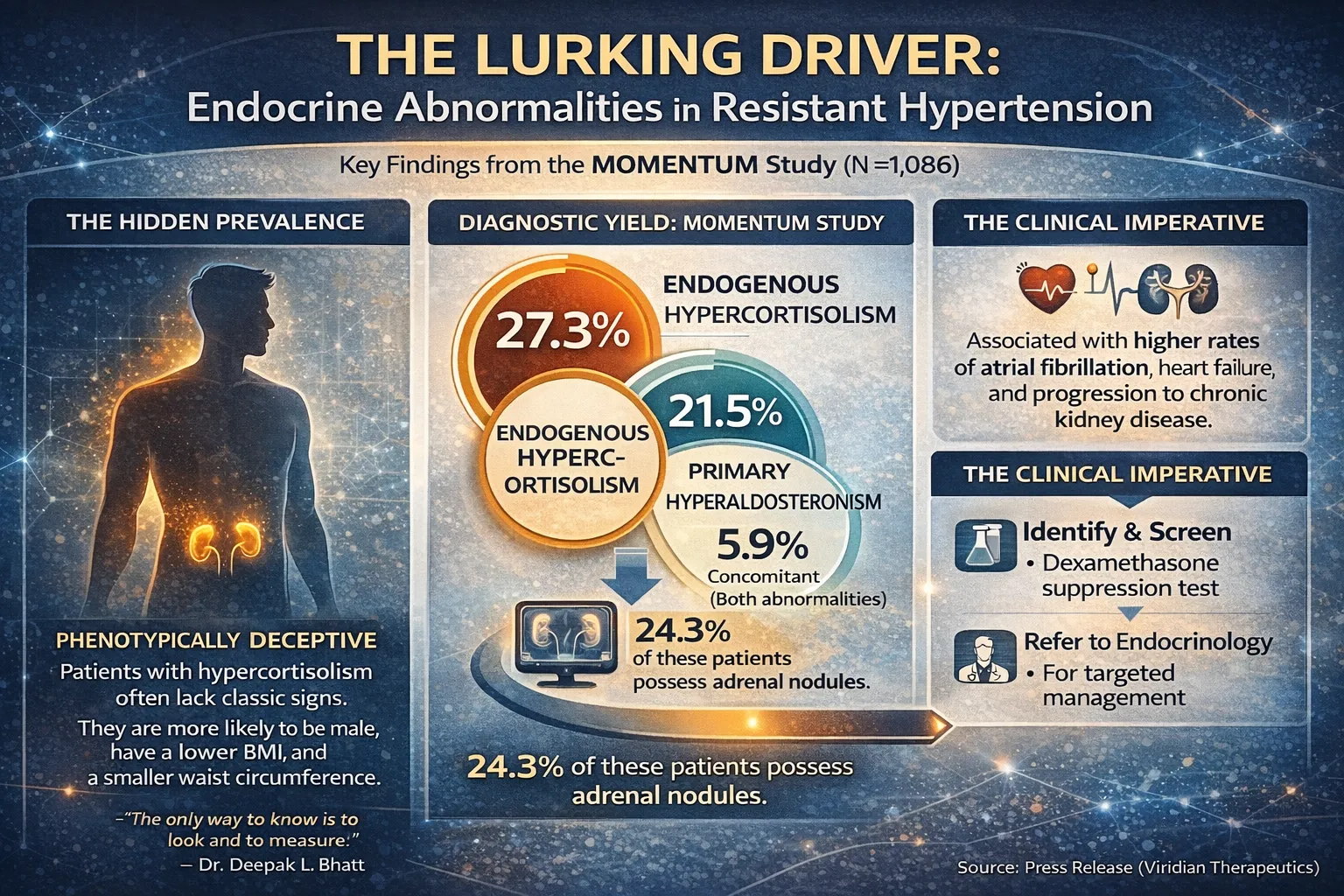
Main Outcomes and Results The study revealed that endogenous hypercortisolism is highly prevalent in this population, affecting more than one in four patients. Specifically, 27.3% (95% CI, 24.7%-31.1%) of the resistant hypertension cohort tested positive for hypercortisolism. Furthermore, primary hyperaldosteronism was identified in 21.5% of the cohort, with an overlapping 5.9% of patients testing positive for both endocrine abnormalities. Among the subset of patients with confirmed hypercortisolism, 24.3% were found to have adrenal nodules upon subsequent CT imaging.

Deepak L. Bhatt, MD, MPH, MBA, director of the Mount Sinai Fuster Heart Hospital, contextualized the magnitude of these findings: โ€œThe purpose of the study [was] to see what the prevalence is of real hypercortisolism in this patient population of folks with resistant hypertension, which is a pretty common population; somewhere between 10% and 15% of patients in that large universe of hypertension have resistant hypertension.โ€ He added, โ€œUnlike what I think lots of doctors believe, it was extremely common.โ€

Table 2. Prevalence of Endocrine Abnormalities in the Resistant Hypertension Cohort (N = 1,086)

Endocrine Abnormality Prevalence (%) 95% Confidence Interval
Hypercortisolism 27.3% 24.7% – 31.1%
Primary Hyperaldosteronism 21.5% โ€”
Concomitant Hypercortisolism & Hyperaldosteronism 5.9% โ€”
Adrenal Nodules(among hypercortisolism-positive patients) 24.3% โ€”

Phenotypically, patients with hypercortisolism deviated from classic expectations. When compared to those without the condition, hypercortisolism-positive patients were more likely to be male and notably possessed lower body mass indices (BMI) and waist circumferences. However, this subgroup exhibited numerically higher rates of significant cardiovascular and metabolic comorbidities, including atrial fibrillation, coronary artery disease, heart failure, and suboptimal glycemic control. Furthermore, hypercortisolism was associated with poorer baseline kidney function and an elevated risk for progression to chronic kidney disease.

ย 

ย 

ย 

Conclusions and Relevance The MOMENTUM study demonstrates that endogenous hypercortisolism is a common, “lurking” driver of resistant hypertension that frequently presents without the classic, observable stigmata of Cushing’s syndrome.

Dr. Bhatt emphasized the limitations of relying on visual assessment alone: โ€œAnother message here is that hypercortisolism within the population of resistant hypertension is quite prevalent. Itโ€™s lurking, and itโ€™s not so obvious that you just look at the patient and say, โ€˜Oh, that one has hypercortisolism.โ€™ So yes, one should be vigilant for things like signs of Cushingโ€™s syndrome, but thatโ€™s not really at all what weโ€™re talking about here. Weโ€™re talking about endogenous hypercortisolism, but without necessarily having those obvious features that any medical student would be trained to detect. What it means is that we canโ€™t just rely on those classic physical exam findings that we memorized in medical school to identify cortisol excess. Within a resistant hypertension population, at least, the only way to know is to look and to measure.โ€

The clinical imperative is systematic screening and subsequent multidisciplinary referral.

โ€œThe message from MOMENTUM is to screen patients with resistant hypertension for hypercortisolism [and] also for hyperaldosteronism,โ€

stated Dr. Bhatt. He advised that upon identifying endogenous hypercortisolism, โ€œthe next best step is probably to refer to an endocrinologist for further management of that… The key is for those types of physicians [primary care and cardiologists] to identify and then refer, most likely to an endocrinologist.โ€

ย 

Source link

Endocrine Drivers in Resistant Hypertension

Prevalence Data from the MOMENTUM Study Cohort (N = 1,086)

โ€” Prevalence
    MOMENTUM Study ยท Resistant Hypertension Cohort


    Related posts:

    Evolocumab cuts heart events in patients with diabetes but no CVD

    April 1, 2026

    Extended use of AUD medications cut mortality risk in severe ALD

    April 1, 2026

    Biomarker panel distinguishes alcohol vs. metabolic liver disease

    March 31, 2026
    You Might Be Interested In
    • Evolocumab cuts heart events in patients with diabetes but no CVD
      April 1, 2026
    • Extended use of AUD medications cut mortality risk in severe ALD
      April 1, 2026
    0 0 votes
    Article Rating
    HypercortisolismMOMENTUM studyResistant hypertension
    (adsbygoogle = window.adsbygoogle || []).push({});
    0 comments 0 FacebookTwitterPinterestEmail
    Team SunilMadhavs World

    Subscribe
    Login
    Notify of
    Save my name, email, and website in this browser cookies for the next time I comment.

    Save my name, email, and website in this browser cookies for the next time I comment.

    0 Comments
    Oldest
    Newest Most Voted
    Inline Feedbacks
    View all comments
    previous post
    Elegrobart reduces proptosis in active thyroid eye disease
    next post
    Asthma exacerbations drop with medium-dose ICS to biologic switch

    Related Articles

    Evolocumab cuts heart events in patients with diabetes...

    April 1, 2026

    Extended use of AUD medications cut mortality risk...

    April 1, 2026

    Biomarker panel distinguishes alcohol vs. metabolic liver disease

    March 31, 2026

    Contact form

    March 23, 2026

    Vitamin D deficiency, respiratory hospitalization risk linked

    February 13, 2026

    Statins may protect against asthma exacerbations

    February 19, 2026

    Login/Register

    New: Instant Back/Forward Navigation

    When you opt to โ€œRemember Meโ€, WordPress will tell your browser to save the state of pages when you navigate away from them. This allows them to be restored instantly when you use the back and forward buttons in your browser.

    Google Icon
    Login With Google
    X Icon
    Login With X
    Facebook Icon
    Login With Facebook

    Keep me signed in until I sign out

    Forgot your password? Register here

    Google Icon
    Login With Google
    X Icon
    Login With X
    Facebook Icon
    Login With Facebook

    Login here

    Social Networks

    Facebook Twitter Instagram Linkedin Rss

    Categories

    Popular Posts

    • 1

      Suicide of patient on LVAD therapy sparks wider mental health discussion

      July 4, 2025
    • 2

      Mediterranean diet could improve psoriasis symptoms

      October 13, 2025
    • 3

      WHO in India

      June 18, 2025
    • 4

      TAVR and surgery showed similar results at 7-year follow-up.

      November 27, 2025
    • 5

      Oral drug lowers OSA severity over 6 months

      June 2, 2025

    Recent Posts

    • Asthma exacerbations drop with medium-dose ICS to biologic switch

      April 13, 2026
    • Hypercortisolism common in patients with resistant hypertension

      April 7, 2026
    • Elegrobart reduces proptosis in active thyroid eye disease

      April 7, 2026
    • Brepocitinib โ€˜a major move forwardโ€™ as first targeted therapy for dermatomyositis: VALOR

      April 2, 2026

    About SunilMadhavs World

    Facebook Twitter Instagram Pinterest Youtube Snapchat
    • Log In
    • About
    • Register
    • Profile
    • My account
    • Edit Account
    • Change Password
    • My Subscriptions
    • chnfo@suni0
    • Support Portal
    • Contact Information
    • Privacy policy
    • GDPR-compliant cookie policy.
    • Terms and conditions
    • Medical Disclaimer

    @2019 - All Right Reserved. Designed and Developed by PenciDesign

    SunilMadhavs World
    • Home
    • Support Portal
    • My Subscriptions
    • Contact Information
    • About
      • Cardiology
        • Gastroenterology
          • Radiology
            • Pulmonology
              • Gynecology
      • Neurology
    • Urology
      • Hematology
        • Profile
          • Log Out
          • Register
          • Edit Account
          • Change Password
          • GDPR-compliant cookie policy.
            • Terms and conditions
              • Contact Information
    • About
      • Privacy policy
        • BASICS DISCUSS
          • BASICS
            • ANATOMY
              • BASICS PRO
                • ANATOMY PRO
                • BIOCHEMISTRY PRO
                • PHYSIOLOGY
                  • BIOCHEMISTRY
                    • PHYSIOLOGY PRO
                      • BASICS RESEARCH
                      • ANATOMY ADVANCEMENTS
                      • BIOCHEMISTRY ADVANCEMENTS
                      • PHYSIOLOGY ADVANCEMENTS
    • Team SunilMadhavs World
    • TOPICS
    • INTERMEDIATE
    SunilMadhavs World
    • Home
    • Support Portal
    • My Subscriptions
    • Contact Information
    • About
      • Cardiology
        • Gastroenterology
          • Radiology
            • Pulmonology
              • Gynecology
      • Neurology
    • Urology
      • Hematology
        • Profile
          • Log Out
          • Register
          • Edit Account
          • Change Password
          • GDPR-compliant cookie policy.
            • Terms and conditions
              • Contact Information
    • About
      • Privacy policy
        • BASICS DISCUSS
          • BASICS
            • ANATOMY
              • BASICS PRO
                • ANATOMY PRO
                • BIOCHEMISTRY PRO
                • PHYSIOLOGY
                  • BIOCHEMISTRY
                    • PHYSIOLOGY PRO
                      • BASICS RESEARCH
                      • ANATOMY ADVANCEMENTS
                      • BIOCHEMISTRY ADVANCEMENTS
                      • PHYSIOLOGY ADVANCEMENTS
    • Team SunilMadhavs World
    • TOPICS
    • INTERMEDIATE
    @2019 - All Right Reserved. Designed and Developed by PenciDesign

    Shopping Cart

    Close

    No products in the cart.

    Close
    wpDiscuz