
Polycystic Ovary Syndrome May Be Associated With Cognitive Impairment and Dementia Risk, Review Finds
1-minute summary
Women with polycystic ovary syndrome (PCOS), also referred to as polyendocrine metabolic ovarian syndrome (PMOS) in the supplied article, may have an increased risk of cognitive impairment, Alzheimer’s disease, and related dementias. However, the association remains uncertain, and metabolic conditions such as obesity and insulin resistance may help explain the observed relationship.
A review published in the Journal of the Endocrine Society examined clinical and mechanistic studies addressing PCOS/PMOS, Alzheimer’s disease, dementia, cognitive function, and neuroimaging. Some clinical studies reported poorer performance on executive-function and attention tests, greater memory impairment, and differences in selected blood biomarkers among people with PCOS/PMOS. However, studies investigating dementia incidence produced mixed results: some found an increased incidence, while others reported no significant difference compared with the general population.
The review identified obesity and insulin resistance as potential contributors to neurological risk. Other proposed mechanisms included dyslipidemia, cardiovascular and autonomic dysfunction, chronic inflammation, gut microbiome changes, and alterations in sex hormones.
The authors emphasized that the relationship remains hypothetical and that evidence is insufficient to recommend PCOS/PMOS-specific treatments for dementia prevention. They also concluded that routine dementia screening is not currently warranted solely because a person has PCOS/PMOS.
Why this matters
PCOS is a complex endocrine and metabolic condition that can coexist with obesity, insulin resistance, dyslipidemia, and other cardiometabolic abnormalities. These conditions have also been associated with adverse neurological outcomes, raising questions about whether women with PCOS may face additional risks of cognitive impairment as they age.
Understanding this possible connection could help researchers identify shared biological pathways and determine whether metabolic risk reduction influences long-term brain health.
However, an association between PCOS/PMOS and cognitive outcomes does not establish that the syndrome directly causes Alzheimer’s disease or dementia. The review suggests that metabolic dysfunction may account for some of the observed relationship, but the available evidence does not establish the extent of this contribution.
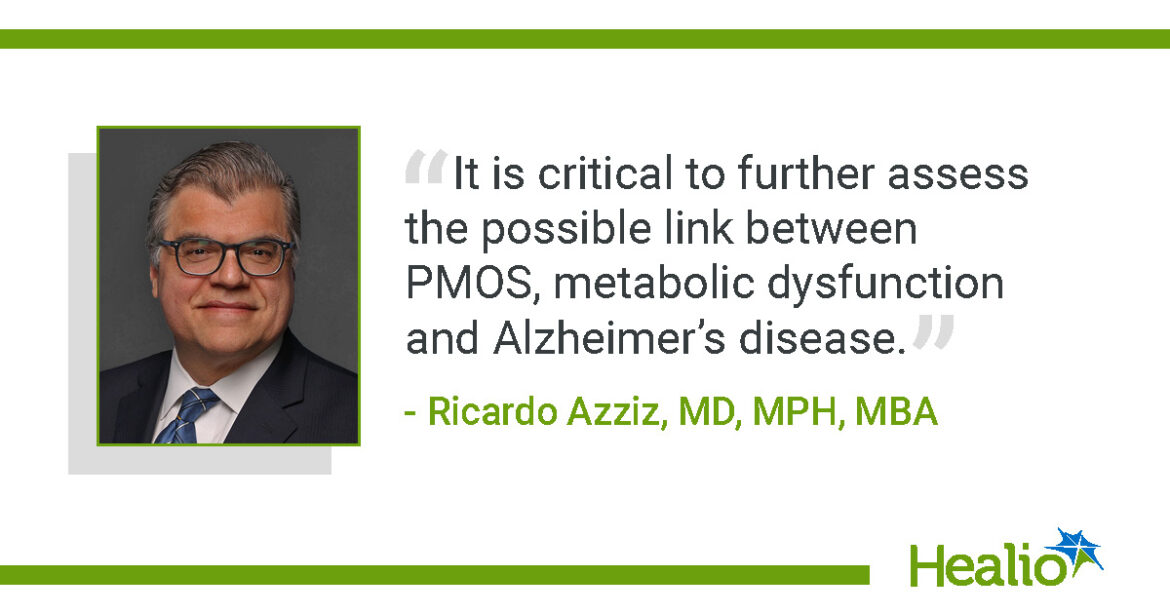
Ricardo Azziz, MD, MPH, MBA, executive director at the Foundation for Research & Education Excellence and professor at the University of Alabama at Birmingham, cautioned:
“The data indicate that it is critical to further assess the possible link between PMOS, metabolic dysfunction and Alzheimer’s disease, but we should recognize that according to the information we reviewed, this link is still hypothetical and much more research is needed.”
He also explained the rationale for the review:
“Alzheimer’s disease and PMOS are two disorders that frequently affect women and often may present in the same individual.”
The review therefore addresses an important research question, not a confirmed causal relationship.
Study at a glance
| Feature | Details |
|---|---|
| Study type | Literature review examining clinical and mechanistic studies |
| Publication | Journal of the Endocrine Society |
| Literature source | PubMed |
| Population of interest | People with PCOS/PMOS, with comparisons against people without the condition in some included studies |
| Intervention | None; this was a review of existing research |
| Comparator | Varied across the included studies; often individuals without PCOS/PMOS |
| Main outcomes examined | Cognitive function, dementia incidence, Alzheimer’s disease-related findings, and neuroimaging |
| Main finding | Some studies reported poorer cognitive performance and higher dementia risk, but dementia-incidence findings were inconsistent |
| Proposed mechanisms | Obesity, insulin resistance, dyslipidemia, cardiovascular dysfunction, inflammation, gut microbiome changes, and sex-hormone alterations |
| Follow-up | Not applicable to the review as a whole; follow-up varied among the underlying studies |
| Number of included studies | Not reported in the supplied article |
| Meta-analysis | No pooled quantitative estimate reported in the supplied article |
| DOI | Not provided in the supplied article |
What the researchers found
1. Cognitive performance in people with PCOS/PMOS
Some clinical studies reported that people with PCOS/PMOS performed worse than healthy controls on tests assessing executive function and attention. Other studies described greater memory impairment.
These findings suggest a possible association between PCOS/PMOS and differences in cognitive performance. However, poorer performance on cognitive tests is not equivalent to a diagnosis of Alzheimer’s disease or dementia.
The supplied report does not provide the number of participants, effect sizes, specific test scores, or consistency of findings across individual studies. The magnitude and clinical importance of the reported cognitive differences therefore cannot be quantified from the available summary.
2. Biomarkers associated with Alzheimer’s disease
Some studies included in the review reported increased levels of amyloid precursor protein and apolipoprotein E in people with PCOS/PMOS. The authors noted that similar biomarker patterns have been described in adults with type 2 diabetes and Alzheimer’s disease.
According to the review, these elevated plasma levels were more commonly observed in people with obesity. In contrast, people with PCOS/PMOS who did not have obesity or insulin resistance were reported to have increased levels of serum amyloid P component.
| Finding reported in the review | Interpretation |
|---|---|
| Differences in amyloid precursor protein levels | A possible biomarker association; not proof of Alzheimer’s disease |
| Differences in apolipoprotein E levels | May overlap with metabolic and neurological risk profiles |
| Elevated levels more commonly reported in people with obesity | Suggests obesity may modify the observed association |
| Increased serum amyloid P component in some participants without obesity or insulin resistance | A potential finding requiring further investigation |
These findings should be interpreted cautiously. The supplied report does not establish that these biomarkers predict future dementia in people with PCOS/PMOS, nor does it provide evidence that they should be used for routine clinical screening in this population.
3. Dementia incidence: inconsistent evidence
The studies examining whether PCOS/PMOS is associated with a higher incidence of dementia did not produce consistent results.
| Evidence area | Reported findings |
|---|---|
| Studies reporting increased dementia incidence | Some found a higher incidence among people with PCOS/PMOS |
| Studies reporting no increased incidence | Other studies found no difference compared with the general population |
| Overall interpretation | Evidence is insufficient to establish a consistent independent association |
The mixed findings are a central limitation of the current evidence. Differences in study design, population characteristics, duration of follow-up, and adjustment for metabolic conditions may contribute to inconsistent results, although the supplied article does not quantify the effect of these factors.
4. Metabolic dysfunction as a possible link
The review suggests that the relationship between PCOS/PMOS and adverse brain outcomes may be influenced substantially by metabolic conditions, particularly obesity and insulin resistance.
The authors described obesity as a potential modifier of neurological risk, stating that it:
“appears to be a central modifier of neurological risk in PCOS/PMOS”
They also noted that direct evidence connecting adipose-derived amyloid beta to brain pathology specifically among people with PCOS/PMOS remains lacking.
The review discussed several other possible contributors:
| Proposed factor | Potential relevance described in the review |
|---|---|
| Obesity | May modify neurological risk and is associated with less favorable biomarker profiles |
| Insulin resistance and diabetes | Metabolic abnormalities associated with Alzheimer’s disease and dementia risk |
| Dyslipidemia | May contribute to broader cardiometabolic risk |
| Cardiovascular and autonomic dysfunction | Potential pathways connecting metabolic health with neurological outcomes |
| Chronic inflammation | A proposed mechanism requiring further investigation |
| Gut microbiome dysbiosis | A possible contributor to metabolic and neurological changes |
| Sex-hormone alterations | May be relevant to the relationship between reproductive endocrine function and brain health |
The authors cautioned that many of these factors overlap with obesity and insulin resistance. Consequently, it remains unclear whether PCOS/PMOS independently increases dementia risk or whether the observed association is largely explained by accompanying metabolic abnormalities.
5. Evidence for preventive interventions remains limited
The review found limited evidence from intervention studies assessing cognitive outcomes in people with PCOS/PMOS. Published studies were generally characterized by small cohorts and inconsistent findings.
The researchers emphasized that more rigorous trials are needed before recommending syndrome-specific treatments for neuroprotection:
“Intervention data examining cognitive outcomes remain limited and inconsistent, and well-designed randomized controlled trials with standardized cognitive endpoints, adequate metabolic phenotyping and longer follow-up are required before recommending PCOS/PMOS-specific treatments for neuroprotection.”
They added:
“Until such data are available, neurological benefits of PCOS/PMOS-directed therapies remain speculative.”
Accordingly, the review does not establish that any particular PCOS treatment prevents Alzheimer’s disease, slows cognitive decline, or reduces dementia incidence.
Clinical significance
The review highlights a possible connection between reproductive endocrine disorders, metabolic health, and long-term cognitive outcomes. Its implications are primarily research-oriented at present.
Metabolic health deserves attention. Obesity, insulin resistance, diabetes, and dyslipidemia are important components of the proposed relationship. Assessing and managing these conditions remains relevant to the overall health of patients with PCOS/PMOS, although this review does not establish that their treatment prevents dementia.
Cognitive symptoms require appropriate assessment. Patients reporting memory difficulties or changes in attention should be evaluated according to their symptoms and clinical context. A PCOS/PMOS diagnosis alone does not establish cognitive impairment or Alzheimer’s disease.
Routine dementia screening is not supported solely by PCOS/PMOS status. The authors concluded that routine screening is not necessary for this population based on the current evidence. This does not mean that evaluation is inappropriate when cognitive symptoms or other clinical indications are present.
Long-term studies are needed. Prospective studies that follow participants over time, measure metabolic factors carefully, and use standardized cognitive outcomes could help clarify whether PCOS/PMOS independently contributes to dementia risk.
Limitations
- Review-level evidence: The article summarizes previously published studies rather than reporting a new prospective clinical cohort or randomized trial.
- Inconsistent findings: Studies examining dementia incidence reported mixed results, limiting confidence in a consistent association.
- Potential confounding: Obesity, insulin resistance, diabetes, and other cardiometabolic conditions may influence both PCOS/PMOS-related outcomes and neurological risk.
- Limited intervention evidence: The available studies do not establish that PCOS/PMOS treatments prevent cognitive decline or dementia.
- Small cohorts in some studies: The review authors noted that many published studies had small samples, potentially limiting statistical precision and generalizability.
- Incomplete quantitative information: The supplied article does not provide the number of studies reviewed, pooled effect estimates, participant totals, or detailed measures of study quality.
- Uncertain mechanisms: The proposed biological pathways remain incompletely established, and some may overlap substantially with metabolic dysfunction.
- No established screening strategy: The review does not identify a validated PCOS/PMOS-specific dementia screening approach or demonstrate that routine screening improves outcomes.
What doctors should know
- Explain the uncertainty: Some studies suggest an association between PCOS/PMOS and cognitive impairment or dementia, but the evidence does not establish a direct causal relationship.
- Assess relevant metabolic factors: Obesity, insulin resistance, diabetes, and dyslipidemia are important considerations in the broader health assessment of patients with PCOS/PMOS.
- Do not equate cognitive-test differences with dementia: Lower scores on executive-function, attention, or memory tests do not independently establish Alzheimer’s disease.
- Avoid unsupported claims about prevention: The review does not show that a specific PCOS/PMOS treatment prevents dementia or provides proven neuroprotection.
- Use symptom-driven evaluation: Cognitive concerns should be assessed on their own merits. The review does not support routine dementia screening solely because a patient has PCOS/PMOS.
- Follow emerging evidence: Better-designed longitudinal studies and randomized trials are needed to establish whether the relationship is independent of metabolic factors and whether interventions alter long-term cognitive outcomes.
Bottom line
A review of clinical and mechanistic studies suggests that PCOS/PMOS may be associated with poorer cognitive performance and possibly an increased risk of Alzheimer’s disease and related dementias. However, findings on dementia incidence are inconsistent, and obesity, insulin resistance, and other metabolic abnormalities may explain part of the observed relationship.
The association remains hypothetical. Current evidence does not support PCOS/PMOS-specific treatment for dementia prevention or routine dementia screening solely on the basis of the diagnosis. Larger longitudinal studies and well-designed randomized trials are needed to clarify causality, mechanisms, and potential preventive strategies.
Original research / DOI
Article: Review of the relationship between polycystic ovary syndrome/polyendocrine metabolic ovarian syndrome and Alzheimer’s disease, dementia, cognitive function, and neuroimaging.
Journal: Journal of the Endocrine Society.
Literature source: PubMed.
DOI: Not provided in the supplied report.
Review lead discussed in the article: Ricardo Azziz, MD, MPH, MBA.
Disclosure information: The supplied article does not provide a complete author-disclosure statement for the review.