MedResearch Pro
Welcome to MedResearch Pro
Join thousands of medical professionals advancing their knowledge.
By continuing, you agree to our Terms of Service and Privacy Policy.
Already have an account? Log in
Join thousands of medical professionals advancing their knowledge.
By continuing, you agree to our Terms of Service and Privacy Policy.
Already have an account? Log in
Join thousands of medical professionals advancing their knowledge.
By continuing, you agree to our Terms of Service and Privacy Policy.
Already have an account? Log in
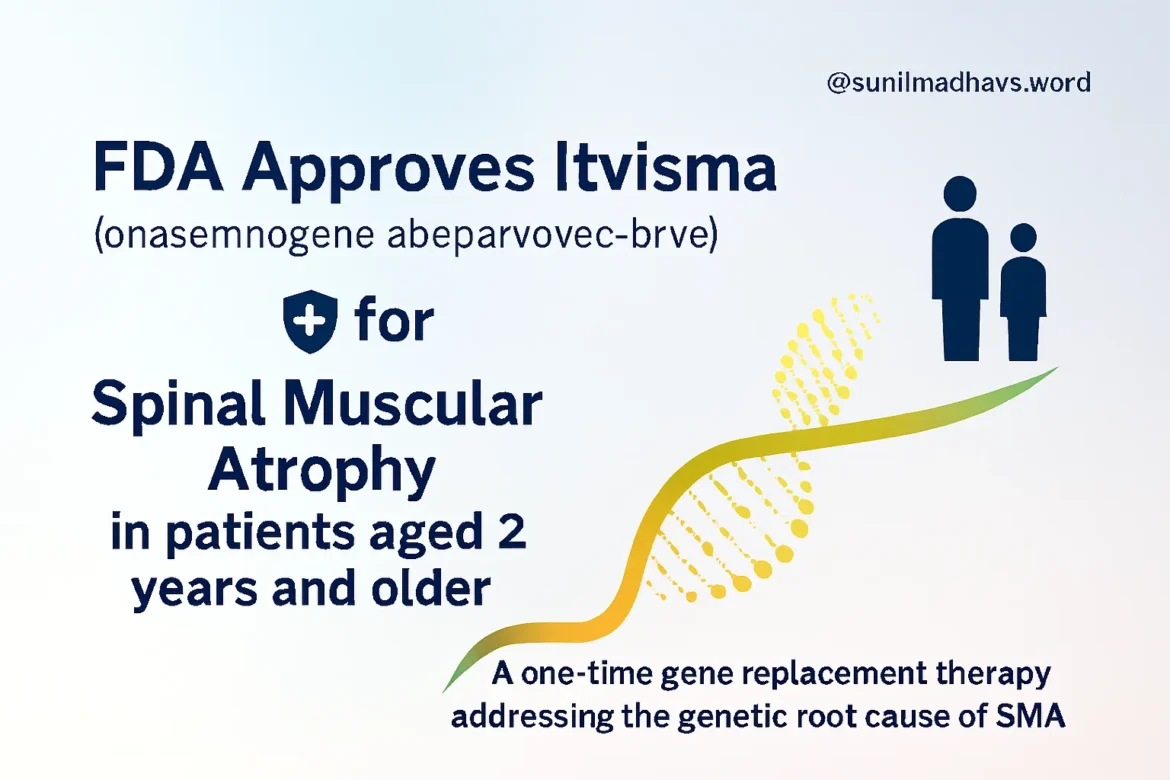
FDA Approves Itvisma for Spinal Muscular Atrophy Treatment
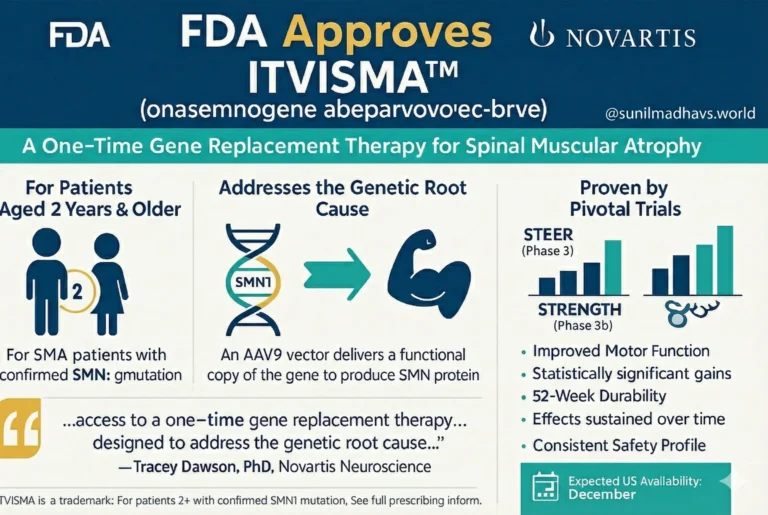
The FDA has granted approval to Novartis for Itvisma (onasemnogene abeparvovec-brve), a new gene replacement therapy designed for patients aged 2 years and older who have been diagnosed with spinal muscular atrophy (SMA) and possess a confirmed mutation of the survival motor neuron 1 (SMN1) gene.
According to the manufacturer, this approval marks a significant milestone, establishing Itvisma as the first and only gene replacement therapy available to treat SMA across virtually the entire lifespan of the patient.
Clinical Evidence and Efficacy
The regulatory approval was driven by data derived from two key studies: the Phase 3 STEER clinical trial and the supporting open-label Phase 3b STRENGTH study.
Outcomes: In these trials, the therapy demonstrated statistically significant improvements in motor function as well as the stabilization of motor abilities.
Durability: These positive effects were sustained over a follow-up period of 52 weeks.
Safety: Novartis reported that the safety profile of the drug remained consistent across both studies.

Tracey Dawson, PhD, the senior vice president and U.S. therapeutic area head of neuroscience at Novartis, highlighted the necessity of this approval for the patient community:
“We believe every patient with SMA deserves access to transformative treatment, regardless of age or disease severity. Many older children, teens and adults continue to face unmet needs and disease progression.โ
Understanding the Mechanism and Disease
SMA is a neuromuscular condition caused by a missing or mutated SMN1 gene. This gene is critical because it produces the majority of the SMN protein needed to sustain essential muscle functions, such as movement, swallowing, and breathing.
While the SMN2 gene also produces SMN protein, it creates a much smaller portion of functional protein. Consequently, disease severity often correlates with SMN2 copy numbersโpatients with more copies generally experience a less severe form of the condition than those with fewer copies.
Itvisma functions as an adeno-associated virus 9 (AAV9) gene replacement therapy. By targeting the underlying genetic issue, it offers a distinct advantage over chronic management options.
With the approval of Itvisma, this broad range of patients with SMA can have access to a one-time gene replacement therapy that is uniquely designed to address the genetic root cause of their disease, offering the potential to reduce the need for chronic treatment and improve motor function,โ Dawson stated.
Dosage and Availability
Administration: Itvisma is administered via a one-time fixed intrathecal dose. Uniquely, this dosage does not require adjustments based on the patient’s body weight or age.
Market Release: The therapy is expected to become available in the United States starting in December.
Lifestyle Medicine Conference in Dallas.
The Core Problem: Stagnation Despite Innovation
Dr. Koushik Reddy, an interventional cardiologist and director at the James A. Haley VA Medical Center, highlighted a critical paradox in modern medicine: despite significant technological advancements in cardiology, death rates are not dropping.
Citing a recent review in Circulation, Dr. Reddy pointed out that age-adjusted cardiovascular death rates have remained flat since 2010, while risk factors continue to skyrocket. He expressed frustration with the traditional “symptom management” approach, stating:
โCardiovascular mortality across the population has not gone down even by a single percent… Meanwhile, almost every cardiovascular risk factor is skyrocketing, and here I am in the confines of a cath lab, wondering if the letters next to my name, MD, have merely become โmanager of disease,โ because thatโs what Iโm doing.โ

He further critiqued the pharmaceutical-first model, noting:
> โIโm wondering if Iโm living a paradigm where for every ill, I have a pill, and you get the bill.โ
The Solution: “Flipping the Script”
Dr. Reddy proposes that the healthcare system must shift its foundation from tertiary care (treating the sick) to lifestyle promotion (preventing illness). He advocates for a “flipped pyramid” where population health and primary care form the base, rather than relying on interventionalists to save lives only when “everything fails.”
He summarized this shift with a poignant message to the President of the American College of Lifestyle Medicine (ACLM):
> โMeet me at the kitchen table, not the cath table.โ
The “CARROTS” Methodology
Dr. Reddy is the first interventional cardiologist to be recognized as a lifestyle medicine intensivist. To bridge the gap between invasive surgery and preventative living, he adopted the slogan, โI have a carrot and a stent. You pick.โ
He utilizes the acronym CARROTS to define the pillars of his lifestyle medicine approach:
Caring relationship
Avoid toxins
Restful sleep
Regular exercise
Omitting stress
Thoughtful eating
Social driver
Integration into Clinical Workflow
Dr. Reddy acknowledges the difficulty of implementing soft skills in a high-acuity environment like a catheterization lab or ICU. However, he insists that transformation must begin with the individual physician.
> โThe change has to start with me. … My space is a cath lab and a [critical care unit]. Thatโs where I have to change because thatโs my sphere of influence.โ
To make this practical, Dr. Reddy altered his clinical documentation. In his medical notes, he lists the six pillars of lifestyle medicine at the very top, placing them above the active cardiovascular disease. This forces the entire medical team to view social connection, nutrition, and stress as primary factors rather than afterthoughts.
Conclusion
Dr. Reddy emphasized that while there will always be a need for interventionalists to treat acute heart attacks, that role should not be the cornerstone of the healthcare system. He argues for a system where the “very presence” of a lifestyle medicine intensivist in a cath lab becomes unnecessary because the system successfully prioritizes prevention.
Source link
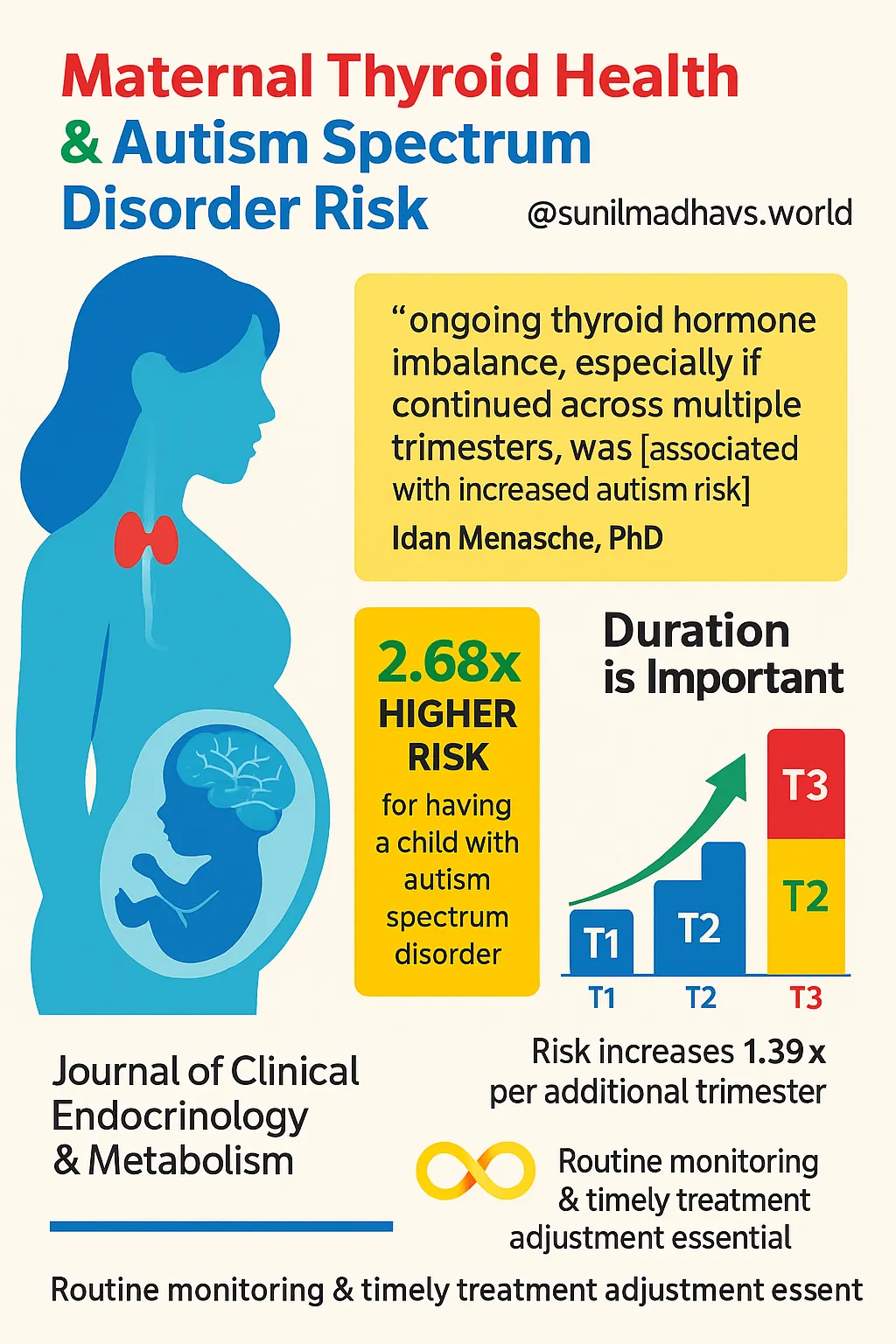
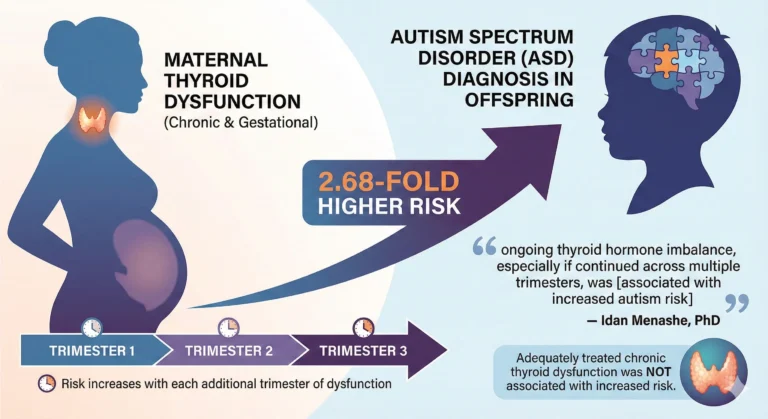
Key findings from the study indicate that women who experienced thyroid dysfunction both before conception and during pregnancy had a 2.68-times greater likelihood of having a child later diagnosed with autism, and that the risk increased with each additional trimester affected by thyroid imbalance.
According to research published in The Journal of Clinical Endocrinology & Metabolism, maternal thyroid issues that occur before or persist throughout pregnancy may heighten the probability of autism spectrum disorder (ASD) in their children.
Idan Menashe, PhD โ who leads the department of epidemiology, biostatistics and community health sciences at the faculty of health sciences at Ben-Gurion University of the Negev โ explained the results stating:
โThe findings of our study suggest that while adequately treated chronic thyroid dysfunction was not associated with increased autism risk in offspring, ongoing thyroid hormone imbalance, especially if continued across multiple trimesters, was.โ
Study Details
Menashe and his team performed a retrospective cohort analysis involving women who delivered a single baby at Soroka University Medical Center in Israel between 2011 and 2017. Chronic thyroid dysfunction was determined using ICD-9 diagnostic codes for hyperthyroidism or hypothyroidism in patient health records. In contrast, gestational thyroid dysfunction was identified through thyroid hormone testing during each trimester of pregnancy.
Of the 51,296 women included, 8.6% had some form of thyroid dysfunction. The breakdown was as follows:
– 1,161 had chronic hypothyroidism
– 1,600 had gestational hypothyroidism
– 1,054 had both chronic and gestational hypothyroidism
– 100 had chronic hyperthyroidism
– 376 had gestational hyperthyroidism
– 15 had both chronic and gestational hyperthyroidism
Children were diagnosed with ASD at a median age of 4.6 years. When comparing all women with any thyroid disorder to women with normal thyroid levels, there was no overall difference in ASD incidence.
However, women with both chronic and gestational thyroid dysfunction had a significantly higher risk of having a child diagnosed with ASD compared with women who were euthyroid (adjusted HR = 2.68; 95% CI, 1.52โ4.72). A similar increased risk was found specifically for women with both chronic and gestational hypothyroidism (aHR = 2.61; 95% CI, 1.44โ4.74).

When thyroid dysfunction occurred during pregnancy only, risk rose with the number of trimesters affected. Each additional trimester of thyroid imbalance was linked to higher ASD risk for:
– gestational hypothyroidism alone (aHR = 1.39; 95% CI, 1.16โ1.68)
– both chronic and gestational hypothyroidism (aHR = 1.28; 95% CI, 1.02โ1.93)
The highest autism risk was observed among women who had gestational hypothyroidism during all three trimesters. Menashe noted that the connection between prolonged thyroid abnormalities during pregnancy and elevated ASD risk in children was unexpected.
He emphasized:
โOur findings underscore the need for routine monitoring and timely adjustment of therapy to maintain normal thyroid hormone levels throughout pregnancy.โ
Menashe also noted that more research is required to understand the mechanisms through which abnormal thyroid hormone levels influence fetal brain development.
For further correspondence, Menashe can be contacted at idanmen@bgu.ac.il.
This research contributes to an expanding collection of epidemiological studies (such as Kaplan ZB et al., Thyroid, 2024) that imply a link between maternal hypothyroidism during pregnancy and an increased likelihood of ASD in children. In this Israeli retrospective cohort, the offspring of women who were hypothyroid both before and during pregnancy showed more than double the risk of receiving an ASD diagnosis compared with children of mothers with normal thyroid function. Importantly, hypothyroidism occurring only before pregnancy or only during pregnancy did not demonstrate a similar association, indicating that the duration and continuity of untreated hypothyroidism may be key contributors.
The studyโs strengths included multiple thyroid function assessments throughout pregnancy and a long follow-up period. However, its retrospective nature introduced several limitations. The researchers did not evaluate variables such as maternal iodine levels, socioeconomic status, or thyroid autoimmunity, and they also lacked data on levothyroxine treatment. Additionally, the study did not examine outcomes related to isolated maternal hypothyroxinemia. The small number of ASD cases among children of mothers with hyperthyroidism limited meaningful analysis in that subgroup. Existing knowledge already highlights the importance of properly treating overt hyperthyroidism during pregnancy to ensure healthy obstetric and developmental outcomes.
While this study raises the possibility that even subclinical hypothyroidism in pregnancy may elevate ASD risk, the ability of levothyroxine therapy to reduce this risk has not yet been tested in clinical trials.
This perspective was provided by Elizabeth N. Pearce, MD, MSc, of the Boston University Chobanian & Avedisian School of Medicine, who reported no relevant financial disclosures.