Headline
FDA Advisory Committee to Re-Evaluate Low-Dose Atropine (SYD-101) and Experts Weigh In on Genetic Testing for Pediatric Myopia
1-Minute Summary
Following a Complete Response Letter (CRL) issued by the US Food and Drug Administration (FDA) in October 2025 to Sydnexis for SYD-101 (an investigational 0.01% low-dose atropine formulation), an FDA Advisory Committee meeting scheduled for October 30, 2026, has renewed discussions around regulatory hurdles in myopia control. Despite meeting its primary Phase 3 efficacy endpoints, SYD-101 was denied approval initially, largely due to trial design limitations—such as omitting axial length measurements and averaging outcomes across broad age groups—as well as regulatory interpretation of clinical significance. In a expert panel discussion, pediatric ophthalmologists M. Edward Wilson, MD, and Douglas R. Fredrick, MD, highlighted SYD-101’s superior drug stability compared to compounded atropine and addressed the emerging, yet currently limited, role of genetic testing in routine pediatric myopia management.
Why This Matters
Dilute atropine is widely utilized off-label for pediatric myopia control, but compounded formulations below 1% concentration suffer from chemical instability and rapid acidification. An FDA-approved, shelf-stable low-dose atropine drop would establish a standardized, quality-assured therapeutic option for eye care providers. Furthermore, as genetic testing panels expand, clinicians must understand the boundaries between actionable genetic diagnoses for syndromic myopia and the unnecessary anxiety driven by ordering routine panels for simple refractive errors.
Study at a Glance
| Feature | Details |
| Study Type | Expert Panel Discussion / Clinical Commentary |
| Participants | M. Edward Wilson, MD (Storm Eye Institute, MUSC) & Douglas R. Fredrick, MD (Icahn School of Medicine at Mount Sinai / NY Eye and Ear Infirmary) |
| Intervention | Investigational low-dose atropine 0.01% (SYD-101) & Genetic Testing / Polygenic Risk Scores |
| Comparator | Compounded atropine formulations & Standard clinical refractive monitoring |
| Primary Outcome | Re-evaluation of Phase 3 trial design endpoints, drug stability, and clinical indications for genetic testing in pediatric myopia |
| Main Finding | SYD-101 offers critical chemical stability lacking in compounded drops; trial endpoint choices (omission of axial length) contributed to regulatory delay; routine genetic testing remains inappropriate for non-syndromic myopia |
| Follow-Up | FDA Advisory Committee meeting scheduled for October 30, 2026 |
Formulation Comparison: SYD-101 vs. Compounded Atropine
| Characteristic | FDA-Investigational SYD-101 (Sydnexis) | Compounded Low-Dose Atropine (<1%) |
| Regulatory Status | Under FDA Advisory Committee Re-evaluation | Unregulated compounding pharmacy production |
| Chemical Stability | Patented formulation prevents degradation | Highly unstable; acidifies over time |
| Shelf Life | Long, standardized shelf life | Variable and short-term expiration |
| Dosing Consistency | Strict, batch-tested laboratory manufacturing | Quality and concentration varies by compounder |
Clinical Utility of Genetic Testing in Refractive Errors
| Clinical Setting | Recommended Action | Primary Rationale |
| Simple / Run-of-the-Mill Myopia | Not Recommended | High likelihood of identifying Variants of Unknown Significance (VUS), causing family anxiety |
| Early-Onset High Myopia or Strong Family History | Recommended (via Specialist) | Identifies actionable pathogenic mutations early in disease course |
| Suspected Syndromic Conditions (e.g., Stickler, Marfan, CSNB, Foveal Hypoplasia) | Recommended (via Specialist) | Guides multidisciplinary medical management and life planning |
What the Researchers Found
Low-Dose Atropine and Regulatory Evaluation
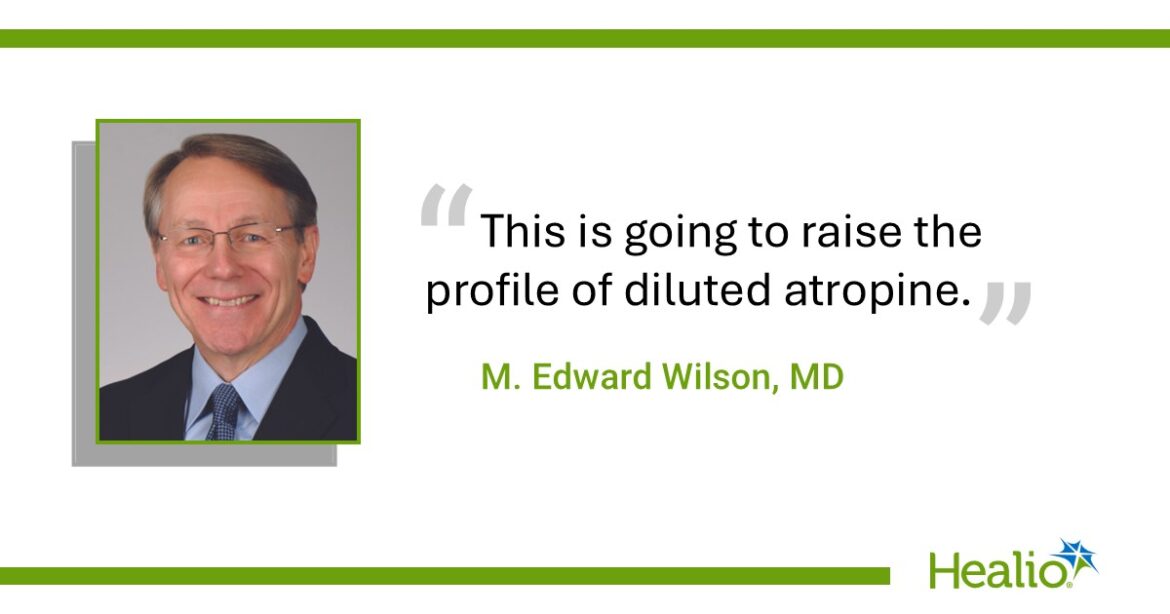
Dr. M. Edward Wilson emphasized that many clinicians hesitate to utilize current off-label options due to reliance on compounding pharmacies: “I believe that there are many pediatric ophthalmologists, and perhaps optometrists, who would like to prescribe more atropine but don’t like the idea of compounding.” He noted that pharmaceutical stabilization at low concentrations is technically challenging: “My understanding is that when atropine is diluted below 1%, it is unstable and acidifies over time, and I have been impressed that Sydnexis developed and patented a unique way to stabilize the molecule. The low-dose atropine drop is going to have stability that you can’t get in compounding because Sydnexis will be the only company that knows how to do it.”
Discussing the FDA’s initial refusal to approve SYD-101, Dr. Wilson suggested that trial data averaging masked treatment benefits in high-risk cohorts: “The FDA most likely had some issues with looking at averages for all of the myopia studies of dilute atropine and trying to decide if the reduction in myopia progression was clinically meaningful.” He elaborated that “in a study, you may get unbelievable results in a subset of younger, fast-progressing patients and then some not-so-impressive results in the older ones who are aging out of myopia progression. Those results are averaged away because the FDA wants them to include older kids.”
Dr. Douglas R. Fredrick pointed out a key methodological omission in the Phase 3 design: “The fact that the study was designed without including axial length as an endpoint hurt Sydnexis. All the other recent myopia control studies have included axial length, and that was just a pragmatic decision.” He explained that implementing axial length measurements across all sites would have required purchasing expensive biometers (such as Lenstar or IOLMaster) for every investigator, adding: “It’s a cautionary tale for other companies and investigators as they look forward to doing similar types of studies to consider all types of data that regulators are going to want to look at.” Furthermore, Dr. Fredrick expressed hope that Sydnexis will explore multiple dosage concentrations in the future, comparing it to allergy medications: “When olopatadine came out, it was just one concentration. Now we have three… I hope the same thing will happen with Sydnexis.”
Genetic Testing in Pediatric Myopia
Regarding the role of genetics, Dr. Wilson noted that while research into polygenic risk scores is advancing, “they don’t think that it’s necessarily ready for prime time.” He explained that while amalgamating candidate genes may eventually assist in risk stratification, he currently reserves testing only for cases where he suspects systemic syndromes such as Stickler or Marfan syndrome.
Dr. Fredrick concurred that genetic panels should not be ordered routinely for typical pediatric myopia: “For simple run-of-the-mill myopia, I think genetic testing can cause a lot of problems. Any time you do a targeted panel, you will get variations of unknown significance, which can cause a lot of grief for families.” He advised that when genetic evaluation is warranted—such as in early-onset high myopia, congenital stationary night blindness (CSNB), or foveal hypoplasia—the testing and counseling should be managed by geneticists: “Our genetic colleagues also advise us not to order anything; let them do the ordering and let them have the discussion… Overall, I think most of us agree that we are not equipped to do genetic counseling. Leave it to the experts.”
Clinical Significance
The availability of an FDA-approved low-dose atropine formulation like SYD-101 would transform pediatric myopia management by providing clinicians with a stable, standardized alternative to compounded drops. Mechanistically, stabilizing sub-1% atropine prevents acidification and variable dosing, which are major obstacles in current compounding practices. From a diagnostic standpoint, understanding the limitations of broad genetic testing prevents over-testing and misinterpretation of Variants of Unknown Significance (VUS) in general pediatric populations, ensuring genetic evaluations remain targeted toward syndromic or severe early-onset cases.
Limitations
- Trial Methodology: The Phase 3 trial for SYD-101 lacked axial length measurement endpoints, which have become a benchmark parameter for modern myopia control regulatory submissions.
- Data Aggregation: Primary efficacy endpoints averaged treatment responses across wide age ranges, potentially diluting the demonstrated clinical impact in younger, rapidly progressing children.
- Dose Availability: Investigating a single concentration (0.01%) may not address the clinical needs of patients who show an insufficient response to lower doses.
- Genetic Panel Interpretation: Polygenic risk scores for myopia currently lack standardized predictive validity for routine clinical decision-making.
What Doctors Should Know
- FDA Advisory Status: The upcoming October 30 Advisory Committee meeting will re-evaluate SYD-101’s efficacy data, specifically subgroup analyses and clinical relevance.
- Compounding Risks: Standard diluted atropine drops (<1%) lack long-term chemical stability and tend to acidify over time; patented stabilization methods in commercial formulations overcome this issue.
- Trial Endpoint Benchmarks: Future myopia trial protocols must incorporate objective axial length data alongside cycloplegic auto-refraction to meet evolving regulatory expectations.
- Genetic Testing Protocol: Avoid ordering targeted genetic panels for typical pediatric myopia to prevent unnecessary distress from Variants of Unknown Significance (VUS). Refer patients with early-onset high myopia or suspected syndromic features directly to medical geneticists.
Bottom Line
While regulatory delays for SYD-101 highlight the need for standardized trial endpoints (including axial length and age-stratified analyses), an FDA-cleared low-dose atropine formulation remains vital to overcome the chemical instability of compounded drops. Simultaneously, while genetic research advances, routine genetic testing should remain strictly confined to suspected syndromic conditions or severe early-onset high myopia managed by medical geneticists.
Original Research / DOI
- Source Article: Wilson ME, Fredrick DR. Panel Discussion: FDA Evaluation of Low-Dose Atropine (SYD-101) and the Clinical Role of Genetic Testing in Pediatric Myopia. Healio OSN Pediatrics/Strabismus Board Discussion. Published October 7, 2026.