30
Headline
Prevalence of Opioid Use Disorder Reaches 4% Among Patients With Rheumatic Disease, but Fewer Than 15% Receive Evidence-Based Pharmacotherapy
1-Minute Summary
In a large nationwide cohort study published in Arthritis Care & Research, investigators evaluated 37,282 patients with rheumatic diseases—including osteoarthritis, rheumatoid arthritis, systemic lupus erythematosus, and spondyloarthritis—enrolled in the National Institutes of Health (NIH) All of Us Research Program. Opioid use disorder (OUD) was documented in 4.0% of the cohort (n = 1,502). Compared with their peers without OUD, patients with OUD experienced significantly higher rates of psychiatric comorbidity, acute care utilization, mortality, and corticosteroid use, along with markedly higher rates of prior prescription opioid exposure (75.7% vs 45.8%). Despite the proven mortality-reducing benefits of medications for opioid use disorder (MOUD; methadone, buprenorphine, and naltrexone), only 14.5% of diagnosed patients received treatment—substantially below the 25% treatment rate reported in the general population. These findings reveal an urgent, addressable care gap in rheumatology clinical practice.
Why This Matters
Patients managing chronic rheumatic diseases experience persistent musculoskeletal pain and are prescribed opioid analgesics at rates exceeding those of the general population. When chronic therapy transitions to opioid use disorder, patients face heightened risks of severe morbidity, accidental overdose, and death. Because MOUD regimens substantially reduce all-cause and overdose-related mortality, defining the magnitude of OUD and identifying barriers to pharmacotherapy in rheumatology clinics is vital for developing integrated addiction screening, referral pathways, and harm reduction models.
Study at a Glance
| Feature | Details |
| Study type | Large-scale, observational cohort study |
| Participants | 37,282 adult patients with osteoarthritis, rheumatoid arthritis, systemic lupus erythematosus, or spondyloarthritis |
| Data Source | NIH All of Us Research Program |
| Exposure / Factor | Documented diagnosis of opioid use disorder ($\ge$1 diagnostic code for opioid dependence or abuse) |
| Comparator | Rheumatic disease patients without OUD; general population benchmarks for MOUD uptake (~25%) |
| Primary outcome | Prevalence of OUD, proportion of patients receiving MOUD (methadone, buprenorphine, or naltrexone), and clinical characteristics/outcomes |
| Main finding | 4.0% (n = 1,502) of patients had OUD. Only 14.5% received MOUD. Patients with OUD exhibited higher psychiatric comorbidities, increased acute care use, higher mortality, greater corticosteroid and prior opioid use (75.7% vs 45.8%), and lower DMARD use. |
| Follow-up | Longitudinal electronic health record (EHR) surveillance post-diagnosis |
What the Researchers Found
Among 37,282 individuals with confirmed rheumatic conditions, 1,502 individuals (4.0%) had at least one diagnostic code for opioid dependence or abuse.
Clinical Patterns and Treatment Disparities
| Parameter / Measure | Patients With OUD (n = 1,502) | Patients Without OUD (n = 35,780) | General Population Benchmark |
| Prior Prescription Opioid Use | 75.7% | 45.8% | — |
| MOUD Receipt (Methadone, buprenorphine, or naltrexone) | 14.5% | — | ~25.0% |
| DMARD Utilization (Conventional, biologic, or targeted synthetic) | Decreased | Reference | — |
| Glucocorticoid / Corticosteroid Use | Increased | Reference | — |
| Psychiatric Comorbidities | Elevated | Reference | — |
| Acute Care Utilization & Mortality | Elevated | Reference | — |
Lead author Jacob S. Riegler, MD, MBA, MSBE, rheumatology fellow at Brigham and Women’s Hospital, highlighted the rationale:
“Patients with rheumatic conditions are prescribed opioids at higher rates than the general population, but we know very little about opioid use disorder in this group. Opioid use disorder is a pathologic pattern of use that raises the risk for overdose and death. Although medications for opioid use disorder lower mortality, no previous study had examined if patients with rheumatic diseases are receiving them.”
Characterizing the clinical trajectory of affected individuals, Dr. Riegler noted:
“Those patients had more psychiatric comorbidities, higher acute care use, higher mortality, more glucocorticoid use and less disease-modifying antirheumatic drug use. They were also more likely to have received prior prescription opioids — 75.7% vs. 45.8% — and corticosteroids, but less likely to have used biologic, targeted synthetic, or conventional DMARDs.”
Only 14.5% of patients with rheumatic conditions and documented OUD were prescribed an approved pharmacotherapy (buprenorphine, methadone, or naltrexone) following their initial diagnosis, indicating that more than 85% of diagnosed patients remained untreated with first-line medications.
Clinical Significance
These data demonstrate a concerning management paradox: patients with rheumatic disease who develop OUD receive less disease-modifying therapy for their underlying autoimmune condition while simultaneously experiencing higher exposure to systemic glucocorticoids and prior opioids. Under-treating systemic inflammation with disease-modifying antirheumatic drugs (DMARDs) may cause worsening chronic pain, precipitating opioid escalation and subsequent dependence.
Furthermore, the 14.5% MOUD uptake rate reflects an even more pronounced treatment gap than the ~25% observed across general population samples, suggesting that stigma, fragmented transitions between rheumatology and addiction medicine, and clinician unfamiliarity with addiction pharmacotherapy hinder access to life-saving care.
Limitations
- Diagnostic Code Reliance: Case identification relied on EHR diagnostic coding for opioid abuse or dependence, which frequently under-captures milder or unrecognized cases of substance use disorder.
- Prescription vs Consumption: Data captured prescription orders or dispenses for MOUD, DMARDs, and opioids, but could not verify real-time adherence or illicit opioid exposure.
- Confounding by Indication: Patients with severe psychiatric distress or non-inflammatory pain phenotypes (e.g., fibromyalgia overlap) may have been preferentially prescribed opioids or avoided DMARDs, introducing potential selection bias.
What Doctors Should Know
- Routinely Screen for Opioid Misuse: Recognize that OUD is present in at least 1 in 25 patients with chronic rheumatic conditions. Screen regularly using validated assessment tools.
- Optimize Underlying Disease Control: Prioritize aggressive titration of guideline-directed DMARDs over chronic opioids or steroids to minimize chronic inflammatory pain.
- Bridge the Addiction Care Divide: Rheumatologists need not manage addiction alone, but they must identify and connect vulnerable patients to addiction medicine specialists or prescribe buprenorphine directly where trained.
Dr. Riegler underscored:
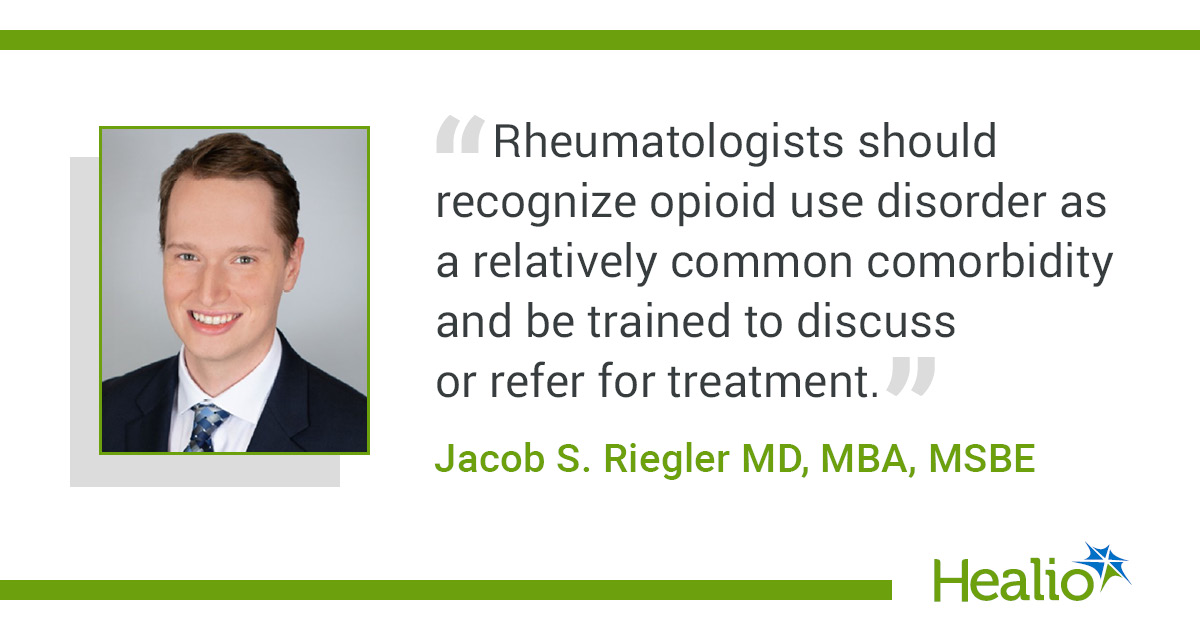
“Rheumatologists should recognize opioid use disorder as a relatively common comorbidity and be trained to discuss or refer for treatment, since starting treatment early is an important step in reducing opioid use disorder-related mortality.”
Bottom Line
Opioid use disorder affects 4.0% of patients with rheumatic disease and is linked to higher mortality, increased healthcare utilization, and lower DMARD use. Yet, fewer than 15% receive evidence-based medications for opioid use disorder, highlighting a critical care gap in rheumatology practice.
Original Research / Reference
Riegler JS, et al. Opioid use disorder and receipt of medications for opioid use disorder among patients with rheumatic conditions. Arthritis Care Res. 2026.