38
Headline
Childhood Overweight and Obesity Trajectories Associated With Reduced Likelihood of Childbirth in Adulthood Without Increased Risk of Diagnosed Infertility
1-Minute Summary
A nationwide Danish population-based cohort study published in JAMA Network Open reveals that girls who follow BMI trajectories consistent with overweight or obesity between ages 6 and 15 years have significantly lower odds of giving birth between the ages of 25 and 45 years compared with peers with average childhood BMI trajectories. This reduction in the likelihood of childbirth intensifies with advancing maternal age, dropping by more than 40% after age 30. Paradoxically, childhood adiposity was not associated with an increased risk of any diagnosed infertility and was linked to a lower rate of diagnosed primary infertility. These findings suggest that the long-term reproductive impact of childhood adiposity may be mediated by an interplay of biological factors, adult BMI persistence, reproductive intentions, and differential access to fertility evaluation.
Why This Matters
Childhood obesity represents an escalating global public health priority with established risks for cardiometabolic disease; however, its lifecourse implications for female reproductive outcomes remain incompletely characterized. Understanding whether childhood adiposity compromises future parity through biologic subfertility or through complex sociodemographic and healthcare-seeking pathways is essential. This evidence broadens the scope of pediatric weight management counseling by framing reproductive health as another potential long-term consideration without erroneously stigmatizing girls with unfounded expectations of clinical infertility.
Study at a Glance
| Feature | Details |
| Study type | Population-based retrospective cohort linkage study |
| Participants | 60,864 women evaluated for childbirth (median age at childbirth: 27.2 years); 58,148 women in primary infertility analyses; 63,066 women in any infertility analyses |
| Exposure / Factor | Childhood BMI trajectories from age 6 to 15 years (categorized as average, above-average, or overweight/obesity), derived from serial measurements in the Copenhagen School Health Records Register |
| Comparator | Average childhood BMI trajectory |
| Primary outcome | Hazard of first live birth across adulthood age brackets (25–29, 30–34, 35–45 years); diagnosis of primary or any infertility |
| Main finding | Childhood obesity trajectories were linked to significantly lower hazards of childbirth from age 25 to 45 years (HRs: 0.78 at 25–29 y, 0.58 at 30–34 y, and 0.56 at 35–45 y); no increased risk for any infertility was observed, and primary infertility diagnoses were lower (HR = 0.79) |
| Follow-up | Childhood health examinations through adulthood (up to age 45 years) |
What the Researchers Found
Investigators linked longitudinal physical examination data from the Copenhagen School Health Records Register with nationwide registries, including the Danish Medical Birth Register, the Danish Infertility Cohort, hospital inpatient/outpatient ICD-10 diagnostic records, and the Danish In Vitro Fertilization (IVF) Register. Eligible women had at least 2 serial BMI assessments documented between 6 and 15 years of age.
Among the 60,864 women included in the childbirth analysis, 78.3% gave birth to a child at a median age of 27.2 years.
Likelihood of Live Childbirth by Age Bracket and Childhood BMI Trajectory
| Maternal Age Interval | Childhood BMI Trajectory | Hazard Ratio (95% CI) | Statistical Significance |
| Age 25–29 Years | Obesity Trajectory | 0.78 (0.72–0.86) | Statistically significant reduction |
| Above-Average Trajectory | Ref. / Non-significant | Non-significant | |
| Age 30–34 Years | Obesity Trajectory | 0.58 (0.52–0.66) | Statistically significant reduction |
| Above-Average Trajectory | 0.91 (0.86–0.96) | Statistically significant reduction | |
| Age 35–45 Years | Obesity Trajectory | 0.56 (0.46–0.67) | Statistically significant reduction |
| Above-Average Trajectory | 0.83 (0.76–0.91) | Statistically significant reduction |
Reference group for all comparisons: Women with an average childhood BMI trajectory.
Infertility Outcomes
- Primary Infertility (n = 58,148): Women with a childhood obesity trajectory exhibited a lower risk of being diagnosed with primary infertility compared with those on an average BMI trajectory (HR = 0.79; 95% CI, 0.68–0.92).
- Any Infertility (n = 63,066): No statistically significant differences in risk were observed across any of the childhood BMI trajectory groups.
- Sensitivity Analyses: Discrete evaluations of BMI measured specifically at age 7 and age 13 years yielded concordant results with the longitudinal trajectory models.
Senior author Jennifer L. Baker, PhD, head of lifecourse epidemiology research at the Center for Clinical Research and Prevention at Frederiksberg Hospital, commented:
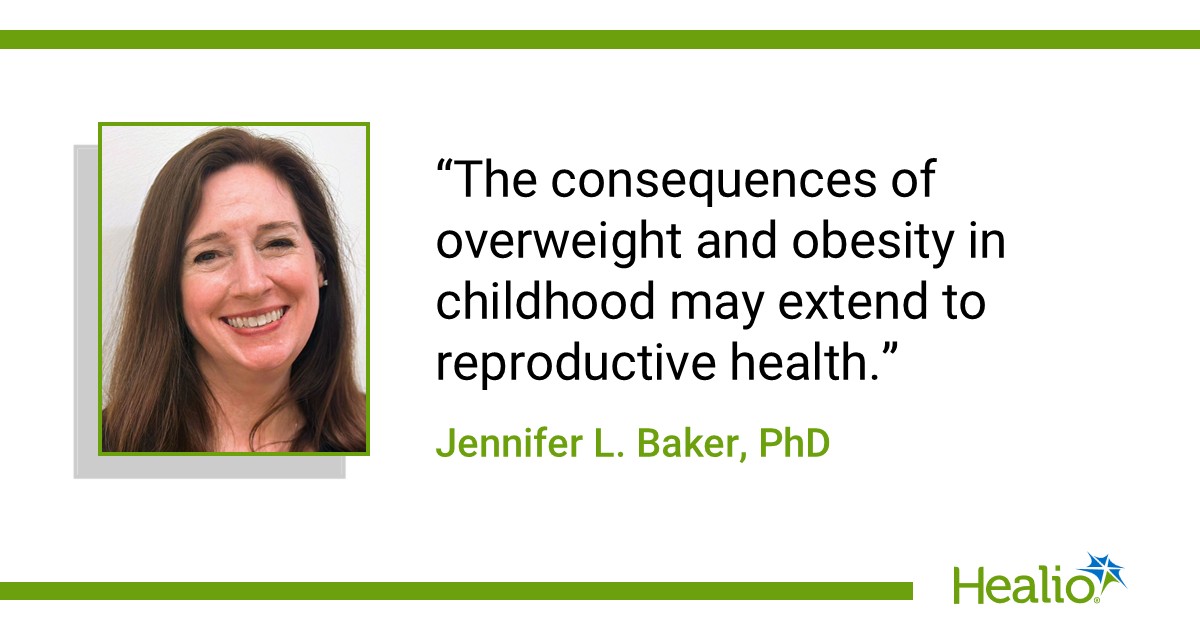
“Our findings suggest that the consequences of overweight and obesity in childhood may extend to reproductive health. While they don’t support specific fertility monitoring, they highlight reproductive health as another potential long-term consideration in the health of girls with excess adiposity.”
Regarding the age-dependent divergence in live birth rates, Dr. Baker observed:
“What surprised us was that the association became stronger with age, particularly after age 30 years, which is when the reproductive window begins to narrow.”
Clinical Significance
The divergence between decreased childbirth rates and absent or inverted infertility diagnoses presents a critical clinical paradox. Rather than reflecting purely anovulatory or biologic tubal/uterine pathology, the reduced parity among women with a history of childhood obesity may stem from complex lifecourse determinants:
- Differential Healthcare Utilization & Referral Bias: Women with obesity may encounter administrative, clinical, or weight-based BMI thresholds when seeking assisted reproductive technologies (ART), leading to fewer recorded formal infertility evaluations or IVF entries.
- Social and Behavioral Factors: Lifelong adiposity can influence self-esteem, partnership formation, marital status, and voluntary childlessness.
- Biological Ovulatory Aging: Accelerated follicular decline or chronic low-grade inflammation may compound physiological age-related fertility declines, explaining why the reduction in childbirth becomes most pronounced past age 30.
Limitations
- Ascertainment of Infertility: Diagnosed infertility relied on registry entries (hospital diagnoses, IVF registration), potentially missing individuals who experienced subfertility but never sought clinical care or were turned away due to body weight restrictions.
- Unmeasured Lifestyle & Social Confounders: The dataset did not capture adult personal reproductive intention, partnership status, or voluntary family planning decisions.
- Mediation by Adult BMI: The study reflects the lifecourse trajectory from childhood; isolating the independent effect of childhood adiposity apart from persistent adult obesity remains challenging.
- Generalizability: The analysis was conducted within a homogeneous Scandinavian population with universal healthcare access, which may limit generalizability to diverse healthcare environments.
What Doctors Should Know
- Do Not Assume Infertility: A childhood history of overweight or obesity is not an indicator of inevitable clinical infertility; routine diagnostic testing or premature reproductive workups in adolescence are not warranted.
- Lifecourse Counseling: Physicians managing pediatric and adolescent obesity should recognize reproductive health as a facet of overall metabolic wellness, emphasizing durable lifestyle habits that preserve future endocrine and ovulatory function.
- Address Systemic Barriers in Reproductive Care: Clinicians should be mindful of weight bias and restrictive clinical criteria that may deter women with elevated BMI from seeking timely evaluation when they encounter difficulty conceiving.
As Dr. Baker noted:
Mechanistic studies are needed to determine which factors are behind the link between childhood obesity and odds for having a child… biology, adulthood obesity, reproductive choices and access to fertility care may influence the association.
Bottom Line
Childhood overweight and obesity trajectories are associated with significantly lower rates of childbirth across adulthood—particularly after age 30—yet do not confer an increased risk of diagnosed clinical infertility, pointing to a multifaceted combination of social, behavioral, and clinical access barriers alongside metabolic factors.
Original Research / DOI
Baker JL, et al. Childhood body mass index trajectories, childbirth, and infertility in adulthood. JAMA Netw Open. 2026.