33
Headline
Comorbid Insomnia and Obstructive Sleep Apnea (COMISA) Associated With Greater Systolic Blood Pressure Reductions Following CPAP Therapy
1-Minute Summary
In a prospective cohort study published in CHEST, patients with comorbid insomnia and obstructive sleep apnea (COMISA) demonstrated significantly larger reductions in 24-hour, daytime, and nocturnal systolic blood pressure (SBP) after 4 weeks of continuous positive airway pressure (CPAP) therapy compared with individuals presenting with OSA alone. Despite the common clinical challenge of CPAP intolerance in patients with insomnia, individuals with baseline insomnia symptoms experienced more than a 5-fold increase in the odds of achieving a clinically meaningful reduction (≥5 mmHg) in 24-hour SBP after adjusting for relevant confounders. These results highlight COMISA as a unique clinical phenotype that may experience heightened cardiovascular and hemodynamic benefits from targeted airway therapy when treatment adherence is maintained.
Why This Matters
Hypertension is one of the most common and damaging cardiovascular sequelae of obstructive sleep apnea. Although CPAP is the gold-standard therapy for OSA, blood pressure responses across patient cohorts are heterogeneous. Comorbid insomnia affects a substantial subset of patients with OSA, often predisposing them to elevated sympathetic activity, fragmented sleep, and reduced adherence to positive airway pressure. Clarifying how comorbid insomnia modulates the vascular response to CPAP is critical for risk stratification and personalizing cardiovascular intervention strategies in sleep clinics.
Study at a Glance
| Feature | Details |
| Study type | Prospective cohort study |
| Participants | 71 adults with OSA (median AHI: 54.4 events/h) and elevated blood pressure (mean age: 40.9 years; 93% men) |
| Intervention | 4-week auto-titrating continuous positive airway pressure (auto-CPAP) therapy |
| Comparator | Patients with COMISA (n = 22) vs patients with OSA alone (n = 49) |
| Primary outcome | Change in 24-hour ambulatory systolic blood pressure (SBP) from baseline to 4 weeks post-treatment |
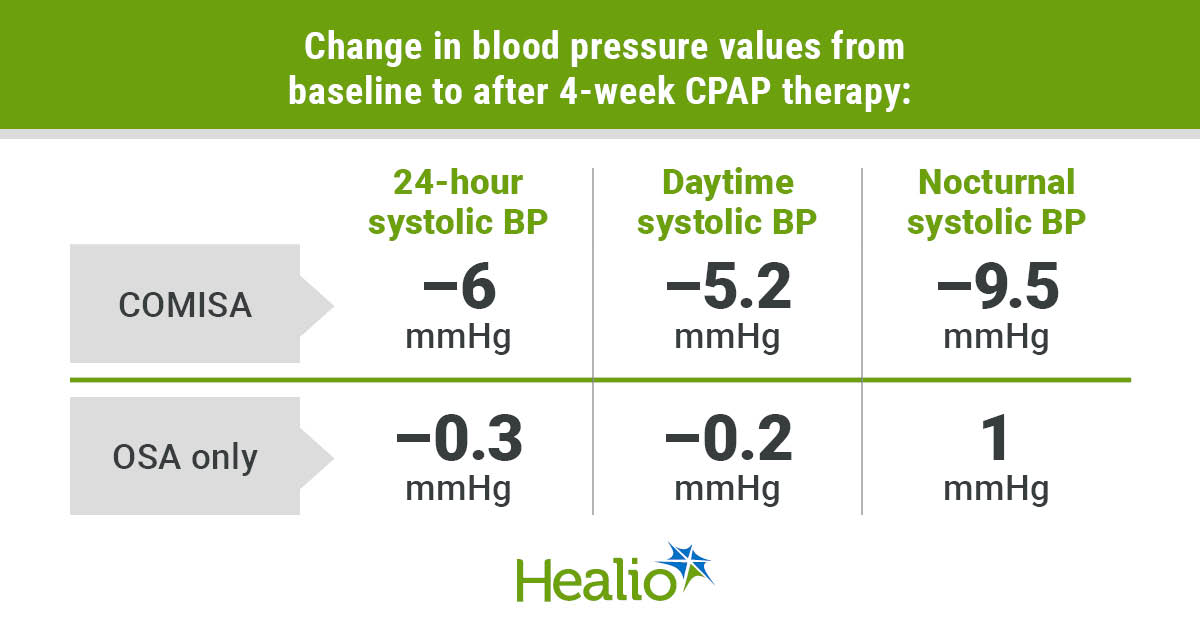
| Main finding | 24-hour SBP fell by 6.0 mmHg in patients with COMISA vs 0.3 mmHg in patients with OSA only (P = .002); baseline insomnia was associated with higher odds of achieving a clinically meaningful (≥5 mmHg) 24-hour SBP drop (adjusted OR = 5.05) |
| Follow-up | 4 weeks |
What the Researchers Found
Baseline Cohort Profile
| Characteristic | All Participants (N = 71) | COMISA (n = 22) | OSA Only (n = 49) |
| Mean Age (years) | 40.9 | 39.7 | 41.5 |
| Sex (% Men) | 93.0% | 95.5% | 91.8% |
| Median AHI (events/hour) | 54.4 | 50.6 | 54.4 |
SBP Reductions by Phenotype After 4 Weeks of CPAP
| Blood Pressure Measure | COMISA (n = 22) | OSA Only (n = 49) | P Value |
| 24-Hour SBP Change | –6.0 mmHg | –0.3 mmHg | .002 |
| Daytime SBP Change | –5.2 mmHg | –0.2 mmHg | .013 |
| Nocturnal SBP Change | –9.5 mmHg | +1.0 mmHg | .001 |
A decline of at least 5 mmHg was predefined as a clinically meaningful reduction. Baseline insomnia was strongly linked to achieving this threshold.
In multivariable logistic regression models adjusted for age, sex, body mass index (BMI), and daytime sleepiness, baseline insomnia was associated with markedly higher odds of a clinically meaningful 24-hour SBP reduction across various adjustment paradigms:
- Model 1 (Age, sex, BMI, sleepiness): aOR = 5.05 (95% CI, 1.64–15.55)
- Model 2 (+ Baseline BP): aOR = 6.34 (95% CI, 1.87–21.55)
- Model 3 (+ Baseline BP, AHI): aOR = 6.56 (95% CI, 1.91–22.56)
- Model 4 (+ Baseline BP, AHI, lowest oxygen saturation [LSpO2]): aOR = 5.43 (95% CI, 1.48–19.96)
- Model 5 (+ Baseline BP, AHI, percentage sleep time with SpO2 <90%): aOR = 6.49 (95% CI, 1.89–22.29)
- Model 6 (+ Baseline BP, AHI, LSpO2, and CPAP adherence): aOR = 5.62 (95% CI, 1.50–21.15)
When evaluating absolute categorical decreases (>0 mmHg), the association between insomnia and daytime or 24-hour SBP reductions was not statistically significant in the fully adjusted model. Nocturnal SBP reduction was initially higher among individuals with insomnia (aOR = 4.76; 95% CI, 1.21–18.72), but this relationship did not retain significance following Bonferroni correction.
Impact of CPAP Adherence
When stratified by therapy usage, patients with good CPAP adherence (n = 40) demonstrated statistically significant reductions from baseline in 24-hour, daytime, and nocturnal SBP, whereas those with poor adherence (n = 31) did not.
Among patients with good CPAP adherence:
- COMISA group: 24-hour SBP decreased by 6.8 mmHg
- OSA-only group: 24-hour SBP decreased by 1.5 mmHg (P = .026)
Lead author Shuang Li, MD, and colleagues noted:
“These findings underscore the potential for a more personalized management strategy for [blood pressure] management in patients with OSA, where the presence of comorbid insomnia may signal a subgroup with a distinct and favorable hemodynamic response to CPAP therapy.”
Clinical Significance
These findings challenge the assumption that insomnia comorbidity merely acts as a barrier to effective OSA management. Although insomnia frequently complicates CPAP compliance, patients with COMISA who tolerate and utilize the therapy demonstrate a pronounced cardiovascular benefit, potentially secondary to the relief of compounded sympathetic hyperactivity driven by both airway collapse and hyperarousal states.
Limitations
- Sample Size & Demographics: The cohort was small (N = 71; 22 COMISA) and predominantly male (93%), limiting generalizability to female populations and milder OSA severities.
- Short Duration: The follow-up interval was 4 weeks; long-term durability of blood pressure lowering beyond 1 month requires further evaluation.
- Adherence Drop-off: Insomnia remains a major driver of non-adherence, which can negate these therapeutic gains in standard outpatient settings if unaddressed.
- Correction Attenuation: Specific secondary associations (such as nocturnal SBP drop odds) lost significance after multiplicity adjustment (Bonferroni correction).
What Doctors Should Know
- Do Not Withhold CPAP: Comorbid insomnia should not discourage clinicians from prescribing CPAP; these patients represent a high-yield subgroup for blood pressure reduction.
- Proactively Protect Adherence: Because poor adherence eliminates the blood pressure benefit, clinicians must address insomnia symptoms concurrently.
As Li and colleagues concluded:
“Good CPAP adherence is critical but challenged by insomnia-induced intolerance. Future strategies should therefore combine insomnia-targeted interventions with CPAP to improve tolerance and potentially achieve synergistic cardiovascular benefits.”
- Consider Combined Therapies: Integrating Cognitive Behavioral Therapy for Insomnia (CBT-I) alongside positive airway pressure initiation can improve CPAP compliance and help secure favorable hemodynamic outcomes.
Bottom Line
Patients suffering from both OSA and insomnia exhibit significantly greater blood pressure reductions on CPAP than those with OSA alone, establishing COMISA as a phenotype with high cardiovascular responsiveness when treatment adherence is secured.
Original Research / DOI
Li S, et al. CHEST. 2026.