Incidence of New-Onset Metabolic Syndrome and Related Comorbidities in Men With Prostate Cancer Receiving Concurrent ADT and ARPIs
Based on findings reported by Shaver AL, et al. JAMA Oncol. 2026;doi:10.1001/jamaoncol.2026.2790.
Background and Rationale
Metabolic syndrome—clinically characterized by central adiposity, hypertriglyceridemia, hypertension, insulin resistance, and decreased high-density lipoprotein levels—affects more than one-third of the US adult population, with higher prevalence observed among older demographics. Although oncology practice guidelines recommend combining androgen receptor pathway inhibitors (ARPIs) with androgen deprivation therapy (ADT) for advanced prostate cancer, the exact metabolic liability of this dual regimen remained insufficiently defined.
Dr. Amy L. Shaver, principal biostatistician at Thomas Jefferson University, underscored the clinical trade-off between survival benefits and adverse systemic effects:
“Patients who receive ARPI and ADT have immense benefits to overall survival. However, monitoring for metabolic abnormality needs to happen early and systematically in treatment. It should happen before treatment begins, and then it needs to be watched.”
Shaver also highlighted the inherent risks of therapeutic escalation:
“If you’re adding regimens, that’s something you should know. Every time you put a drug on board with somebody, things can happen.”
Methods and Study Cohort
A retrospective cohort analysis was executed using the Epic Cosmos database, capturing clinical documentation across more than 1,800 hospitals and 41,000 outpatient centers. The cohort comprised 16,924 male patients diagnosed with prostate cancer between January 2014 and September 2025 who initiated combination therapy with ADT and ARPIs and possessed no prior history or clinical indicators of metabolic syndrome or its discrete components. The primary study endpoint was the development of new-onset metabolic syndrome within 12 months of starting concurrent therapy.
Table 1. Baseline Characteristics of the Study Population ($N = 16,924$)
| Characteristic | Proportion of Cohort (%) |
| Age | |
| <70 years | 35.0% |
| 70–79 years | 40.0% |
| $\ge$80 years | 25.0% |
| Race/Ethnicity | |
| White | 65.5% |
| Black | 21.0% |
| Other / Not Reported | 13.5% |
Primary Results and Onset Dynamics
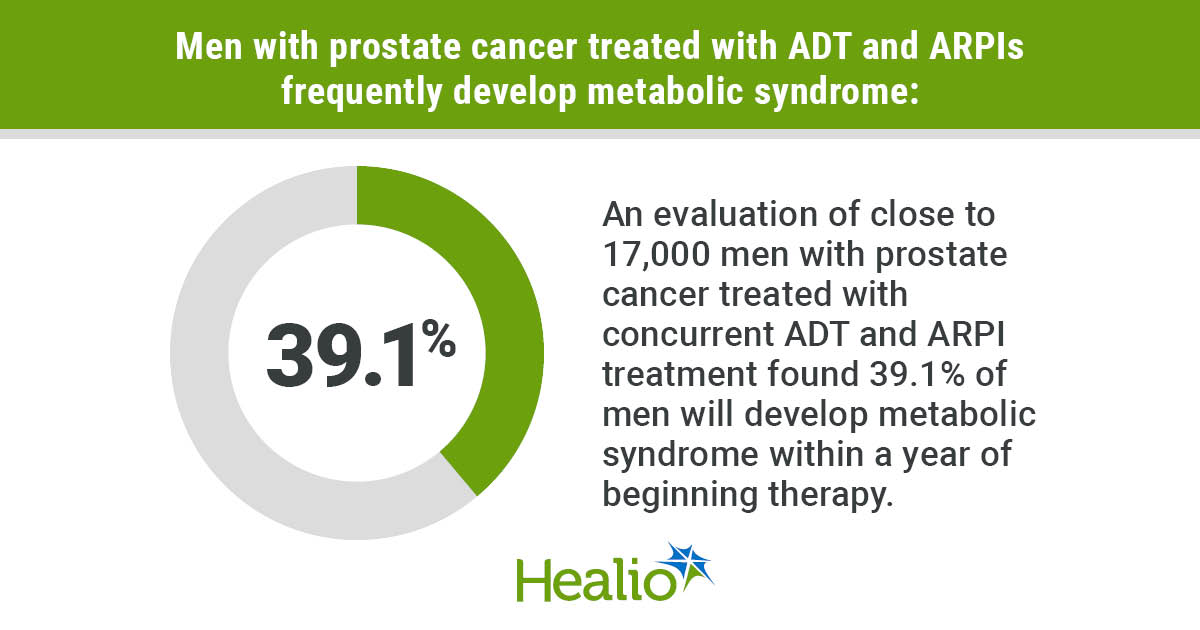
Across 152,905.7 patient-months of accumulated follow-up, 39.1% of patients developed metabolic syndrome within 12 months. Overall, 86.9% developed at least one metabolic dysfunction, corresponding to an event rate of 245.5 per 1,000 person-months.
The median time to the presentation of the first metabolic aberration was 1.0 month (most frequently hypertension), with a median duration of 2.6 months to fulfillment of complete metabolic syndrome criteria.
Regarding the unexpectedly rapid clinical onset, Shaver stated:
“We fully expected that we would see a decent amount of people who developed metabolic syndrome, or had one of the components of metabolic syndrome, but what was surprising was how frequent it was, and how early it happened. I remember when we first had the results, the oncologist who was working with us, he was like, ‘Wow. I know this happens, but to actually see it black and white, this is a lot of people, and it’s quick.’”
Table 2. Cumulative 1-Year Incidence and Rates of Metabolic Comorbidities
| Condition | 1-Year Incidence (%) | Incidence Rate (per 1,000 Person-Months) |
| Any metabolic dysfunction | 86.9% | 245.5 |
| Hypertension | 83.0% | 204.9 |
| Dyslipidemia | 51.8% | — |
| Obesity | 40.5% | — |
| Metabolic syndrome (full) | 39.1% | — |
| Insulin resistance | 24.0% | — |
Age Stratification
Patients aged 70 to 79 years exhibited the highest 1-year cumulative rate of metabolic syndrome (41.7%), compared with 37.8% among patients aged 80 years and older and 37.2% among those aged 18 to 69 years. Conversely, obesity risk showed an inverse relationship with increasing age.
Table 3. Risk of Metabolic Dysfunctions: Ages 70–79 Years vs 18–69 Years
| Metabolic Outcome | Adjusted Hazard Ratio (aHR) | 95% Confidence Interval (CI) |
| Dyslipidemia | 1.33 | 1.25–1.41 |
| Insulin resistance | 1.26 | 1.15–1.38 |
| Hypertension | 1.10 | 1.04–1.15 |
| Metabolic syndrome | 1.09 | 1.02–1.17 |
Comparative ARPI Analysis
An exploratory analysis evaluated the differential risk profiles of individual ARPI agents (enzalutamide and apalutamide) relative to abiraterone acetate.
Shaver emphasized the hypothesis-generating nature of these findings:
“It was exploratory. It’s not what we were specifically looking at. We were trying to see, is there a signal there? Is it something worth looking at? I think so.”
Table 4. Hazard Ratios for Enzalutamide and Apalutamide vs Abiraterone
| Agent | Comorbidity End Point | Hazard Ratio (HR) | 95% Confidence Interval (CI) |
| Enzalutamide | Hypertension | 0.85 | 0.81–0.88 |
| Insulin resistance | 1.08 | 1.00–1.18 | |
| Apalutamide | Hypertension | 0.81 | 0.76–0.85 |
| Dyslipidemia | 1.08 | 1.00–1.16 | |
| Insulin resistance | 1.10 | 0.99–1.23 | |
| Metabolic syndrome | 1.04 | 0.96–1.14 |
Discussion and Clinical Implications
The primary limitation acknowledged by investigators was the lack of an ADT-alone control cohort. Shaver observed:
“How much of that burden, how much of that risk can be attributed just to ADT? Just to the addition of the ARPI?”
Dr. Grace Lu-Yao, professor of medical oncology at Sidney Kimmel Medical College, stressed that oncologists and primary care teams must collaborate to prevent non-oncologic morbidity:
“A lot of patients, when they have cancer, they just single-minded focus on cancer and do not think about other potential health issues. Close monitoring plus coordinated care is truly important, because not only do patients have to deal with cancer, but there are other issues related to cancer therapy that could have significant impact on overall health.”
Shaver reinforced the preventive role of targeted surveillance:
“Ideally, after doing studies like this, we can identify who’s at most risk and test interventions that help reduce complications, so that you don’t have somebody who is surviving their prostate cancer but dies of a heart attack.”
As ARPI-based therapies migrate to earlier disease stages where extended survival is common, longitudinal cardiometabolic surveillance becomes critical. As Lu-Yao concluded:
“Some high-risk patients are already using this regimen. Those patients could potentially have 15, 20 years to live. Because of that, it’s even more important to monitor the potential impact of the therapy on their metabolic health.”