47
Dual Continuous Glucose and Ketone Monitoring in Type 1 Diabetes Management and Diabetic Ketoacidosis Prevention
Based on clinical presentations by Christie Beatson, MS, RD, CDCES, at the Association of Diabetes Care & Education Specialists Annual Meeting (ADCES26; Columbus, Ohio).
Background and Clinical Rationale
Diabetic ketoacidosis (DKA) represents an acute, life-threatening metabolic complication initiated by severe insulin deficiency, precipitating accelerated lipolysis, hepatic ketogenesis, and systemic acidosis. In August 2026, the US Food and Drug Administration (FDA) approved the first continuous dual glucose and ketone sensor (Libre Duo 10 Day system, Abbott Diabetes) for individuals aged 2 years or older with diabetes.
Addressing attendees at the ADCES26 meeting, Christie Beatson, MS, RD, CDCES, senior instructor at the Barbara Davis Center for Diabetes at the University of Colorado, underscored the historical shortcomings in patient adherence and outpatient monitoring:
Table 1. Diagnostic Criteria, Epidemiologic Burden, and At-Risk Populations for DKA
| Category | Clinical Specifications and Parameters |
| Diagnostic Laboratory Thresholds | * Blood Glucose: >200 mg/dL * Circulating Ketones: Serum $\beta$-hydroxybutyrate $\ge$3.0 mmol/L (or urine ketones $\ge$2+) * Acid-Base Balance: Venous/arterial blood pH <7.3 |
| Epidemiologic Prevalence and Outcomes | * Adults with Type 1 Diabetes (T1D): 4% to 8% affected annually * Pediatric Inception: Up to 80% of youth $\le$15 years present with DKA at initial T1D diagnosis * Mortality: Documented case-fatality rates ranging between 0.65% and 3.3% |
| Documented Patient Knowledge Deficits* | * 32% of individuals with T1D report no familiarity with DKA * 46% cannot identify hallmark DKA symptoms * 64% do not engage in routine home ketone surveillance |
| High-Risk Patient Populations | * Individuals with newly diagnosed T1D * Children and adolescents * Continuous subcutaneous insulin infusion (insulin pump) users * Patients prescribed sodium-glucose cotransporter 2 (SGLT2) inhibitors * Concurrent acute infectious illness * Pregnant patients with pre-existing T1D * Concomitant cannabis use or prolonged fasting/starvation |
*Data sourced from a 2023 survey published in BMJ Open Diabetes Research & Care.
Highlighting the acute severity and clinical burden of the disorder, Beatson remarked:
Comparative Analysis of Ketone Surveillance Modalities
Conventional point-of-care testing methods—namely urine dipstick testing and handheld point-of-care capillary meters—have historically introduced operational barriers that impede early clinical detection.
Regarding capillary blood monitoring constraints, Beatson observed:
Table 2. Comparison of Outpatient Ketone Monitoring Methods
| Surveillance Modality | Analyte Measured | Clinical Advantages | Implementation Challenges and Limitations |
| Urine Ketone Dipstick | Acetoacetate | * Low acquisition cost * Readily accessible over-the-counter | * Measures acetoacetate rather than $\beta$-hydroxybutyrate * Delayed excretion reflects past, not immediate, systemic state * Subjective colorimetric interpretation leads to reader variation * Inconvenient sample collection protocol |
| Capillary Blood Ketone Meter | $\beta$-hydroxybutyrate | * Direct, quantitative assessment of dominant circulating ketone body * Provides point-in-time circulating levels | * Requires dedicated meters and separate diagnostic test strips * High out-of-pocket costs and irregular insurance coverage * Infrequently prescribed by primary clinicians * Invasive (fingerstick required) |
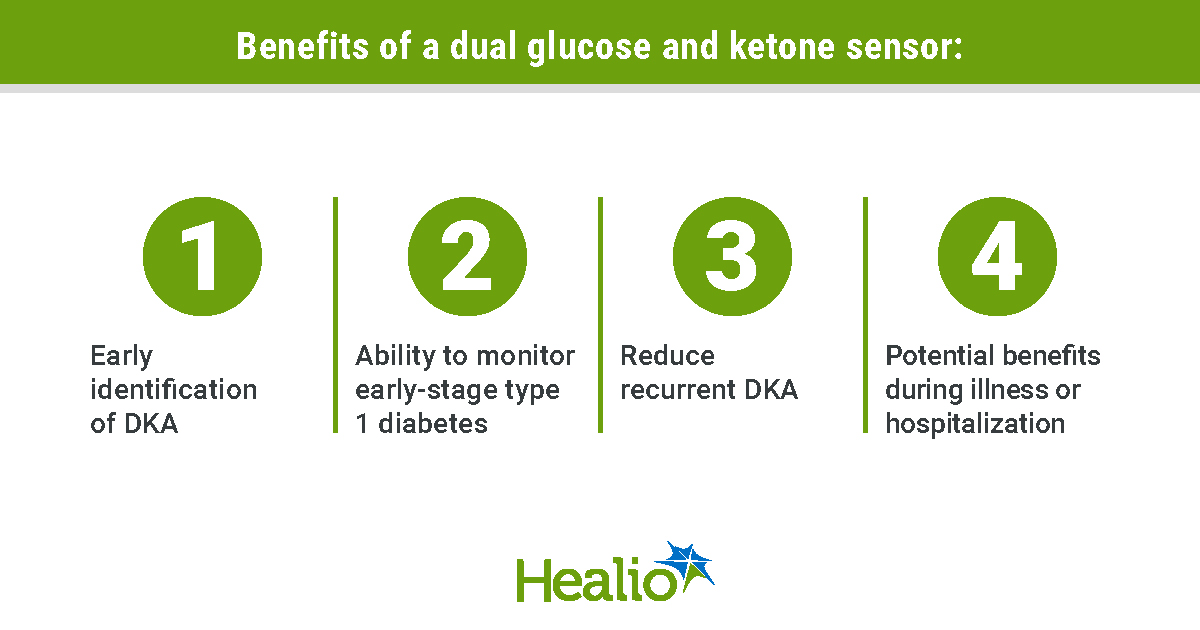
| Continuous Dual Sensor (Libre Duo 10 Day) | Interstitial Glucose + $\beta$-hydroxybutyrate | * Real-time co-monitoring (minute-by-minute evaluation) * Dynamic, threshold-based automated alerts for rising ketosis * Identifies early-stage ketosis prior to frank DKA * Facilitates surveillance in high-risk scenarios (acute illness, SGLT2i use, pregnancy) | * Lack of patient and family familiarity with ketone metrics * Potential for alarm fatigue from additive notification thresholds * Interindividual variation in physiologic baseline ketone levels * Necessity for clinical workflow integration and education |
Clinical Implementation and Actionable Ketone Protocols
Although continuous dual monitoring reduces sampling friction, therapeutic success requires structured clinical integration and patient education to prevent alarm fatigue and manage baseline interindividual variation.
Addressing these implementation barriers, Beatson explained:
Table 3. Structured Components for a Continuous Ketone Management Plan
| Component | Target Action and Clinical Recommendation |
| Baseline Assessment | Establish individualized baseline resting ketone ranges for each patient |
| Mild Elevation Intervention | Written guidance on hydration, supplemental corrective insulin dosing, and carbohydrate ingestion |
| Escalation Thresholds | Clear, objective cutoffs for clinician contact, urgent care consultation, or emergency department referral |
| Clinical Consensus Basis | Alignment with consensus-derived threshold action tiers published in The Lancet Diabetes & Endocrinology |
| Caregiver / Patient Education | Device-specific training on alert interpretation, sensor change protocols, and troubleshooting |
Successful deployment of dual continuous sensor systems depends on establishing formalized, written management protocols prior to initiation. By contextualizing real-time biometrics within actionable, consensus-aligned treatment plans, multidisciplinary diabetes care teams can systematically intervene during early ketosis, mitigating the recurrence and acute morbidity of DKA.