57
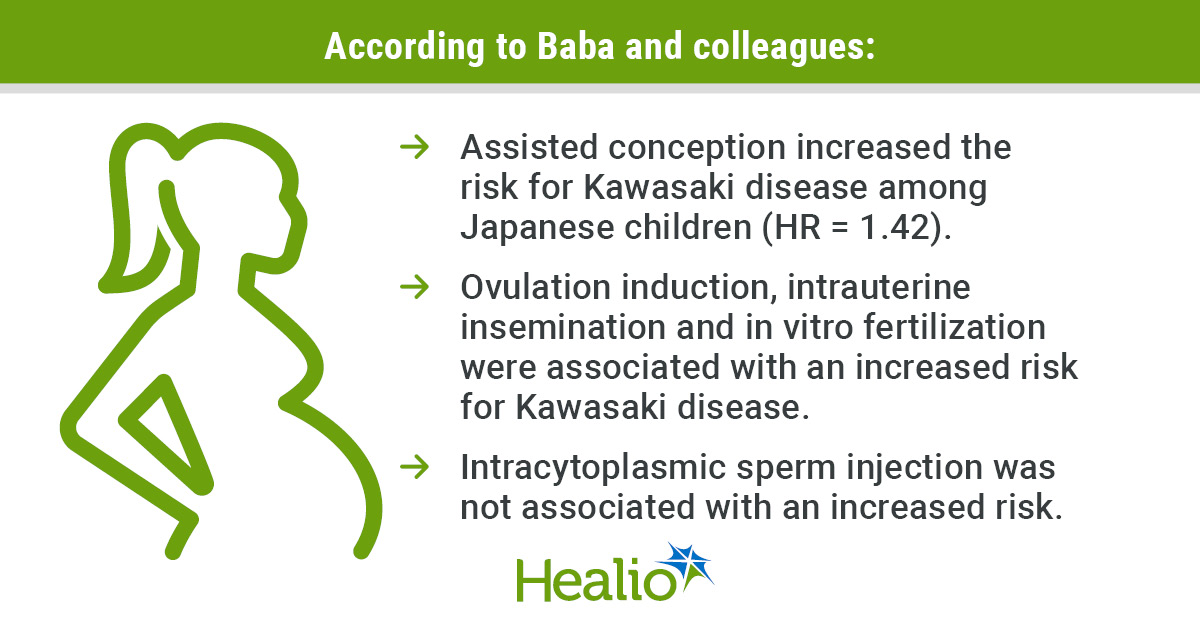
A nationwide prospective cohort study published in JAMA Network Open identified an increased risk of Kawasaki disease (KD) in children conceived via certain assisted reproductive technologies (ART) and fertility treatments compared with those conceived spontaneously.¹ While overall assisted conception was linked to a 42% higher relative risk of KD, the association varied across specific modalities, showing elevated risks for ovulation induction, intrauterine insemination (IUI), and in vitro fertilization (IVF), but no statistically significant elevation for intracytoplasmic sperm injection (ICSI).¹
Background and Clinical Rationale
The global utilization of fertility treatments has grown substantially, with Japan reporting particularly high adoption rates. As lead author Sachiko Baba, MD, PhD, and colleagues highlighted:
“In 2023, approximately 11.7% of all live births in Japan resulted from assisted reproductive technology (ART), which is substantially higher than the rates in Europe (7.9%) and the U.S. (5.1%). Given this widespread and increasing use of ART, there is also growing interest in understanding the long-term health outcomes of children conceived by these technologies. Previous reports suggest that ART procedures may induce epigenetic modification, including alterations in DNA methylation patterns, which has been observed in Kawasaki disease (KD).”¹
Because both KD and fertility treatments are suspected to intersect through immune-mediated and epigenetic pathways, the authors noted:
“Despite extensive research on ART and the health of offspring, to our knowledge, no studies have examined whether fertility treatment is associated with KD, both of which are considered to involve immune-related mechanisms and have shown increasing trends.”¹
Study Design and Population
The authors analyzed data from the Japan Environmental and Children’s Study (JECS), a nationwide prospective birth cohort that enrolled pregnant women between January 2011 and March 2014. Enrolled children were monitored through 59 months of age (approximately 5 years) to evaluate the incidence of KD.¹
| Cohort Parameter | Value |
| Total Cohort Size | 101,864 children |
| Total Follow-up Time | 431,558 person-years |
| Follow-up Duration | Up to 59 months of age |
| Male Offspring | 51,402 (50.5%) |
| Mean Gestational Age (SD) | 38.8 (1.7) weeks |
| Total Incident KD Cases | 1,226 cases |
| Overall Incidence Rate | 284 per 100,000 person-years |
Key Findings and Modality-Specific Outcomes
Children conceived through assisted modalities demonstrated a higher overall rate of KD than those conceived spontaneously (391 vs 274 per 100,000 person-years). After multivariable adjustment—including adjustments for maternal comorbidities—the elevated risk remained statistically significant for assisted conception overall, as well as for ovulation induction, IUI, and standard IVF. In contrast, ICSI did not exhibit an increased risk.¹
| Conception Modality | Incidence Rate (per 100,000 person-years) | Adjusted Hazard Ratio (aHR)* | 95% Confidence Interval (CI) | Statistical Significance |
| Spontaneous Conception | 274 | 1.00 [Reference] | — | — |
| Assisted Conception (Overall) | 391 | 1.42 | 1.18–1.70 | Significant risk increase |
| • Ovulation Induction | Not specified | 1.57 | 1.22–2.03 | Significant risk increase |
| • Intrauterine Insemination (IUI) | Not specified | 1.48 | 1.01–2.16 | Significant risk increase |
| • In Vitro Fertilization (IVF) | Not specified | 1.53 | 1.07–2.20 | Significant risk increase |
| • Intracytoplasmic Sperm Injection (ICSI) | Not specified | 0.91 | 0.58–1.43 | No significant association |
*Adjusted for baseline maternal comorbidities and confounding clinical variables.
Summarizing their primary findings, the authors concluded:
“In this nationwide cohort study, most fertility treatments, with the exception of intracytoplasmic sperm injection, were associated with an increased risk of KD among offspring. Further research is necessary to examine the consistency of our findings and elucidate the underlying mechanisms.”¹
Expert Commentary and Clinical Caveats
In an accompanying perspective, Cuoghi Edens, MD, a pediatric rheumatologist at the University of Chicago Medicine, emphasized clinical caution when interpreting these epidemiological links, underscoring that the fundamental etiology of Kawasaki disease remains *”elusive.”*²
Dr. Edens remarked that the findings present a classic scenario where *”correlation may not imply causation.”*² Specifically, she addressed the proposed biological mechanism:
- While IVF and ICSI have previously been studied in relation to rare medical conditions and oncologic outcomes in offspring, the study’s working hypothesis regarding epigenetic alterations (such as DNA methylation) lacks a coherent mechanistic explanation when generalized across such differing modalities.
- It remains biologically unclear why non-invasive or less manipulative techniques—such as ovulation induction medications or intrauterine insemination—would share the same epigenetic alteration pathways as laboratory-based embryological interventions while ICSI demonstrated no elevated risk.²
References
- Baba S, et al. Association between fertility treatment and Kawasaki disease among offspring: the Japan Environmental and Children’s Study. JAMA Netw Open. 2026. doi:10.1001/jamanetworkopen.2026.28586
- Edens C. Perspective on assisted conception and Kawasaki disease risk. Healio. Published September 15, 2026.