Liver Transplantation Shows Promising Survival Outcomes in Selected Patients With Unresectable Colorectal Liver Metastases
1-minute summary
Liver transplantation may offer a meaningful treatment option for carefully selected patients with unresectable colorectal liver metastases (CRLM) confined to the liver, according to a US national registry analysis presented at the American College of Gastroenterology (ACG) Annual Scientific Meeting in October 2026.
The study analyzed 203 adult liver transplant recipients identified through the Scientific Registry of Transplant Recipients. Transplants were performed between 2017 and 2025. Overall survival after transplantation was 90.9% at 1 year, 69.8% at 3 years, and 48.9% at 5 years. In a separate meta-analysis of studies investigating transplantation for CRLM, pooled 5-year overall survival was 57% (95% CI, 46%-67.3%).
By the end of the registry study period, 16.3% of recipients had died. Among deaths, 45.5% were attributed to malignancy, whereas graft failure accounted for 3%. These findings suggest that recurrent or progressive cancer, rather than graft failure, may represent an important challenge to long-term survival.
The investigators emphasized that these results apply to a highly selected population, generally characterized by good functional status and low Model for End-Stage Liver Disease (MELD) scores. They recommended early identification and multidisciplinary assessment of potential candidates, while highlighting the need to balance possible oncologic benefits against the limited supply of donor organs.
Why this matters
Colorectal cancer can spread to the liver, and some patients develop metastases that cannot be removed safely or completely through conventional liver surgery. For these patients, treatment options may be limited, particularly when disease remains confined to the liver but is not surgically resectable.
Liver transplantation removes the affected liver and replaces it with a donor organ. The reported survival outcomes suggest that this strategy may provide meaningful long-term survival for a narrowly defined group of patients with unresectable CRLM.
However, transplantation is not suitable for all patients with metastatic colorectal cancer. Candidate selection is especially important because cancer recurrence can compromise long-term outcomes, while transplantation uses a scarce donor resource that must be allocated responsibly.
As study investigator Ragesh B. Thandassery, MD, explained:
“Liver transplantation for unresectable [colorectal liver metastases] is an emerging indication, but its role in the United States remains highly selective and continues to evolve.”
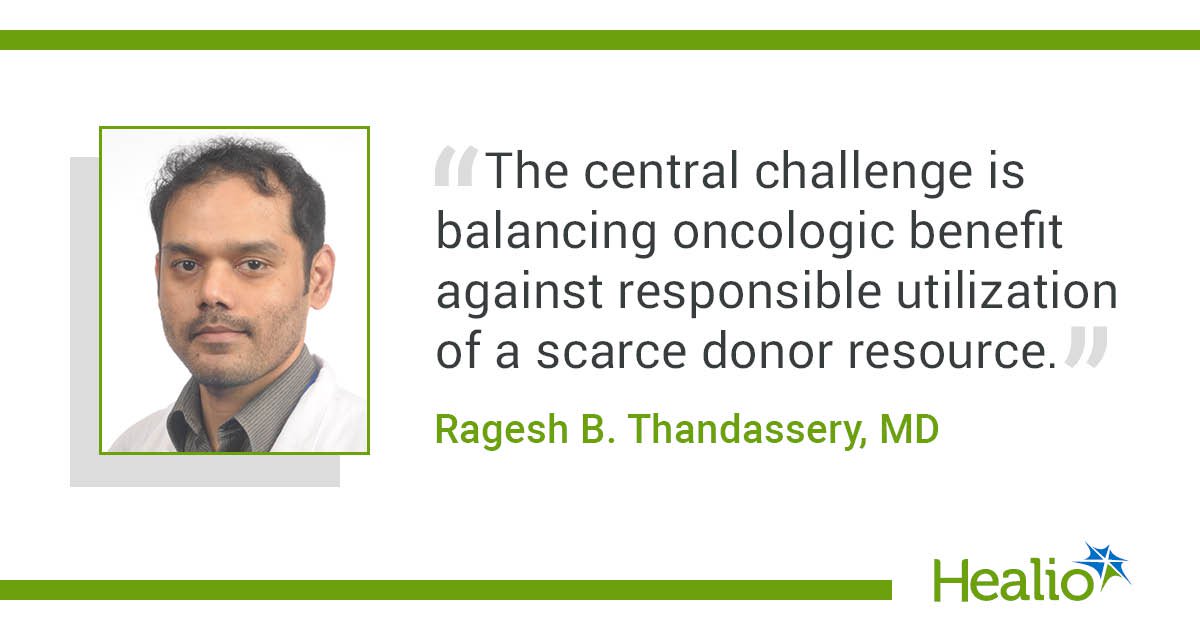
He also emphasized the central challenge of “balancing oncologic benefit against responsible utilization of a scarce donor resource.”
The findings reinforce the importance of multidisciplinary evaluation involving medical oncology, hepatobiliary surgery, and transplant hepatology.
Study at a glance
| Feature | Details |
|---|---|
| Study type | US national transplant-registry cohort analysis and separate meta-analysis |
| Data source | Scientific Registry of Transplant Recipients |
| Participants | 203 adult liver transplant recipients with colorectal liver metastases |
| Mean age | 49.6 years |
| Sex | 64% men |
| Race | 82.3% White |
| Median MELD score | 8 |
| Intervention | Liver transplantation for unresectable CRLM |
| Comparator | No comparator reported for the US registry cohort |
| Transplant period | 2017-2025 |
| Follow-up | Study follow-up ended in March; the supplied report does not specify the exact year or individual follow-up duration |
| Primary outcome | Overall survival after transplantation, as reported in the article |
| Additional outcomes | Deaths, causes of death, graft-related outcomes, donor type, waiting time, and hospital length of stay |
| 1-year survival | 90.9% |
| 3-year survival | 69.8% |
| 5-year survival | 48.9% |
| Meta-analysis finding | Pooled 5-year overall survival of 57% (95% CI, 46%-67.3%) |
| Presentation | ACG Annual Scientific Meeting, October 12-14, 2026 |
| DOI | Not provided in the supplied report |
What the researchers found
1. Patient characteristics and transplant eligibility
The analysis included 203 adults who underwent liver transplantation for CRLM between 2017 and 2025. The cohort had a mean age of 49.6 years, and 64% were men. The median MELD score was 8, indicating that the cohort generally had relatively low scores on this measure of liver disease severity.
Functional status was also favorable: 94.1% of recipients had a Karnofsky performance status greater than 70. More than three-quarters of recipients, 76.8%, had private insurance.
These characteristics are important when interpreting the outcomes. The investigators noted that favorable survival may partly reflect careful patient selection rather than an effect that can be generalized to all patients with CRLM.
| Patient characteristic | Reported finding |
|---|---|
| Number of recipients | 203 |
| Mean age | 49.6 years |
| Men | 64% |
| White patients | 82.3% |
| Median MELD score | 8 |
| Karnofsky performance status greater than 70 | 94.1% |
| Privately insured | 76.8% |
2. Donor types and transplant logistics
The registry analysis included several donor categories. Living donors accounted for the largest reported share, followed by extended-criteria donors and donation after cardiac death.
| Transplant characteristic | Reported finding |
|---|---|
| Living-donor grafts | 41.4% |
| Extended-criteria donor grafts | 26.6% |
| Donation after cardiac death | 22.2% |
| Median waitlist time | 118 days |
| Median postoperative hospital stay | 8 days |
The three specified donor categories account for 90.2% of grafts. The supplied article does not describe the remaining 9.8% in this breakdown.
The median waitlist time was 118 days, while the median hospital stay following transplantation was 8 days. These figures provide context for the logistical demands of transplantation in this selected population, but they do not establish how these measures compare with other transplant indications.
3. Survival after transplantation
Reported overall survival declined over time, from 90.9% at 1 year to 48.9% at 5 years.
| Time after transplantation | Overall survival |
|---|---|
| 1 year | 90.9% |
| 3 years | 69.8% |
| 5 years | 48.9% |
The results indicate favorable short-term survival, with approximately half of recipients alive at 5 years according to the reported estimate. The supplied article does not provide confidence intervals for these registry survival estimates, nor does it specify whether the estimates were adjusted for particular patient or tumor characteristics.
Thandassery described the findings as encouraging, stating:
“The survival we observed suggests that transplantation is certainly a promising and important step forward.”
This observation should be interpreted in the context of the selected study population and the absence of a reported nontransplant comparator.
4. Deaths and causes of mortality
By the end of the study period, 16.3% of recipients had died. The article reported that malignancy was responsible for 45.5% of deaths, while graft failure accounted for 3%.
| Outcome | Reported finding |
|---|---|
| Recipients who had died by the end of the study period | 16.3% |
| Deaths attributed to malignancy | 45.5% of deaths |
| Deaths attributed to graft failure | 3% of deaths |
The percentages for causes of death refer to the deaths reported in the article, not to all 203 transplant recipients. The supplied report does not provide the absolute number of deaths or a complete breakdown of other causes.
The authors interpreted the findings as suggesting that malignancy is a major challenge to long-term outcomes. As Thandassery stated:
“Importantly, the major determinant of long-term outcome appears to be recurrent malignancy rather than graft failure, highlighting that oncologic selection and disease control remain key to success.”
This is the investigators’ interpretation of the observed outcomes; the supplied summary does not provide a causal analysis establishing that recurrent malignancy is the determinant of survival.
5. Meta-analysis of international survival outcomes
In addition to the US registry analysis, the researchers conducted a meta-analysis of studies examining liver transplantation for CRLM. The pooled 5-year overall survival was 57%, with a 95% confidence interval of 46% to 67.3%.
| Meta-analysis outcome | Estimate |
|---|---|
| Pooled 5-year overall survival | 57% |
| 95% confidence interval | 46%-67.3% |
The pooled estimate was numerically higher than the 48.9% 5-year survival reported in the US registry cohort. However, this difference should not be interpreted as evidence of better outcomes in the international studies. Differences in eligibility criteria, study populations, treatment eras, follow-up, and study methods may affect pooled estimates.
The supplied article does not provide the number of studies or patients included in the meta-analysis, the statistical model used, or measures of between-study heterogeneity.
Clinical significance
The findings support the possibility that liver transplantation may have a role in the management of selected patients with unresectable CRLM confined to the liver. They also highlight several considerations for clinical practice.
Potential for long-term survival: The reported 1-, 3-, and 5-year survival estimates suggest that transplantation may provide durable survival for some carefully selected patients.
Importance of cancer-related selection: Because malignancy accounted for a substantial proportion of reported deaths, assessment of tumor biology, disease distribution, response to cancer treatment, and risk of recurrence is central to considering transplantation. The supplied report does not specify the exact selection criteria used for each recipient.
Donor-organ stewardship: The authors stressed that potential oncologic benefit must be balanced against the scarcity of donor organs. The results therefore support specialized assessment rather than broad application of transplantation to all patients with unresectable liver metastases.
Multidisciplinary care: Early discussion among medical oncologists, hepatobiliary surgeons, and transplant hepatologists may help identify patients who warrant evaluation before treatment options become more limited.
Need for comparative evidence: The survival estimates are encouraging, but the registry cohort does not establish that transplantation improves survival compared with other treatment strategies in otherwise similar patients.
Limitations
Several limitations should be considered when interpreting these findings:
- Highly selected cohort: The recipients generally had good functional status and low MELD scores. Their outcomes may not be representative of all patients with unresectable CRLM.
- No reported comparator group: The supplied report does not describe a matched group receiving systemic therapy, liver-directed treatment, or other nontransplant management. The survival benefit attributable specifically to transplantation therefore cannot be determined from this cohort alone.
- Potential selection bias: Patients who reach transplantation may differ substantially from patients who are not selected or who progress while awaiting a transplant.
- Limited follow-up detail: Although survival was reported at 1, 3, and 5 years, the supplied article does not specify the exact follow-up end date or provide individual follow-up distributions.
- Incomplete statistical information: Confidence intervals and adjustment details for the US registry survival estimates were not provided in the supplied report.
- Incomplete meta-analysis details: The number of included studies, total sample size, study-selection criteria, heterogeneity statistics, and sensitivity analyses were not provided. The robustness of the pooled estimate cannot therefore be fully evaluated from the summary.
- Limited detail on cancer characteristics: The supplied article does not report the tumor-selection criteria, molecular characteristics, disease-free intervals, response to prior treatment, or recurrence rates in sufficient detail to identify which patient subgroups derive the greatest benefit.
- Observational evidence: The registry findings describe outcomes after transplantation but cannot establish causality or prove superiority over alternative treatments.
What doctors should know
- Consider early specialist referral: Patients with liver-confined CRLM that cannot be resected may warrant multidisciplinary discussion to determine whether specialized transplant evaluation is appropriate.
- Avoid generalizing the survival figures: The reported outcomes arose from a highly selected cohort and should not be used as expected survival estimates for every patient with unresectable colorectal cancer liver metastases.
- Evaluate oncologic suitability carefully: Cancer distribution, tumor biology, response to treatment, and recurrence risk are important considerations, although the supplied report does not provide a complete selection protocol.
- Discuss uncertainty with patients: The reported survival figures are encouraging, but the analysis does not establish the size of the survival benefit compared with nontransplant treatment.
- Consider donor availability and allocation: Transplantation must be evaluated in the context of limited organ availability and the expected benefit for the individual patient.
- Interpret the meta-analysis cautiously: The pooled 5-year survival estimate of 57% summarizes other studies and should not be assumed to represent the outcome expected in every transplant program or patient population.
Bottom line
A US registry analysis of 203 adults who underwent liver transplantation for unresectable colorectal liver metastases reported overall survival of 90.9% at 1 year, 69.8% at 3 years, and 48.9% at 5 years. A separate meta-analysis reported pooled 5-year overall survival of 57% (95% CI, 46%-67.3%).
These findings suggest that transplantation may be a meaningful option for a small, carefully selected group of patients whose colorectal liver metastases are confined to the liver and cannot be resected. However, the observational data do not establish superiority over nontransplant treatment. Careful oncologic selection, multidisciplinary assessment, and responsible use of donor organs remain essential.
Original research / DOI
Conference presentation: Thandassery RB, et al. Liver transplantation for colorectal liver metastases in the United States: Contemporary outcomes and a comparative analysis of international survival trends.
Presented at: ACG Annual Scientific Meeting, October 12–14, 2026; Nashville, Tennessee.
Data source: Scientific Registry of Transplant Recipients.
DOI: Not provided in the supplied report.
Disclosure: Ragesh B. Thandassery, MD, reported no relevant financial disclosures. Readers should consult the original study for disclosures from the other authors.