
[ad_1]
Key Points
-
- In adults with obesity who had recently lost weight, exercise during weight-loss maintenance lowered the progression of atherosclerosis.
-
- In contrast, liraglutide (a GLP-1 receptor agonist) did not show this effect in the same group.
Study Overview
A clinical trial presented at the European Association for the Study of Diabetes (EASD) Annual Meeting evaluated how exercise and liraglutide affect weight-loss maintenance and cardiovascular health.
-
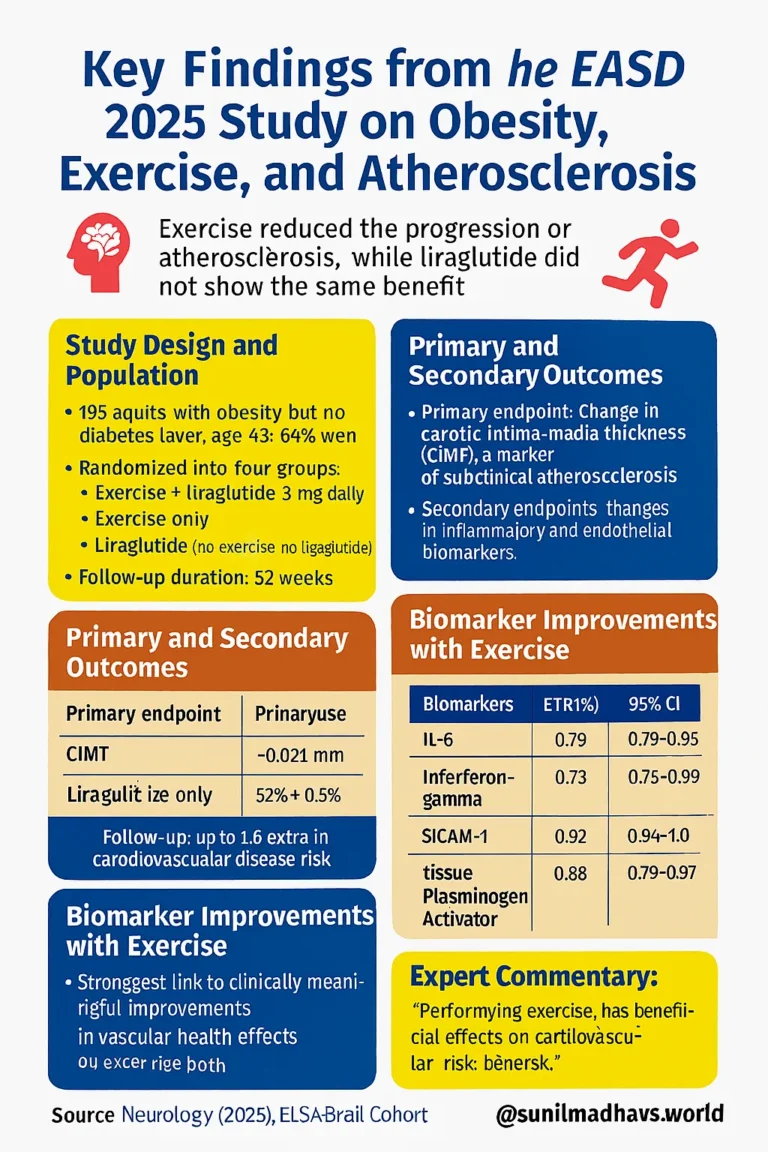
- Participants: 195 adults with obesity but without diabetes (average age 43 years; 64% women).
-
- Initial Phase: All participants followed a low-calorie diet for 8 weeks, leading to an average weight loss of 13.1 kg.
-
- Randomization: Afterward, they were assigned to one of four groups for 52 weeks:
- Exercise + liraglutide
- Exercise only
- Liraglutide only
- Placebo
Scientific Rationale
According to Signe Sørensen Torekov, PhD (University of Copenhagen), obesity and physical inactivity promote inflammation and endothelial dysfunction, both of which drive early atherosclerosis and cardiovascular disease.
-
- Exercise improves body composition, lowers inflammation, and enhances vascular function.
-
- GLP-1 receptor agonists, such as liraglutide, also reduce inflammation and support weight loss.
-
- The hypothesis: both strategies might reduce atherosclerosis progression.
Outcomes Measured
-
- Primary outcome: Change in carotid intima-media thickness (CIMT), a marker of early atherosclerosis.
-
- Secondary outcomes: Changes in biomarkers of inflammation and endothelial function.
Results
Body Composition
-
- Initial rapid weight loss caused both fat and muscle loss.
-
-
-
- Combined treatment (exercise + liraglutide): Showed the greatest fat loss and a small increase in muscle mass.
-
- Liraglutide group: Further fat reduction but no muscle gain.
-
- Exercise groups: Gained back lean muscle while continuing to lose fat.Over the following year:
-
- Liraglutide group: Further fat reduction but no muscle gain.
-
- Combined treatment (exercise + liraglutide): Showed the greatest fat loss and a small increase in muscle mass.
-
-
Atherosclerosis (CIMT)
-
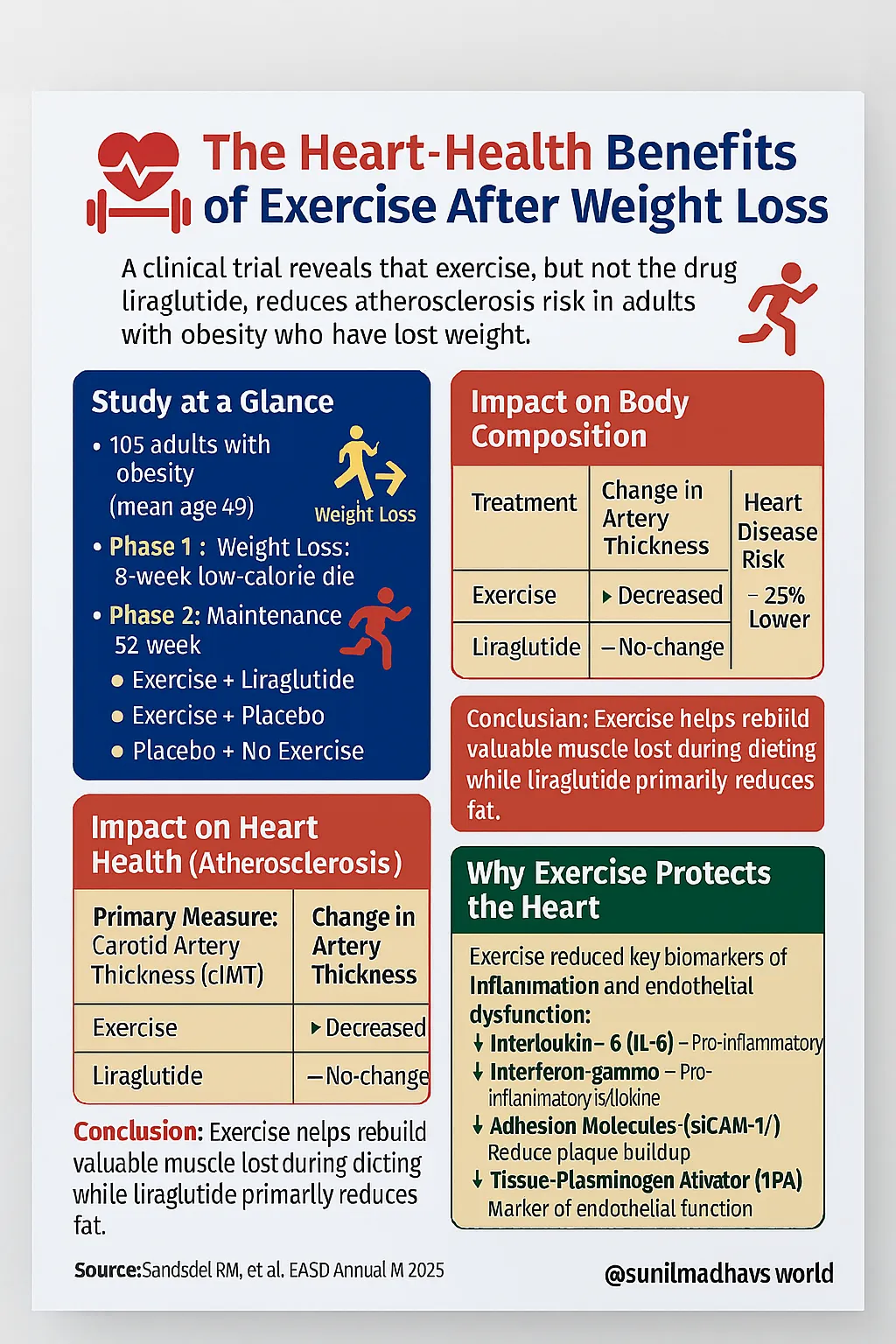
- Exercise groups: CIMT decreased by –0.024 mm, nearly three times more than in non-exercise groups. This corresponds to an estimated 25% lower risk of cardiovascular disease.
-
- Liraglutide groups: No meaningful difference compared with placebo.
Inflammation & Endothelial Dysfunction
Only exercise showed significant reductions in pro-inflammatory and endothelial markers:
-
- Interleukin-6 (IL-6) ↓
-
- Interferon-gamma ↓
-
- Soluble ICAM-1 ↓
-
- Soluble VCAM-1 ↓
-
- Tissue plasminogen activator ↓
Liraglutide did not produce similar improvements.
Conclusions
-
- Exercise, not liraglutide, reduced subclinical atherosclerosis (CIMT).
-
- The benefits were linked to reduced inflammation and improved vascular function.
-
- Combination therapy (exercise + liraglutide) provided the greatest fat loss, but only exercise contributed to cardiovascular risk reduction.
Dr. Torekov summarized:
-
- Exercise after weight loss helps preserve lean mass, reduce fat, and protect cardiovascular health.
-
- GLP-1 drugs support fat loss but do not substitute for exercise in preventing atherosclerosis.
This work earned the Best Abstract Prize from the EASD Early Career Academy.
Bottom Line: Exercise during and after weight loss not only helps maintain healthy body composition but also directly reduces cardiovascular risk factors, whereas liraglutide alone does not reduce subclinical atherosclerosis.
[ad_2]

No comments yet. Start the discussion!