72
Epidemiological Burden and Clinical Challenges in Glaucoma
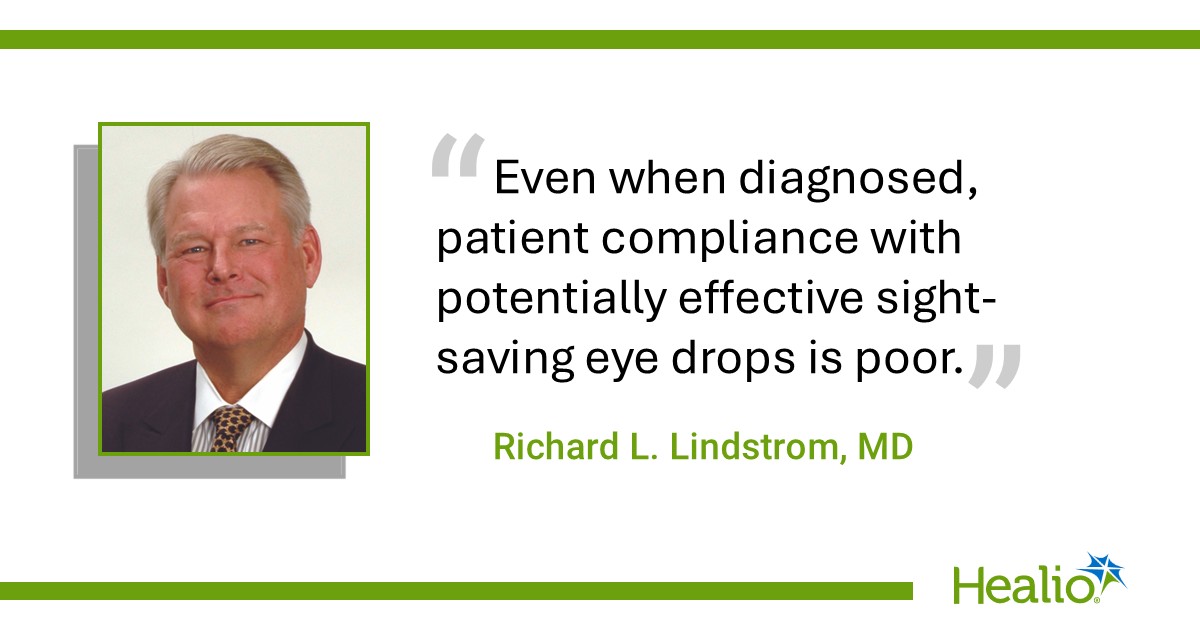
In a commentary published by Dr. Richard L. Lindstrom (Lindstrom’s Perspective), the current landscape of glaucoma care in the United States highlights critical public health hurdles. It is estimated that 4.22 million Americans are affected by glaucoma, reflecting an overall prevalence rate of 1.62% in adults aged 18 and older, and 2.56% in individuals over the age of 40. Primary open-angle glaucoma (POAG) remains the most common diagnosis, with disproportionately higher risk profiles observed in Black adults.
Management is severely hampered by two primary systemic barriers: widespread undiagnosed disease and exceptionally low patient compliance with topical drop regimens.
Key Epidemiological Metrics in Glaucoma
| Epidemiological Parameter | Statistic / Finding | Clinical Implications |
| Total U.S. Prevalence | ~4.22 million individuals | Major public health impact |
| Prevalence (> 40 years) | 2.56% | Age-dependent risk scaling |
| Prevalence (Adults 18+) | 1.62% | Broad adult screening requirement |
| Undiagnosed Rate (U.S.) | ~50% | Highest burden concentrated in Black and Hispanic populations |
| First-Year Adherence Rate | 56% | Significant drop-off in initial prescription acquisition |
| One-Year Continuation Rate | 31% | Long-term therapeutic failure due to non-compliance |
The Limitations of Topical Medical Therapy
Despite the availability of safe and affordable intraocular pressure (IOP)-lowering drops, long-term adherence remains poor. Pharmacy fill data cited by Dr. Lindstrom indicate that patients acquire only enough medication to achieve a 56% treatment rate during the first year, plummeting to 31% after 12 months.
Furthermore, chronic topical administration is associated with local and systemic side effects that impair quality of life:
- Ocular surface toxicity and discomfort
- Conjunctival hyperemia and periocular skin dermatitis
- Periorbital fat atrophy (altering appearance)
- Spectacle blur upon instillation
- Documented induction of significant clinical depression
As Dr. Lindstrom notes, when discussing the psychological and physiological toll:
“The chronic use of glaucoma eye drops has been confirmed to reduce quality of life and in some cases even induce significant depression.”
The Paradigm Shift to Interventional Glaucoma (IG)
Because traditional drop-first protocols frequently result in progressive optic nerve damage despite subspecialist oversight, key opinion leaders are advocating for a structural transition. Interventional glaucoma (IG) redefines the treatment hierarchy by establishing laser therapy, injectable/implantable devices, and incisional surgery as first-line interventions, utilizing eye drops purely as adjunctive support.
Evidence from the LiGHT Trial
The foundational evidence supporting primary interventional management stems from the LiGHT trial, which evaluated treatment-naive POAG patients randomized to selective laser trabeculoplasty (SLT) versus initial drop therapy.
- Drop-Free Success: At 3 years, 76% of SLT-treated patients remained completely free of eye drops while maintaining their target IOP.
- Optic Nerve Protection: At 6 years, patients treated with primary eye drops experienced progressive optic nerve damage in 26.8% of cases, compared to only 19.6% in the SLT cohort.
- Surgical Reductions: The SLT group required significantly fewer invasive trabeculectomies (13 eyes vs. 32 eyes in the medical therapy group), with no reported serious laser-related adverse events.
Therapeutic Advancements and Emerging Modalities
Beyond primary SLT, modern interventional glaucoma incorporates several advanced procedural and pharmaceutical innovations:
- Office-Based Injectables & Implants: Extended-release drug delivery systems like Durysta (bimatoprost intracameral implant) and iDose TR (travoprost intracameral implant) bypass patient compliance hurdles.
- Early Cataract Surgery: Recognizing that clear lens extraction provides sustained, powerful IOP reduction, surgeons are performing cataract/IOL procedures earlier, particularly for patients with narrow anterior chamber angles.
- Minimally Invasive Glaucoma Surgery (MIGS): Combining cataract procedures with MIGS enhances pressure-lowering efficacy without escalating risk, though third-party payer restrictions continue to create access hurdles.
Dr. Lindstrom summarizes the contemporary direction of the specialty:
“Interventional glaucoma procedures including SLT, direct SLT, intraocular injectable or implantable extended drug release devices, and MIGS are gaining traction as superior first-line therapies for vision preservation and enhanced quality of life.”
Zero-CLS Interactive Widget Code (WordPress / Soledad Theme)
To implement an interactive management comparison widget in a Soledad-themed WordPress site without triggering Cumulative Layout Shift (CLS), the container utilizes strict structural bounding and a fixed minimum viewport height.
HTML
<!-- Zero-CLS Interventional Glaucoma Interactive Widget -->
<div class="ig-widget-wrapper">
  <div class="ig-header">
    <h3>Glaucoma Management Paradigm Explorer</h3>
    <p>Select a treatment phase to review clinical outcomes and strategies.</p>
  </div>
  <div class="ig-tab-bar">
    <button class="ig-btn active" onclick="switchIgTab('traditional')">Traditional Drop-First</button>
    <button class="ig-btn" onclick="switchIgTab('interventional')">Interventional IG-First</button>
    <button class="ig-btn" onclick="switchIgTab('implants')">Implants & MIGS</button>
  </div>
  <div class="ig-viewport-box">
    <div id="ig-pane-traditional" class="ig-content-pane active">
      <h4>Traditional Medical Management</h4>
      <p>Relies on daily topical drops. Suffers from poor long-term compliance (only 31% continuation at 1 year), ocular surface toxicity, and high rates of progressive nerve damage.</p>
    </div>
    <div id="ig-pane-interventional" class="ig-content-pane">
      <h4>Interventional Glaucoma (SLT-First)</h4>
      <p>Supported by LiGHT trial data: 76% drop-free at 3 years, lower 6-year optic nerve progression (19.6%), and significantly reduced needs for invasive trabeculectomies.</p>
    </div>
    <div id="ig-pane-implants" class="ig-content-pane">
      <h4>Advanced Implants & MIGS</h4>
      <p>Utilizes office-based intracameral devices (Durysta, iDose TR) and early cataract surgery combined with MIGS to achieve sustained IOP control without daily patient burden.</p>
    </div>
  </div>
</div>

<style>
/* Strict structural bounding prevents Cumulative Layout Shift (CLS) */
.ig-widget-wrapper {
  width: 100%;
  max-width: 800px;
  background: #fbfbfc;
  border: 1px solid #dcdfe6;
  border-radius: 6px;
  padding: 20px;
  box-sizing: border-box;
  margin: 25px auto;
  font-family: inherit;
}
.ig-header h3 {
  margin: 0 0 4px 0;
  font-size: 1.2rem;
  color: #1a1a1a;
}
.ig-header p {
  margin: 0 0 14px 0;
  font-size: 0.85rem;
  color: #555;
}
.ig-tab-bar {
  display: flex;
  gap: 8px;
  margin-bottom: 12px;
  flex-wrap: wrap;
}
.ig-btn {
  background: #eef2f7;
  border: none;
  padding: 8px 14px;
  border-radius: 4px;
  cursor: pointer;
  font-weight: 600;
  font-size: 0.8rem;
  color: #333;
  transition: background 0.2s;
}
.ig-btn.active {
  background: #004080;
  color: #fff;
}
/* Fixed viewport height constraints eliminate layout jumps */
.ig-viewport-box {
  position: relative;
  min-height: 120px;
  background: #ffffff;
  border: 1px solid #e1e4e8;
  border-radius: 4px;
  padding: 15px;
  box-sizing: border-box;
}
.ig-content-pane {
  display: none;
  position: absolute;
  top: 15px;
  left: 15px;
  right: 15px;
  bottom: 15px;
}
.ig-content-pane.active {
  display: block;
}
.ig-content-pane h4 {
  margin: 0 0 6px 0;
  font-size: 1rem;
  color: #004080;
}
.ig-content-pane p {
  margin: 0;
  font-size: 0.9rem;
  color: #444;
  line-height: 1.4;
}
</style>

<script>
function switchIgTab(paneId) {
  var panes = document.querySelectorAll('.ig-content-pane');
  var buttons = document.querySelectorAll('.ig-btn');

  panes.forEach(function(p) {
    p.classList.remove('active');
  });
  buttons.forEach(function(b) {
    b.classList.remove('active');
  });

  document.getElementById('ig-pane-' + paneId).classList.add('active');
  event.currentTarget.classList.add('active');
}
</script>
Zero-CLS Clinical Trials Summary HTML Code
The standalone HTML card below provides a clinical trial breakdown engineered with rigid box-sizing constraints to guarantee zero layout shifting on page load.
HTML
<div class="clinical-summary-card-ig">
  <div class="csc-badge">LiGHT Trial Evidence Summary</div>
  <h4 class="csc-title">Primary Selective Laser Trabeculoplasty (SLT) vs. Medical Drops</h4>
  <p class="csc-desc"><strong>Core Insight:</strong> Long-term data proves SLT-first strategies yield superior optic nerve preservation and eliminate reliance on daily drops for the majority of patients.</p>
  <div class="csc-metrics-grid">
    <div class="csc-metric-box">
      <span class="csc-val">76%</span>
      <span class="csc-label">Drop-free at 3 years (SLT Group)</span>
    </div>
    <div class="csc-metric-box">
      <span class="csc-val">19.6%</span>
      <span class="csc-label">Nerve damage progression at 6 yrs (SLT)</span>
    </div>
    <div class="csc-metric-box">
      <span class="csc-val">26.8%</span>
      <span class="csc-label">Nerve damage progression at 6 yrs (Drops)</span>
    </div>
  </div>
</div>

<style>
.clinical-summary-card-ig {
  width: 100%;
  max-width: 800px;
  background: #ffffff;
  border-left: 4px solid #004080;
  border-top: 1px solid #dcdfe6;
  border-right: 1px solid #dcdfe6;
  border-bottom: 1px solid #dcdfe6;
  border-radius: 4px;
  padding: 20px;
  box-sizing: border-box;
  margin: 25px auto;
  font-family: inherit;
}
.csc-badge {
  display: inline-block;
  background: #e6eff7;
  color: #004080;
  font-size: 0.75rem;
  font-weight: 700;
  padding: 3px 7px;
  border-radius: 3px;
  text-transform: uppercase;
  margin-bottom: 6px;
}
.csc-title {
  margin: 0 0 6px 0;
  font-size: 1.1rem;
  color: #1a1a1a;
}
.csc-desc {
  margin: 0 0 15px 0;
  font-size: 0.85rem;
  color: #555;
  line-height: 1.4;
}
.csc-metrics-grid {
  display: flex;
  gap: 10px;
  flex-wrap: wrap;
}
.csc-metric-box {
  flex: 1;
  min-width: 130px;
  background: #f9fbfd;
  border: 1px solid #eaeaea;
  border-radius: 4px;
  padding: 10px;
  box-sizing: border-box;
  text-align: center;
}
.csc-val {
  display: block;
  font-size: 1.3rem;
  font-weight: 700;
  color: #004080;
  margin-bottom: 3px;
}
.csc-label {
  display: block;
  font-size: 0.75rem;
  color: #666;
  line-height: 1.2;
}
</style>