48
Pulmonary Artery Denervation Combined With Medical Therapy for Heart Failure and Left-Sided Pulmonary Hypertension: Findings From the PADN-HF-PH Trial
Based on data presented by Chen SL, et al. at the European Society of Cardiology (ESC) Congress 2026 (Hot Line 6; Munich, Germany) and simultaneously published in The New England Journal of Medicine.
Background and Pathophysiologic Rationale
Left-sided pulmonary hypertension secondary to heart failure (HF) carries high morbidity and mortality, with few therapeutic options that alter disease trajectory beyond guideline-directed medical therapy (GDMT). Pulmonary artery denervation (PADN) utilizes catheter-based radiofrequency ablation to disrupt hyperactive perivascular sympathetic nerve fibers surrounding the pulmonary trunk, dampening neurohormonal overactivation driven by the sympathetic nervous system and the renin-angiotensin system (RAS).
Describing the clinical rationale for the trial, Shao-Ling Chen, MD, director of cardiology at Nanjing First Hospital, Nanjing Medical University, stated:
“Despite contemporary guideline-directed medical therapy, we still lack an effective treatment for patients with heart failure associated with pulmonary hypertension. With understanding the central role of sympathetic and RAS activation in the heart failure development, so the PADN technology emerges. It was designed to interrupt sympathetic nerves surrounding the pulmonary artery. The consistent findings from prior studies included improvements in hemodynamics and exercise capacity, and many fewer clinical events. Unfortunately, neither of these studies provided definitively very strong power of the clinical benefit. So a large clinical trial was therefore required.”
Trial Design and Baseline Cohort Characteristics
The multicenter, open-label, randomized controlled PADN-HF-PH trial enrolled 264 patients across clinical centers in rural China. Eligible participants had left-sided pulmonary hypertension and concomitant heart failure across the ejection fraction spectrum. Participants were randomized to receive either catheter-based pulmonary artery denervation (PADN system, Pulnovo Medical) plus GDMT or GDMT alone. The median study follow-up was 338 days.
Table 1. Trial Architecture and Patient Demographics ($N = 264$)
| Parameter | Clinical Trial Specification |
| Study Design | Randomized, unblinded, active-controlled clinical trial |
| Study Population | Patients with left-sided pulmonary hypertension and HF (any ejection fraction) |
| Sample Size | 264 patients |
| Demographics | * Median age: 66 years * Sex: 51% men, 49% women |
| Study Setting | Academic medical centers in rural China |
| Intervention Arm | Pulmonary artery denervation (PADN system) + GDMT |
| Control Arm | Guideline-directed medical therapy (GDMT) alone |
| Follow-Up Duration | Median follow-up: 338 days (Kaplan-Meier projections to 2 years) |
| Primary End Point | Composite clinical worsening (all-cause mortality, heart/lung transplantation, HF hospitalization, outpatient IV diuretic requirement, or functional decline of $\ge$10% or $\ge$30 m on 6-minute walk distance) |
Primary and Secondary Clinical Outcomes
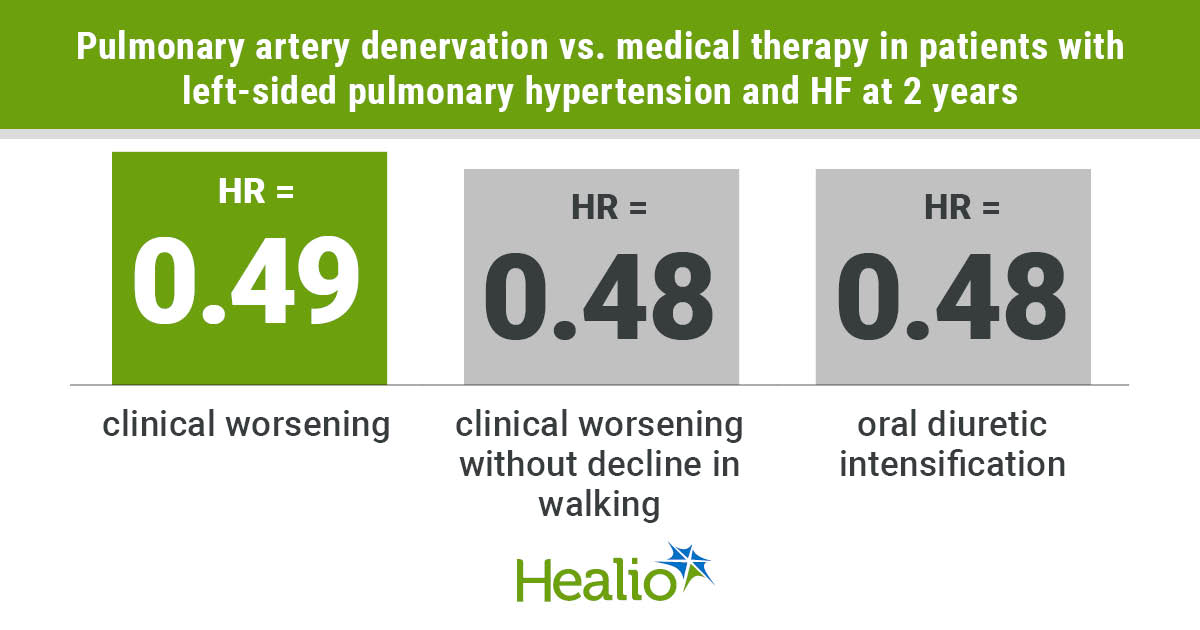
At 2 years, the Kaplan-Meier estimated cumulative incidence of the primary composite outcome was 25.7% in the PADN plus GDMT group compared with 51.1% in the GDMT-alone group, representing a 51% relative risk reduction (HR = 0.49; 95% CI, 0.30–0.82; $P = .006$).
Significant risk reductions were also observed for composite worsening excluding functional walk performance, as well as outpatient worsening requiring oral diuretic escalation. However, when individual conventional endpoints were assessed in isolation—including all-cause mortality, transplantation, HF hospitalizations, and need for outpatient IV diuresis—differences between the study arms did not reach statistical significance. Subgroup analysis demonstrated a more pronounced treatment benefit among women ($P$ for interaction = .04).
Table 2. Two-Year Cumulative Clinical Efficacy Endpoints
| Clinical End Point | PADN + GDMT | GDMT Alone | Hazard Ratio (95% CI) | P Value |
| Primary Composite Clinical Worsening* | 25.7% | 51.1% | 0.49 (0.30–0.82) | .006 |
| Clinical Worsening Without 6MWD Decline | Lower | Higher | 0.48 (0.27–0.86) | .01 |
| Outpatient Worsening (Oral Diuretic Intensification) | Lower | Higher | 0.48 (0.30–0.78) | <.001 |
| All-Cause Mortality | Equivalent | Equivalent | No statistically significant difference | NS |
| Heart or Lung Transplantation | Equivalent | Equivalent | No statistically significant difference | NS |
| Heart Failure Hospitalization | Lower numerical rate | Higher numerical rate | No statistically significant difference | NS |
| Outpatient IV Diuresis | Equivalent | Equivalent | No statistically significant difference | NS |
| Functional Decline ($\ge$10% or $\ge$30 m in 6MWD) | Equivalent | Equivalent | No statistically significant difference | NS |
*Defined as all-cause death, transplantation, HF hospitalization, outpatient IV diuresis, or 6MWD reduction.
Functional Capacity and Hemodynamic Parameters
At 6 months of follow-up, patients assigned to PADN demonstrated substantial improvements in patient-reported outcomes, functional exercise capacity, neurohormonal biomarkers, and noninvasive echocardiographic parameters of biventricular performance.
Dr. Chen highlighted these physiological and functional gains:
“Also PADN improved the outcomes directly relevant to the patient, including 6-minute walk distance, [Kansas City Cardiomyopathy Questionnaire score] and [N-terminal pro-B-type natriuretic peptide]. At 6 months of follow-up, echocardiography confirmed the PADN plus GDMT led to significant improvements in left and right heart function, notably [right ventricular] systolic pressure decreased by 13 mm Hg and the ratio of [tricuspid annular plane systolic excursion] to [systolic pulmonary artery pressure] increased by 15 in the PADN plus GDMT group.”
Table 3. Functional and Echocardiographic Parameters at 6-Month Evaluation
| Parameter / Biomarker | Clinical Direction / Reported Change (PADN + GDMT Group) |
| Functional Exercise Capacity | Significant improvement in 6-minute walk distance (6MWD) |
| Health-Related Quality of Life | Significant improvement in Kansas City Cardiomyopathy Questionnaire (KCCQ) score |
| Biochemical Neurohormonal Marker | Significant reduction in N-terminal pro-B-type natriuretic peptide (NT-proBNP) |
| Right Ventricular Systolic Pressure (RVSP) | Decreased by 13 mm Hg |
| Right Ventricular–Vascular Coupling | TAPSE/sPAP ratio increased by 15 |
Study Limitations and Methodological Considerations
Dr. Chen candidly identified several important structural limitations inherent to the trial design:
“Our trial has several limitations. No. 1 is the trial was unblinded to the operators, research personnel and patients. Secondly, secondary endpoints were not powered or adjusted for multiplicity. No. 3, we need long-term clinical follow-up, particularly beyond 3 years of follow-up, to identify the real difference in all-cause deaths or rehospitalization between two groups. Finally, all patients were in rural China. However, the generalizability and the impact of blinding are being assessed in the ongoing international sham control trial PULSE-LHD.”
Expert Commentary and Discussant Critique
Serving as the formal trial discussant, Felix Mahfoud, MD, MA, professor of cardiology at the University of Basel and chairman of the Department of Cardiology at University Hospital Basel, characterized the topline results as “quite impressive,” but highlighted key caveats regarding the primary composite outcome and the absence of a sham procedure:
“when looking more closely at the primary endpoint, the picture becomes somewhat more nuanced. Only 67 patients experienced the first primary event. There was no significant difference in death, and although the numbers were lower for heart failure hospitalization, the difference was not statistically significant. So indeed, no individual conventional component of this clinical composite was significantly improved with pulmonary denervation. But most important for me, the most relevant limitation of this trial is the lack of sham control. The physicians and patients were aware of treatment allocation. And we have learned from other trials that invasive placebos can be quite powerful.”
Dr. Mahfoud concluded with a call for confirmatory international trials:
“We have a compelling efficacy signal, [but] we require further confirmation with sham-controlled, larger trials, international with hard endpoints, and longer follow-up duration with careful phenotype selection before final conclusions can be drawn with respect to pulmonary denervation.”
Disclosures and Trial Support
The PADN-HF-PH trial was funded by Pulnovo Medical. Dr. Chen reported receiving speaker honoraria from Biomed Central, Boston Scientific, Medtronic, Microport Scientific, and Pulnovo Medical; reported a family member employed by Pulnovo Medical; and is named as an inventor on a patent assigned to Pulnovo Medical for a multipole synchronous pulmonary artery radiofrequency ablation catheter. Dr. Mahfoud reported receiving consulting or speaking honoraria from Ablative Solutions, AstraZeneca, Inari, Medtronic, Merck, Novartis, Philips, and Recor Medical, and institutional research support from Ablative Solutions, Medtronic, and Recor Medical.