
Top Posts
US obesity prevalence 75% under new Lancet criteria
Test post
test post
First
First
New Hope for SMA: FDA Approves Itvisma for...
Addressing lifestyle for CVD prevention
Thyroid imbalance in pregnancy linked to increased likelihood...
SunilMadhavs World
Banner
  • Home
  • Support Portal
  • My Subscriptions
  • Contact Information
  • About
    • Cardiology
      • Gastroenterology
        • Radiology
          • Pulmonology
            • Gynecology
    • Neurology
  • Urology
    • Hematology
      • Profile
        • Log Out
        • Register
        • Edit Account
        • Change Password
        • GDPR-compliant cookie policy.
          • Terms and conditions
            • Contact Information
  • About
    • Privacy policy
      • BASICS DISCUSS
        • BASICS
          • ANATOMY
            • BASICS PRO
              • ANATOMY PRO
              • BIOCHEMISTRY PRO
              • PHYSIOLOGY
                • BIOCHEMISTRY
                  • PHYSIOLOGY PRO
                    • BASICS RESEARCH
                    • ANATOMY ADVANCEMENTS
                    • BIOCHEMISTRY ADVANCEMENTS
                    • PHYSIOLOGY ADVANCEMENTS
  • Team SunilMadhavs World
  • TOPICS
  • INTERMEDIATE
  • 0
Home » Thyroid imbalance in pregnancy linked to increased likelihood of autism.
ENDOCRINOLOGYOBSTETRICSPSYCHIATRY

Thyroid imbalance in pregnancy linked to increased likelihood of autism.

by Team SunilMadhavs World December 1, 2025
A+A-
Reset
86


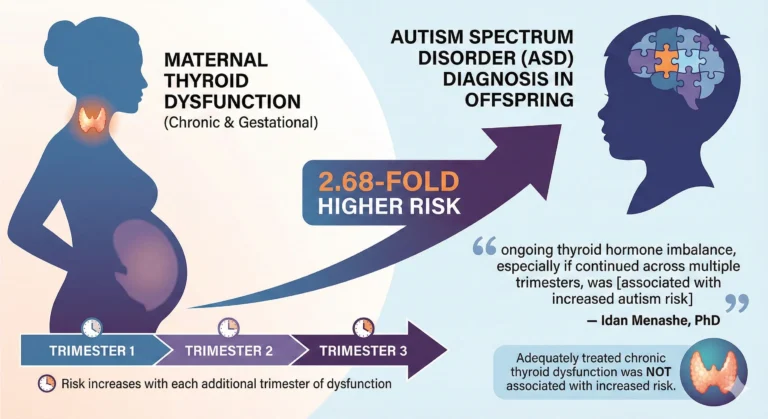
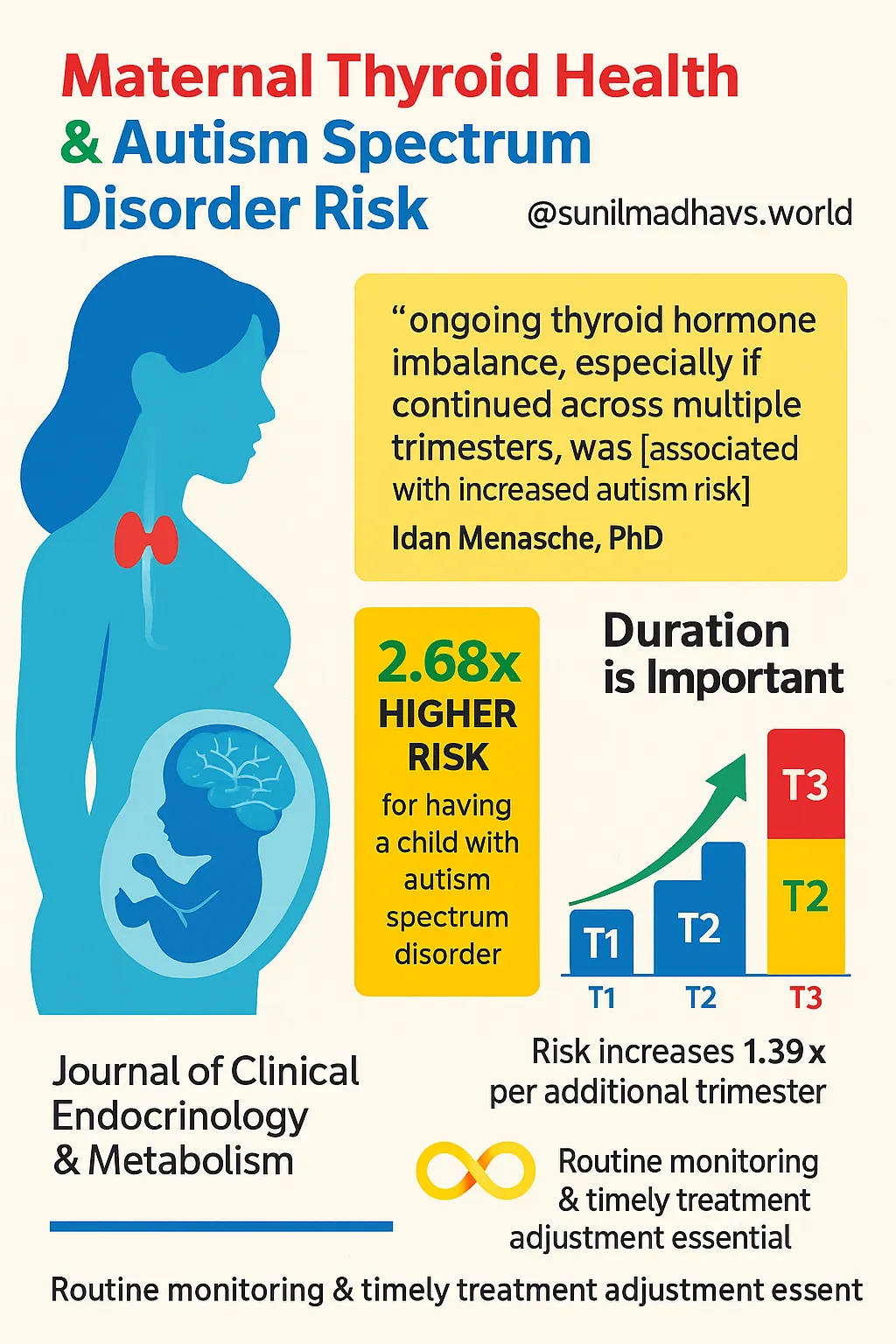
Key findings from the study indicate that women who experienced thyroid dysfunction both before conception and during pregnancy had a 2.68-times greater likelihood of having a child later diagnosed with autism, and that the risk increased with each additional trimester affected by thyroid imbalance.

According to research published in The Journal of Clinical Endocrinology & Metabolism, maternal thyroid issues that occur before or persist throughout pregnancy may heighten the probability of autism spectrum disorder (ASD) in their children.

Idan Menashe, PhD — who leads the department of epidemiology, biostatistics and community health sciences at the faculty of health sciences at Ben-Gurion University of the Negev — explained the results stating:
“The findings of our study suggest that while adequately treated chronic thyroid dysfunction was not associated with increased autism risk in offspring, ongoing thyroid hormone imbalance, especially if continued across multiple trimesters, was.”

Study Details

You Might Be Interested In
  • Risk for Parkinson’s disease increased with presence of metabolic syndrome components
    August 30, 2025
  • Although rare, GLP-1s tied to higher risk for eye complications
    November 9, 2025

Menashe and his team performed a retrospective cohort analysis involving women who delivered a single baby at Soroka University Medical Center in Israel between 2011 and 2017. Chronic thyroid dysfunction was determined using ICD-9 diagnostic codes for hyperthyroidism or hypothyroidism in patient health records. In contrast, gestational thyroid dysfunction was identified through thyroid hormone testing during each trimester of pregnancy.

Of the 51,296 women included, 8.6% had some form of thyroid dysfunction. The breakdown was as follows:

– 1,161 had chronic hypothyroidism
– 1,600 had gestational hypothyroidism
– 1,054 had both chronic and gestational hypothyroidism
– 100 had chronic hyperthyroidism
– 376 had gestational hyperthyroidism
– 15 had both chronic and gestational hyperthyroidism

Children were diagnosed with ASD at a median age of 4.6 years. When comparing all women with any thyroid disorder to women with normal thyroid levels, there was no overall difference in ASD incidence.

However, women with both chronic and gestational thyroid dysfunction had a significantly higher risk of having a child diagnosed with ASD compared with women who were euthyroid (adjusted HR = 2.68; 95% CI, 1.52–4.72). A similar increased risk was found specifically for women with both chronic and gestational hypothyroidism (aHR = 2.61; 95% CI, 1.44–4.74).
You Might Be Interested In
  • Risk for Parkinson’s disease increased with presence of metabolic syndrome components
    August 30, 2025
  • Although rare, GLP-1s tied to higher risk for eye complications
    November 9, 2025

When thyroid dysfunction occurred during pregnancy only, risk rose with the number of trimesters affected. Each additional trimester of thyroid imbalance was linked to higher ASD risk for:

– gestational hypothyroidism alone (aHR = 1.39; 95% CI, 1.16–1.68)
– both chronic and gestational hypothyroidism (aHR = 1.28; 95% CI, 1.02–1.93)

The highest autism risk was observed among women who had gestational hypothyroidism during all three trimesters. Menashe noted that the connection between prolonged thyroid abnormalities during pregnancy and elevated ASD risk in children was unexpected.

He emphasized:
“Our findings underscore the need for routine monitoring and timely adjustment of therapy to maintain normal thyroid hormone levels throughout pregnancy.”

Menashe also noted that more research is required to understand the mechanisms through which abnormal thyroid hormone levels influence fetal brain development.

For further correspondence, Menashe can be contacted at idanmen@bgu.ac.il.

You Might Be Interested In
  • Risk for Parkinson’s disease increased with presence of metabolic syndrome components
    August 30, 2025
  • Although rare, GLP-1s tied to higher risk for eye complications
    November 9, 2025

This research contributes to an expanding collection of epidemiological studies (such as Kaplan ZB et al., Thyroid, 2024) that imply a link between maternal hypothyroidism during pregnancy and an increased likelihood of ASD in children. In this Israeli retrospective cohort, the offspring of women who were hypothyroid both before and during pregnancy showed more than double the risk of receiving an ASD diagnosis compared with children of mothers with normal thyroid function. Importantly, hypothyroidism occurring only before pregnancy or only during pregnancy did not demonstrate a similar association, indicating that the duration and continuity of untreated hypothyroidism may be key contributors.

The study’s strengths included multiple thyroid function assessments throughout pregnancy and a long follow-up period. However, its retrospective nature introduced several limitations. The researchers did not evaluate variables such as maternal iodine levels, socioeconomic status, or thyroid autoimmunity, and they also lacked data on levothyroxine treatment. Additionally, the study did not examine outcomes related to isolated maternal hypothyroxinemia. The small number of ASD cases among children of mothers with hyperthyroidism limited meaningful analysis in that subgroup. Existing knowledge already highlights the importance of properly treating overt hyperthyroidism during pregnancy to ensure healthy obstetric and developmental outcomes.

While this study raises the possibility that even subclinical hypothyroidism in pregnancy may elevate ASD risk, the ability of levothyroxine therapy to reduce this risk has not yet been tested in clinical trials.

This perspective was provided by Elizabeth N. Pearce, MD, MSc, of the Boston University Chobanian & Avedisian School of Medicine, who reported no relevant financial disclosures.

 

Source link

You Might Be Interested In
  • Risk for Parkinson’s disease increased with presence of metabolic syndrome components
    August 30, 2025
  • Although rare, GLP-1s tied to higher risk for eye complications
    November 9, 2025

Related posts:

Risk for Parkinson’s disease increased with presence of metabolic syndrome components

August 30, 2025

Although rare, GLP-1s tied to higher risk for eye complications

August 28, 2025

Living in rural areas may elevate risk for developing type 1 diabetes

August 10, 2025
You Might Be Interested In
  • Risk for Parkinson’s disease increased with presence of metabolic syndrome components
    August 30, 2025
  • Although rare, GLP-1s tied to higher risk for eye complications
    November 9, 2025
0 0 votes
Article Rating
Autism spectrum disorderHypothyroidismPregnancy
0 comments 0 FacebookTwitterPinterestEmail
Team SunilMadhavs World

previous post
New technologies advance wet AMD treatment space
next post
Addressing lifestyle for CVD prevention

Related Articles

Risk for Parkinson’s disease increased with presence of...

August 30, 2025

Although rare, GLP-1s tied to higher risk for...

November 9, 2025

Living in rural areas may elevate risk for...

August 10, 2025

New framework would reclassify many Americans with overweight...

July 25, 2025
Subscribe
Login
Notify of
Save my name, email, and website in this browser cookies for the next time I comment.

Save my name, email, and website in this browser cookies for the next time I comment.

0 Comments
Oldest
Newest Most Voted
Inline Feedbacks
View all comments

Login/Register

Google Icon
Login With Google
X Icon
Login With X
Facebook Icon
Login With Facebook

Keep me signed in until I sign out

Forgot your password? Register here

Google Icon
Login With Google
X Icon
Login With X
Facebook Icon
Login With Facebook

Login here

Social Networks

Facebook Twitter Instagram Linkedin Rss

Categories

Popular Posts

  • 1

    Suicide of patient on LVAD therapy sparks wider mental health discussion

    July 4, 2025
  • 2

    WHO in India

    June 18, 2025
  • 3

    Mediterranean diet could improve psoriasis symptoms

    October 13, 2025
  • 4

    Oral drug lowers OSA severity over 6 months

    June 2, 2025
  • 5

    FDA Approves Lenz Therapeutics’ Vizz™ for Presbyopia Treatment

    August 2, 2025

Recent Posts

  • US obesity prevalence 75% under new Lancet criteria

    January 19, 2026
  • Test post

    January 5, 2026
  • January 1, 2026
  • test post

    January 1, 2026

About SunilMadhavs World

Facebook Twitter Instagram Pinterest Youtube Snapchat
  • Log In
  • About
  • Register
  • Profile
  • My account
  • Edit Account
  • Change Password
  • My Subscriptions
  • chnfo@suni0
  • Support Portal
  • Contact Information
  • Privacy policy
  • GDPR-compliant cookie policy.
  • Terms and conditions
  • Medical Disclaimer

@2019 - All Right Reserved. Designed and Developed by PenciDesign

SunilMadhavs World
  • Home
  • Support Portal
  • My Subscriptions
  • Contact Information
  • About
    • Cardiology
      • Gastroenterology
        • Radiology
          • Pulmonology
            • Gynecology
    • Neurology
  • Urology
    • Hematology
      • Profile
        • Log Out
        • Register
        • Edit Account
        • Change Password
        • GDPR-compliant cookie policy.
          • Terms and conditions
            • Contact Information
  • About
    • Privacy policy
      • BASICS DISCUSS
        • BASICS
          • ANATOMY
            • BASICS PRO
              • ANATOMY PRO
              • BIOCHEMISTRY PRO
              • PHYSIOLOGY
                • BIOCHEMISTRY
                  • PHYSIOLOGY PRO
                    • BASICS RESEARCH
                    • ANATOMY ADVANCEMENTS
                    • BIOCHEMISTRY ADVANCEMENTS
                    • PHYSIOLOGY ADVANCEMENTS
  • Team SunilMadhavs World
  • TOPICS
  • INTERMEDIATE
SunilMadhavs World
  • Home
  • Support Portal
  • My Subscriptions
  • Contact Information
  • About
    • Cardiology
      • Gastroenterology
        • Radiology
          • Pulmonology
            • Gynecology
    • Neurology
  • Urology
    • Hematology
      • Profile
        • Log Out
        • Register
        • Edit Account
        • Change Password
        • GDPR-compliant cookie policy.
          • Terms and conditions
            • Contact Information
  • About
    • Privacy policy
      • BASICS DISCUSS
        • BASICS
          • ANATOMY
            • BASICS PRO
              • ANATOMY PRO
              • BIOCHEMISTRY PRO
              • PHYSIOLOGY
                • BIOCHEMISTRY
                  • PHYSIOLOGY PRO
                    • BASICS RESEARCH
                    • ANATOMY ADVANCEMENTS
                    • BIOCHEMISTRY ADVANCEMENTS
                    • PHYSIOLOGY ADVANCEMENTS
  • Team SunilMadhavs World
  • TOPICS
  • INTERMEDIATE
@2019 - All Right Reserved. Designed and Developed by PenciDesign

Shopping Cart

Close

No products in the cart.

Close
wpDiscuz