49
A large-scale retrospective cohort study of US veterans published in the Journal of the American Academy of Dermatology (JAAD) demonstrated that individuals diagnosed with melanoma have a significantly elevated risk of subsequently developing Parkinson disease (PD).¹ While prior medical literature has recognized that patients with PD have higher incidences of cutaneous melanoma, this investigation examined the reverse relationship, finding that veterans with melanoma experienced a 47% increased likelihood of receiving a subsequent PD diagnosis.¹
Clinical Rationale and Background
Veterans represent a uniquely vulnerable group with historically elevated baseline risks for both cutaneous malignancies and neurodegenerative conditions. Discussing the clinical significance and existing literature gap, senior investigator Rebecca I. Hartman, MD, MPH, FAAD, associate professor of dermatology at Harvard Medical School and chief of dermatology at VA Boston Healthcare System, noted:
“It is relatively well-established that patients with Parkinson’s disease have an increased risk for melanoma. But the reverse — whether patients with melanoma have an increased risk for Parkinson’s disease — is not as clear cut, with mixed results from prior studies.”²
By evaluating a massive longitudinal database, investigators sought to minimize temporal bias and evaluate whether bidirectional or shared underlying pathophysiologic pathways exist between melanocytic oncogenesis and dopaminergic neurodegeneration.¹
Study Population and Cohort Design
Investigators analyzed electronic health records from the Veterans Affairs (VA) Cancer Registry merged with the VA Corporate Data Warehouse between 2009 and 2022. The exposure of interest was a confirmed diagnosis of primary cutaneous melanoma, and the primary evaluated outcome was the subsequent diagnosis of PD.¹
| Cohort Metric | Parameter Specification |
| Data Sources | VA Cancer Registry & Corporate Data Warehouse |
| Study Period | 2009–2022 |
| Eligibility Criteria | Veterans aged 50 years or older with ≥1 VA primary care visit |
| Total Cohort Size | 7,421,059 veterans |
| Primary Exposure Group (Melanoma) | 65,496 veterans |
| Primary Exposure | Confirmed primary melanoma diagnosis |
| Primary Outcome | Incident Parkinson disease diagnosis |
Key Findings and Multivariable Analysis
Veterans diagnosed with primary melanoma exhibited a 1.47-fold increased hazard of later developing Parkinson disease (adjusted hazard ratio [aHR] = 1.47; 95% CI, 1.37–1.57) compared with veterans without a melanoma history.¹
The analysis also evaluated key demographic factors, healthcare system contact frequency, military service branch, and historical environmental exposures.¹
Demographic and Healthcare Utilization Covariates
| Variable | Category / Comparison | Adjusted Hazard Ratio (aHR) | 95% Confidence Interval (CI) | Interpretation |
| Primary Exposure | Melanoma vs No Melanoma | 1.47 | 1.37–1.57 | 47% increased risk of PD |
| Sex | Female vs Male | 0.80 | 0.76–0.84 | 20% decreased risk of PD |
| Race/Ethnicity | Black vs White | 0.73 | 0.71–0.75 | 27% decreased risk of PD |
| Asian vs White | 0.79 | 0.74–0.83 | 21% decreased risk of PD | |
| Hispanic vs White | 1.09 | 1.06–1.13 | 9% increased risk of PD | |
| Healthcare Utilization | High contact (≥2 visits) vs Lower | 1.14 | 1.09–1.19 | Associated with higher PD detection |
Note on Detection Bias: The researchers noted that increased physician encounters were independently linked to higher diagnostic rates of PD (aHR = 1.14), indicating that residual surveillance or detection bias could represent a potential limitation of the findings despite statistical adjustment.¹
Military Branch and Specific Deployment Exposures
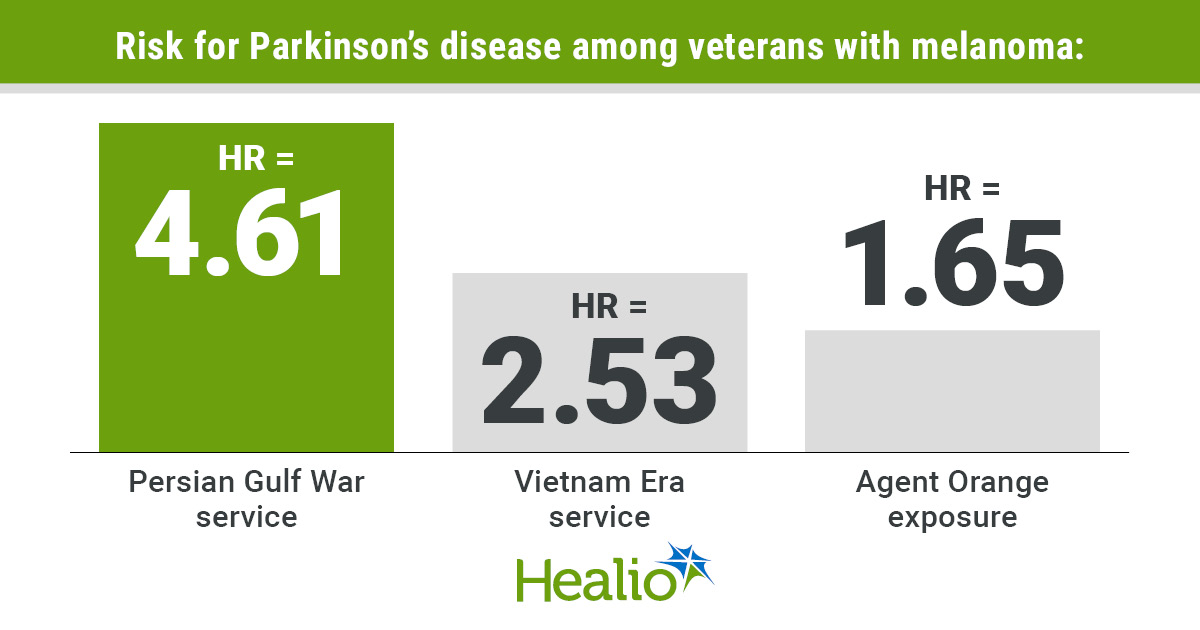
Subgroup analyses identified substantial variations in risk according to service branch, deployment era, and toxic exposures:
| Military Factor / Exposure Group | Comparison Reference | Adjusted Hazard Ratio (aHR) | 95% Confidence Interval (CI) |
| Maritime Service (Navy/Marines) | Air Force service | 1.05 | 1.03–1.08 |
| Persian Gulf War Service | Non-deployed / Non-era cohort | 4.61 | 4.45–4.79 |
| Vietnam Era Service | Non-deployed / Non-era cohort | 2.53 | 2.49–2.58 |
| Agent Orange Exposure | Unexposed veterans | 1.65 | 1.62–1.68 |
Clinical Implications and Expert Recommendations
The authors emphasized that the observed association suggests shared biological mechanisms between melanoma and Parkinson disease—such as common embryonic origins from neural crest precursors, melanin and dopamine biosynthesis pathways, or common genetic and immune dysregulation patterns.¹
Dr. Hartman highlighted actionable steps for practicing clinicians encountering this patient population:
“Clinically, dermatologists should be aware of this association and consider appropriate referral when melanoma patients develop symptoms of Parkinson’s disease like resting tremor, shuffling gait or problems with balance.”²
“Understanding the relationship between the development of these two diseases could prompt research on shared biological mechanisms, which down the road could identify preventive or therapeutic targets.”²
References
- Huhmann LB, et al. Risk of Parkinson’s disease in veterans with melanoma. J Am Acad Dermatol. 2026. doi:10.1016/j.jaad.2026.08.078
- Hartman RI. Quoted in: Melanoma linked to 47% greater risk for Parkinson’s disease in veterans. Healio Dermatology. Published September 11, 2026.