46
Survival, Institutionalization, and Days at Home Following Hip Fracture Among Medicare Beneficiaries With Dementia
Based on findings reported by Rodin R, et al. JAMA Netw Open. 2026;doi:10.1001/jamanetworkopen.2026.18658.
Background and Clinical Rationale
Hip fractures in geriatric populations frequently precipitate severe functional decline, loss of independence, and increased mortality. While elevated post-fracture risks are recognized in patients with cognitive impairment, the long-term trajectory of institutionalization versus time spent at home has remained underdefined.
Characterizing the clinical severity of this injury in cognitively impaired individuals, lead author Rebecca Rodin, MD, MSc, physician and clinician scientist at the Icahn School of Medicine at Mount Sinai’s Brookdale Department of Geriatrics and Palliative Medicine, explained:
Study Design and Cohort Definition
Investigators conducted a retrospective longitudinal cohort study utilizing Centers for Medicare & Medicaid Services (CMS) claims from 2012 through 2021. The dataset captured all fee-for-service Medicare and Medicare Advantage beneficiaries. Researchers linked the Master Beneficiary Summary File with Medicare Provider and Analysis Review (MedPAR) inpatient files to identify community-dwelling beneficiaries aged 65 years or older hospitalized with an acute hip fracture.
Dementia diagnoses, fracture classifications, anatomic locations, and surgical repair techniques were defined using ICD-9 and ICD-10 clinical coding. The primary patient-centered metric—days at home—was defined as total days alive in the community minus days spent admitted to an acute care hospital, inpatient rehabilitation facility, or long-term nursing facility. Days at home were evaluated across 3 landmark survival intervals (30 days, 6 months, and 1 year) conditional upon surviving each preceding observation window.
Table 1. Study Population Architecture and Baseline Cohort Distribution ($N = 1,756,388$)
| Cohort Parameter | Patient Count / Proportion |
| Total Hospitalized Hip Fracture Cohort | 1,756,388 patients |
| Pre-existing Dementia Diagnosis | 29.2% ($n \approx 512,865$) |
| No Pre-existing Dementia Diagnosis | 70.8% ($n \approx 1,243,523$) |
| Total Mortality Within 1 Year Post-Fracture | 454,112 patients |
| Dementia Representation Among 1-Year Deaths | 47.3% ($n \approx 214,795$) |
| Non-Dementia Representation Among 1-Year Deaths | 52.7% ($n \approx 239,317$) |
Post-Fracture Survival, Institutionalization, and Place of Death
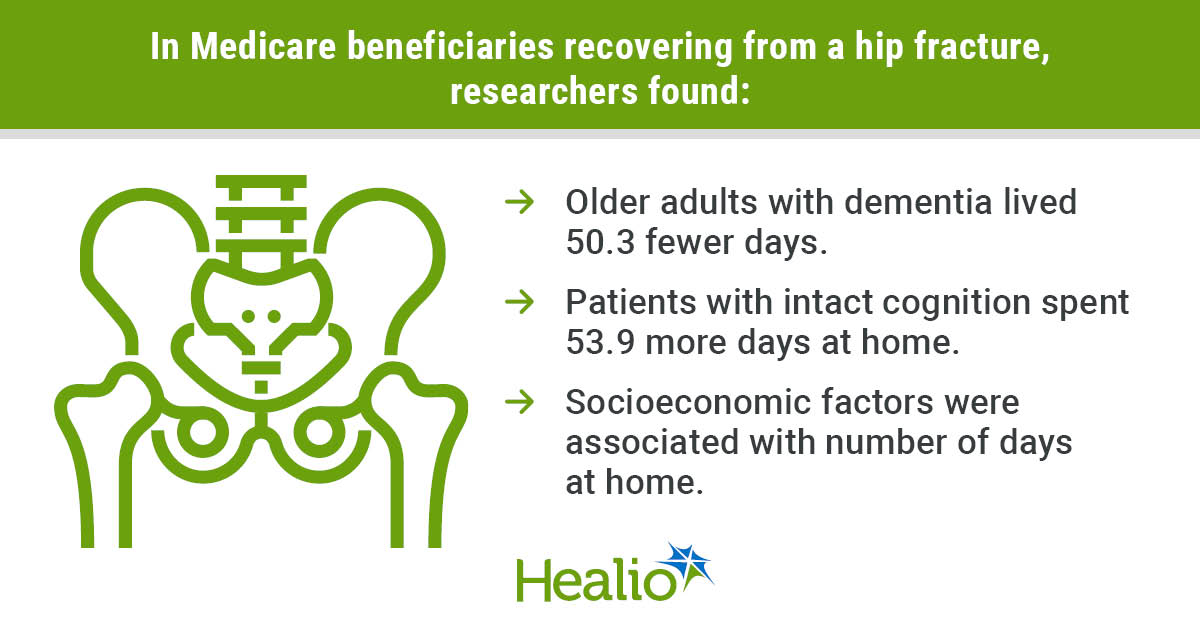
Patients with pre-existing dementia experienced marked survival deficits and increased institutionalization across all evaluation intervals. Within the first year following hip fracture, individuals with dementia died an average of 50.3 days earlier than those without dementia. Among patients who survived the full 1-year follow-up, those with dementia spent an average of 53.9 fewer days residing at home due to extended placement in skilled nursing facilities, inpatient rehabilitation units, or long-term care institutions. These relative differences were consistent across all evaluated sub-intervals (1–30 days, 31 days to 6 months, and 6 months to 1 year).
Disparities were also evident in terminal care settings. Beneficiaries with dementia were substantially more likely to die enrolled in home hospice care compared with cognitively intact peers (53.2% vs 40.7%). Conversely, individuals without dementia were nearly twice as likely to experience an inpatient hospital death (27.6% vs 14.0%).
Table 2. Comparative Clinical Outcomes and End-of-Life Distribution by Dementia Status
| Outcome Measure | Patients With Dementia | Patients Without Dementia | Intergroup Disparity |
| Survival Duration (1 Year) | Reduced | Reference group | Died 50.3 days earlier on average |
| Days at Home (1-Year Survivors) | Substantially fewer | Reference group | Spent 53.9 fewer days at home |
| Place of Death: Home Hospice | 53.2% | 40.7% | +12.5 percentage points |
| Place of Death: Inpatient Hospital | 14.0% | 27.6% | -13.6 percentage points |
Impact of Clinical Versus Socioeconomic Determinants
Multivariable models evaluating drivers of time spent at home revealed that non-clinical structural factors had a larger effect than conventional surgical or medical variables. While comorbidity indices, anatomic fracture subtype, surgical approach, and incident perioperative delirium influenced recovery, socioeconomic position and geographic setting were the dominant determinants of whether surviving patients returned to community living.
Dr. Rodin highlighted the primacy of these structural inequities:
Table 3. Relative Magnitude of Determinants on Days at Home Post-Hip Fracture
| Determinant Category | Evaluated Variables | Relative Association With Days at Home |
| Structural & Socioeconomic Determinants | * Dual Medicaid eligibility * Rural residence * Geographic region / service environment | Largest differences observed (primary drivers of institutionalization duration) |
| Clinical & Surgical Determinants | * Baseline comorbidity score * Anatomic fracture classification * Surgical procedure type * Documented perioperative delirium | Comparatively smaller changes (secondary drivers of institutionalization duration) |
Clinical Implications
These findings indicate that older adults with dementia account for nearly half of all 1-year deaths following a hip fracture despite comprising less than one-third of initial admissions. Because time spent in the home environment is governed primarily by socioeconomic barriers, Medicaid dual eligibility, and regional resource availability rather than clinical fracture characteristics alone, post-acute care transitions require systemic modifications. Optimizing outcomes for cognitively impaired fracture patients requires proactive discharge planning, coordinated community-based supports, and targeted outpatient caregiver resources to mitigate long-term institutionalization and bridge healthcare disparities.