Patients With Inflammatory Bowel Disease Report Symptom Relief and Improved Quality of Life With Marijuana Use, Survey Finds
Publication date: September 23, 2026
Journal: Medical Cannabis and Cannabinoids
Clinical specialty: Gastroenterology
Study design: Cross-sectional, single-center patient survey
Original research DOI: 10.1159/000553354
1-Minute Summary
Patients with inflammatory bowel disease (IBD) who reported using marijuana commonly described relief of selected symptoms, improved quality of life, and reduced reliance on other analgesics, according to a survey conducted at the University of Florida’s IBD clinic. The study included 108 adults with Crohn disease or ulcerative colitis who were current marijuana users.
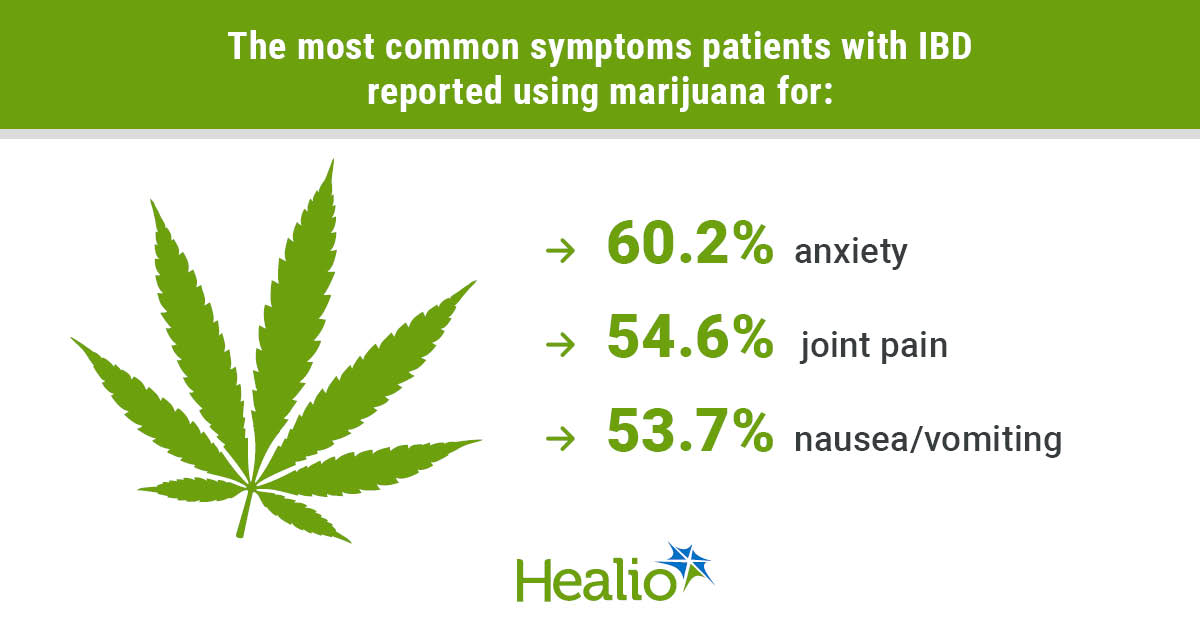
Nearly 70% of respondents reported daily or almost-daily use. Anxiety was the most frequently reported reason for use (60.2%), followed by joint pain (54.6%) and nausea or vomiting (53.7%). Overall, 87.6% reported improved quality of life, and 59.3% believed marijuana reduced their use of other analgesics.
Despite widespread use, only 24.5% of participants reported receiving counseling about potential interactions between marijuana and prescription medications. Furthermore, 67.6% recognized that marijuana had not improved their intestinal inflammation.
The findings highlight a gap between patients’ perceived symptom benefits and the limited evidence that cannabis improves the underlying inflammatory process in IBD. Because the study surveyed current users at a single center and relied on self-reported outcomes, it cannot establish treatment efficacy or causality.
Why This Matters
IBD, which primarily includes Crohn disease and ulcerative colitis, is characterized by chronic intestinal inflammation, periods of disease activity and remission, and a range of gastrointestinal and extraintestinal symptoms. Patients may experience abdominal discomfort, nausea, fatigue, joint pain, anxiety, and impaired quality of life.
Some patients use cannabis products to manage symptoms or treatment-related adverse effects. However, perceived improvement in symptoms does not necessarily indicate control of intestinal inflammation, mucosal healing, or prevention of disease complications.
The survey highlights three important clinical considerations:
- Symptom management: Patients report benefits involving anxiety, joint pain, nausea, vomiting, insomnia, and daily functioning.
- Medication safety: Limited counseling about possible drug interactions may leave patients unaware of clinically relevant risks.
- Disease control: Cannabis use should not be assumed to replace evidence-based IBD treatment or to produce objective improvement in inflammation.
Naueen A. Chaudhry, MD, assistant professor of gastroenterology at the University of Florida, explained the rationale for the research:
“Marijuana use is prevalent for symptom control among patients with IBD and is rising with legalization; however, it is often not discussed in clinic visits.”
Chaudhry added that physicians have limited information about patients’ experiences and perceived responses to marijuana use.
Study at a Glance
| Feature | Details |
|---|---|
| Study type | Cross-sectional, observational, single-center survey |
| Study setting | University of Florida IBD clinic, Florida, United States |
| Participants | 108 patients with Crohn disease or ulcerative colitis who reported marijuana use |
| Study instrument | A 39-question survey |
| Intervention | None; participants reported their existing marijuana use |
| Comparator | No control group or nonuser comparison group |
| Primary outcome | No single primary outcome was specified in the supplied report; the survey assessed use patterns, perceived symptom relief, quality of life, medication use, and patient knowledge |
| Main finding | 87.6% reported improved quality of life, while 59.3% believed marijuana reduced their use of other analgesics |
| Frequency of use | 68.3% reported daily or almost-daily use |
| Most common reasons for use | Anxiety, joint pain, and nausea or vomiting |
| Medication counseling | 24.5% reported receiving counseling about possible drug interactions |
| Follow-up | No longitudinal follow-up was described |
| Statistical analysis | Associations with selected patient characteristics and outcomes were reported with P values |
| Original research DOI | 10.1159/000553354 |
Interpretation: This was a survey of existing users, not a randomized controlled trial. It therefore describes patient experiences and associations rather than demonstrating that marijuana caused symptom improvement.
What the Researchers Found
1. Participant characteristics
The survey included 108 patients with IBD who reported marijuana use. Approximately four-fifths had Crohn disease, and the remaining participants had ulcerative colitis.
| Characteristic | Reported finding |
|---|---|
| Total participants | 108 |
| Women | 51.9% |
| Aged 26–45 years | 50.0% |
| Crohn disease | 79.6% |
| Receiving pharmacotherapy for IBD | 82.4% |
| Currently receiving biologic therapy | 56.5% |
| Formal diagnosis of depression or anxiety | 61.1% |
| Reported PTSD | 19.4% |
| Reported ADD/ADHD | 19.4% |
The high prevalence of depression or anxiety is clinically relevant because psychological symptoms may influence perceived disease burden, quality of life, and decisions about cannabis use. The survey does not establish whether these conditions preceded marijuana use or were affected by it.
2. Reasons for marijuana use
Participants reported using marijuana for several symptoms, including both psychological and physical complaints.
| Reason for use | Participants reporting use |
|---|---|
| Anxiety | 60.2% |
| Joint pain | 54.6% |
| Nausea and vomiting | 53.7% |
| Other symptoms | Not fully quantified in the supplied report |
Anxiety was the most frequently reported indication, followed by joint pain and nausea or vomiting. These results suggest that patients may use cannabis to address a broad range of symptoms associated with living with chronic disease, rather than gastrointestinal symptoms alone.
However, the percentages reflect reasons reported by current users. They do not establish that cannabis is more effective than other treatments for any of these symptoms.
3. Frequency and type of use
Frequent use was common among respondents.
| Measure | Percentage |
|---|---|
| Daily or almost-daily marijuana use | 68.3% |
| Medical use rather than recreational or combined use | 61.9% |
The high frequency of use indicates that marijuana may form part of the ongoing symptom-management practices of some patients with IBD.
The survey also identified differences in reported use patterns by age, disease duration, and sex.
| Patient characteristic | Reported association |
|---|---|
| Younger age | More likely to report recreational use; P = 0.0074 |
| More recently diagnosed IBD | More likely to report recreational use; P = 0.006 |
| Middle-aged adults and patients with longer disease duration | Medical use was more common |
| Women | More likely to use oral nonedible formulations |
| Men | More likely to smoke marijuana; P = 0.011 |
These findings indicate associations within the surveyed population. They should not be interpreted as evidence that age, sex, or disease duration independently determines an individual’s cannabis use.
4. Patient-reported benefits
Most participants perceived some benefit from marijuana use, particularly in overall quality of life and pain management.
| Patient-reported outcome | Percentage |
|---|---|
| Improved quality of life | 87.6% |
| Believed marijuana reduced use of other analgesics | 59.3% |
| Reported better ability to live independently among daily or almost-daily users | Association reported; P = 0.0075 |
| More likely to be employed among daily or almost-daily users | Association reported; P = 0.04 |
Daily or almost-daily use was also associated with patient-reported relief of nausea and vomiting, joint pain, and insomnia.
Chaudhry commented on participants’ perceptions of analgesic use:
“Many patients relied on marijuana use to reduce their reliance on opioid pain medications.”
She described this as an interesting observation concerning patients’ efforts to avoid potential opioid dependence and addiction.
Nevertheless, the survey did not objectively measure opioid dose reductions, verify medication dispensing records, or demonstrate that marijuana use directly caused lower analgesic consumption. The finding should therefore be interpreted as a patient-reported association.
5. Awareness of intestinal inflammation
Although many participants reported symptomatic benefits, the majority did not believe marijuana had improved their intestinal inflammation.
| Measure of patient knowledge | Percentage |
|---|---|
| Reported that marijuana did not improve gut inflammation | 67.6% |
| Reported counseling about possible interactions with other medications | 24.5% |
| Comfortable disclosing marijuana use to their physician | 97.9% |
The distinction between symptom relief and control of inflammation is central to interpreting these findings. A patient may experience less nausea, pain, or anxiety without achieving objective improvement in the intestinal inflammation responsible for IBD.
The results also reveal a potential educational gap: most respondents were comfortable disclosing marijuana use, but only about one-quarter recalled receiving counseling about possible drug interactions.
Chaudhry emphasized:
“Patients are not aware of the potential for drug interactions between marijuana formulations and their prescription medications.”
She also noted that organized efforts to educate patients about these interactions were lacking from clinical and pharmaceutical perspectives.
6. Physician perspective
Jami A. Kinnucan, MD, highlighted the limited evidence supporting cannabis as a treatment for intestinal inflammation. In her perspective, she noted that although patients may report meaningful symptomatic improvement, clinical trials have not demonstrated objective improvement in intestinal inflammation with the cannabis formulations and dosing strategies studied.
Kinnucan emphasized the importance of routinely asking patients about cannabinoid use, explaining the distinction between symptom relief and inflammatory disease control, and encouraging continued use of evidence-based anti-inflammatory therapies.
She also identified the need for further research into the endocannabinoid system and cannabinoid receptor-targeted treatments that could potentially complement established IBD therapies.
Clinical Significance
The study offers insight into patient experiences but does not establish marijuana as an effective treatment for IBD itself.
Symptom relief is not equivalent to inflammatory disease control. Patients may experience improvements in nausea, pain, insomnia, or anxiety without achieving reduced intestinal inflammation. Clinical assessment should therefore incorporate appropriate disease activity measures and objective evaluation when indicated.
Medication reconciliation is important. Clinicians should ask about cannabis use, including the formulation, route, frequency, and other medications being taken. Cannabis products may interact with prescription drugs, and the clinical significance depends on the specific product and medication combination.
Mental health deserves attention. The high prevalence of reported depression and anxiety highlights the importance of evaluating psychological symptoms as part of comprehensive IBD care. Cannabis may have different effects across individuals, and psychiatric comorbidities warrant individualized assessment.
Evidence-based treatment should continue. Patients should not discontinue prescribed IBD medications solely because cannabis appears to improve symptoms. Decisions about treatment changes should be based on clinical assessment and established evidence.
Patient-centered counseling may improve safety. The high proportion of participants comfortable disclosing use suggests that nonjudgmental discussions may be a practical way to identify potential interactions, clarify expectations, and support informed decisions.
Limitations
Several limitations affect the interpretation and generalizability of this survey.
- Single-center design: Participants were recruited from one IBD clinic in Florida. Their experiences may not represent patients in other geographic locations or health care settings.
- Small sample size: The study included 108 respondents, limiting the precision of subgroup comparisons and the ability to evaluate less common outcomes.
- Selection bias: All respondents reported current marijuana use. Patients who avoided cannabis or discontinued it because of poor response or adverse effects may be underrepresented, potentially making perceived benefits appear more common.
- Self-reported outcomes: Symptom relief, quality of life, medication use, and other outcomes were based on participant reports rather than independently verified clinical measurements.
- No control group: The absence of a nonuser group or randomized comparator prevents the study from determining whether reported benefits were attributable to marijuana rather than other factors.
- No causal inference: The observational survey cannot establish whether marijuana use improved functioning or whether patients with particular symptom patterns were more likely to use marijuana.
- No objective inflammatory endpoints: The supplied report does not describe evidence of improvement in endoscopic findings, biomarkers, or other objective measures of intestinal inflammation attributable to cannabis use.
- Psychiatric comorbidity: Depression, anxiety, PTSD, and ADD/ADHD were common among participants and may influence symptoms, quality of life, and patterns of cannabis use.
- Uncertain dosing and formulations: The survey does not establish an optimal dose, formulation, route, or frequency for symptom control. These limitations make it difficult to translate the findings into a standardized treatment recommendation.
The findings are best viewed as descriptive evidence of how current users perceive marijuana’s role in managing IBD-related symptoms.
What Doctors Should Know
- Ask patients with IBD about marijuana and other cannabinoid products during routine medication reconciliation.
- Document the formulation, route of administration, frequency of use, perceived benefits, and any adverse effects.
- Explain that reported symptom relief does not establish control of intestinal inflammation.
- Review possible interactions with prescribed medications, particularly when patients use multiple therapies.
- Assess anxiety, depression, sleep disturbance, pain, and other symptoms that may be driving cannabis use.
- Encourage adherence to evidence-based IBD therapy unless a treatment change is clinically indicated.
- Do not infer that cannabis reduces opioid requirements from this survey alone; the reported reduction was based on patient perception.
- Discuss the uncertainty surrounding effective doses, formulations, long-term safety, and objective effects on disease activity.
- Use nonjudgmental communication to encourage disclosure and shared decision-making.
Bottom Line
In a single-center survey of 108 patients with IBD who reported marijuana use, most respondents perceived improvements in quality of life, and many believed cannabis reduced their reliance on other analgesics. Anxiety, joint pain, and nausea or vomiting were the most frequently reported reasons for use.
However, the study did not establish that marijuana caused these benefits or improved intestinal inflammation. Limited counseling about drug interactions and the potential for selection bias underscore the need for better patient education and more rigorous research.
For clinicians, the principal message is to ask about cannabis use, discuss potential risks and interactions, distinguish symptom management from inflammatory disease control, and reinforce evidence-based IBD treatment.
Original Research and Disclosures
Original research DOI: https://doi.org/10.1159/000553354
Journal: Medical Cannabis and Cannabinoids
Publication date of the Healio report: September 23, 2026
Study setting: University of Florida IBD clinic
Study design: Single-center, cross-sectional survey of 108 patients with Crohn disease or ulcerative colitis who reported marijuana use.
Survey instrument: 39 questions covering use patterns, experiences, perceived symptom responses, and patient knowledge.
Lead investigator quoted in the report: Naueen A. Chaudhry, MD, University of Florida.
Perspective author: Jami A. Kinnucan, MD. The supplied report stated that Kinnucan had no relevant financial disclosures.