Cardioprotective Prophylaxis Rarely Used in Adults With AML and DLBCL Receiving Anthracycline Chemotherapy
1-minute summary
Fewer than 3% of adults with newly diagnosed acute myeloid leukemia (AML) and fewer than 2% of adults with diffuse large B-cell lymphoma (DLBCL) received cardioprotective prophylaxis alongside first-line anthracycline-based chemotherapy, according to a study published in JAMA Network Open.
The retrospective analysis included 13,331 adults with hematologic malignancies identified through the Flatiron Health Research Database. Researchers examined the use of cardioprotective strategies, including dexrazoxane and liposomal anthracycline formulations, among patients receiving frontline treatment for DLBCL, AML, follicular lymphoma, or mantle cell lymphoma.
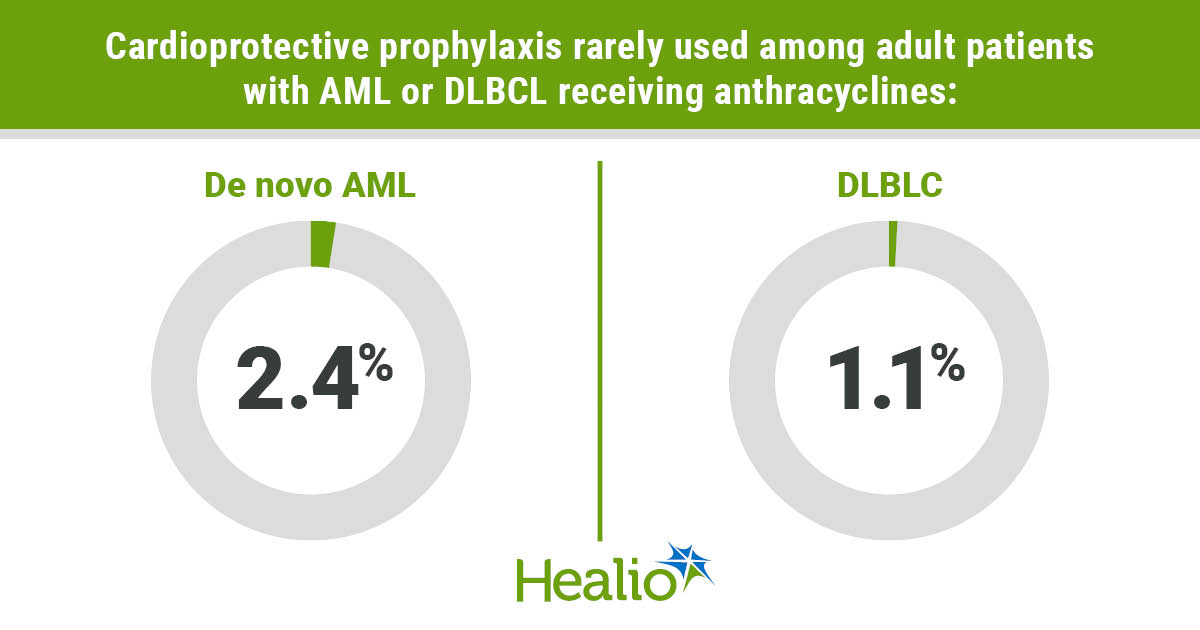
Only 2.4% of patients with de novo AML and 1.1% of patients with DLBCL received cardioprotective prophylaxis. Among patients with DLBCL who received cardioprotection, liposomal anthracyclines were used more frequently than dexrazoxane. Factors associated with receiving cardioprotective treatment included sex, age, insurance status, and unfavorable cytomolecular risk features.
The researchers did not observe significant associations between liposomal anthracycline use and overall survival in patients with de novo AML or DLBCL, or between dexrazoxane use and overall survival in DLBCL. However, the investigators cautioned that the survival analyses were underpowered.
The findings highlight a potential gap in cardiovascular risk management during adult cancer treatment. Prospective studies are needed to determine which patients benefit most from prophylaxis and whether these strategies improve long-term cardiac outcomes and survival.
Why this matters
Anthracyclines are widely used in the treatment of hematologic malignancies, including AML and DLBCL. Although effective against cancer, these drugs can damage the heart, potentially resulting in impaired cardiac function and heart failure during treatment or years afterward.
Cardiotoxicity may have consequences beyond cardiovascular health. Previous research cited in the article suggests that early cardiac injury can be associated with poorer survival among patients with pediatric hematologic malignancies.
Two cardioprotective strategies discussed in the study are dexrazoxane and liposomal anthracycline formulations. These approaches are intended to reduce cardiac injury associated with anthracycline exposure.
Despite this rationale, the analysis found that prophylaxis was rarely used in adults receiving first-line treatment for AML or DLBCL.
Alexis C. Boulter, MD, MS, described the unexpectedly low use:
“We had certainly hypothesized that the uptake would be low, but I don’t think we had suspected that it would be as low as it was. It really was shocking to us.”
Kelly D. Getz, PhD, MPH, similarly stated:
“Cardioprotection is underutilized in the adult setting.”
The findings raise questions about how cardiovascular risk is assessed during adult cancer treatment and whether evidence from pediatric oncology could help inform prevention strategies in selected adult populations.
Study at a glance
| Feature | Details |
|---|---|
| Study type | Retrospective observational cohort analysis |
| Data source | Flatiron Health Research Database |
| Total participants | 13,331 adults |
| Cancer types | DLBCL, AML, follicular lymphoma, and mantle cell lymphoma |
| Intervention/exposure | Use of cardioprotective prophylaxis, including dexrazoxane or liposomal anthracycline formulations |
| Comparator | Patients who received anthracycline-based treatment without the reported cardioprotective strategies |
| Primary endpoint | Use of cardioprotective strategies |
| Main finding | Cardioprotective prophylaxis was used in 2.4% of patients with de novo AML and 1.1% of patients with DLBCL |
| Additional outcome | Associations between cardioprotective strategy use and overall survival |
| Follow-up | Not specified in the supplied report |
| Publication | JAMA Network Open, 2026 |
| DOI | 10.1001/jamanetworkopen.2026.30536 |
What the researchers found
1. Study population
The researchers evaluated 13,331 adults who received frontline anthracycline-based treatment for one of four hematologic malignancies.
| Diagnosis | Number of patients | Additional characteristics reported |
|---|---|---|
| Diffuse large B-cell lymphoma (DLBCL) | 7,241 | Median age, 68 years; IQR, 58–76; 56.3% men; 65.5% White |
| Acute myeloid leukemia (AML) | 3,661 | Includes 2,125 patients with de novo AML |
| De novo AML subgroup | 2,125 | Median age, 57 years; IQR, 45–66; 53.1% men; 65.5% White |
| Follicular lymphoma | 1,275 | Additional demographic details not provided |
| Mantle cell lymphoma | 1,154 | Additional demographic details not provided |
| Total | 13,331 | Adults receiving frontline anthracycline-based treatment |
The report provides detailed demographic information for DLBCL and the de novo AML subgroup but not for every cancer group.
2. Cardioprotective prophylaxis was uncommon
The principal finding was the low use of cardioprotective prophylaxis among patients with de novo AML and DLBCL.
| Cancer type | Patients receiving cardioprotective prophylaxis |
|---|---|
| De novo AML | 2.4% |
| DLBCL | 1.1% |
These figures indicate that only a small proportion of patients in the two reported groups received the cardioprotective strategies evaluated.
The supplied article does not provide the exact numbers of treated patients in each group, the complete uptake percentages for follicular and mantle cell lymphoma, or a breakdown of prophylaxis use across every cancer type.
3. Which cardioprotective strategies were used?
The study evaluated dexrazoxane and liposomal anthracycline formulations as cardioprotective approaches.
Among patients with DLBCL who received cardioprotective care, liposomal anthracyclines accounted for a greater share of use than dexrazoxane.
| Cardioprotective strategy in DLBCL | Proportion among patients receiving cardioprotection |
|---|---|
| Liposomal anthracycline formulations | 67.1% |
| Dexrazoxane | 32.9% |
The percentages describe the distribution of strategies among DLBCL patients who received cardioprotective care, not the proportion of all patients with DLBCL who received each treatment.
For AML, the report states that most patients receiving cardioprotective care received CPX-351. The supplied article does not provide a complete numerical breakdown of the AML cardioprotective regimens.
4. Factors associated with cardioprotection
The researchers identified several factors associated with receipt of cardioprotective strategies.
| Factor | Reported association |
|---|---|
| Sex | Male sex was associated with receipt |
| Age | Older age was associated with receipt |
| Insurance | Public insurance was associated with receipt |
| Disease characteristics | Unfavorable cytomolecular risk features were associated with receipt |
These findings describe associations within the observational dataset. They do not establish why individual treatment decisions were made or whether the associated characteristics independently caused greater use of cardioprotection.
The supplied report also does not provide the effect estimates or confidence intervals needed to compare the strength of these associations.
5. Overall survival findings
The researchers examined whether cardioprotective strategy use was associated with overall survival.
They did not observe significant associations between liposomal anthracycline use and worse overall survival in patients with de novo AML or DLBCL. They also did not observe a significant association between dexrazoxane use and overall survival in DLBCL.
Getz emphasized the uncertainty surrounding the survival analyses:
“These data were very underpowered [regarding survival]. There’s more to learn.”
These findings should not be interpreted as proof that cardioprotective strategies improve survival, have no effect on survival, or are equivalent to one another. The analyses were limited by statistical power, and the supplied report does not provide detailed survival estimates or confidence intervals.
Clinical significance
The study identifies a potential gap between recognition of anthracycline-associated cardiac risks and the use of preventive strategies in adult hematologic oncology.
Cardiac injury can have long-term consequences. The article cites previous evidence suggesting that approximately 6% of patients develop clinical cardiotoxicity and 18% experience subclinical effects. It also notes that elevated heart-failure risk may persist for up to 20 years. These figures come from prior research cited in the article, not from the current cohort analysis.
Cardioprotection is an area for further evaluation. Dexrazoxane and liposomal anthracyclines are approaches used to mitigate anthracycline-associated cardiac injury. The appropriate strategy depends on the malignancy, chemotherapy regimen, patient characteristics, and applicable clinical evidence.
Cardiac risk management should be integrated into cancer care. Baseline cardiovascular status, prior cardiac disease, other cardiovascular risk factors, and planned anthracycline exposure are relevant considerations when assessing patients receiving potentially cardiotoxic treatment.
Survival benefits remain uncertain in this study. The analysis did not establish a survival benefit from prophylaxis. Prospective research is needed to assess cardiac outcomes, cancer outcomes, and the balance between potential benefits and risks.
Getz summarized the potential importance of prevention by describing cardiotoxicity as a “multiple-hit mechanism.” She explained:
“If we can do our best to mitigate the potential insult of chemotherapy treatment, it may have long and immediate effects on the patients and their cardiac outcomes.”
This represents the rationale for further study, rather than proof that prophylaxis produces those outcomes in every adult patient.
Limitations
- Retrospective observational design: The study describes treatment patterns and associations but cannot establish causal relationships between cardioprotective prophylaxis and clinical outcomes.
- Limited baseline clinical information: The researchers acknowledged a lack of data on baseline cardiac function, intensive care use, and frailty.
- Potential confounding: Patients who received cardioprotection may have differed from those who did not in ways that influence both treatment decisions and outcomes.
- Underpowered survival analyses: The investigators noted that the analyses were insufficiently powered to draw firm conclusions about survival associations.
- Incomplete follow-up information in the supplied report: The duration and completeness of follow-up are not specified in the article excerpt.
- Limited information on regimen-specific use: The supplied report does not provide a complete breakdown of prophylaxis use across all four malignancies.
- Generalizability: The results are based on patients represented in the Flatiron Health Research Database and may not reflect all adult oncology settings.
- No prospective comparison: The study does not establish whether routine prophylaxis, selective prophylaxis, or another strategy produces the best balance of cardiac protection and cancer-treatment outcomes.
What doctors should know
- Recognize the potential cardiac risk: Anthracyclines can cause cardiac injury that may emerge during treatment or years later.
- Assess cardiovascular risk during treatment planning: Baseline cardiac status, existing cardiovascular disease, other risk factors, and the planned chemotherapy regimen should inform individualized assessment.
- Understand the available strategies: Dexrazoxane and liposomal anthracycline formulations were the principal cardioprotective approaches evaluated in this study. Their use should be guided by the specific cancer regimen and applicable clinical evidence.
- Interpret low utilization carefully: The study documents infrequent prophylaxis use but does not establish that every patient receiving anthracyclines should receive cardioprotection.
- Do not infer survival benefit from these results: The survival analyses were underpowered, and the study did not demonstrate a definitive survival advantage.
- Consider multidisciplinary care: Coordination between hematology-oncology and cardiovascular specialists may be appropriate when patients have substantial cardiac risk or complex treatment considerations.
- Support further research: Prospective studies are needed to clarify which adult patients benefit from cardioprotection and whether preventive strategies improve long-term cardiac outcomes without compromising cancer treatment.
Bottom line
In a retrospective analysis of 13,331 adults receiving frontline anthracycline-based therapy for hematologic malignancies, cardioprotective prophylaxis was uncommon. Only 2.4% of patients with de novo AML and 1.1% of patients with DLBCL received the strategies evaluated.
The findings highlight an opportunity to examine cardiovascular risk management in adult cancer care. However, the study does not establish that all patients require prophylaxis or that these strategies improve overall survival. Prospective trials are needed to determine optimal patient selection and the effects of cardioprotection on long-term cardiac and cancer outcomes.
Original research / DOI
Article: Boulter AC, et al. Study of cardioprotective prophylaxis use among adults with hematologic malignancies receiving anthracycline-based treatment.
Journal: JAMA Network Open. 2026.
DOI: 10.1001/jamanetworkopen.2026.30536
Data source: Flatiron Health Research Database.
Disclosures: The supplied article excerpt does not provide a complete disclosure statement for all authors.