
Top Posts
US obesity prevalence 75% under new Lancet criteria
Test post
test post
First
First
New Hope for SMA: FDA Approves Itvisma for...
Addressing lifestyle for CVD prevention
Thyroid imbalance in pregnancy linked to increased likelihood...
SunilMadhavs World
Banner
  • Home
  • Support Portal
  • My Subscriptions
  • Contact Information
  • About
    • Cardiology
      • Gastroenterology
        • Radiology
          • Pulmonology
            • Gynecology
    • Neurology
  • Urology
    • Hematology
      • Profile
        • Log Out
        • Register
        • Edit Account
        • Change Password
        • GDPR-compliant cookie policy.
          • Terms and conditions
            • Contact Information
  • About
    • Privacy policy
      • BASICS DISCUSS
        • BASICS
          • ANATOMY
            • BASICS PRO
              • ANATOMY PRO
              • BIOCHEMISTRY PRO
              • PHYSIOLOGY
                • BIOCHEMISTRY
                  • PHYSIOLOGY PRO
                    • BASICS RESEARCH
                    • ANATOMY ADVANCEMENTS
                    • BIOCHEMISTRY ADVANCEMENTS
                    • PHYSIOLOGY ADVANCEMENTS
  • Team SunilMadhavs World
  • TOPICS
  • INTERMEDIATE
  • 0
Home » Risk for Parkinson’s disease increased with presence of metabolic syndrome components
ENDOCRINOLOGYINTERNAL MEDICINENeurologyTRIALS

Risk for Parkinson’s disease increased with presence of metabolic syndrome components

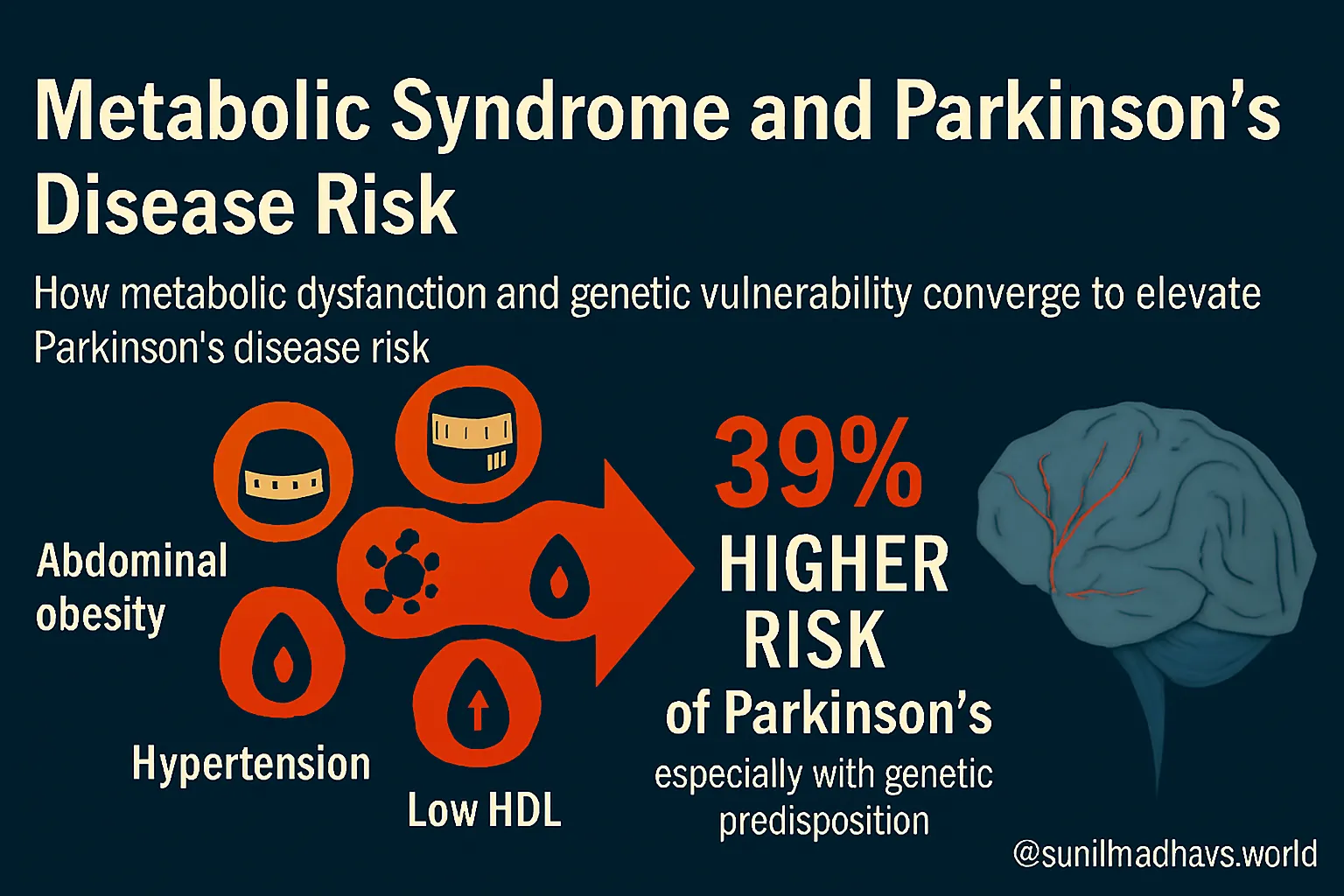
How metabolic dysfunction and genetic vulnerability converge to elevate Parkinson’s disease risk

by Team SunilMadhavs World August 30, 2025
A+A-
Reset
159

A new study has found that metabolic syndrome (MetS) significantly raises the risk of developing Parkinson’s disease (PD). People with metabolic syndrome were more likely to develop PD compared with those without it, and the risk grew in proportion to the number of metabolic abnormalities present. The findings, published in Neurology, highlight the importance of metabolic health in reducing neurological risks.

According to lead researcher Weili Xu, PhD, professor of neurobiology, care sciences and society at the Karolinska Institute in Sweden, improving midlife metabolic health could be a key preventive measure against Parkinson’s in later life.


Study Design and Population

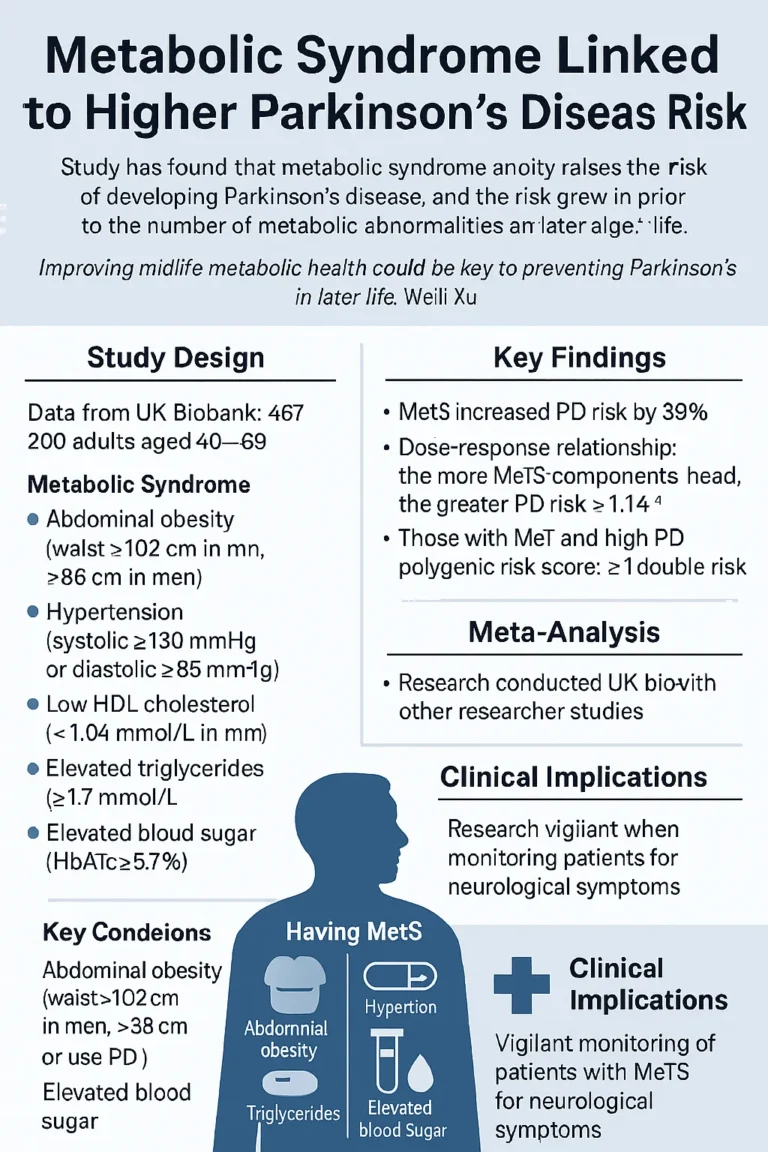
The investigation used data from the UK Biobank, focusing on adults aged 40 to 69 who lived within 40 kilometers of one of 23 UK assessment centers. A total of 467,200 participants were included, with an average age of 56.5 years, and slightly more than half (54.3%) were women. Of these, 177,407 participants (38%) had MetS.

Metabolic syndrome was defined as having three or more of the following five conditions:

  1. Abdominal obesity (waist >102 cm in men, >88 cm in women)
  2. Hypertension (systolic ≥130 mmHg, diastolic ≥85 mmHg, or use of antihypertensives)
  3. Low HDL cholesterol (<1.04 mmol/L for men, <1.3 mmol/L for women, or taking lipid-lowering drugs)
  4. Elevated triglycerides (≥1.7 mmol/L or treated with lipid-lowering drugs)
  5. Elevated blood sugar (HbA1c ≥5.7%)

Researchers also calculated a polygenic risk score (PRS-PD) for each participant, based on 26 PD-associated genetic variants, and classified individuals into low, moderate, or high genetic risk categories.

You Might Be Interested In
  • New Hope for SMA: FDA Approves Itvisma for Ages 2+
    December 3, 2025
  • Psychiatric disorders ‘common’ among patients with inflammatory bowel disease
    August 8, 2025


Participants were tracked for a median of 15 years, during which 3,222 individuals developed PD.


Key Findings

  • Having MetS increased the risk of PD by 39% compared with participants without MetS (HR = 1.39; 95% CI: 1.11–1.74).
  • A dose-response relationship was observed: the more MetS components a person had, the greater their PD risk (HR per component = 1.14; 95% CI: 1.05–1.24).
  • Risk was especially elevated among individuals who had both MetS and a high PD polygenic risk score, with more than double the risk (HR = 2.58; 95% CI: 2.12–3.14).
  • Specific metabolic components also contributed to elevated PD risk:
    • Central obesity → 33% higher risk
    • Obesity (general) → 43% higher risk
    • Low HDL cholesterol → 28% higher risk
    • High blood sugar → significantly elevated risk

The study also found that participants with MetS were more likely to be older, male, white, and have higher socioeconomic status than those without MetS. Incidence rates showed a difference: 4.87 cases per 10,000 person-years in those without MetS vs. 5.21 cases in those with MetS.

Meta-Analysis

To strengthen their findings, the researchers conducted a meta-analysis by pooling UK Biobank data with eight other observational studies. Reviewing 24.7 million participants and 98,582 PD cases, they found that MetS was associated with a 29% higher PD risk (HR = 1.29; 95% CI: 1.15–1.44). The association was consistent across all five MetS components.


Clinical Implications

The study suggests that clinicians should be more vigilant in monitoring patients with metabolic syndrome, particularly those with genetic predisposition to PD. Early recognition of neurological symptoms in these individuals could lead to improved outcomes.

You Might Be Interested In
  • New Hope for SMA: FDA Approves Itvisma for Ages 2+
    December 3, 2025
  • Psychiatric disorders ‘common’ among patients with inflammatory bowel disease
    August 8, 2025

Dr. Xu emphasized a positive takeaway:

“The same lifestyle choices that protect against heart disease and diabetes may also help protect against neurodegenerative diseases like Parkinson’s,” Xu noted.


Funding and Disclosures

The research was supported by the Swedish Research Council, the Swedish Research Council for Health, Working Life and Welfare, the Karolinska Institute Research Foundation, and Lindhes Avokatbyra AB. Full author disclosures are available in the original publication.

Source link

Related posts:

New Hope for SMA: FDA Approves Itvisma for Ages 2+

December 3, 2025

Thyroid imbalance in pregnancy linked to increased likelihood of autism.

December 1, 2025

Brepocitinib may emerge as the first targeted treatment option for dermatomyositis.

November 27, 2025
You Might Be Interested In
  • New Hope for SMA: FDA Approves Itvisma for Ages 2+
    December 3, 2025
  • Psychiatric disorders ‘common’ among patients with inflammatory bowel disease
    August 8, 2025
5 1 vote
Article Rating
Metabolic syndromeParkinsons disease
0 comments 0 FacebookTwitterPinterestEmail
Team SunilMadhavs World

previous post
Air pollution tied to 91,000 premature deaths yearly
next post
Baxdrostat delivers significant blood pressure reductions in patients with treatment-resistant hypertension.

Related Articles

New Hope for SMA: FDA Approves Itvisma for...

December 3, 2025

Psychiatric disorders ‘common’ among patients with inflammatory bowel...

August 8, 2025

MIND Diet and Dementia Risk Reduction

October 30, 2025

World Brain Day encourages awareness, knowledge, action for...

July 19, 2025
Subscribe
Login
Notify of
Save my name, email, and website in this browser cookies for the next time I comment.

Save my name, email, and website in this browser cookies for the next time I comment.

0 Comments
Oldest
Newest Most Voted
Inline Feedbacks
View all comments

Login/Register

Google Icon
Login With Google
X Icon
Login With X
Facebook Icon
Login With Facebook

Keep me signed in until I sign out

Forgot your password? Register here

Google Icon
Login With Google
X Icon
Login With X
Facebook Icon
Login With Facebook

Login here

Social Networks

Facebook Twitter Instagram Linkedin Rss

Categories

Popular Posts

  • 1

    Suicide of patient on LVAD therapy sparks wider mental health discussion

    July 4, 2025
  • 2

    WHO in India

    June 18, 2025
  • 3

    Mediterranean diet could improve psoriasis symptoms

    October 13, 2025
  • 4

    Oral drug lowers OSA severity over 6 months

    June 2, 2025
  • 5

    FDA Approves Lenz Therapeutics’ Vizz™ for Presbyopia Treatment

    August 2, 2025

Recent Posts

  • US obesity prevalence 75% under new Lancet criteria

    January 19, 2026
  • Test post

    January 5, 2026
  • January 1, 2026
  • test post

    January 1, 2026

About SunilMadhavs World

Facebook Twitter Instagram Pinterest Youtube Snapchat
  • Log In
  • About
  • Register
  • Profile
  • My account
  • Edit Account
  • Change Password
  • My Subscriptions
  • chnfo@suni0
  • Support Portal
  • Contact Information
  • Privacy policy
  • GDPR-compliant cookie policy.
  • Terms and conditions
  • Medical Disclaimer

@2019 - All Right Reserved. Designed and Developed by PenciDesign

SunilMadhavs World
  • Home
  • Support Portal
  • My Subscriptions
  • Contact Information
  • About
    • Cardiology
      • Gastroenterology
        • Radiology
          • Pulmonology
            • Gynecology
    • Neurology
  • Urology
    • Hematology
      • Profile
        • Log Out
        • Register
        • Edit Account
        • Change Password
        • GDPR-compliant cookie policy.
          • Terms and conditions
            • Contact Information
  • About
    • Privacy policy
      • BASICS DISCUSS
        • BASICS
          • ANATOMY
            • BASICS PRO
              • ANATOMY PRO
              • BIOCHEMISTRY PRO
              • PHYSIOLOGY
                • BIOCHEMISTRY
                  • PHYSIOLOGY PRO
                    • BASICS RESEARCH
                    • ANATOMY ADVANCEMENTS
                    • BIOCHEMISTRY ADVANCEMENTS
                    • PHYSIOLOGY ADVANCEMENTS
  • Team SunilMadhavs World
  • TOPICS
  • INTERMEDIATE
SunilMadhavs World
  • Home
  • Support Portal
  • My Subscriptions
  • Contact Information
  • About
    • Cardiology
      • Gastroenterology
        • Radiology
          • Pulmonology
            • Gynecology
    • Neurology
  • Urology
    • Hematology
      • Profile
        • Log Out
        • Register
        • Edit Account
        • Change Password
        • GDPR-compliant cookie policy.
          • Terms and conditions
            • Contact Information
  • About
    • Privacy policy
      • BASICS DISCUSS
        • BASICS
          • ANATOMY
            • BASICS PRO
              • ANATOMY PRO
              • BIOCHEMISTRY PRO
              • PHYSIOLOGY
                • BIOCHEMISTRY
                  • PHYSIOLOGY PRO
                    • BASICS RESEARCH
                    • ANATOMY ADVANCEMENTS
                    • BIOCHEMISTRY ADVANCEMENTS
                    • PHYSIOLOGY ADVANCEMENTS
  • Team SunilMadhavs World
  • TOPICS
  • INTERMEDIATE
@2019 - All Right Reserved. Designed and Developed by PenciDesign

Shopping Cart

Close

No products in the cart.

Close
wpDiscuz