29
Comparison of Completion and Publication Rates Between Industry-Sponsored and Academic Dermatology Trials
Overview
According to a recent study published in the Journal of the American Academy of Dermatology, industry-sponsored clinical trials in dermatology demonstrate significantly higher rates of both completion and publication compared with academically sponsored trials. The findings suggest that disparities in funding, infrastructure, and study design may affect the availability of evidence that clinicians rely on to treat patients.
Study Design and Characteristics
Researchers analyzed a comprehensive dataset of 4,987 dermatology trials conducted between 2015 and 2024. The distribution of sponsorship was nearly even, with industry sponsors accounting for 51% of the trials and academic institutions accounting for the remaining 49%.
The data revealed notable differences in the design and scale of the trials based on sponsorship. Industry-sponsored trials were generally larger, more likely to be randomized and multicenter, and more frequently involved FDA-regulated drugs (Table 1).
Table 1. Characteristics of Dermatology Clinical Trials (2015–2024)*
| Study Characteristic | Academic Trials | Industry-Sponsored Trials |
| Total Trials Analyzed (%) | 49% | 51% |
| Mean Sample Size (Participants) | 40 | 90 |
| Randomized Design | 86% | 93% |
| Multicenter Design | 11% | 48% |
| FDA-Regulated Drug Study | 19% | 52% |
| Quadruple-Masking | 7% | 30% |
| Involvement of Placebo | 11% | 22% |
| Involvement of Active Comparators | 11% | 26% |
*Data reflects the comparative percentages and means reported in the source text.
Outcomes and Completion Metrics
In addition to structural differences, the analysis highlighted substantial disparities in trial outcomes (Table 2). Academic trials were half as likely to report that a trial had been completed and were approximately one-third less likely to publish their results. Furthermore, industry-sponsored trials reached completion faster, outpacing academic trials by an average of 13 weeks.
Table 2. Trial Completion and Publication Outcomes by Sponsor Type
| Outcome Metric | Academic vs Industry Comparison | Adjusted Odds Ratio (95% CI) |
| Reporting Trial Completion | Academic trials half as likely to report | aOR = 0.51 (0.39-0.68) |
| Publishing Results | Academic trials 34% less likely to publish | aOR = 0.66 (0.44-0.97) |
| Time to Completion | Industry trials completed 13 weeks faster | Difference = 13 weeks (10-15) |
Potential Drivers and Bias Considerations
The researchers noted that because the type of sponsor heavily influences study design, these adjusted estimates represent conditional comparisons rather than strict causality. The higher completion and publication rates among industry trials may be driven by the substantial resources required for FDA-regulated drug and device studies.
However, the authors also cautioned against industry bias. Citing a Cochrane review, the researchers noted that industry-sponsored trials are 27% more likely to report favorable efficacy outcomes and 34% more likely to reach favorable conclusions than academic studies.
Rebecca I. Hartman, MD, MPH, FAAD, associate professor of dermatology at Harvard Medical School and lead author, contextualized these disparities:
“These findings could be due to several different factors, which are unclear, such as differences in study design, funding and reporting bias,” Hartman told Healio. “This could influence the body of evidence dermatologists have at their disposal.”
Clinical Implications and Recommendations
The underperformance of academic trials in reaching completion and publication poses a direct risk to evidence-based clinical practice, potentially leaving critical patient questions unanswered.
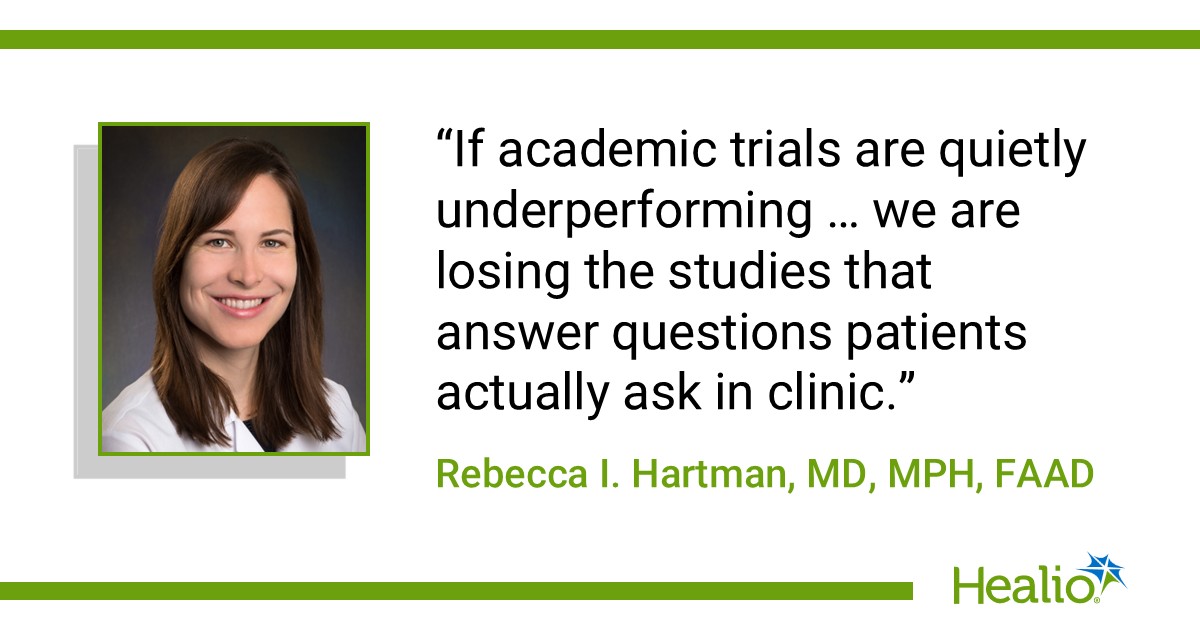
“Dermatology may suffer from a knowledge gap in these areas favored by academic trials if they are not being completed and published,” Hartman said. “If academic trials are quietly underperforming on completion and reporting, we are losing the studies that answer questions patients actually ask in clinic, such as ‘Which of these two treatments is better for me?’ or ‘Does this procedure work better?’”
To mitigate this knowledge gap and improve the overall quality of dermatologic care, proactive measures must be established within academic research settings.
“Those conducting and sponsoring academic trials should be aware of these differences and work to ensure trial completion and publication, such as identifying a plan for reporting from the start,” Hartman told Healio. “Identifying this gap is important to develop solutions to address it to improve patient care and dermatologist knowledge.”