34
Association Between Invasive Cancer Diagnosis and Short-Term Risk of First-Ever Ischemic Stroke: A Nationwide Cohort Study
Background and Epidemiologic Context
Malignancy and cerebrovascular disease constitute two leading global contributors to chronic disease morbidity and mortality. Approximately 10% of acute stroke presentations occur in patients with an active or preexisting malignancy—a proportion projected to rise alongside population aging and enhanced oncologic survivorship. While prior meta-analyses and systematic reviews have established an overarching association between cancer and elevated cerebrovascular risk, poststroke outcomes among oncology patients are disproportionately severe, marked by heightened risks of neurologic recurrence and case fatality.
Nevertheless, critical epidemiological gaps have persisted. Lead investigator Carmit Libruder, MSc, a researcher affiliated with the University of Haifa and the Israel Ministry of Health, noted:
“Yet the magnitude and timing of first-ever ischemic stroke risk across specific cancer types have not been fully characterized. We, therefore, examined this question using a large, nationwide population-based cohort to determine how the risk varies by cancer type, time since diagnosis, stage, age and other demographic characteristics.”
Cohort Design and Methodology
To clarify these associations, investigators analyzed linked data from Israel’s universal health care system, integrating population-based national cancer and stroke registries. Standardized incidence ratios (SIRs) were calculated to compare the incidence of first-ever ischemic stroke among patients with incident cancer against the general population, stratifying results by tumor site, anatomical stage, time elapsed since oncologic diagnosis, and demographic variables.
To present relative risk estimates:
“in a more clinically interpretable context,”
the authors evaluated the 1-year cumulative incidence of ischemic stroke while accounting for the competing risk of all-cause mortality.
The study population comprised 182,221 individuals aged 40 years or older (median age, 67.1 years; 52.0% women) who received a primary diagnosis of invasive cancer between 2014 and 2021 without prior stroke history. The most prevalent malignancies were breast (18.2%), colorectal (11.5%), prostate (10.5%), and lung (9.8%) cancers. Across a cumulative 162,593 person-years of longitudinal observation, 1,125 incident ischemic stroke events were documented.
Temporal Dynamics and Cumulative Stroke Incidence
Overall, individuals with newly diagnosed invasive cancer exhibited a nearly 2-fold higher risk of ischemic stroke within the first year of diagnosis compared with the general population (SIR, 1.8; 95% CI, 1.7–1.9). The 1-year cumulative incidence reached 0.62% (equivalent to 62 events per 10,000 individuals).
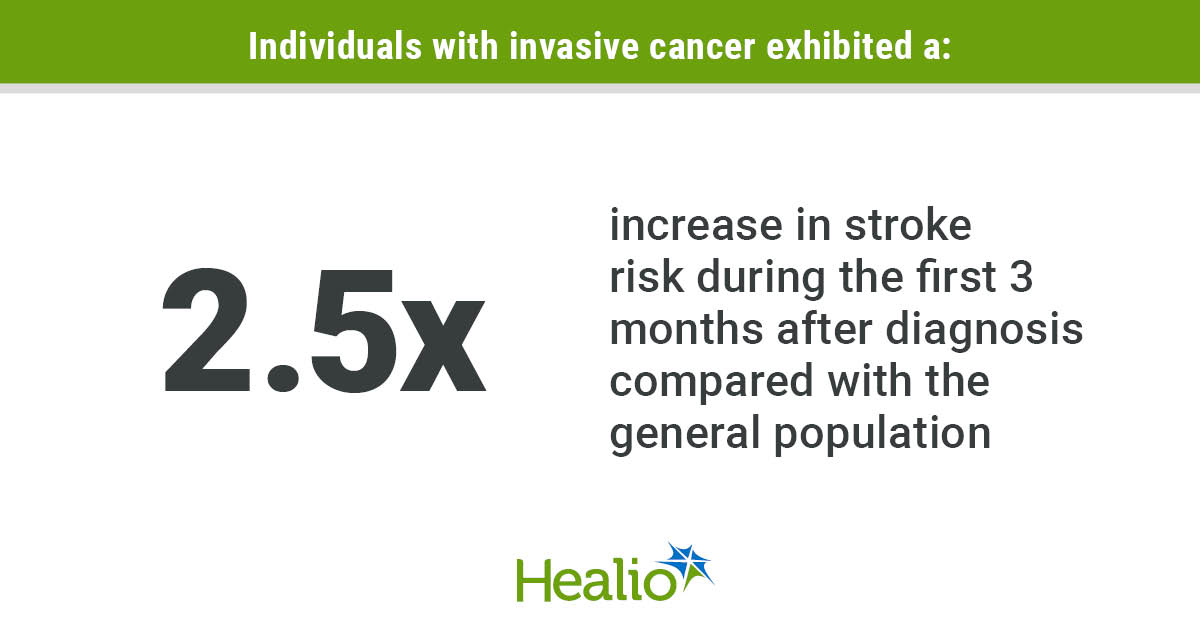
Cerebrovascular risk displayed pronounced temporal clustering. Excess risk peaked during the initial 3 months following cancer diagnosis (SIR, 2.5; 95% CI, 2.2–2.7). Although risk attenuated over time, it remained significantly elevated between months 3 and 6 (SIR, 1.6; 95% CI, 1.4–1.8) and between months 6 and 12 (SIR, 1.5; 95% CI, 1.3–1.6). In exploratory extended analyses, a modest elevation in relative risk (SIR range, 1.3–1.5) persisted up to 3 years postdiagnosis.
Libruder emphasized that this early temporal concentration establishes:
“a critical window”
for surveillance, noting:
“Our findings reinforce the importance of a multidisciplinary approach to cancer care. Cancer treatment is, of course, central after diagnosis, but vascular health should not be overlooked. Identifying and appropriately managing modifiable vascular risk factors — while taking the patient’s cancer type, stage, age, treatments and overall clinical situation into account — may be particularly important during this period.”
Stratification by Malignancy Site, Patient Age, and Disease Stage
Although an overall risk elevation was anticipated, Libruder remarked that:
“the marked variation” across cancer types “stood out.”
The highest 1-year cumulative incidence and standardized relative risk occurred among patients with pancreatic cancer (1-year cumulative incidence, 1.62%; SIR, 5.9; 95% CI, 4.8–7.3) and lung cancer (SIR, 3.9; 95% CI, 3.4–4.4). The investigators observed:
“pronounced excess risks”
among individuals diagnosed with esophageal cancer (SIR, 4.1; 95% CI, 2.2–6.8) and gallbladder cancer (SIR, 3.6; 95% CI, 2.0–5.9), though with wider confidence intervals reflecting smaller event counts. Significant 2- to 3-fold elevations in stroke risk were likewise recorded in gastric, bladder, and hepatic cancers, myeloid leukemia, and malignant primary central nervous system tumors. Conversely, breast cancer (cumulative incidence, 0.30%) and prostate cancer diagnoses were not associated with increased stroke risk.
Relative risk was inversely associated with advancing age: individuals aged 40 to 54 years demonstrated the greatest relative excess (SIR, 3.6; 95% CI, 2.8–4.6), whereas patients aged 75 years or older exhibited an SIR of 1.4 (95% CI, 1.3–1.6). Metastatic cancer at presentation conferred greater risk (SIR, 2.8; 95% CI, 2.5–3.2) than localized disease (SIR, 1.2; 95% CI, 1.0–1.4). Relative risks did not differ substantively by sex or between Jewish and Arab subpopulations.
Mechanistic Hypotheses, Study Limitations, and Research Priorities
Addressing the divergent risks across anatomical sites, Libruder suggested there is likely:
“no single explanation,”
further explaining:
“Cancer can promote hypercoagulability and systemic inflammation, which can increase the tendency to form clots, and these mechanisms may be particularly relevant in cancers with strong prothrombotic features, such as pancreatic and lung cancers. Shared vascular risk factors for both cancer and ischemic stroke — including smoking — may also contribute, and cancer treatment-related factors may play a role, as well. Our study did not have the clinical information needed to disentangle these different potential contributions.”
Several methodological limitations were cited, including statistical imprecision for rarer cancer sites, unmeasured confounders (such as systemic antineoplastic regimens, baseline vascular comorbidities, and antithrombotic therapies), and undocumented tumor stage at diagnosis in roughly half of the registry cohort.
Concluding on the translational implications of the work, Libruder outlined the path forward for cardio-oncology and neuro-oncology:
“Our study adds a clearer understanding of how substantially stroke risk differs across cancer types and patient subgroups and helps identify which patients may be most vulnerable. Our findings [also] highlight how much we still need to learn about cancer-associated ischemic stroke. We can identify cancer types and patient groups in whom the risk is clearly higher, but there is still limited evidence on how best to translate that information into prevention. In that sense, the field now needs to move from describing the risk to understanding how best to act on it.”
“More detailed studies that take cancer type, stage, treatment, vascular risk factors and biomarkers into account will be important for determining which patients may benefit from closer cerebrovascular assessment and which preventive approaches are effective. Ultimately, that evidence could help inform more specific clinical guidance for stroke prevention in patients with cancer.”
“One of the main unanswered questions is how much of the increased stroke risk is attributable to the cancer itself and how much is related to the patient’s underlying vascular risk, cancer treatment, medications or other clinical factors. We would also like to better understand why the risk differs substantially between cancer types and, ultimately, identify which patients are at sufficiently high risk to benefit from more individualized preventive strategies.”
Table 1. Cohort Baseline Characteristics and Study Metrics
| Characteristic / Metric | Value |
| Total Cohort Size ($N$) | 182,221 adults |
| Eligibility Criteria | Age $\ge 40$ years; first invasive cancer diagnosis (2014–2021); no prior stroke history |
| Median Age | 67.1 years |
| Sex (Female), % | 52.0% |
| Total Observation Time | 162,593 person-years |
| Total Incident Ischemic Stroke Events | 1,125 events |
| Overall 1-Year Cumulative Incidence | 0.62% (62 per 10,000 individuals) |
| Most Prevalent Malignancies (% of cohort) | Breast (18.2%), colorectal (11.5%), prostate (10.5%), lung (9.8%) |
| Highest vs Lowest 1-Year Cumulative Incidence | Pancreatic cancer (1.62%) vs Breast cancer (0.30%) |
Table 2. Standardized Incidence Ratios (SIRs) for First-Ever Ischemic Stroke by Time Elapsed Since Cancer Diagnosis
| Follow-Up Interval Post-Diagnosis | Standardized Incidence Ratio (SIR) | 95% Confidence Interval | Clinical Interpretation |
| 0 to 3 Months | 2.5 | 2.2 to 2.7 | Peak risk window immediately following oncologic diagnosis |
| 3 to 6 Months | 1.6 | 1.4 to 1.8 | Attenuated yet persistently elevated risk |
| 6 to 12 Months | 1.5 | 1.3 to 1.6 | Sustained moderate risk elevation |
| Full Year 1 (Overall) | 1.8 | 1.7 to 1.9 | Nearly twofold baseline population risk across first year |
| 1 to 3 Years (Extended Follow-up) | 1.3 to 1.5 | — | Modestly elevated risk persisting up to 36 months |
Table 3. Standardized Incidence Ratios (SIRs) for First-Ever Ischemic Stroke by Cancer Site, Stage, and Age Group
| Subgroup Category | Stratification Factor | SIR | 95% Confidence Interval |
| High-Risk Primary Cancer Sites | Pancreatic cancer | 5.9 | 4.8 to 7.3 |
| Esophageal cancer | 4.1 | 2.2 to 6.8 | |
| Lung cancer | 3.9 | 3.4 to 4.4 | |
| Gallbladder cancer | 3.6 | 2.0 to 5.9 | |
| Moderate-Risk Primary Cancer Sites | Bladder, stomach, liver, myeloid leukemia, brain/CNS tumors | 2.0 to 3.0 | Varied (2- to 3-fold elevation) |
| Non-Elevated Risk Primary Sites | Breast cancer | Not elevated | — |
| Prostate cancer | Not elevated | — | |
| Age at Cancer Diagnosis | 40 to 54 years | 3.6 | 2.8 to 4.6 |
| $\ge 75$ years | 1.4 | 1.3 to 1.6 | |
| Disease Stage at Diagnosis | Metastatic disease | 2.8 | 2.5 to 3.2 |
| Localized disease | 1.2 | 1.0 to 1.4 |