Study Finds No Association Between Circumcision and Autism
Key Points
-
In an analysis of 2,771 boys enrolled in the NIH Environmental Influences on Child Health Outcomes (ECHO) cohort, circumcision was not associated with a subsequent diagnosis of autism.
-
After adjustment for potential confounding factors, the association remained nonsignificant (OR, 0.83; 95% CI, 0.59-1.17).
-
Autism was diagnosed in approximately 6% of circumcised boys compared with 9% of uncircumcised boys.
-
Fewer than 5% of circumcised boys received neonatal acetaminophen, providing little support for neonatal acetaminophen exposure as an explanation for the observed findings in this cohort.
-
Circumcision was also not associated with higher scores on measures of social responsiveness or emotional and behavioral difficulties.
Study Overview
A study using data from the National Institutes of Health’s Environmental Influences on Child Health Outcomes (ECHO) cohort found no statistically significant association between circumcision and autism among male children in the United States.
The analysis was prompted in part by public statements in 2025 suggesting that circumcision might be associated with autism and that acetaminophen administered for pain after circumcision could potentially account for such an association.
Monica McGrath, ScD, MHS, a research professor in the Department of Epidemiology at the Johns Hopkins Bloomberg School of Public Health, and colleagues examined longitudinal health information collected through the ECHO cohort. The data covered the period from February 2003 through September 2025.
The investigators specifically evaluated whether boys who underwent circumcision were subsequently more likely to receive an autism diagnosis than boys who were not circumcised.
Study Population
The study included 2,771 boys from the ECHO cohort.
Of these, 1,840 (66%) were circumcised, whereas 931 (34%) were not. Overall, 192 boys (7%) had been diagnosed with autism, with the diagnosis occurring at a mean age of 3.8 years.
Participant and Autism Data
| Measure | Findings |
|---|---|
| Total boys analyzed | 2,771 |
| Circumcised | 1,840 (66%) |
| Not circumcised | 931 (34%) |
| Boys diagnosed with autism | 192 (7%) |
| Mean age at autism diagnosis | 3.8 years |
| Standard deviation of age at diagnosis | 2.2 years |
Circumcision and Autism
The researchers found that autism was diagnosed in approximately 6% of circumcised boys, compared with 9% of boys who were not circumcised.
However, after adjustment for potential confounding variables, circumcision was not significantly associated with autism. The adjusted odds ratio was 0.83, with a 95% confidence interval of 0.59 to 1.17.
Because the confidence interval includes 1.0, the findings do not demonstrate a statistically significant difference in autism risk associated with circumcision.
Autism Outcomes According to Circumcision Status
| Circumcision status | Autism diagnosis | Approximate proportion |
|---|---|---|
| Circumcised | Reported | 6% |
| Not circumcised | Reported | 9% |
| Adjusted association | OR, 0.83 | 95% CI, 0.59-1.17 |
The numerical difference in unadjusted percentages therefore should not be interpreted as evidence that circumcision protects against autism. After accounting for potential confounding factors, the study did not identify a statistically significant association.
Other Neurobehavioral Measures
The investigators also assessed whether circumcision was associated with measures of social responsiveness or broader behavioral difficulties.
No significant association was identified between circumcision and elevated scores on the Social Responsiveness Scale, which evaluates social impairment.
Similarly, circumcision was not associated with elevated scores on the Child Behavior Checklist, a standardized instrument used to identify emotional and behavioral problems in children.
Secondary Outcomes
| Outcome | Association with circumcision |
|---|---|
| Autism diagnosis | No significant association |
| Social Responsiveness Scale | No significant association |
| Child Behavior Checklist | No significant association |
Neonatal Acetaminophen Exposure
The investigators also examined neonatal acetaminophen exposure because acetaminophen administered for pain after circumcision had been proposed as a possible pathway linking circumcision with autism.
The study found that fewer than 5% of circumcised boys received acetaminophen as neonates.
Consequently, the researchers concluded that neonatal acetaminophen exposure could not explain the relationship in this population, particularly because the study itself did not identify an association between circumcision and autism.
Why the Study Was Conducted
The researchers said the study was motivated by public discussion in 2025 concerning a possible relationship between circumcision and autism.
McGrath explained that the research team became interested in the question after hearing concerns from people in their professional and personal circles following media reports about statements linking male circumcision with autism.
“We knew the ECHO Cohort had relevant data to help investigate this question.”
The ECHO cohort was particularly useful because it contains longitudinal information concerning children’s health and environmental exposures, with some participants followed from the preconception period onward.
Context Regarding Acetaminophen and Autism
The study was conducted amid broader debate concerning whether acetaminophen exposure could contribute to autism or other neurodevelopmental outcomes.
The article notes that the Trump administration had previously drawn a connection between prenatal acetaminophen exposure and autism or attention-deficit/hyperactivity disorder. However, the evidence cited in the article does not establish a causal relationship.
A systematic review and meta-analysis published in a Lancet journal in 2026 reportedly did not demonstrate a causal relationship, while the American Academy of Pediatrics has emphasized that extensive research does not support the concept of a single underlying cause of autism.
These broader findings are important when interpreting the present study because an observed association between an exposure and autism would not, by itself, establish causation.
Interpretation
The principal finding of this cohort analysis is that circumcision was not significantly associated with autism diagnosis after adjustment for potential confounding factors.
Although the unadjusted prevalence of autism was numerically lower among circumcised boys than among uncircumcised boys, the adjusted estimate did not demonstrate a statistically significant association.
The findings were also consistent across additional behavioral and social measures, with no evidence that circumcision was associated with increased Social Responsiveness Scale or Child Behavior Checklist scores.
The investigators further reported that neonatal acetaminophen exposure was uncommon among circumcised boys in the cohort.
Authors’ Perspective
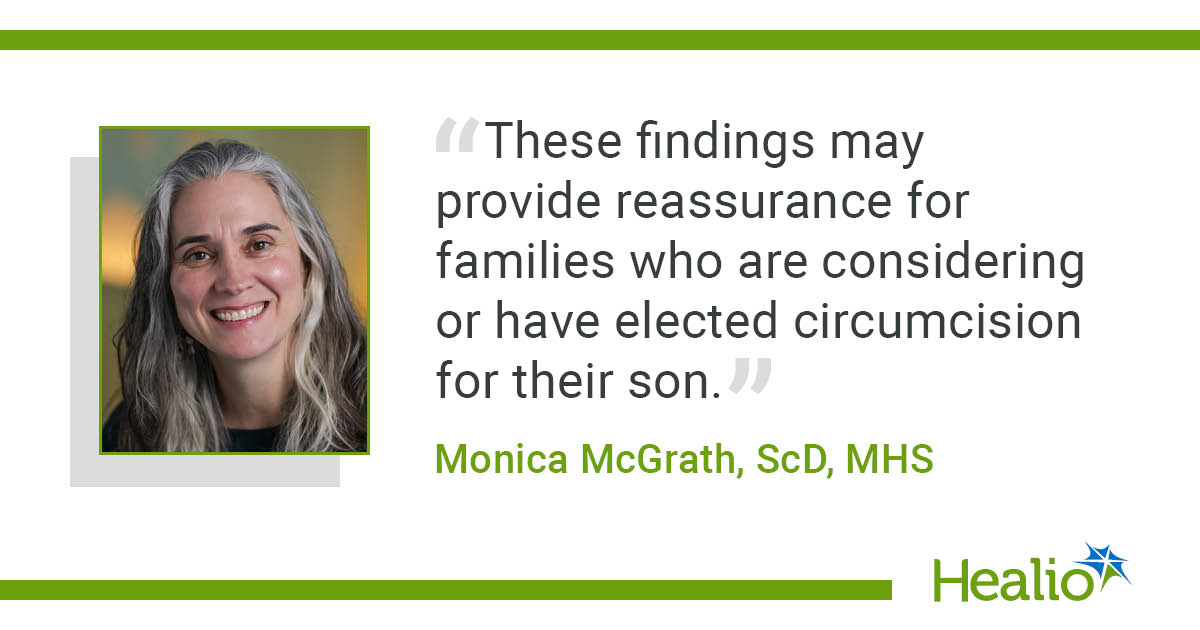
McGrath said the results could provide reassurance to families considering circumcision:
“These findings may provide reassurance for families who are considering or have elected circumcision for their son.”
She also noted that the research group is continuing to investigate other potential factors that could contribute to the increasing number of autism diagnoses.
“My colleagues and I continue to evaluate other factors that may explain the rise in autism diagnoses.”
Clinical and Research Perspective
The findings provide no evidence from this cohort that circumcision is associated with an increased likelihood of autism.
Importantly, the study addresses association rather than causation. Its results indicate that, within the population examined and after statistical adjustment for measured confounding factors, circumcision was not significantly associated with autism diagnosis.
The findings also do not establish that circumcision reduces autism risk. The lower unadjusted proportion of autism among circumcised boys should therefore not be interpreted as a protective effect.
Further research using large, longitudinal cohorts may help clarify the contributions of genetic, prenatal, environmental, developmental, and other factors associated with autism.
Bottom Line
In this analysis of 2,771 boys from the NIH ECHO cohort, circumcision was not significantly associated with autism after adjustment for potential confounding factors (OR, 0.83; 95% CI, 0.59-1.17). Circumcision was also not associated with increased measures of social impairment or childhood behavioral difficulties. Because fewer than 5% of circumcised boys received neonatal acetaminophen, the findings also provide little support for neonatal acetaminophen exposure as a mechanism explaining an association between circumcision and autism in this cohort.