Deucravacitinib Sustains Efficacy Through 52 Weeks in Active Psoriatic Arthritis
Headline
Deucravacitinib Maintains Clinical Efficacy Through 52 Weeks in Adults With Active Psoriatic Arthritis
1-minute summary
The oral selective tyrosine kinase 2 (TYK2) inhibitor deucravacitinib demonstrated sustained efficacy and tolerability through 52 weeks in adults with active psoriatic arthritis (PsA) enrolled in the phase 3 POETYK PsA-2 trial.
At week 16, 54.2% of patients receiving deucravacitinib achieved an ACR20 response, compared with 39.4% receiving placebo.
The treatment effect was maintained through 1 year. At week 52, ACR20 responses were observed in 62.2% of patients who received deucravacitinib continuously and 67.3% of patients who switched from placebo to deucravacitinib.
The trial included 729 patients with active PsA, most of whom had not previously received biologic therapy. Approximately 13% had previously received a tumor necrosis factor (TNF) inhibitor.
Deucravacitinib was also reported to have a favorable tolerability profile compared with apremilast, with fewer treatment-related symptoms such as nausea, diarrhea and headache reported by the investigator.
Serious adverse events at week 16 occurred in 1.9% of patients receiving deucravacitinib, 1.0% receiving placebo and 3.8% receiving apremilast.
Why this matters
Psoriatic arthritis is a chronic inflammatory disease that can affect the joints, skin and other musculoskeletal structures. Effective treatment requires sustained control of inflammation and prevention of progressive disease-related disability.
Deucravacitinib represents a different therapeutic mechanism from many established PsA treatments. It is an oral selective TYK2 inhibitor that modulates signaling involving cytokine pathways implicated in psoriatic disease.
The 52-week findings are important because efficacy demonstrated at an early time point must be maintained over longer treatment periods for a chronic disease such as PsA.
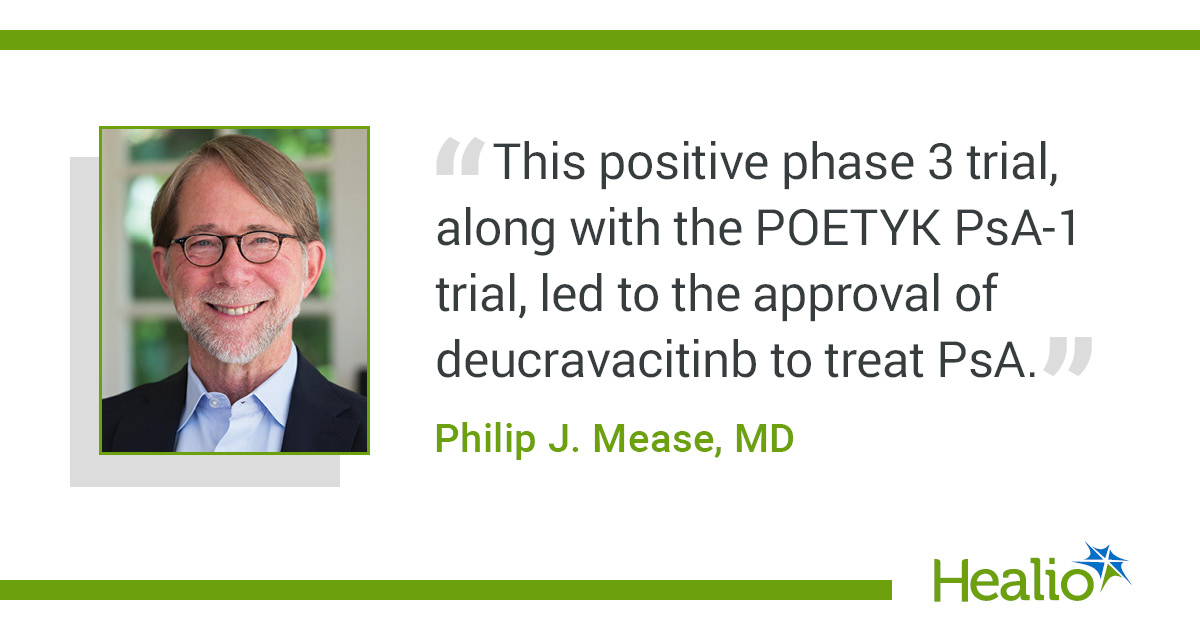
The results from POETYK PsA-2 build on previously reported 16-week results and, together with the POETYK PsA-1 trial, contributed to the approval of deucravacitinib for adults with active PsA, according to the supplied report.
Study at a glance
| Feature | Details |
|---|---|
| Study type | Phase 3, multicenter, randomized, double-blind, placebo-controlled clinical trial |
| Trial | POETYK PsA-2 |
| Participants | 729 adults with active PsA |
| Intervention | Deucravacitinib 6 mg orally once daily |
| Initial comparator | Placebo |
| Additional comparator/safety group | Apremilast 30 mg twice daily |
| Initial treatment period | 16 weeks |
| Longer follow-up | 52 weeks |
| Primary endpoint | ACR20 response at week 16 |
| Secondary endpoints | PASI75 and HAQ-DI |
| Main week-16 finding | ACR20: 54.2% with deucravacitinib vs 39.4% with placebo |
| Week-52 continuous-treatment response | ACR20: 62.2% |
| Week-52 placebo-to-deucravacitinib response | ACR20: 67.3% |
| Week-16 treatment completion | 92.6% |
| Week-52 treatment completion | 91.1% |
Study population
The POETYK PsA-2 trial enrolled 729 patients with active psoriatic arthritis.
According to the report, the study population had substantial disease activity at baseline.
Approximately 13% of participants had previously received a TNF inhibitor.
The remaining participants were biologic-naive and had previously received conventional synthetic disease-modifying antirheumatic drugs (csDMARDs) but had experienced either an inadequate response or intolerance.
Philip J. Mease, MD, characterized the population as having substantial disease activity at the beginning of the study:
“The patients showed evidence of highly active disease at baseline.”
Prior treatment characteristics
| Characteristic | Reported finding |
|---|---|
| Total enrolled | 729 |
| Previous TNF inhibitor exposure | 13% |
| Biologic-naive | Majority of participants |
| Previous csDMARD exposure | Remaining biologic-naive participants |
| Reason for prior csDMARD discontinuation | Inadequate response or intolerance |
Treatment groups
During the initial 16-week period, patients were randomly assigned to treatment groups.
| Group | Treatment | Patients |
|---|---|---|
| Deucravacitinib | 6 mg once daily | 312 |
| Placebo | Placebo once daily | 312 |
| Apremilast | 30 mg twice daily | 105 |
The apremilast group was included primarily for additional safety and tolerability assessment.
After the initial placebo-controlled period, patients continued on deucravacitinib or apremilast, while patients initially assigned to placebo were switched to deucravacitinib for longer-term assessment.
Primary outcome
The primary efficacy endpoint was the proportion of patients achieving an ACR20 response at week 16.
ACR20 represents at least a 20% improvement according to the American College of Rheumatology response criteria, together with specified improvements in tender and swollen joint counts and other disease-activity measures.
The trial also evaluated:
- PASI75, a measure of psoriasis skin response
- Health Assessment Questionnaire Disability Index (HAQ-DI), assessing physical function and disability
What the researchers found
Week-16 ACR20 response
At week 16, more patients receiving deucravacitinib achieved ACR20 than those receiving placebo.
| Treatment | ACR20 response at week 16 |
|---|---|
| Deucravacitinib 6 mg once daily | 54.2% |
| Placebo | 39.4% |
The absolute difference was approximately 14.8 percentage points in favor of deucravacitinib.
This was the primary efficacy outcome reported for the trial.
Sustained response through week 52
The treatment response observed at week 16 was maintained through 1 year.
Among patients who remained on deucravacitinib throughout the study, 62.2% achieved ACR20 at week 52.
Among patients who initially received placebo and subsequently switched to deucravacitinib, 67.3% achieved ACR20 at week 52.
ACR20 response over time
| Treatment sequence | Week 16 | Week 52 |
|---|---|---|
| Deucravacitinib throughout | 54.2% | 62.2% |
| Placebo → deucravacitinib | 39.4% with placebo | 67.3% after switching |
These results indicate that the clinical response to deucravacitinib persisted during longer-term treatment in the study population.
Treatment retention
Most participants remained in treatment during the study.
| Time point | Patients completing treatment |
|---|---|
| Week 16 | 92.6% (674 patients) |
| Week 52 | 91.1% (614 patients) |
The relatively high completion proportions provide important context when considering the durability findings.
Tolerability and safety
The investigators reported that deucravacitinib was generally well tolerated.
Compared with apremilast, Mease reported fewer symptoms such as:
- nausea,
- diarrhea, and
- headache.
He stated:
“Deucravacitinib was better tolerated than apremilast regarding symptoms such as nausea, diarrhea and headache, and did not demonstrate concerning numbers of severe infections, major adverse cardiovascular events or malignancy.”
A small number of patients developed:
- acne, and
- rash.
Serious adverse events
Serious adverse events reported during the first 16 weeks occurred at the following frequencies:
| Treatment | Serious adverse events |
|---|---|
| Deucravacitinib | 1.9% |
| Placebo | 1.0% |
| Apremilast | 3.8% |
The report did not identify concerning numbers of severe infections, major adverse cardiovascular events or malignancies during the reported follow-up.
Mechanism of action
Deucravacitinib is an oral, selective TYK2 inhibitor.
According to the supplied report, its mechanism targets signaling associated with:
- interleukin-23
- interleukin-12
- interferon
This represents a distinct therapeutic approach to psoriatic disease compared with several other commonly used targeted therapies.
Mease described the regulatory significance of the trial results as follows:
“These approvals usher in a new mechanism of action which targets interleukin-23, interleukin-12 and interferon.”
Clinical significance
The findings suggest that deucravacitinib can provide sustained control of clinical disease activity in adults with active PsA over a 52-week period.
The results are particularly relevant because:
- The study enrolled patients with active disease.
- Most participants had not previously received biologic therapy.
- A subset had prior TNF inhibitor exposure.
- The ACR20 response observed at week 16 was maintained through week 52.
- Patients who initially received placebo and subsequently switched to deucravacitinib also demonstrated substantial response at 1 year.
- The treatment was reported to be generally well tolerated.
The findings therefore support the longer-term efficacy of deucravacitinib in the studied population.
What the 52-week results do—and do not—show
What the study supports
- Deucravacitinib produced greater ACR20 response than placebo at 16 weeks.
- Response persisted through 52 weeks.
- Patients switching from placebo to deucravacitinib subsequently achieved substantial ACR20 response.
- Treatment completion remained high through 1 year.
- No major new safety signal was highlighted in the supplied report.
What cannot be concluded from these data alone
The study does not establish that deucravacitinib is superior to all other biologic or targeted synthetic DMARD options for PsA.
The supplied report also does not provide sufficient comparative data to determine its relative effectiveness against individual TNF inhibitors, IL-17 inhibitors, IL-23 inhibitors, JAK inhibitors or other targeted therapies.
Limitations
1. Limited direct comparisons with modern PsA therapies
The primary efficacy comparison was with placebo rather than a broad range of active PsA treatments.
Therefore, the results cannot be used to establish comparative superiority over other targeted therapies.
2. Limited prior biologic exposure
Only 13% of participants had previously received a TNF inhibitor. The population therefore consisted predominantly of biologic-naive patients.
The results may not fully represent patients with extensive prior exposure to multiple biologic or targeted therapies.
3. One-year follow-up
Although 52 weeks represents meaningful longer-term follow-up, PsA is a chronic disease requiring treatment over many years.
Longer-term surveillance is needed to characterize durability and uncommon adverse events.
4. Safety-event interpretation
Rare adverse events may not be detected reliably in a phase 3 trial of this size and duration.
Long-term postmarketing and registry data are important for identifying uncommon or delayed safety signals.
5. Trial population may differ from routine practice
Clinical trials generally use predefined eligibility criteria and structured follow-up. Consequently, outcomes in routine clinical practice may differ from those observed in the trial.
What doctors should know
- Deucravacitinib 6 mg once daily demonstrated greater ACR20 response than placebo at 16 weeks.
- ACR20 response was 54.2% vs 39.4% with placebo at week 16.
- At week 52, 62.2% of patients receiving continuous deucravacitinib achieved ACR20.
- Among patients who switched from placebo to deucravacitinib, 67.3% achieved ACR20 at week 52.
- The trial included 729 patients with active PsA.
- Approximately 13% had previous TNF inhibitor exposure.
- Treatment completion remained high: 92.6% at week 16 and 91.1% at week 52.
- Serious adverse events at week 16 occurred in 1.9% with deucravacitinib, compared with 1.0% with placebo and 3.8% with apremilast.
- The investigator reported fewer nausea, diarrhea and headache symptoms with deucravacitinib than with apremilast.
- Acne and rash were reported in a small number of patients.
- The study adds evidence for sustained efficacy of an oral TYK2 inhibitor in active PsA.
- The results should not be interpreted as a head-to-head demonstration of superiority over other modern PsA therapies.
Bottom line
In the phase 3 POETYK PsA-2 trial, deucravacitinib demonstrated greater clinical efficacy than placebo at 16 weeks and maintained its therapeutic effect through 52 weeks in adults with active psoriatic arthritis.
The ACR20 response increased from 54.2% at week 16 to 62.2% at week 52 among patients receiving continuous deucravacitinib. Patients who initially received placebo and subsequently switched to deucravacitinib achieved a 67.3% ACR20 response at week 52.
The reported safety profile remained generally favorable, with no concerning numerical signal for severe infections, major adverse cardiovascular events or malignancy in the reported period.
Overall, the study provides evidence for durable efficacy and tolerability of deucravacitinib over 1 year in the studied active-PsA population.
Original research / DOI
Mease PJ, et al.
Arthritis & Rheumatology. 2026.
Title: Efficacy and safety of deucravacitinib in patients with active psoriatic arthritis who are naïve to biologic disease-modifying antirheumatic drugs or have previously received TNF inhibitor treatment: week 16 and longer-term results from POETYK PsA-2.
DOI: 10.1002/art.70280
Trial: POETYK PsA-2
Study design: Phase 3, multicenter, randomized, double-blind, placebo-controlled trial with longer-term follow-up.
Clinical population: Adults with active psoriatic arthritis.
Investigational treatment: Deucravacitinib 6 mg once daily.
Primary endpoint: ACR20 response at week 16.
Follow-up: 52 weeks.